
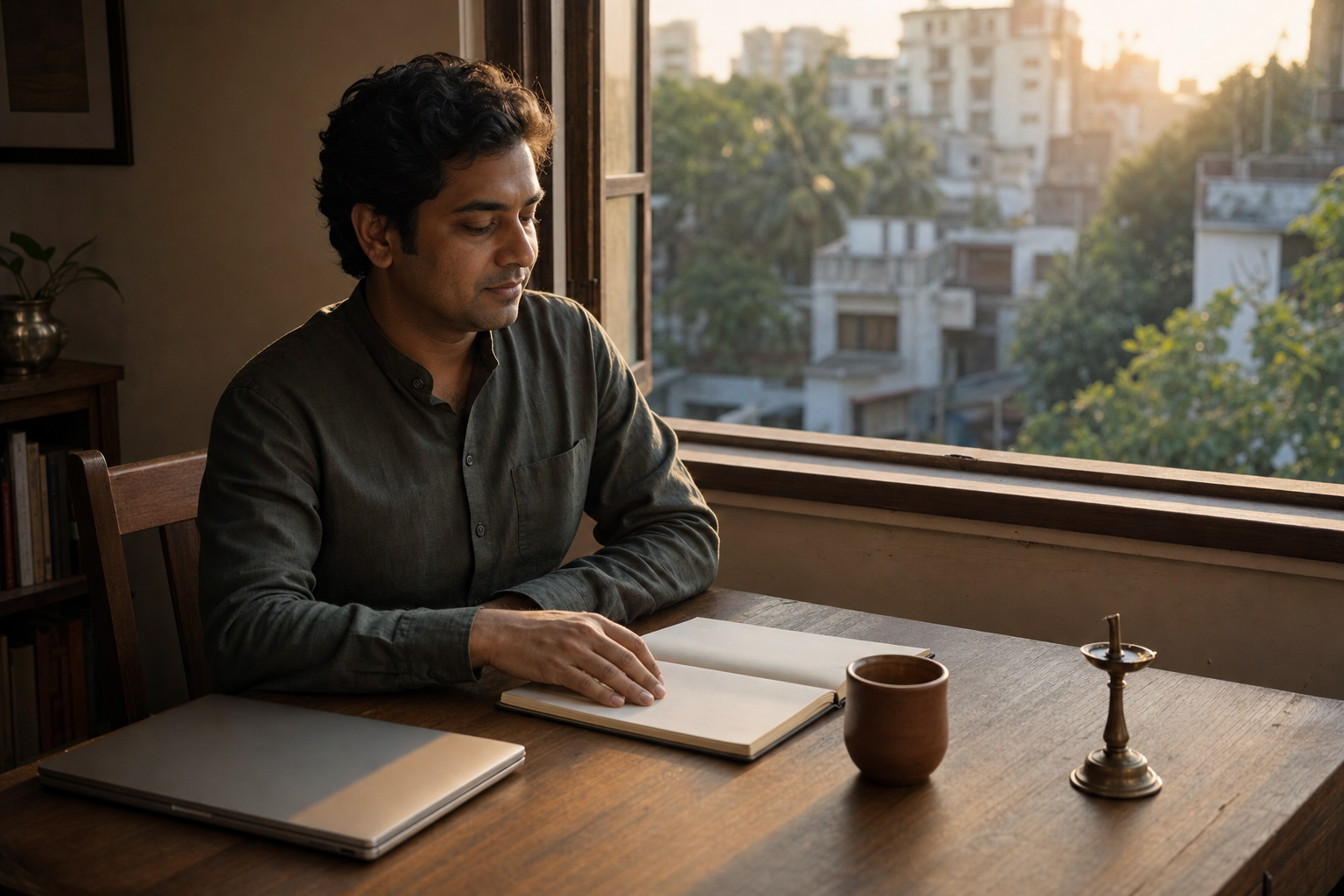
If your meditation streak feels like a performance review, your yoga practice ends in self-criticism, or an unscheduled evening makes you guilty, hustle culture has entered the one place meant to free you from it. The problem is not that you lack discipline. It is that discipline, rest, and even spirituality have been placed under the rule of measurement.
Dharmic mindfulness offers a different relationship with effort. You still make plans, meet obligations, cultivate skill, and serve others. You simply stop asking every action to prove your worth. The practical aim is not to withdraw from life, but to act within it with steadier attention, less attachment, and less violence toward yourself.
Recognise when mindfulness has become another performance
Hustle culture is easy to notice at work and harder to notice in spiritual practice. It rarely announces itself as greed or obsession. It sounds responsible: improve the pose, extend the session, protect the streak, optimise the morning, and extract a useful insight from every quiet moment.
The decisive question is not whether you have goals. It is whether the goal has consumed the practice. A timer can support meditation; it becomes a problem when the number determines whether the sitting was worthwhile. A yoga sequence can develop strength and mobility; it becomes corrosive when discomfort, comparison, or limited range of motion turns into a judgement about who you are.
- You finish a practice and immediately assess whether it was productive.
- You compare your flexibility, concentration, calmness, or devotion with somebody else’s.
- You lengthen a session despite pain, exhaustion, or mounting agitation because stopping would feel like failure.
- You treat rest as permission that must be earned through prior output.
- You use meditation only to make yourself work harder afterward.
- You feel compelled to record, photograph, share, or preserve an experience before you have fully inhabited it.
These tendencies fuse three different things: your duty, the result of your action, and your human worth. A Dharmic approach separates them. Duty concerns what is yours to do. Results arise from your effort plus conditions you do not control. Worth is not a market rating awarded after the result arrives.
Try a simple audit the next time a contemplative practice feels tense. Ask, “If nobody knew I had done this, would I still do it?” Then ask, “If I could not record a score, what change would I notice in my conduct?” Useful answers concern patience, attention, honesty, restraint, and kindness. If your only answer is a number, the scoreboard may have displaced the purpose.
Four Dharmic lenses for effort without self-commodification

Hinduism, Buddhism, Jainism, and Sikhism are distinct traditions with different scriptures, metaphysical commitments, disciplines, and communities. They should not be blended into a vague wellness philosophy. Yet each contains resources for resisting the belief that a person is valuable only when visibly producing.
Hindu thought: act fully without claiming the fruit
Nishkama karma is often mistranslated in practice as indifference to results. It does not require careless work, the abandonment of planning, or a refusal to learn from consequences. It asks you to perform the action appropriate to your dharma without making possession of a particular result the condition of your inner stability.
Before a demanding task, distinguish intention from entitlement. Your intention might be to prepare carefully, speak truthfully, or make a sound decision. Entitlement says the audience must approve, the application must succeed, or the effort must immediately produce recognition. You can govern the first. You cannot fully govern the second.
This is also where atma-vichara, inquiry into the nature of the self, becomes practical. Ask what exactly has been threatened when a target is missed. Your role may have encountered a setback. A plan may need revision. Neither event proves that the whole self has become deficient.
Buddhist practice: notice craving without obeying it
Dhyana trains sustained attention, while metta and karuna cultivate goodwill and compassion. Applied to hustle, these practices help you see the movement from a useful preference to a demand: “I would like to succeed” hardens into “I must succeed in order to be acceptable.” Mindfulness catches that hardening before it governs the next action.
You do not have to argue with every demanding thought. Name its function: comparison, fear, grasping, or self-protection. Then return to direct experience. Feel your feet, hear the sounds in the room, and notice the next breath. The thought remains present, but it no longer receives automatic authority.
Jain ethics: apply non-violence and non-possession inwardly
Ahimsa makes the quality of your means ethically significant. An admirable goal does not sanctify needless harm used to reach it. That principle can expose the everyday violence of chronic sleep sacrifice, contemptuous self-talk, ignored pain, and relationships treated as interruptions to output.
Aparigraha, non-possessiveness, also applies to subtler possessions: titles, streaks, rankings, praise, and the image of being exceptionally busy. You may use a metric without letting it become something you must defend. When a record begins creating agitation or vanity, practise putting it down.
Sikh wisdom: let contentment strengthen service
Santokh, contentment, is not resignation. It frees action from the panic that says there is never enough achievement, recognition, or status. Seva then becomes service rather than a hidden bargain for approval.
This distinction matters if you habitually help until you are depleted. Selfless service does not require self-erasure. When exhaustion makes you resentful, inattentive, or unreliable, a boundary can protect the quality and continuity of service. Rest may be part of responsibility rather than an escape from it.
The shared direction is practical, not doctrinal: steady attention, compassionate means, simpler desires, responsible action, and less ownership of outcomes. You can learn from that family resemblance while respecting the integrity of each path.
Build a presence-first practice into an overloaded day

You do not need a retreat, elaborate equipment, or a redesigned life. Start with one presence block lasting five to fifteen minutes. Its purpose is not to produce calm on command. Its purpose is to practise remaining with experience without immediately converting it into a task, judgement, or piece of content.
Use this five-part presence block
- Remove the demand to perform. Put the phone out of reach. Use a timer only if it helps you stop checking the clock. Decide beforehand that restlessness will not make the session a failure.
- Check the body before changing it. Notice the jaw, shoulders, hands, abdomen, and the pressure of the floor or chair. Release unnecessary effort, but do not force yourself to relax.
- Orient through the senses. Name five things you see, four sounds you hear, three tactile sensations, two scents, and one taste. Adapt the order if a sense is unavailable. The point is contact with your present environment, not perfect completion.
- Let breathing be felt rather than conquered. Follow an ordinary breath or allow comfortable diaphragmatic breathing. Slow, coherent breathing can support autonomic regulation and recovery from stress, but forcing the breath turns regulation into another contest. Stop breath holds or controlled breathing if they cause pain, dizziness, panic, or distress.
- Choose one value for the next action. End with a quality such as care, courage, patience, precision, or honesty. Carry that quality into the next task instead of asking the practice to guarantee a result.
Restlessness during the first few minutes is not proof that stillness is unsuitable for you. It often reveals how accustomed the mind has become to stimulation, checking, and evaluation. Notice the urge to reach for the phone or declare the exercise pointless. Let the urge rise without immediately serving it.
Insert a real transition between tasks
Much of the day’s agitation accumulates because one task is carried mentally into the next. Before opening another tab, entering a meeting, or walking through your front door, pause. Feel the contact of your feet, release your jaw, allow one unforced exhalation, and ask, “What is the next right action?” This micro-pause interrupts momentum without requiring a full meditation session.
Use the same principle in yoga. Evaluate a pose by the continuity of breath, avoidable tension in the face and shoulders, steadiness of attention, and the body’s signals. Range of motion and duration can provide information, but they do not determine the worth of the practice. Pain is not a spiritual achievement; change or leave a position that hurts.
Protect one activity from utility
Choose one ordinary activity that does not have to improve you: drinking tea, watching changing light, sitting on a balcony, walking without audio, or eating a device-free meal. Do not photograph it, track it, or use it to solve a problem. If an insight arrives, let it arrive. If nothing arrives, the time was not wasted.
Unstructured pauses can support attentional recovery, memory consolidation, and the incubation of ideas. Yet turning every pause into a creativity technique recreates the original trap. The deeper training is to let a moment be complete even when it produces nothing you can display.
Keep ambition and duties, but release the identity wager
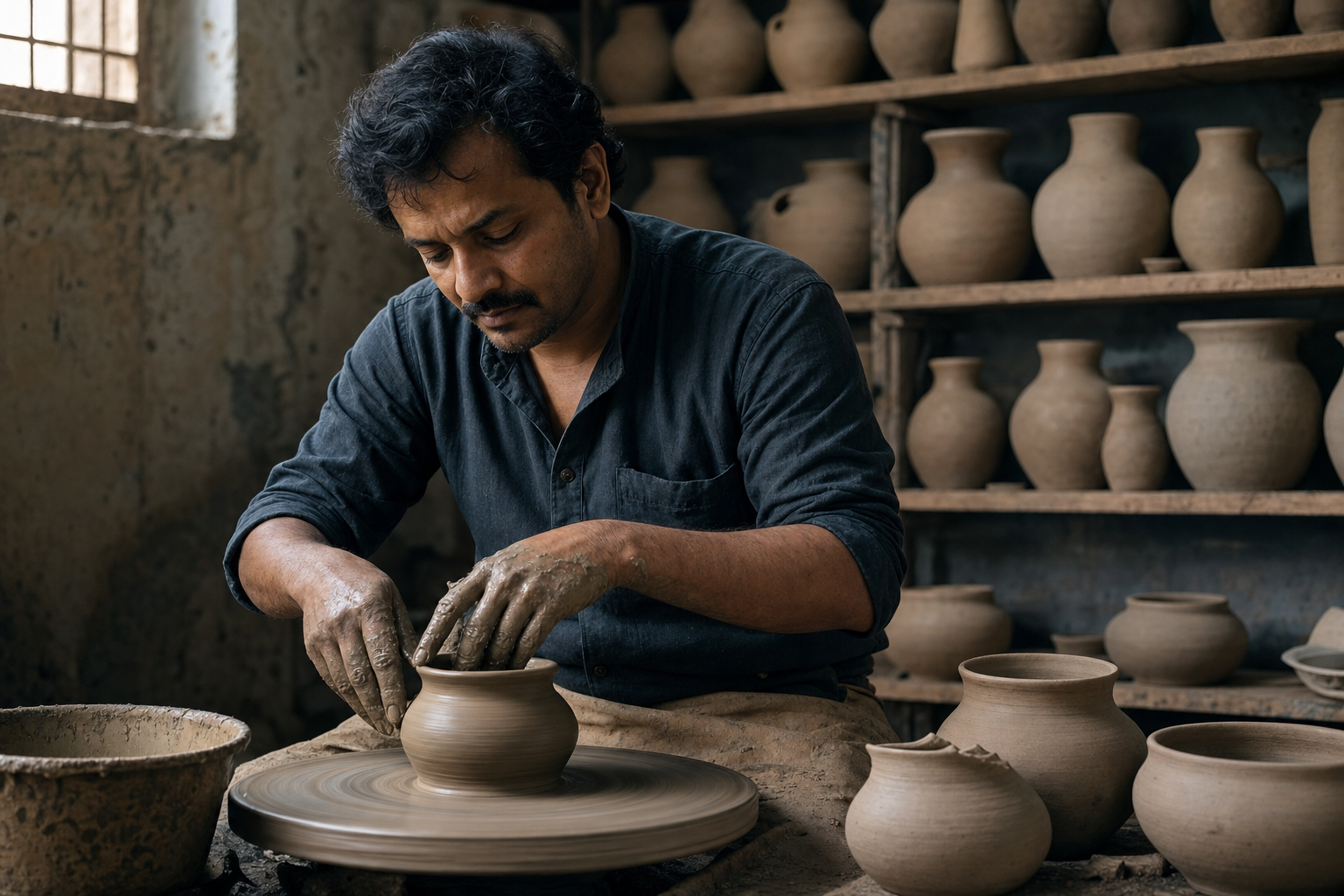
Non-attachment does not ask you to stop caring. It asks you to stop wagering your identity on an outcome. You can pursue a promotion, train for a demanding skill, build an organisation, care for a family, or serve a community with intensity. The test is what happens when reality refuses your preferred timetable.
For any substantial goal, write down four separate items:
- The duty: What responsibility or value makes this action worth doing?
- The controllable action: What can you actually do next, rather than merely hope will happen?
- The stopping condition: When is today’s effort enough? Define this before fatigue and anxiety begin negotiating with you.
- The released result: What response, timing, recognition, or final outcome remains outside your command?
This structure prevents a useful plan from becoming an endless demand. It also makes review more honest. If the result disappoints, examine preparation, judgement, and changed conditions. Do not smuggle a verdict about your entire character into an operational review.
The same separation helps when you do not have a five-year plan. Dharma can be lived through context-sensitive action rather than rigid forecasting. Ask, “What is mine to tend in this season?” That question can accommodate changing duties to family, livelihood, health, study, community, and spiritual life without treating change as failure.
Be equally candid about structural problems. Mindfulness can alter your relationship with pressure, but it cannot make an impossible workload fair, repair an abusive workplace, or create hours that do not exist. A breathing exercise should not be used to train yourself to tolerate exploitation. Where the problem is excessive demand, the appropriate action may be renegotiation, delegation, a firm boundary, collective support, or leaving when that is realistically possible.
A useful boundary names both the limit and the commitment: “I cannot take this on today; I can review it on Thursday,” or “I can complete these two items by the deadline, but the third requires more time.” This is clearer than silent overcommitment followed by exhaustion. It also protects other people from promises you cannot sustainably keep.
If you like tracking, record supports rather than trophies. A consistent sleep routine, morning sunlight, whether you paused to breathe, and a simple sense of ease or gratitude can reveal patterns without turning contemplation into competition. Choose only one or two measures. If tracking increases guilt, checking, or self-punishment, stop tracking; the scaffold has outlived its purpose.
Mindfulness and breathing practices are not substitutes for medical or psychological care. If stillness repeatedly intensifies panic, traumatic memories, severe distress, or an inability to function, use a gentler external grounding practice and seek help from a qualified health professional. A practice is meant to support life, not become another ordeal you believe you must endure.
Key takeaways for the next seven days
- Separate duty, outcome, and worth. Give full effort to the first without making the other two identical.
- Set aside one five-to-fifteen-minute presence block with no target beyond noticing what is here.
- Measure yoga or meditation by breath, attention, and unnecessary tension before using duration, range, or streaks.
- Use a sensory grounding pause when comparison, checking, or productivity guilt takes over.
- Protect one ordinary activity from screens, documentation, optimisation, and the demand to produce an insight.
- Define a stopping condition for important work before anxiety turns “enough” into a moving target.
- Keep a tracker only while it supports awareness; release it as soon as it becomes a new source of pressure.
Do not attempt a complete reinvention this week. For seven days, keep one presence block and one device-free activity. At the end of each day, ask only whether you were more available to the person, duty, or moment in front of you. That question keeps mindfulness connected to dharma rather than display.
Tomorrow, begin before the day’s scoreboard appears. Sit for five minutes, feel one unforced breath, and name the duty that deserves your care. Then do it wholeheartedly. When the work is complete, let completion be enough.
References
