
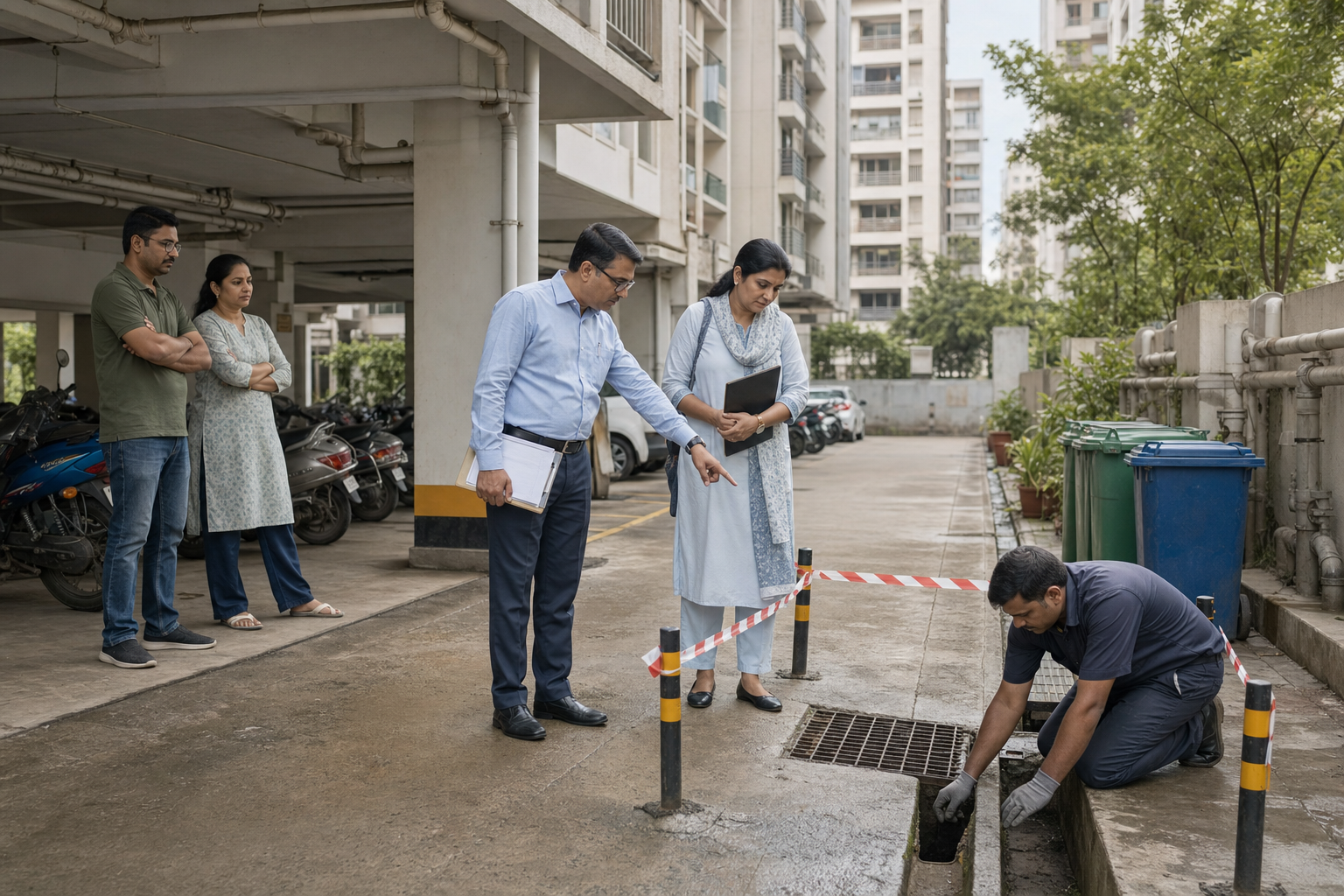
If you are a housing-society secretary, committee member, or resident and hear that animal slaughter is planned in a parking area, basement, terrace, flat, or society compound, do not let the next step become a confrontation in the residents’ group. Treat it as a municipal-compliance, facilities, and public-health matter.
Your immediate job is to establish what is actually happening, protect shared water and drainage systems, notify the competent authority, and preserve a calm record. That approach is firmer than an argument because it puts enforcement where it belongs: with officials who can inspect, stop the activity, manage waste, and act under the applicable law.
The legal question is the act and the place, not a resident’s faith
The central rule is straightforward. The Prevention of Cruelty to Animals (Slaughter House) Rules, 2001 restrict animal slaughter within a municipal area to a slaughterhouse recognised or licensed by the competent authority. A residential building is not converted into such a facility by a society resolution, a resident’s consent, or the arrival of a festival. Maharashtra’s municipal rules and local by-laws also require slaughter to occur in compliant facilities with veterinary oversight.
Other laws address different parts of the same activity. Food-safety licensing and hygiene requirements become relevant when meat enters the human food chain. Environmental and solid-waste rules govern the containment and authorised disposal of blood, offal, and other animal material. Maharashtra’s animal-preservation framework separately restricts the slaughter of certain bovine species. Goats and sheep are not exempt from the requirement to use a compliant facility merely because the species itself is not prohibited. These overlapping requirements are why ad hoc slaughter in residential premises falls outside the lawful municipal system.
Exact complaint channels, responsible officers, local operating hours, and enforcement provisions can differ by municipal corporation. Your society should therefore obtain the current advisory and list of licensed facilities directly from its municipality. If ownership rights, tenancy terms, or another disputed legal issue becomes central, take advice from a qualified local lawyer rather than improvising a legal conclusion in a committee meeting.
Three distinctions will keep the society on sound ground:
- A rumour, a resident’s identity, or the presence of an animal is not proof that slaughter has occurred. Act on credible information about conduct, location, waste, or an imminent plan.
- Lawful transport of meat processed at a licensed facility is not the same compliance issue as killing and processing an animal inside residential premises.
- A society may protect common facilities and report a suspected violation, but its members should not enter a home, seize an animal or equipment, physically restrain anyone, or organise vigilante enforcement. Those acts can create danger and separate legal exposure.
Write the society protocol before a festival-day dispute

A neutral, year-round rule is easier to enforce than a hurried circular aimed at one community. Frame the policy as an on-site slaughter and biological-waste protocol applicable to every resident, event, and occasion. The operative sentence can be simple: animal slaughter and the washing, processing, storage, or disposal of slaughter waste are not permitted anywhere within the residential premises; residents must use facilities licensed by the competent local authority.
Adopt the protocol through the society’s normal governance process, record it in the minutes, and circulate it before any period in which the issue is reasonably anticipated. Do not add insulting religious commentary or claims about residents’ motives. A notice that states the rule, the public-health reason, and the lawful alternative gives both residents and officials something usable.
The protocol should assign named responsibilities rather than vaguely telling everyone to remain alert:
- The secretary or manager keeps the current municipal health, sanitation, veterinary, water, and control-room contacts, along with the police contact for an immediate safety threat.
- The facilities lead checks whether storm-water gullies, sewage lines, lift pits, pump rooms, sumps, and overhead tanks are properly separated and secured. Isolation valves should be identified before an emergency, not searched for after contamination is suspected.
- Security personnel receive a short instruction sheet: report observable conduct to the manager, avoid arguments, do not search private property, and do not profile residents by name, dress, faith, or food preference.
- The committee obtains the municipality’s current list of licensed slaughterhouses or officially approved arrangements. Do not copy an unverified address from social media into the society circular.
- One authorised person receives complaints and maintains an incident log. This prevents contradictory calls, exaggerated messages, and the uncontrolled circulation of photographs.
- The society identifies in advance who can isolate a tank, arrange an alternative water supply, contact a qualified water-treatment service, and request microbiological testing.
The circular should also tell residents how to report a concern: location, time, observable activity, whether blood or wash-water is present, and whether a drain, tank, lift shaft, or pump room may be affected. It should not invite residents to spy through windows, enter a flat, publish names, or circulate allegations in public groups.
A short pre-festival meeting with community and religious representatives can prevent confusion. The message is not that a lawful observance is forbidden. It is that any slaughter must take place at a licensed facility and that residential water, waste, and common areas cannot be exposed to the process. Municipalities can support compliance by publishing facility information, extending authorised operating arrangements where feasible, and coordinating health, veterinary, and sanitation teams.
When an incident starts, protect people before debating motives
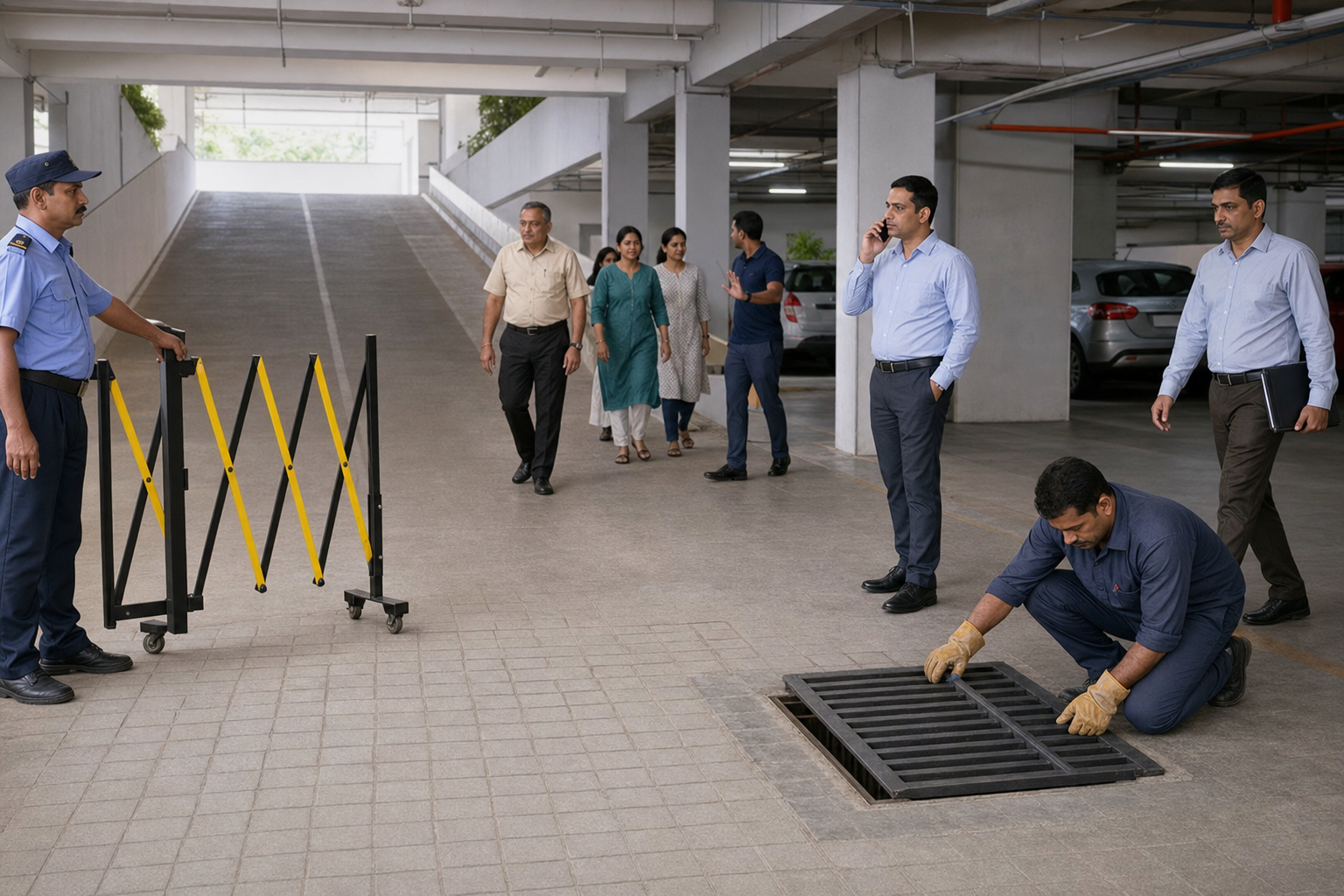
If slaughter appears imminent or has begun, speed matters, but confrontation rarely helps. Use a fixed sequence so that the committee does not lose time deciding what to do while blood or wash-water reaches a drain.
- Verify the immediate facts from a lawful vantage point. Record the exact common-area location, time, nature of the activity, presence of waste, proximity to utilities, and whether anyone is at risk. Do not enter a private residence or provoke the people involved.
- Secure shared infrastructure. Keep children, elderly residents, pets, and bystanders away. Prevent anyone from hosing blood or animal material toward a gully, lift shaft, garden, sump, or pump room. Restrict access to the affected common area without physically trapping or confronting residents.
- Notify the municipal health or sanitation authority and request an inspection. Where animal condition, species, or veterinary compliance is relevant, ask for the veterinary department as well. Obtain the complaint number, officer’s name, and expected response route.
- Call the police immediately if there is violence, a credible threat, forced entry, weapons being used against people, or another urgent danger. Police involvement may also be necessary when an ongoing violation persists despite municipal direction, but it should not replace the initial health and civic complaint where no immediate danger exists.
- Document only what is necessary. Photographs from common areas, timestamps, maintenance logs, water observations, witness names, and copies of official complaints can help an inspection team. Keep this material with the authorised committee contact instead of publishing faces, flat numbers, or accusations online.
- Preserve the site for the competent team. Do not wash evidence down a drain, move animal remains, open unknown bags, or ask untrained housekeeping workers to handle biological material. Record what the inspecting authority removes, cleans, samples, or directs the society to do.
- Close the loop in writing. Note the official action, waste-disposal route, water measures, cleaning completed, test results where applicable, resident notice, and any change needed in the society protocol.
If shared water may have been contaminated
Blood or wash-water near an open sump, overhead tank, pump room, damaged pipe, or poorly separated wastewater line warrants immediate precaution. The facility manager should isolate the suspected tank, line, or sump if this can be done safely and without spreading the contamination. Issue a narrow, factual notice identifying the affected supply and advise residents not to use it for drinking, cooking, or brushing teeth until the competent authority clears it. Arrange an alternative potable supply and follow official advice about any additional restrictions.
Do not ask a guard or committee member to guess a chlorine dose. Blood and other organic material can increase chlorine demand, so casually adding bleach is not proof that the water is safe. A qualified team may need to inspect the entry route, remove contamination, flush the system, perform controlled shock chlorination, and obtain microbiological test results before normal service resumes. Colour and smell alone cannot clear a water supply.
If a resident becomes unwell after credible contact with contaminated water or animal material, that person should seek medical advice and explain the nature and timing of the exposure. Children, older people, immunocompromised residents, and anyone exposed through broken skin deserve particular caution. A society committee should report the exposure facts; it should not attempt to diagnose the illness.
Blood and slaughter waste are not ordinary wet waste

The instruction not to hose blood into a drain is not about appearance. Blood carries a high organic load, commonly described through biochemical oxygen demand and chemical oxygen demand. When a large load enters stagnant or poorly flowing water, microbial decomposition consumes oxygen, encourages anaerobic conditions, and produces persistent odour. A storm-water drain may carry the material into an open water body rather than to treatment, while a sewage connection may overflow or leak into vulnerable building infrastructure.
Improperly handled slaughter material can carry pathogens associated with serious human disease, including Salmonella, Campylobacter, pathogenic Escherichia coli, Leptospira, Brucella, and Coxiella burnetii. Listing these organisms does not mean every incident will cause disease. It explains why bare-handed handling, aerosol-producing hosing, improvised storage, and untested restoration of water are unacceptable risk controls.
Offal and blood left in ordinary bins or open areas also attract flies, vermin, and stray dogs. They can spread material beyond the original location and turn a contained incident into a building-wide sanitation problem. Strong odour is therefore not the only concern, and the absence of odour does not establish safety.
The society should insist on collection, containment, transport, and disposal through the authorised municipal or licensed channel. Do not mix animal remains into routine household garbage, bury them in society landscaping, push them into a drain, or move leaking packages in a passenger lift. Cleaning should be conducted by properly equipped personnel after the authority has documented the scene and determined the disposal route.
After removal, inspect the path the material may have taken: floor joints, gullies, lift pits, drains, pump rooms, sumps, hoses, cleaning tools, and waste-storage areas. Organic residue must be physically removed before disinfection can work reliably. If shared water infrastructure was involved, professional treatment and testing remain necessary even when visible staining has disappeared.
Key takeaways: firm enforcement without communal friction

- Use one neutral rule: no animal slaughter or slaughter-waste processing within residential premises; direct residents to facilities licensed by the competent authority.
- Act on observable conduct and credible evidence, not a resident’s religion, food preference, or the circulation of a rumour.
- Make municipal health, sanitation, and veterinary authorities the normal enforcement route; call police immediately for violence or another urgent threat.
- Protect tanks, sumps, pump rooms, lift shafts, drains, children, and bystanders before anyone attempts cleaning.
- Document timestamps and common-area conditions privately. Do not enter homes, seize property, dox residents, or stage a public confrontation.
- Use authorised waste handlers and restore a potentially affected water supply only after proper cleaning, disinfection, and testing.
Ahimsa is practical here. It asks you to reduce harm to animals, residents, sanitation workers, and the relationships that hold a neighbourhood together. It does not require a committee to ignore unlawful conduct, and it does not justify humiliating an entire community for the alleged act of an individual. Even-handed enforcement is both the lawful course and the Dharmic one.
Before the next major festival, put three items before your committee: a neutral written protocol, a verified municipal contact sheet with licensed-facility information, and a map of the society’s water-isolation points. If an incident is already developing, skip the group-chat debate. Secure the shared utilities, file the civic complaint, obtain its reference number, and let the competent authorities act.
References
