

A clip claims that a protester has died. A voice note warns of a hidden decision involving Shri Ram Janmabhoomi. A quote card attributes inflammatory words to a defence official. You may have only seconds before family groups, temple networks, or political circles expect you to react. That is precisely when you should slow down.
The appearance of authenticity is no longer a safe test. In July 2026, Delhi Police said it had identified and blocked more than 400 Pakistan-linked accounts allegedly circulating AI-generated media, deepfake videos, edited photographs, and fabricated official statements around protests in Delhi. You do not have to treat an institutional statement as the last word to recognise the danger: a real controversy can now carry convincing material that was never real.
Key takeaways: the sharing rule to remember
- Rewrite the viral message as one exact, checkable claim before you evaluate it.
- Verify the image, audio, caption, date, and location separately. One authentic element does not authenticate the others.
- For claims that could provoke communal anger, panic, or confrontation, look for a primary record and genuinely independent corroboration.
- Use precise labels: verified, attributed, misleading, false, or unverified. Do not turn an allegation into a fact by dropping two words from the sentence.
- If you shared something wrong, correct it in the same groups and channels that received the original.
Do not let a worthy cause authenticate weak evidence
Disinformation works best when it attaches itself to something people already care about. The underlying concern may be genuine: the sanctity of a mandir, alleged failures in an examination system, the conduct of police, or foreign interference in Bharat. None of that establishes that a particular photograph, quotation, casualty claim, or voice note is genuine.
Keep three questions separate:
- What is the underlying controversy? Establish what event, decision, or grievance actually exists.
- What does this particular item claim? State the alleged act, actor, place, and time without emotional adjectives.
- What action is it asking you to take? Sharing, donating, assembling, condemning, or confronting someone requires its own judgement.
A legitimate grievance does not make every supportive clip true. A fabricated clip does not make the underlying grievance illegitimate. This distinction matters in protest reporting, where Delhi Police said it had rebutted at least 18 circulating claims, including allegations of deaths, assaults, detention, and unusual police weapons. Those rebuttals establish the police position on the claims; each disputed event still has to be judged by the available evidence.
The same discipline applies to sacred institutions. At a July 23 gathering in Ayodhya, sants urged devotees to form opinions from facts and favoured dialogue, coordination, and an active religious committee in addressing concerns around Shri Ram Janmabhoomi. That is not a demand for passive acceptance. It is a demand to distinguish a demonstrable problem from an anonymous rumour about that problem.
Language helps preserve that distinction. Call material unverified when you do not yet have enough evidence. Call it misleading when genuine material has been given a false context. Call a claim false when reliable evidence contradicts it. Reserve disinformation for deliberate deception; a mistaken relative forwarding a message is not automatically part of an organised operation. Intent and coordination require evidence too.
Use a seven-step verification ladder
You do not need a forensic laboratory for the first pass. You need a repeatable sequence that prevents emotion from deciding what counts as proof.
- Write the claim in one sentence. Replace phrases such as “look what they have done” with a proposition containing a person or institution, an alleged action, a place, and a time. If the message is too vague to rewrite, it is too vague to share as news.
- Preserve the provenance. Keep the original URL, account name, posting time, and accompanying text. A forwarded download or screenshot may preserve the appearance of a post while removing the information needed to authenticate it.
- Find the earliest available version. Search an exact quotation, look for the full recording, and use a reverse-image or key-frame search when possible. An older occurrence may show that footage from another city, year, or dispute has acquired a new caption.
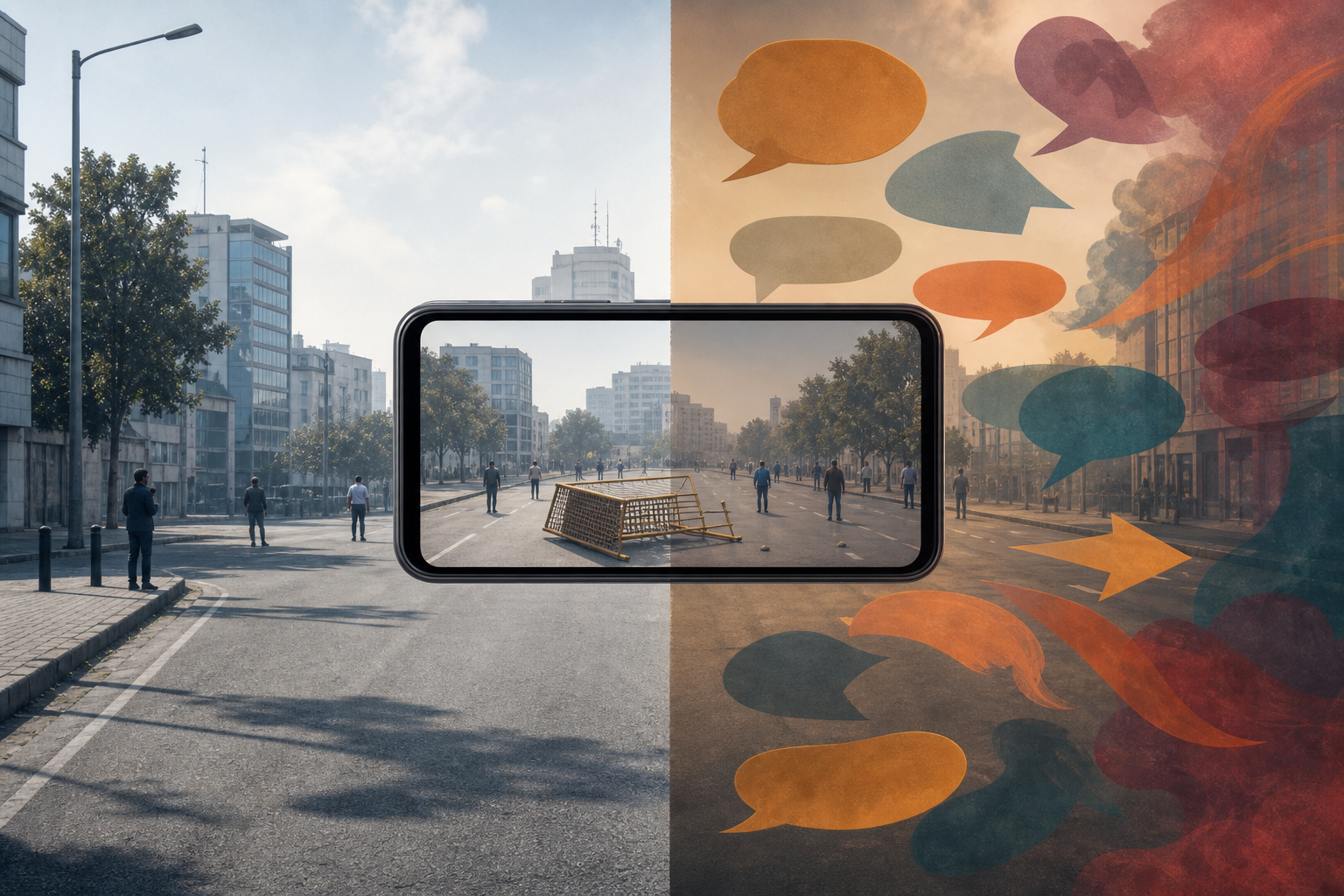
- Separate the media layers. Ask independently whether the video is genuine, whether its audio belongs to it, whether subtitles reproduce the words accurately, and whether the stated time and location are correct. A real video with replaced audio is still a fabricated claim.
- Check the relevant primary record. For an alleged ministerial statement, locate the full official recording or transcript. For a temple decision, look for a named statement from the authorised administration or religious committee. For a police action, check the department’s on-record position while remembering that an official statement is evidence of that institution’s position, not an all-purpose certificate of truth.
- Seek independent corroboration. Five accounts reposting the same clip are one evidentiary trail, not five witnesses. Look for differently sourced footage, identifiable people with direct knowledge, complete records, or contemporaneous reporting that does not merely repeat the same press release or viral caption.
- Assign a verdict before choosing an action. Use verified, attributed, misleading, false, or unverified. If all you can establish is that an authority made a statement, write “Delhi Police said” or “the temple committee stated.” Do not silently upgrade that to an independently proven event.
For a claim likely to trigger communal anger, public panic, reputational destruction, or physical confrontation, we would require at least one primary record plus one genuinely independent form of corroboration before sharing it as fact. If that threshold cannot be met, withholding the forward is the responsible decision. You can still ask a trusted person to verify the URL without broadcasting the allegation.
Recognise the manipulation pattern before chasing the verdict
Different forms of manipulation require different checks. During the 2026 Delhi controversy, fact-checking units associated with the Press Information Bureau and the Bharatiya Army flagged clips said to contain fabricated audio, altered visuals, and remarks falsely attributed to Defence Minister Rajnath Singh and senior military officers. Looking only for an obviously artificial face would have missed the broader method.
| Viral form | Best verification move | Common mistake |
|---|---|---|
| Short clip of an official speaking | Find the complete recording and an official transcript; compare the words immediately before and after the excerpt. | Assuming a familiar face and voice prove that the quoted sentence is authentic. |
| Protest, riot, or police footage | Trace the earliest upload; compare landmarks and sequence with independently recorded views of the same event. | Verifying the footage but never verifying the caption’s city, date, or claimed cause. |
| Claim of death, assault, or detention | Seek specific, on-record confirmation from an appropriate family representative, lawyer, medical institution, authority, or multiple on-scene reporters without publishing private details. | Treating an anonymous message as proof, or treating one institutional denial as the only evidence needed. |
| Temple circular, letter, or voice note | Check whether the authorised temple body or religious committee issued it and whether an accountable office can confirm the exact decision. | Trusting sacred vocabulary, a seal, or a picture of a deity as proof of origin. |
| Quote card or screenshot | Search the exact wording and locate the live original on the claimed speaker’s or institution’s channel. | Accepting a profile photograph, verification mark, or copied interface as authentication. |
| Sudden mass posting by similar accounts | Trace whether the accounts supply independent evidence or merely repeat identical wording and media. | Confusing volume with corroboration, or inferring a foreign government operation from flags, bios, or political slogans alone. |
| Suspected synthetic face or voice | Authenticate the event and its provenance through the original recording, complete statement, and responsible office. | Relying on blinking, lip movement, fingers, compression glitches, or other visual folklore as a decisive test. |
A strange visual detail can justify further checking, but it cannot by itself prove that AI was used. Compression, translation, dubbing, editing, and poor network quality can all create anomalies. The inverse is equally important: a clean, natural-looking clip is not therefore genuine.
Do not download and publicly re-upload suspicious material merely to ask whether it is true. That creates another context-free copy and may expose thousands of people to the allegation. Keep the original URL, capture a screenshot for evidentiary purposes, and send the link privately to an appropriate fact-checking, institutional, or editorial contact.
Use a dharmic response when the stakes are communal or national
A dharmic response is not passive, and it is not credulous. Satya asks whether the claim is true. Viveka asks whether you have separated observation from interpretation. Ahimsa asks what foreseeable harm may follow if an unverified allegation is delivered to an angry audience. You can defend a temple, question an authority, support students, or oppose foreign interference while refusing to lend your credibility to evidence that has not earned it.
When a mandir or Shri Ram Janmabhoomi is invoked
Sacred language can make a rumour feel disloyal to question. In reality, the higher the spiritual and communal stakes, the less acceptable careless forwarding becomes. The Ayodhya sants’ emphasis on facts, dialogue, coordination, and the religious committee’s role offers a practical sequence: identify the exact concern, establish who has responsibility, obtain an accountable response, and pursue resolution without turning speculation into collective anger.
Before forwarding a temple-related warning, ask who issued it, what exact decision or event it describes, where the complete statement can be found, and which authorised body can confirm it. Distinguish criticism of an administrative decision from hostility to the deity or tradition. Conflating the two can silence legitimate questions while giving manipulators an easy way to manufacture outrage.
When protest, Pakistan, or national security is invoked
Use an attribution ladder. “Pakistan-linked accounts,” “operators located in Pakistan,” and “a Pakistan state-directed operation” are progressively stronger claims; they are not interchangeable. Delhi Police alleged that accounts operated from Pakistan had circulated manipulated material and that some had also been active around Operation Sindoor. The accurate public formulation is that police made that finding. A claim of direct state control would require its own evidence.
Foreign amplification also does not erase a domestic grievance. An outside actor can exploit a real protest; that does not prove the protesters’ concern was invented. Conversely, the reality of a grievance does not authenticate casualty rumours, fabricated military statements, or edited police footage. Holding both propositions at once is not fence-sitting. It is analytical discipline in service of Bharat.
If you already shared something false
- Stop further spread. If the platform permits editing, place “Correction” at the beginning of the original. Otherwise remove the public copy after preserving the URL and screenshot needed for your records.
- Return to the same audience. Correct the claim in every group, channel, or account where you sent it. A correction posted only on your own profile will not repair a falsehood distributed through private groups.
- Name the exact error. Write “The claim that X occurred is unverified” or “This video is from a different event.” Do not use a vague line such as “There may have been some confusion.”
- Show the reason for the correction. Link to the original full recording, accountable statement, earlier image occurrence, or other decisive evidence. Avoid attaching the manipulated file again unless viewing it is necessary to understand the correction.
- Ask downstream sharers to update. A direct message to people who forwarded your material often reaches the affected audience more effectively than a general apology.
If the material contains doxxing, impersonation, incitement, or a credible threat, preserve the live URL and a screenshot, report it through the platform and appropriate authorities, and do not attempt to expose the suspected operator yourself. Public accusations based on an account’s language, flag, or biography can misidentify an innocent person and create a second falsehood.
The next time an explosive claim reaches you, make the claim precise, locate its origin, verify each media layer, and label your confidence honestly. If you cannot complete those steps, silence is not surrender. It is a refusal to become part of someone else’s distribution network.

References
- Hindu Post — Sants unite against ‘misinformation’ on Shri Ram Janmabhoomi; urge devotees not to be misled by rumours
- Hindu Post — Delhi Police Uncovers Cross-Border Disinformation Network: Over 400 Pakistan-Linked Social Media Handles Blocked for Spreading AI-Generated Fake Content During CJP Protests
