

You may be deciding whether to donate, serve on a committee, support a budget demand, or challenge a public authority. The loudest question is often who should control a Dharmic institution. The useful question is more exact: which decisions require religious authority, which require professional competence, and which must be open to public scrutiny?
Good governance begins when those lanes are clear. A state department should not rewrite a temple’s maryada. A trustee should not invoke maryada to evade fire safety, property records, fiduciary duties, or accounting for a public grant. Sacred autonomy becomes stronger, not weaker, when it is protected by competence, due process and public trust.
Draw the boundary between sacred authority and public duty
A Dharmic institution is not an ordinary service provider. Its purpose includes worship, sadhana, teaching, transmission and seva. Yet many institutions also maintain land, receive grants and donations, employ people, manage crowds, preserve historic fabric, serve food, and operate public amenities. Temples in particular can sustain ritual life, annadanam, festivals, music, artisans and small local livelihoods. These effects make governance a legitimate public concern without turning sacred practice into a government program.
Dharma supplies the ethic for that governance, not a shortcut around procedure. Satya requires accurate accounts and honest property claims. Ahimsa requires attention to structural, electrical, fire and crowd risks. Nyaya requires the same legal process for every institution. Seva requires that charitable activity reach the people for whom it was intended. Kartavya requires office-bearers to treat authority as a duty rather than a personal possession.
This ethic fits a constitutional order. Articles 25-28 protect religious freedom, while Article 51A expresses civic duties that accompany the exercise of rights. A constitutional Dharmic vision should therefore be judged by its conduct: whether it preserves religious freedom, protects individual dignity, applies law evenly and makes institutions capable of serving society. It need not collapse Hindu, Buddhist, Jain and Sikh traditions into one ritual system. Their maryadas remain distinct even where they share commitments to truth, compassion, learning, restraint and service.
A governing body can make the boundary concrete through a written decision-rights charter. It should state who initiates, reviews, approves and audits each class of decision.
| Decision lane | Appropriate lead | Governance test |
|---|---|---|
| Ritual, doctrine and sacred sequence | Acharyas, peethas, hereditary functionaries and other authorities recognized by the tradition | Does the decision preserve the institution’s Agama, sampradaya and maryada? |
| Conservation and life safety | Qualified conservators, engineers and safety professionals, with ritual consultation | Is the intervention safe, compatible with the historic fabric and acceptable in sacred zones? |
| Property and legal compliance | Trustees, authorized land officials, survey professionals and qualified legal counsel | Can title, permission, boundaries and the decision-making process be documented? |
| Finance, procurement and public services | The governing body, finance personnel and independent reviewers | Can each grant, contract, payment and promised outcome be traced? |
| Community oversight | Trustees, local representatives, women-led groups, service users and technical advisers | Can concerns be raised, answered and resolved without controlling ritual doctrine? |
Small institutions may have the same person serving in more than one lane. That is not automatically a failure. The safeguard is to keep the decisions and sign-offs distinct. The person who proposes a contract should not be its only reviewer; the contractor should not certify the contractor’s own work; and a civil engineer should not decide a question reserved for the sampradaya.
Key takeaways
- Protect ritual autonomy by naming the religious authority for sacred decisions instead of leaving jurisdiction vague.
- Treat safety, property, public grants and procurement as accountable functions, even when the institution itself is sacred.
- Map the institution’s legal status, assets, risks and responsibilities before demanding money or beginning construction.
- Resolve contested land claims through records, measurement, notice, hearing, a reasoned order and appeal, never through allegation alone.
- Measure governance through visible outcomes: safer facilities, maintained heritage, documented spending, functioning grievance channels and continuity of worship.
Build an asset register before approving conservation work
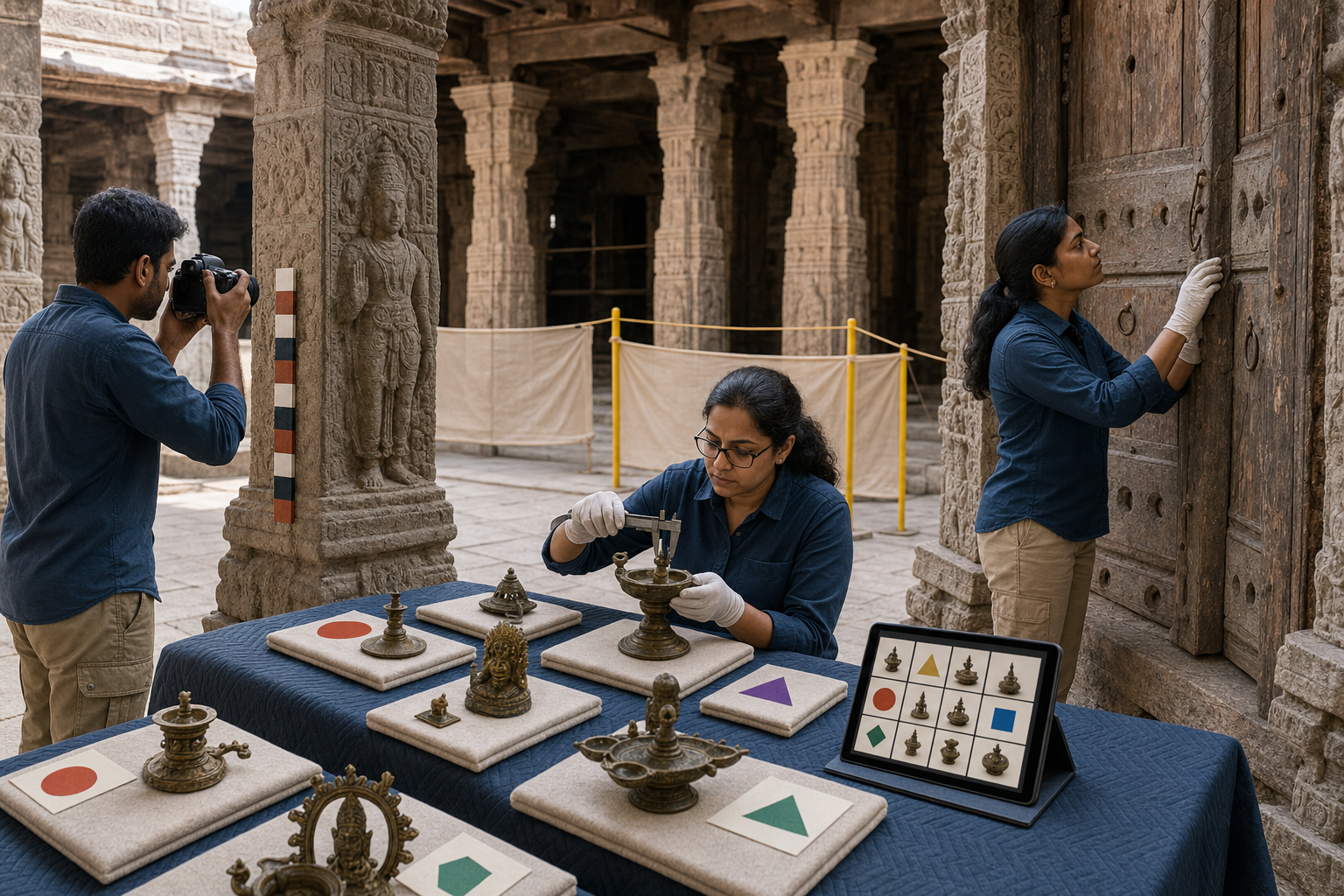
A temple cannot be governed responsibly if no one has assembled a reliable picture of what it owns, who controls it, what condition it is in and which rules apply. Karnataka illustrates the administrative complexity: some temples fall under the Hindu Religious Institutions and Charitable Endowments system, while others are managed by trustees, peethas, mathas or community bodies, and some ancient sites are protected by archaeological authorities. This plurality can preserve local autonomy, but it also creates gaps when every office assumes that another office is responsible.
Do not begin with a renovation wish list. Begin with an institutional and asset register containing the following fields:
- Identity and authority: the institution’s legal name, registration or administrative status, governing instrument, current office-bearers and the religious authorities recognized for ritual decisions.
- Property: survey or city-survey identifiers, title or grant documents, leases and licences, boundaries, recorded access rights, current occupation and any pending dispute.
- Sacred classification: the sampradaya, applicable Agama where relevant, sacred zones, movable icons, ritual objects, inscriptions and practices that constrain the timing or method of work.
- Physical condition: structural cracks, moisture entry, failed joints, drainage, sanitation, electrical systems, fire protection, lightning risk, emergency exits, crowd movement and barrier-free access.
- People and services: archakas and other staff, artisans, kitchens, water points, first aid, waste systems, festivals, peak-footfall conditions and arrangements for elderly people and persons with disabilities.
- Records and money: measured drawings, condition photographs, previous repairs, approved budgets, grants, restricted donations, contracts, bills, completion certificates, audits and insurance or emergency records where applicable.
A statewide program can reasonably start with the proposed 180-day baseline survey, condition assessment and mapping exercise. An individual governing body does not need to wait for the entire state. It can commission its own qualified assessment and place the non-sensitive findings before devotees, donors and the relevant authority. Detailed icon locations, security systems and other information that could create a security risk should remain access-controlled.
The register should produce a priority order. Life safety, structural stability and sanitation come before ornamental additions. Active water entry, unsafe electrical work, blocked drainage and unstable fabric cannot be postponed merely because a more visible project is easier to fund. After immediate hazards are controlled, preventive work such as cleaning, drainage upkeep, termite control, compatible pointing and routine electrical checks should enter a recurring maintenance schedule. Small, regular interventions usually protect both the building and the budget from avoidable emergency work.
Translate the condition assessment into a five-year rolling conservation and maintenance plan with yearly milestones. Each project should identify the defect, proposed treatment, responsible professional, required ritual consultation, budget, work window, inspection stages and maintenance obligation after completion. A plan that ends on inauguration day is incomplete.
Historic sacred fabric needs a different approach from ordinary construction. Compatible traditional materials, including lime-based mortars and appropriate stone-repair techniques, may be necessary. Modern diagnostics such as non-destructive testing and moisture mapping can help locate the problem before intervention begins. The governing principle is minimal, compatible and, where feasible, reversible work. Neither traditional nor modern should be treated as a magic label; the proposed method must fit the actual material, defect and sacred context.
Maryada must enter the project before tendering, not after a contractor reaches the garbhagriha. The work note should identify sacred zones, handling restrictions, acceptable materials, festival and ritual constraints, temporary arrangements for worship, and the religious authority empowered to stop or correct work that violates the agreed protocol. Consultation with acharyas, peethas and hereditary functionaries should be documented alongside the engineer’s or conservator’s approval. This dual sign-off protects both worship and fabric.
Documentation is part of conservation, not clerical decoration. Measured drawings, inscriptions registers, photogrammetry, condition photographs and records of movable objects establish what existed before work began. They allow later committees to distinguish an original feature from a recent alteration, investigate damage and evaluate whether a repair performed as promised.
Make every grant, contract and outcome traceable
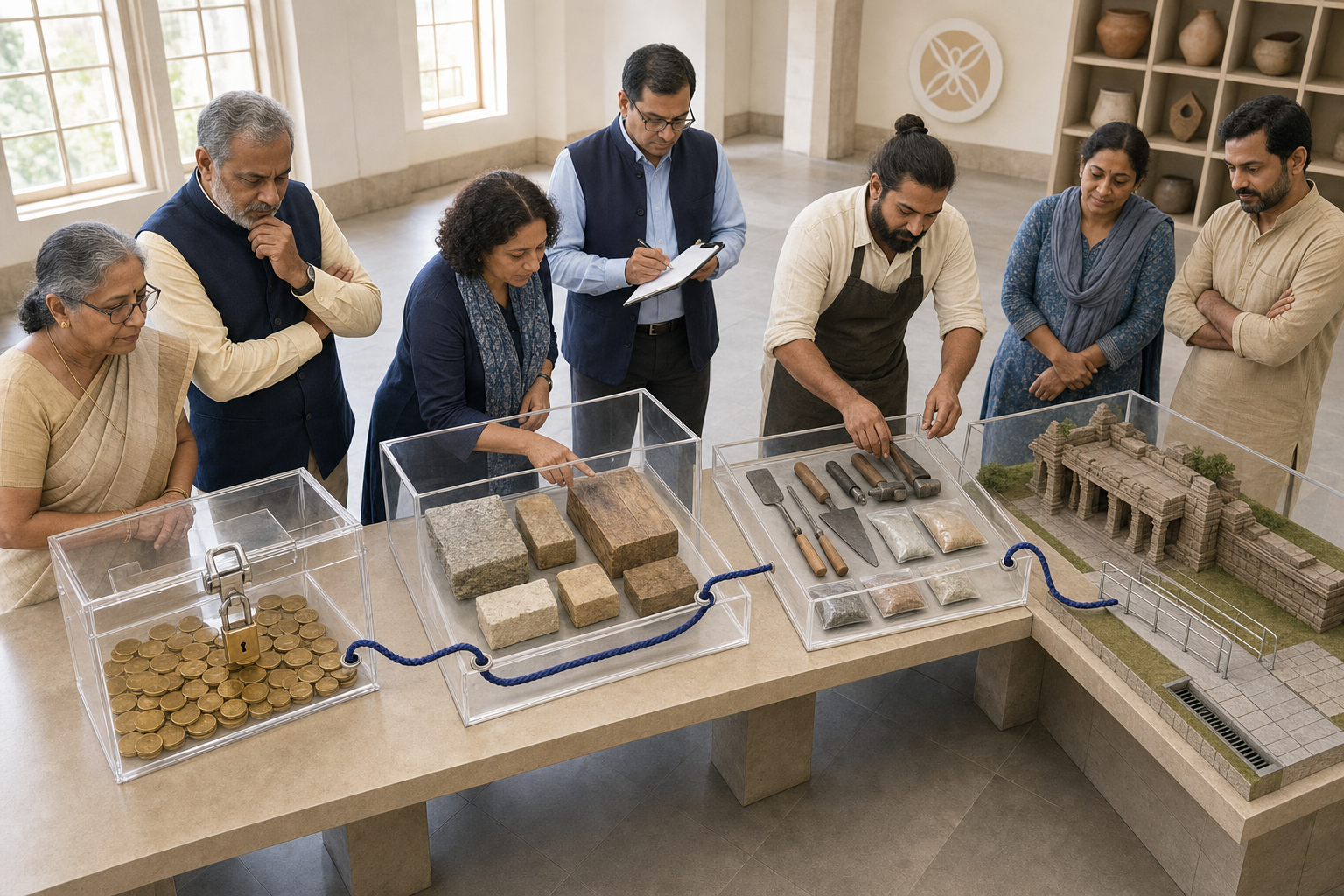
Accountability is not synonymous with departmental control. A temple can retain local and sampradaya-based authority while accepting strict conditions for public money, trust property and publicly promised services. Conversely, placing an institution under a department does not by itself guarantee transparency. What matters is whether responsibility can be followed from the approved purpose to the completed outcome.
A ring-fenced conservation and community-services fund is useful because it prevents safety and maintenance from competing invisibly with unrelated expenditure. It should support structural stabilization, fire and electrical protection, sanitation, documentation, staff and artisan capacity, and predictable maintenance grants for low-revenue rural temples. Prominent institutions can often attract donors; a small village shrine may need a modest but dependable grant to prevent a minor defect from becoming a major failure.
Capital work and routine maintenance should have separate lines. Otherwise a governing body may celebrate a large renovation while leaving no budget to clear drains, inspect wiring or maintain the repaired surface. Archaka and staff welfare should also be visible rather than treated as an afterthought. A beautiful precinct managed by people working without dignity is not sound Dharmic stewardship.
For publicly funded or publicly procured conservation, the control chain should include:
- a clearly approved scope based on the condition assessment;
- a standardized conservation bill of quantities;
- pre-qualification for specialized trades instead of selecting an ordinary contractor for specialist work;
- e-tendering where the applicable rules require or support it;
- independent technical review before award and at defined inspection points;
- third-party quality verification and a documented completion report;
- time-bound payment after verified milestones, so skilled artisans are not forced to finance the project; and
- publication of contracts, drawings, expenditures and audit findings, except information that would create a genuine security risk.
The public dashboard need not be elaborate. For each site, it should show the condition-assessment date, approved scope, amount sanctioned, amount released, amount spent, contractor or executing body, scheduled milestone, current status, audit status and grievance contact. Display the same essentials at the institution so people without reliable internet access can inspect them. If a project is delayed or its scope changes, record the reason rather than quietly rewriting the history.
Outputs should be measured in terms people can verify. Useful indicators include the share of institutions with current condition assessments, completed structural and fire-safety upgrades, changes in reported incidents, artisans trained, documentation completed and devotee feedback collected through anonymous kiosks or helplines. Biannual publication of progress and post-completion audits gives communities a regular opportunity to test whether expenditure produced the promised result.
Community oversight adds legitimacy when it is designed well. Trustees, local representatives, women-led community groups and technical advisers can review project scope, procurement status and grievances. They should not vote on doctrine merely because they sit on an oversight committee. Their remit is to monitor entrusted resources, services and implementation.
CSR and philanthropy can help with water, sanitation, queue systems, first aid, waste management, renewable energy and artisan training. Set the boundary before accepting the money. Sacred architecture and ritual zones remain subject to tradition and qualified conservation judgment. Donor recognition should not become intrusive branding inside a sacred precinct, and a donor should not acquire ritual authority through a cheque.
Resolve land disputes through records, notice and appeal
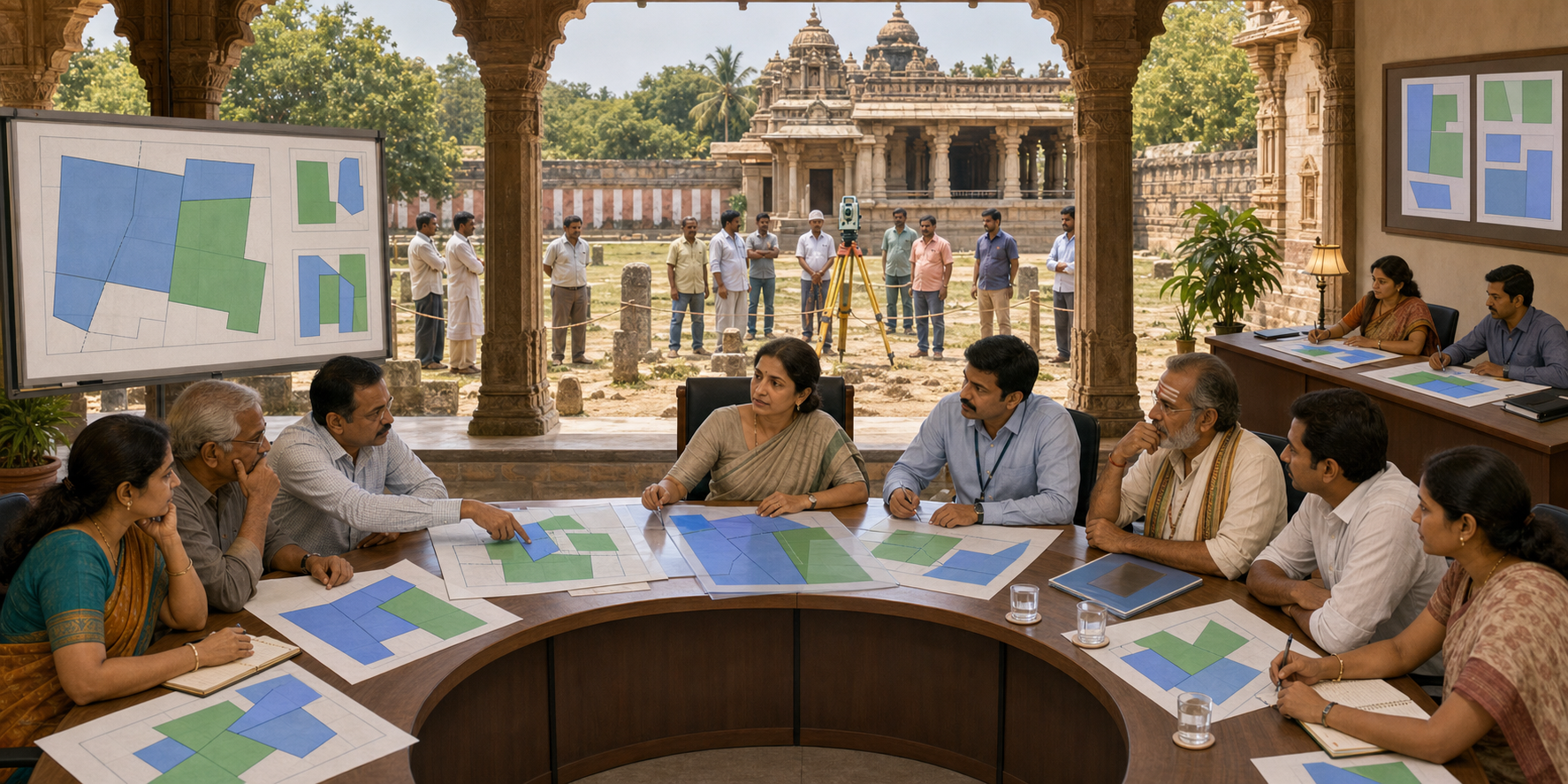
A land controversy involving a religious institution creates pressure to choose a side before the parcel has even been identified correctly. Resist that pressure. An allegation is not a finding, and the religious identity of an occupant is neither proof of title nor proof of encroachment.
The safe and credible route is procedural:
- Identify the exact plot, survey numbers, recorded owner and public authority with jurisdiction.
- Collect the property card or equivalent land record, mutation history, grants, leases, licences, cadastral maps, development-plan maps and relevant permissions.
- Conduct a joint measurement and demarcation through the authorized survey machinery, with institutional and government representatives present.
- Issue a detailed show-cause notice that identifies the alleged occupation and the evidence supporting the concern.
- Hold a fair hearing at which the institution can submit title documents, grants, leases, licences or other permissions.
- Issue a speaking order that sets out the documents considered, applicable law, factual findings and reasons for the decision.
- Preserve the available statutory appeal or review route before an irreversible step is taken.
- If unauthorized occupation is finally established, use a lawful, time-bound and humane rectification process; if it is not established, close the matter publicly with documented reasons.
In Mumbai, for example, the Maharashtra Land Revenue Code, Mumbai Municipal Corporation Act and Bombay Public Trusts Act assign different responsibilities for government land, municipal compliance and public-trust oversight. The District Collector handles government-land administration, the Municipal Corporation addresses relevant construction and land-use violations, the Charity Commissioner oversees registered trusts, and the Police maintain order during sensitive official action. Other states and property classifications may follow different statutes and authorities.
Because the correct route depends on the land record, governing statute and available appeal, trustees should have a qualified land lawyer and an authorized survey professional verify the process before any boundary is shifted, structure is removed or settlement is accepted. A committee, campaign or crowd should never attempt physical rectification on its own. That can endanger people, destroy evidence and create legal exposure even where the original grievance is genuine.
Regularization is not an entitlement. It may be considered only where the applicable policy permits it and the public interest supports it. Removal is likewise not a slogan; it is an administrative act that requires jurisdiction, evidence, notice, hearing and a reasoned order. Uniform enforcement matters because selective action corrodes trust even when an individual order is technically defensible.
Public communication should follow the same discipline. Authorities can publish redacted survey summaries, notices, orders and current status without releasing sensitive personal or security information. Institutional representatives should distinguish claims from established facts and identify the next procedural step. This deprives rumours of the vacuum in which they grow.
Satya and ahimsa demand both halves of this standard: no religious institution should occupy public land unlawfully, and no institution should be condemned or attacked without verified evidence and due process. Dharmic advocacy loses moral force when it asks the state for equality but tolerates prejudgment against someone else.
Turn the framework into a state-community compact
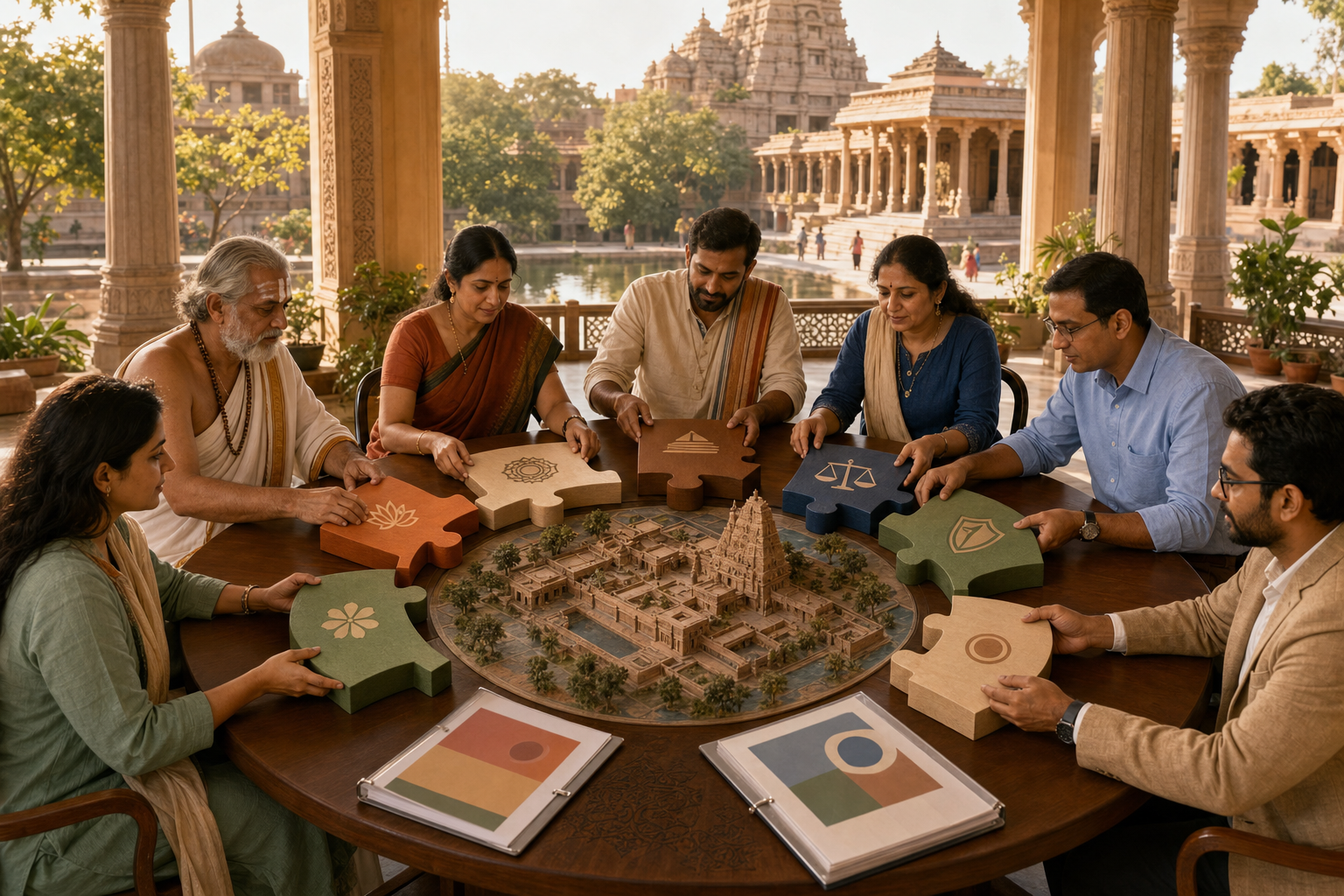
The state has legitimate responsibilities for public safety, lawful property administration, heritage protection, public finance and equal enforcement. The sampradaya has legitimate authority over ritual meaning, sacred sequence and religious continuity. The community supplies local knowledge, scrutiny, service and support. Durable governance requires all three, with no participant pretending to possess the others’ competence.
For a state or district administration, the practical opening move is a 180-day baseline survey tied to a real budget process. Phase I should prioritize life safety, structural stabilization and sanitation at vulnerable rural shrines and high-footfall institutions. Phase II can expand preventive maintenance, documentation and training. Phase III should institutionalize periodic audits, refresher training and appropriate technology upgrades. The sequence matters: a survey without funded action becomes an archive of neglect, while spending without a survey rewards visibility rather than need.
A Temple and Dharmic Heritage Council can establish shared standards for disaster preparedness, documentation, artisan welfare and community services. Hindu, Buddhist, Jain and Sikh participation would allow institutions to exchange technical knowledge without imposing one tradition’s ritual code on another. Shared governance standards should concern matters that are genuinely shared; maryada remains with the relevant tradition.
Heritage planning should also extend beyond the compound wall. Drainage, waste collection, mobility, water bodies, sacred groves and emergency access affect both the sacred experience and the survival of historic fabric. Coordinating temple works with municipal and rural infrastructure prevents a newly repaired precinct from being damaged by the same unmanaged water or traffic problem that harmed it before.
Skills are part of the compact. Sthapatis, shilpis, stone carvers, metalworkers and conservators need apprenticeships, field training and credible pathways for certification. Architecture schools, polytechnics and heritage institutions can help transmit traditional knowledge while teaching documentation, safety and conservation ethics. Procurement rules must then recognize that competence; training artisans is pointless if specialist work is routinely awarded without specialist qualification.
If you govern an institution, place four items before the next formal meeting: the decision-rights charter, asset register, current condition assessment and public reporting format. If you are a donor or devotee, ask who holds title, who approves work in sacred zones, what the latest safety assessment found, where funded work is reported and how a grievance can be filed. A clear answer is evidence of institutional maturity. An unanswered line is not a reason for accusation; it is the first governance task to fix.
Start with one institution. Write down its ritual authority, property custodian, safety assessor, budget publisher and grievance contact. Then ask each of them to accept the duty attached to the role. That small act turns public trust from a slogan into a working institution.
References
- DharmaRenaissance Blog – Stop Neglecting Karnataka’s Temples: Bagalkot Mandir Mahasangh Seeks Bold Budget Action
- DharmaRenaissance Blog – Bantwal Adhiveshan ignites Dharmic unity and values-driven vision for Constitutional Hindu Rashtra
- DharmaRenaissance Blog – Mumbai land row: Hindu Vidhidnya Parishad seeks transparent action on alleged Church encroachment
