
You may be choosing a linga for your home, standing before a yantra in a temple, or wondering why an archaka insists on an exact material, direction, mantra, and sequence. The useful answer is that these details are neither incidental decoration nor interchangeable symbols. They make worship physically coherent and ritually intelligible.
An Agamic form becomes a focus of ritual power through a disciplined relationship. The form must be appropriate to the deity and lineage. It must be supported, invoked, served, and maintained correctly. Once you understand that relationship, you can distinguish a living ritual arrangement from an attractive object assembled without regard for its purpose.
A sacred form is a system, not a religious ornament
A linga, yantra, kalasha, or homa-kunda does not perform the same function as every other sacred object. Each gives a particular ritual action a stable centre. Geometry identifies relationships within the form; material allows it to withstand the prescribed worship; orientation situates it in sacred space; mantra addresses the deity; and the paddhati orders what the worshipper does.
This is why copying a shape is not the same as receiving a practice. A technically accurate yantra without its deity-specific worship is still a diagram. A linga placed in a dish that cannot support it or discharge abhisheka water has been separated from part of its ritual architecture. A fire altar filled with whatever happens to be available ignores the relationship among the kunda, mantra, offering, and sankalpa.
Six elements therefore belong in the same decision: form, support, material, orientation, liturgical sequence, and continuing care. If one is missing, the answer is not to invent it. Ask which sampradaya governs the installation and which archaka, guru, or sthapati is qualified to specify what that lineage requires.
Key takeaways
- Do not choose a sacred form by appearance alone. Establish whether it is intended for portable household worship, procession, or fixed temple installation.
- Treat the support and outlet as parts of the ritual design. Stability, clean flow, and respectful collection of offerings are not secondary concerns.
- Follow one received paddhati. Directions, proportions, mantras, and sequences can differ legitimately among Agamic schools and regional traditions.
- Do not confuse consecration with possession. Acquiring an object does not grant authority to improvise restricted or deity-specific practices.
- Judge ritual integrity by conduct as well as precision: clean materials, ethical intention, disciplined speech, respectful remnants, and responsible seva.
The linga and pitha reveal how sacred architecture works

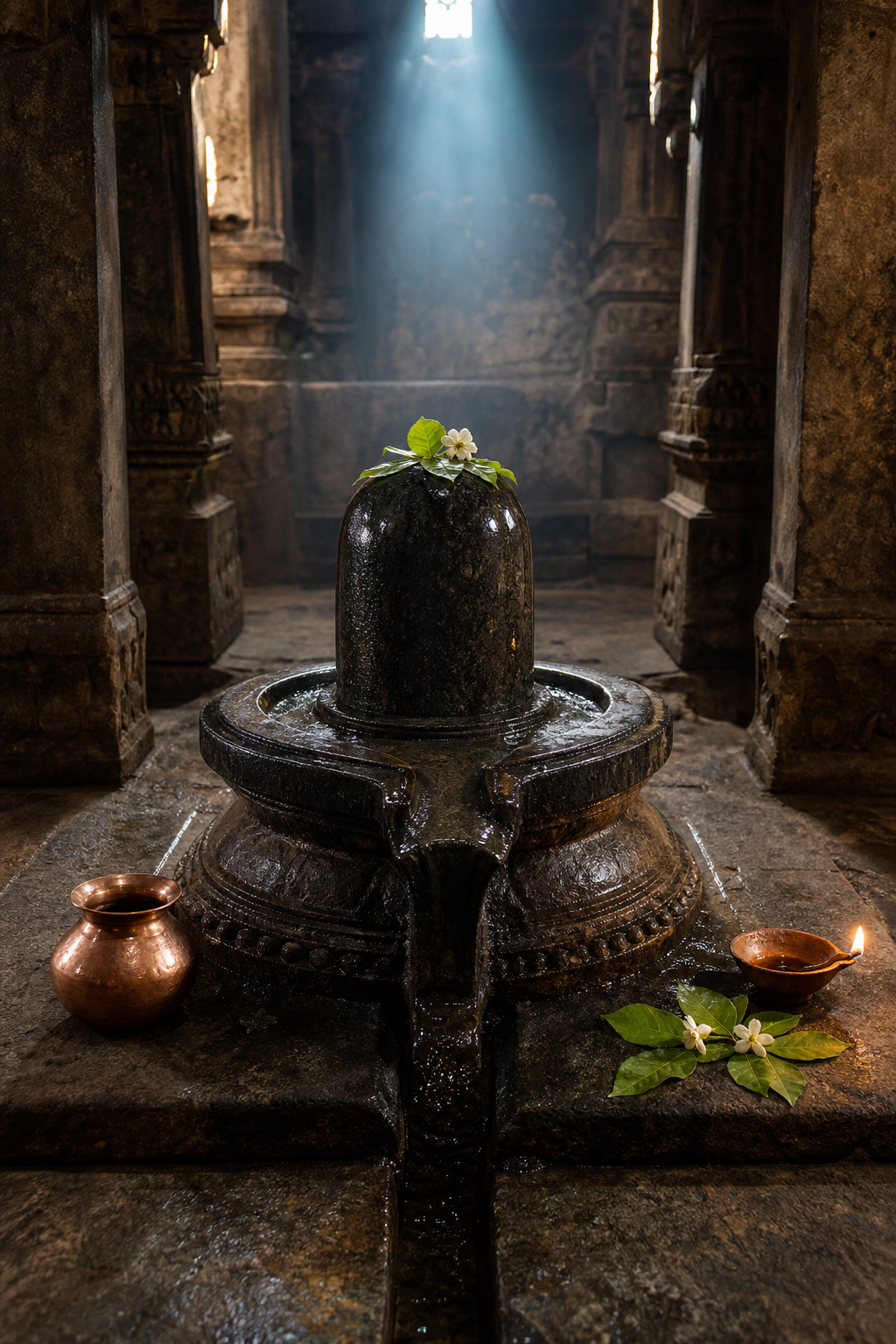
The Shiva linga offers a particularly clear lesson because its visible shaft is only part of the complete form. The pitha beneath it—also called the yoni-pitha, avudaiyar, or pindika—is not a display stand. It is the sustaining field through which the linga is supported and abhisheka offerings are received and returned.
The linga signifies the axis of consciousness, while the pitha embodies Shakti as the field of manifestation. Their union expresses the inseparability of transcendent consciousness and creative potency. Reading it as a merely sexual image strips away its cosmological and ritual grammar. The practical consequence is important: you should not treat the pedestal as an accessory that can be replaced by any convenient base.
Traditional articulation divides the linga into three portions. The square Brahma-bhaga is embedded below and remains unseen. The octagonal Vishnu-bhaga occupies the middle and may be partly visible. The cylindrical Rudra-bhaga rises above the pitha. The hidden portion locks into the support with a carefully dressed socket, giving structural stability a theological meaning: what appears before the worshipper rests upon an unseen foundation.
The outlet makes that unity operational. Known as the soma-sutra, gomukha, or pranala, it conducts water, milk, and other permitted abhisheka dravya away from the linga. In larger temples, its hydraulic line can continue through the sanctum floor and terminate at the outer wall. The slope and cross-section are designed to avoid stagnation and carry consecrated liquids with dignity.
You may see the outlet directed north in one installation and east in another. That difference does not by itself prove that one is wrong. Orientation varies with Agamic school and regional practice, even though north and east are common. A photograph, a commercial listing, or a universal ratio taken out of context cannot settle a lineage-specific question.
Material is equally functional. Dense, fine-grained stones such as granite, basalt, and schist withstand compressive load, repeated bathing, and long ritual use. Panchaloha and sphatika can be used for portable forms where the tradition permits. Surface finishing must support clean flow rather than leave pockets where dravya accumulates.
If you are acquiring a linga for regular home abhishekam, settle four questions before purchase: Is it a chala, or portable, form suitable for household worship? Does its matching pitha hold it securely? Can the outlet discharge into a clean vessel without splashing or pooling? Does your family or initiated lineage permit the material and manner of worship? If formal installation is intended, involve the archaka or sthapati before ordering the form, not after it arrives.
Ritual power is assembled through an ordered sequence
Geometry establishes a seat, but ritual creates the encounter. Agamic worship coordinates intention, bodily preparation, mantra, invocation, offering, and closure. Removing one dramatic element from that sequence—especially a bija, yantra, or fire offering—and performing it in isolation mistakes intensity for completeness.
A Shri Rajmatangi Mahayagya shows how Vedic yajna discipline and Shakta-Agamic upasana can meet within one liturgical architecture. The exact paddhati changes with sampradaya and guru-parampara, but the sequence makes the mechanism of ritual coherence easy to recognise:
- Time is selected. The panchanga coordinates tithi, nakshatra, yoga, karana, and vara so that the rite begins in an accepted muhurta.
- The field is prepared. Achamana, Ganesha-puja, purificatory recitation, and kalasha-sthapana establish ritual readiness.
- The purpose is named. Sankalpa states who is undertaking the rite and toward what dharmic end. In a public ceremony, that purpose can include the welfare, peace, protection, and prosperity of Bharat.
- The deity is approached. The yantra is established, nyasa consecrates the practitioner’s body as a vessel of mantra, and avahana invites the deity to preside.
- Attention is sustained. Mantra-japa and archana continue the worship rhythmically. Japa may be undertaken in multiples of 108, while the actual mantra and count remain matters of lineage.
- Offerings enter the fire. A prepared kunda receives samidh, ghee, rice, sesame, puffed grain, and specified herbs, with each oblation coordinated to mantra.
- The rite is sealed and shared. Purnahuti, ritual sprinkling, diparadhana, and prasada distribution bring the work to an ordered completion.
This is not a universal recipe for conducting a Mahayagya without guidance. It is a way to notice why sequence matters. In deity-specific Vedic-Agamic worship, the fire offering draws on yajna discipline while nyasa, yantra, and mantra follow the relevant upasana. Combining fragments from unrelated recordings can break the very continuity the rite is meant to establish.
If you are attending such a ceremony, arrive before the opening rites when possible and remain through the completion. Listen for the sankalpa rather than focusing only on the most visually dramatic offerings. If you are organising one, confirm the officiating lineage, the complete paddhati, the handling of prasada and remnants, and the division of seva before announcing claims about the ritual’s effects.
What ritual power means—and what it does not mean
Two opposite mistakes make Agamic ritual difficult to understand. One reduces it to art, psychology, or social theatre. The other treats every sacred shape as an automatic machine for obtaining results. Neither view accounts for the discipline built into the tradition.
Within Agamic practice, ritual power is theological: the deity is not merely represented but approached through an authorised form and mode of worship. Grace, presence, purification, and transformation belong to that religious claim. It should be stated as such, without pretending that metaphysical causation has been established by a laboratory measurement.
Ritual power is also embodied. The cool movement of abhisheka water, the stable conjunction of linga and pitha, the geometry of a yantra, the heat of agni, and the rhythm of repeated mantra gather otherwise scattered senses around one act. The form tells the hands where to offer, the body where to stand, the voice what to recite, and attention where to return.
It is communal when the sankalpa exceeds private gain. Preparing a large rite requires cleanliness, hospitality, material stewardship, coordinated recitation, prasada distribution, and service. Those tasks can train cooperation and trust, but only when participants actually practise them. Noise, waste, disorder, or contempt for volunteers cannot be excused by the grandeur of the altar.
It is ethical as well. Shri Rajmatangi, or Raja Shyamala, is associated with vak-shakti, wise counsel, the arts, social harmony, and just governance. Invoking her for influence while using speech to deceive or humiliate would contradict the stated orientation of the worship. The relevant test is not whether the ceremony felt impressive. Ask whether speech became more truthful, counsel more responsible, service more orderly, and shared resources more respectfully handled.
This ethical test protects you from exaggerated claims. A ritual is not a licence to bypass effort, accountability, or dharma. Nor does material prosperity alone demonstrate spiritual success. When sankalpa, mantra, form, and seva point in different directions, external exactness cannot conceal the fracture.
Honour the form through practical care

When you visit a temple
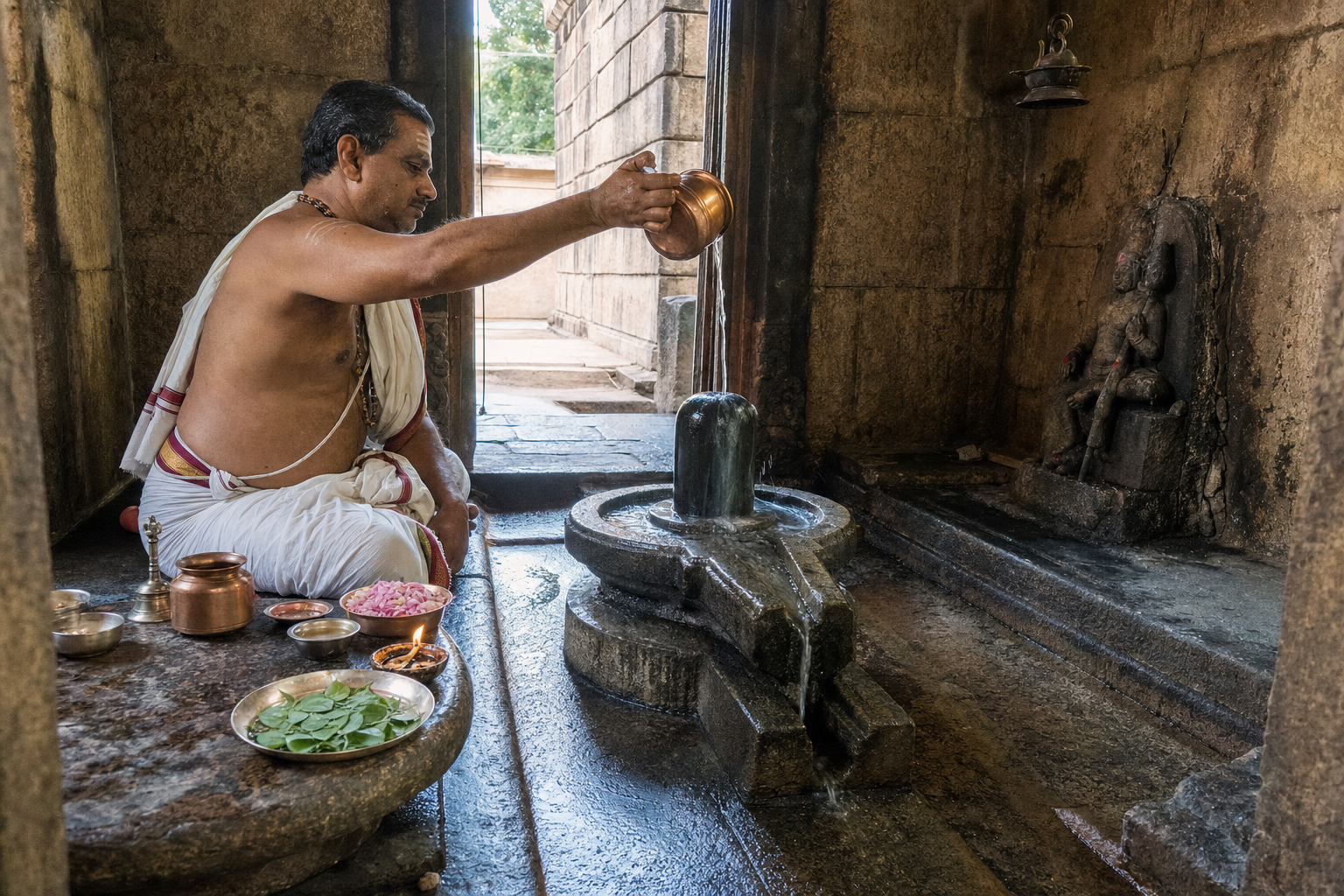
Begin by observing the ritual pathways. The outlet from a linga-pitha may look like a small architectural projection, but it conducts consecrated liquid. Do not obstruct it, place belongings on it, or step over its channel. Do not use the pitha as a shelf or touch it casually. Follow the temple’s directions for receiving tirtha and handling nirmalya, since local practice determines what devotees may collect and where they may stand.
Look at the junction of form and support. Notice how the recess stabilises the linga and how the channel begins its descent. This will teach you more about Agamic design than counting decorative motifs. In a well-functioning installation, theology, stonework, water flow, and the movements of the archaka cooperate.
When you maintain a household shrine
Set a clean receiving vessel beneath the outlet before beginning abhishekam. Use an amount of liquid the pitha can conduct without overflow. Confirm that the linga is stable and the channel is unobstructed. Pooling is not a sign of greater sanctity; it usually means that the outlet, level, or collection arrangement needs attention.
After worship, handle the collected liquid according to your sampradaya. It may be received as tirtha or respectfully offered to sacred plants or flowing water. Clean the form and channel promptly with methods appropriate to the material. Harsh cleaning agents can scar the surface and impair the smooth discharge that repeated abhishekam requires.
If you find a crack, looseness, persistent stagnation, or a badly aligned outlet, pause liquid offerings and consult a knowledgeable archaka or sthapati. Drilling a new channel, sealing a joint with an unsuitable compound, or forcing the linga into a mismatched pitha can damage both the form and its ritual fitness. Repair of a formally installed temple form may also require ritual rededication after the structural work.
Apply the same restraint to mantra. Deity-specific mula-mantras, bija clusters, and nyasa sequences vary across recensions and lineages. A syllable detached from its initiation, pronunciation, and paddhati is not made more authentic by repetition. Use the form of worship you have actually received, and ask for guidance before adding specialised practices.
Your next step can be modest. Before your next puja, inspect where the sacred form meets its support, where every offering will go, and how the rite will close. Correct one practical weakness, then confirm one lineage-specific question with the person responsible for guiding the worship. Agamic power becomes intelligible when reverence takes the form of precision, ethical intention, and sustained care.
References
- DharmaRenaissance Blog — Decoding the Pitha of the Shivling: Divine Architecture, Agamic Science, and Living Ritual
- Hindu Jagruti Samiti — Shri Rajmatangi Mahayagya in Mumbai: A potent Vedic call for Bharat’s protection and prosperity
