

If you have seen the Hindu Rashtra pledge campaign and are deciding whether it deserves your support, begin with one distinction: a pledge can declare civilizational intent, but it does not by itself explain what the state, the law, or citizenship would look like.
That distinction protects you from two easy mistakes. One is dismissing the campaign as mere ceremony. The other is treating its central slogan as if it were already a complete programme of governance. A serious response requires you to identify what happened, what remains undefined, and what standards any Dharmic political movement should meet.
Begin with what the campaign actually did
At the commencement of its 25th, or Silver Jubilee, year, Hindu Janajagruti Samiti led devout Hindus, temple trustees, and pro-Hindu organisations in taking a solemn pledge for the establishment of a Hindu Rashtra. The ceremonies took place at prominent temples across districts in Maharashtra.
The most accurate description, therefore, is a coordinated, temple-centred pledge campaign. Its form matters. A public pledge creates a shared identity, asks participants to move from private sympathy to declared commitment, and places the idea of Hindu Rashtra within a sacred setting. The involvement of trustees and organised groups also gives the event an institutional character that an informal gathering would not have.
There are also limits to what can responsibly be claimed. The reported campaign does not supply the exact number of participants, a complete list of districts or temples, the full wording of the pledge, a timetable, a constitutional proposal, or a measure of wider public support. Participation across districts should not be inflated into participation throughout Maharashtra or Bharat. Nor should photographs of a pledge ceremony be presented as proof that agreement exists on every policy that might be associated with Hindu Rashtra.
Use equally careful anniversary language. Beginning a 25th year is an organisational milestone, but it is not the same statement as having completed that year. If you discuss the campaign publicly, say that HJS entered its 25th year or began its Silver Jubilee year. Small distinctions like this preserve trust when the larger claim is politically contested.
Hindu Rashtra needs an operational definition

Different people can use the words Hindu Rashtra while imagining substantially different outcomes. For one person, the phrase may mean open recognition of Bharat’s Hindu civilizational inheritance. For another, it may mean public policy informed by Dharmic ideas. For a third, it may imply a formal change in the constitutional identity or structure of the state. These meanings can overlap, but they are not interchangeable.
You should therefore ask what the campaign wants beyond affirmation of the phrase. If the objective is civilizational renewal, which institutions and practices require renewal? If it concerns governance, which rules or policies would change? If it concerns the constitutional order, what precise legal arrangement is proposed? A slogan cannot answer these questions, however sincere the people reciting it may be.
Five questions turn the aspiration into something that citizens can evaluate:
- What is the definition? Ask for a short written explanation of Hindu Rashtra that distinguishes cultural recognition, public policy, and constitutional change.
- What is the proposed path? Is the campaign seeking education, social organisation, legislation, constitutional reform, or some combination of these? Each path carries different duties and consequences.
- What would remain unchanged? A credible programme should say what it intends to preserve, including the rule of law, institutional accountability, and the ordinary protections of citizenship.
- How would internal Hindu diversity be treated? Hindu society contains many sampradayas, philosophies, practices, languages, and regional traditions. No organisation can simply assume that one formula speaks for all of them.
- How would every citizen be protected? The treatment of people who dissent, follow another religion, change their beliefs, or reject the campaign is not a secondary question. It is a test of the proposed order.
These questions are not concessions to an anti-Hindu framing. They are how a pro-Hindu claim becomes intellectually serious. Dharma cannot be reduced to possession of state power. It also demands restraint in the use of power, truthfulness about one’s aims, responsibility for consequences, and protection against arbitrary conduct.
A temple setting adds authority and responsibility
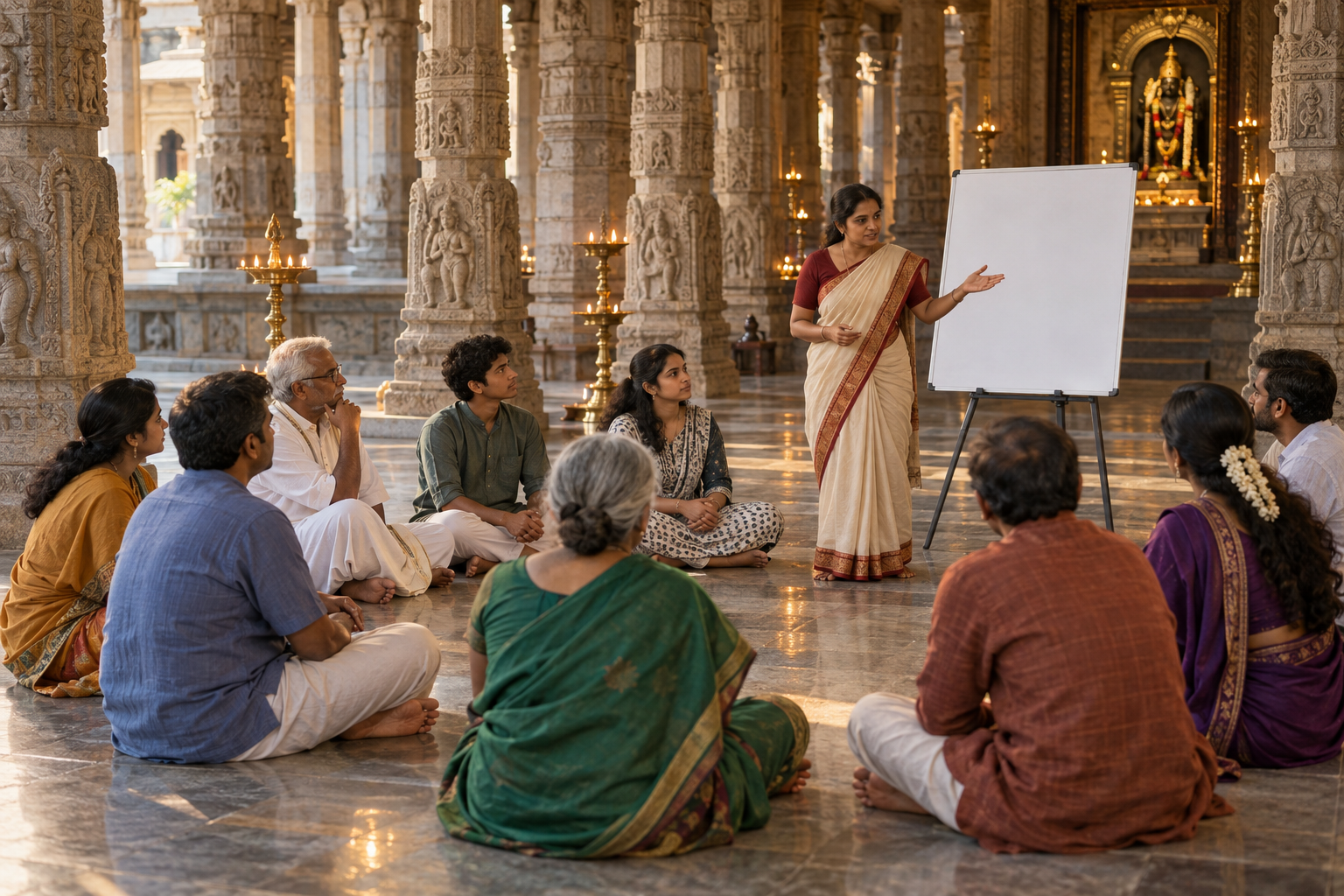
A temple is not neutral scenery. Holding a pledge there frames the commitment as morally weightier than a routine political resolution. Participants may understand it as a sankalpa: a deliberate undertaking made in sacred surroundings. The presence of temple trustees can deepen that sense of legitimacy.
That authority creates corresponding responsibilities. A temple can be a centre of community life without every devotee being bound to one political formulation. Trustees and organisers should be able to show that the event was properly authorised, that the exact pledge was available before recitation, and that participation was voluntary. A person attending for darshan should not be placed under social pressure to make a political commitment that has not been explained.
Before hosting or joining such an event, check four practical matters:
- Obtain the complete pledge in writing and read every sentence before agreeing to it.
- Confirm that the temple’s authorised decision-makers approved the event under the rules that govern the institution.
- Make a visible distinction between ordinary worship and optional campaign participation, so silence or non-participation cannot be misrepresented as endorsement.
- Ensure that speeches, signs, and recordings remain peaceful and do not threaten, humiliate, or dehumanise another community.
Rules governing religious trusts and campaign activity can vary. A trustee contemplating a formal political programme on temple premises should obtain qualified local legal advice rather than relying on assumptions circulated within a volunteer group. The practical downside of ignoring governance requirements is not abstract: a dispute can damage the institution, divide devotees, and displace the religious work for which the temple exists.
The same discipline applies to communications. Do not publish a participant’s name, image, contact information, or supposed endorsement without clear permission. A sacred setting should make consent more careful, not less important.
Use a five-step test before you endorse, host, or share it

You do not have to choose between reflexive approval and reflexive hostility. Use the following test before signing the pledge, offering a venue, contributing money, or forwarding campaign material.
- Read the original words. Do not pledge allegiance to a paraphrase, a poster, or another person’s enthusiastic explanation. If the exact text is unavailable, wait.
- Restate the commitment plainly. Try to explain in two or three sentences what the pledge asks you to support. If you cannot do so without returning to the slogan, the commitment is not yet clear enough.
- Identify the permitted means. Support should be explicitly tied to peaceful, democratic, constitutional, and non-coercive action. Ambiguity about methods is a warning, not a minor drafting problem.
- Apply the reversal test. Ask whether you would accept the same concentration of authority, restrictions, or institutional shortcuts if they were controlled by an ideological opponent. A just rule should not depend on permanent possession of power by people you trust.
- Look for accountable work after the ceremony. Ask who will publish the programme, answer objections, disclose how resources are used, and report concrete progress. A pledge without a structure for accountability can generate excitement while leaving the hard questions untouched.
Clear definitions, peaceful methods, transparent governance, equal civic protection, and a willingness to answer good-faith criticism are encouraging signs. Pressure to recite an undisclosed text, unverifiable claims about the campaign’s reach, contempt for dissenters, or claims that criticism itself is anti-Hindu are reasons to stop and ask harder questions.
Supporters should be especially demanding here. A movement that speaks in the name of Hindu civilisation bears a heavier burden than an ordinary pressure group because its conduct will shape how the public understands Dharma. Satya is incompatible with inflated numbers. Ahimsa is incompatible with intimidation. Seva is incompatible with treating people merely as instruments for displaying organisational strength.
Key takeaways
- HJS’s documented action was a temple-centred pledge campaign across districts in Maharashtra as the organisation entered its 25th year.
- The campaign demonstrates organised commitment, but it does not by itself establish public consensus or provide a complete programme for a Hindu Rashtra.
- You should distinguish civilizational recognition, policy informed by Dharma, and formal constitutional change; endorsing one does not automatically endorse all three.
- Temple participation should be properly authorised, clearly optional, and conducted without coercion or hostility toward dissenters or other communities.
- Before signing, hosting, funding, or sharing the campaign, obtain the exact pledge and ask for a peaceful, lawful, and accountable path from aspiration to action.
If the campaign approaches your temple or organisation, begin by requesting the exact pledge and a concise public charter explaining the intended civic order. If you support the aspiration, make your support conditional on ethical conduct, constitutional clarity, equal protection, and measurable work. If you oppose it, respond to the defined proposal rather than a caricature. The next useful step is not a louder slogan, but a programme that people can read, debate, amend, and hold its organisers to.
References

Leave a Reply
You must be logged in to post a comment.