
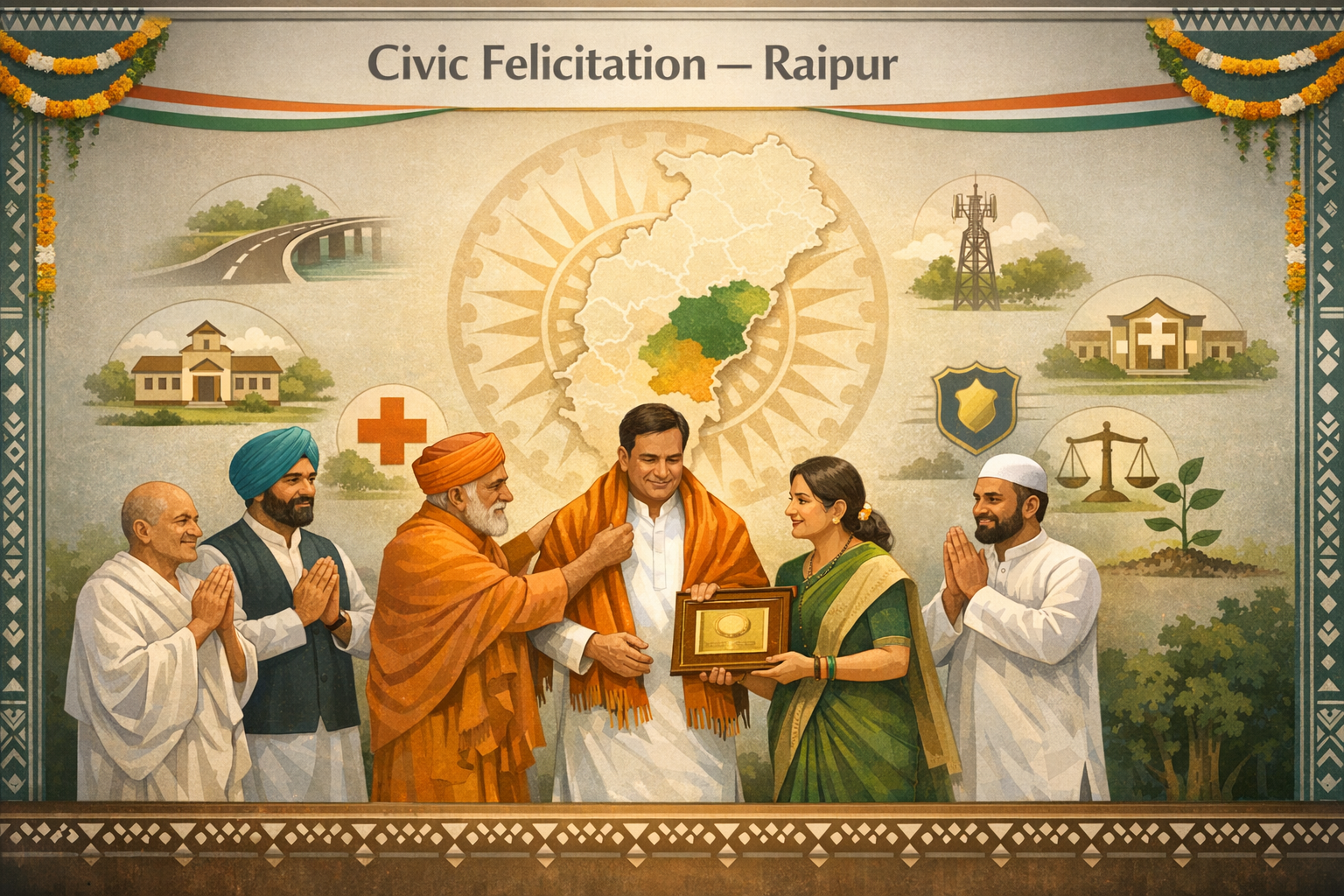
Raipur, Chhattisgarh witnessed a notable moment of civil society recognition as Hindu Janajagruti Samiti (HJS) felicitated Chief Minister Vishnu Deo Sai for what was described as firm, outcome-oriented action against Naxalism. The acknowledgement underscored a broader, community-driven aspiration for durable peace, lawful governance, and inclusive development across the state, particularly in long-affected tribal regions. It also reflected a shared dharmic ethosacross Hindu, Buddhist, Jain, and Sikh communitiesof non-violence, compassion, and social harmony as essential pillars of public life.
Naxalism, often referred to as Left-Wing Extremism (LWE), has historically concentrated in the Bastar division and adjoining districts, exploiting complex socio-economic drivers such as marginalization, resource conflicts, and governance deficits. Chhattisgarh’s geography, dense forests, and porous inter-state borders have enabled insurgent mobility, logistics, and influence over vulnerable communities. Against this backdrop, efforts to protect civilians, strengthen state presence, and address legitimate local grievances are central to any sustainable peace dividend.
The public felicitation of a sitting Chief Minister by HJS carries symbolic weight in a democracy. It affirms the primacy of constitutionalism and rule of law, while signaling that civil society monitors, evaluates, and encourages state performance on security and development. In regions where fear and disruption have been cyclical, such validation can help consolidate trust between citizens, administration, and Security Forces, provided it is matched by consistent safeguards and accountability.
Decisive action in counterinsurgency is best understood not merely as kinetic operations but as clarity of strategy, disciplined execution, and population-centric priorities. Internationally recognized frameworks“clear, hold, build” and intelligence-led, rights-respecting operationsare particularly relevant in central India’s mixed-security environment. The central objective remains constant: protect civilians, expand lawful governance, and deny insurgents the ability to coerce, intimidate, or extort.
Population-centric counterinsurgency places communities at the core. This entails proactive intelligence collection rooted in trust, predictable justice delivery, and visibly accessible administration. In practice, that approach is reinforced by all-weather road connectivity, secure communications, reliable public transport, and the routine presence of police and civil authorities in remote hamletsconditions that make everyday life safer and more dignified for families, traders, students, and health workers.
The security architecture in such contexts typically blends State Police units with Central Armed Police Forces (CAPFs) such as CRPF, BSF, ITBP, and specialized CoBRA battalions, supported by district-level formations and locally recruited cadres. Coordination, unified command structures, and joint operating procedures reduce duplication and improve response times. When allied to community liaison and independent human-rights oversight, these mechanisms enhance both effectiveness and legitimacy.
Human rights safeguards are not ancillary; they are strategic necessities. Strict adherence to Standard Operating Procedures, credible complaint redressal, and transparent inquiries into alleged misconduct protect citizens and shield Security Forces from disinformation or delegitimization campaigns. Minimizing collateral harm sustains the moral high ground, aligns with India’s constitutional values, and fosters long-term cooperation from communities that ultimately decide whether state presence is welcome.
Peace stabilizes when security converges with governance and development. In the Chhattisgarh context, this means upgrading rural roads and bridges, ensuring telecommunication towers and grid power reach interior belts, and streamlining welfare delivery using digital public infrastructure. Functional schools, staffed health sub-centers, and dependable public distribution networks tangibly demonstrate that the state is a consistent ally in daily life.
Legal empowerment through the Panchayats (Extension to Scheduled Areas) Act (PESA) and the Forest Rights Act (FRA) is crucial for Tribal Communities. Effective implementationrecognizing community forest rights, strengthening Gram Sabhas, and ensuring that resource-use decisions are locally ownedreduces the space for extremist narratives that feed on perceptions of exclusion. When local voices shape local outcomes, cycles of distrust begin to weaken.
Livelihoods complete the stability triad. Expanding Minor Forest Produce (MFP) value chains, enforcing fair prices through Minimum Support Price mechanisms, and developing micro-enterprises around bamboo, lac, and medicinal plants anchor household incomes. Complementary measuresself-help group financing, market linkages, and skilling aligned to regional demandtranslate macro-level policy into household-level security.
Public services must be visible and predictable. Eklavya and other residential schooling options, mobile health units, and last-mile nutrition programs reinforce state credibility among youth and womenthe social cohorts that most reliably transform gains into intergenerational progress. Where required, structured surrender, rehabilitation, and reintegration policies for ex-combatants can provide off-ramps from violence and reduce re-recruitment.
A dharmic lenscommon to Hindu, Buddhist, Jain, and Sikh traditionsframes peace as the fruit of satya (truth), ahimsa (non-violence), and seva (service). Hindu Janajagruti Samiti’s felicitation, interpreted through this lens, promotes social cohesion rather than partisanship. It highlights how interfaith cooperation in India’s dharmic family can stand united for public safety and dignity, and for the prosperity of Tribal Communities who have borne the highest costs of conflict.
Objective indicators enable citizens to track progress. Trends in IED incidents and ambush attempts, successful interdictions, road-opening metrics, school attendance, healthcare utilization, and voter turnout offer a composite picture of improving normalcy. Publicly communicating such data, along with independent audits, builds transparency and reduces rumor-driven anxieties.
Technology increasingly undergirds security and development. Secure communications, geospatial mapping, UAV-assisted surveillance in difficult terrain, and analytics-supported logistics reduce risk for Security Forces and civilians alike. On the civic side, Aadhaar-enabled Direct Benefit Transfers, telemedicine, and e-governance portals shorten the distance between interior villages and district headquarters.
Inter-state coordination is equally vital, given that insurgent movement often spans administrative boundaries. Joint planning and synchronized operations across Chhattisgarh, Odisha, Maharashtra, Telangana, and Jharkhand, along with shared training and interoperable communications, help close escape corridors. Such cooperation reduces operational asymmetries that insurgents have historically exploited.
Risks persist and must be anticipated. Extremist groups adapt with shifting tacticsimprovised explosive devices, targeted assassinations, extortion, and intimidation of Panchayat leaders. Continuous learning cycles, after-action reviews, and community feedback loops allow the state to evolve faster than the threat and to keep the protection of civilians front and center.
Governance reforms reinforce field success. Social audits, grievance redress portals, time-bound service delivery, and transparent procurement cut the incentives for corruption and leakages that fuel alienation. When citizens see fairness institutionalizednot episodicconfidence compounds and violence loses its social license.
In this context, HJS’s felicitation of Chief Minister Vishnu Deo Sai functions as both recognition and responsibility. Recognition, for amplifying a policy direction that prioritizes civilian security and inclusive growth; responsibility, because sustained peace requires sustained performanceby Security Forces, administrators, and civil society alike. The event in Raipur affirms a social contract in which unity within India’s dharmic traditions fortifies the collective resolve to end violence through justice, development, and dignity.
Chhattisgarh’s pathway to a stable future lies in aligning counterinsurgency professionalism with rights-based governance and livelihood expansion. If that alignment stays intact, families can live without fear, children can study without interruption, and markets can function without coercion. The felicitation thus marks not an end state but a milestone on a longer journey: a shared, society-wide commitment to peace that protects every community and honors the constitutional promise of India.
Inspired by this post on Hindu Jagruti Samiti.
