
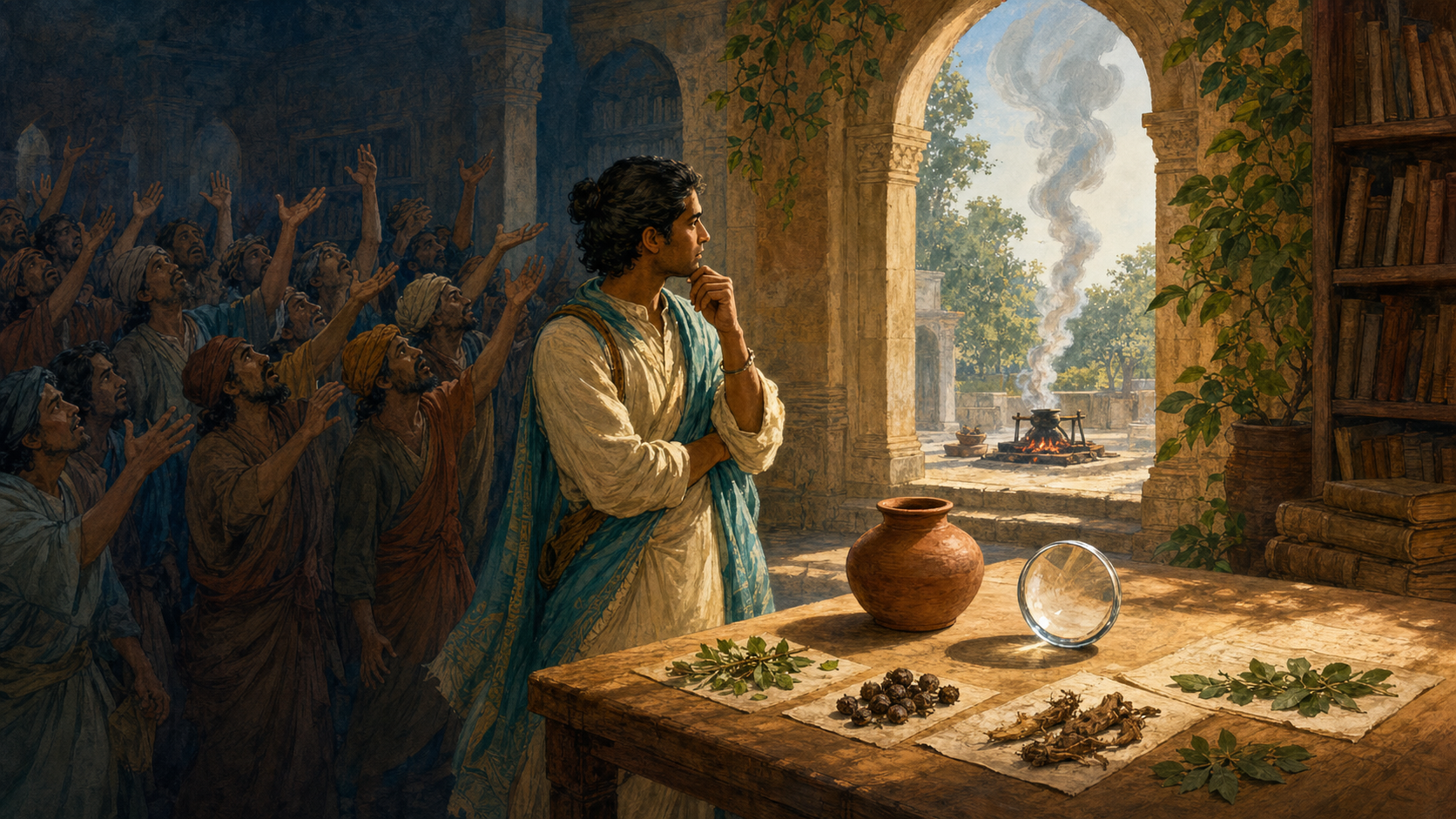
You see a striking claim about scripture, history, politics, or a spiritual teacher. It comes with a confident voice, a vivid image, and thousands of repetitions. None of those features tells you whether it is true.
Nyaya gives you a disciplined way to slow the claim down. You identify how it could be known, separate observation from interpretation, test the connection between evidence and conclusion, and notice when debate has become a contest for victory. The result is not permanent suspicion. It is proportioned confidence: belief where the grounds are sound, doubt where they are incomplete, and correction where a stronger means of knowledge intervenes.
First identify how the claim could be known

Do not begin by asking whether a claim sounds reasonable or agrees with your existing position. Begin with a narrower question: what would make this claim knowable?
Classical Nyaya recognizes four pramanas, or means of reliable knowledge: perception, inference, comparison, and testimony. They are not four interchangeable kinds of support. Each answers a different question and fails in a different way.
| Pramana | What it can establish | Question to ask | Typical failure |
|---|---|---|---|
| Pratyaksha, perception | What is present to the senses under suitable conditions | What was actually seen, heard, or otherwise perceived? | Poor conditions, a defective sense operation, or remembered content mistaken for what is present |
| Anumana, inference | What follows from an established sign and a dependable relation | Does this reason occur in the case, and is it reliably connected to the conclusion? | An unproved reason, an exception to the claimed rule, or a conclusion stronger than the evidence |
| Upamana, comparison | Recognition through an instructed similarity | Which precise similarity supports the identification? | Treating resemblance as complete identity |
| Shabda, testimony | What a competent, sincere, and well-informed speaker communicates | Is this person dependable about this exact matter? | Trust placed outside the speaker’s competence, knowledge, or truthfulness |
A complicated claim often contains several layers. Suppose you are shown an image of a temple inscription. Seeing marks on stone is perception. Accepting a reading supplied by a trained translator is testimony. Concluding that the inscription establishes a particular historical event is inference. Recognizing an unfamiliar letter because it resembles a known form may involve comparison. If you collapse all four layers into the sentence “the inscription proves it,” you hide the point at which an error could have entered.
Write the layers separately. Ask what you perceived, what another person supplied, what resemblance you used, and what you inferred. You may discover that the first two layers are secure while the final conclusion remains uncertain. That is useful discrimination, not evasiveness.
Clean the observation before reasoning from it
Nyaya treats perception as contact with a real external object, but it does not assume that every perceptual judgment is correct. Distance, lighting, or a defect in sense operation can interfere. Memory can also supply a familiar identity too quickly.
The traditional example is silver apparently seen in nacre, or mother-of-pearl. Silver-like features are present, but remembered silver is assigned to the object now before the observer. This account of error, called anyathakhyati, gives you a practical warning: the object may be real, the appearance may have a real basis, and the identification may still be wrong.
- Record the least interpretive observation you can defend: “There are pale, reflective marks,” not “This is silver.”
- Note the conditions of perception, including distance, lighting, obstruction, and the relevant condition of the sense faculty.
- Name the remembered category you applied. Familiarity can help recognition, but it can also outrun what is present.
- Change the conditions and observe again. Move closer, obtain a clearer image, or use another appropriate sense before building an argument on the first appearance.
This distinction matters far beyond optical illusion. A short recording can be perceived accurately while its date, location, speaker, and surrounding events remain unknown. Perception gives you the recording’s audible or visible content. It does not automatically give you its provenance or meaning.
Build the inference so another person can inspect it

Most weak arguments jump from an interesting detail to a desired conclusion. Nyaya makes the bridge visible through the five-membered inference, or panchavayava:
- Pratijna, thesis: There is fire on the hill.
- Hetu, reason: There is smoke on the hill.
- Drishtanta, rule with example: Wherever there is smoke, there is fire, as in a kitchen.
- Upanaya, application: The hill has smoke of that relevant kind.
- Nigamana, conclusion: Therefore, there is fire on the hill.
The form is valuable because it exposes three claims that an abbreviated argument tends to conceal. The reason must actually be present on the hill. Smoke must be dependably connected with fire. The smoke observed on the hill must be the kind covered by that connection. A dispute at any one of those points is different from a dispute about the conclusion itself.
The central issue is vyapti, the dependable pervasion between the reason and what is to be proved. Repetition alone does not establish it. You must look for agreement, difference, counterexamples, and hidden conditions.
- Anvaya, agreement: examine cases in which the sign is present together with the property to be established.
- Vyatireka, difference: examine relevant cases in which the property is absent and determine whether the sign is also absent.
- Upadhi, qualifying condition: look for an unspoken restriction that explains why an apparent universal holds in some cases but not others.
Direction matters. Smoke can function as a sign of fire, but the relation cannot simply be reversed. The assertion “wherever there is fire, there is smoke” fails because a red-hot iron ball supplies fire without smoke. One counterexample is enough to defeat that unrestricted universal. The right response is not to ignore the iron ball. It is to abandon the overbroad rule or identify a legitimate condition that narrows it.
Use the same discipline whenever you hear “X always leads to Y,” “people who do X are Y,” or “this event proves that intention.” Search for cases where X occurs without Y. Search for Y without X. Then ask whether a third condition explains the observed pairing. Until that relation is secure, you have a pattern worth investigating, not a conclusion you are entitled to announce.
Tarka, hypothetical reasoning, can pressure-test the proposed relation. Assume the claim or its denial for the sake of examination and trace what follows. But a clever hypothetical does not replace perception, inference, comparison, or testimony. Its role is to expose trouble in an argument and direct attention back to the evidence.
Reject reasons that merely resemble evidence

A reason can be grammatically attached to a conclusion and still do no logical work. Nyaya classifies five major hetvabhasas, or apparent reasons. Learning them is more useful than memorizing a collection of rhetorical tricks because each one tells you exactly what must be repaired.
- Asiddha, the unproved reason: the supposed evidence has not been established in the case. “The initiative failed because participation collapsed” proves nothing if the claimed collapse has not itself been shown.
- Savyabhichara, the irregular reason: the reason occurs both where the conclusion is true and where it is false. Eloquence, for example, cannot by itself establish a speaker’s truthfulness because eloquence is compatible with both truth and error.
- Viruddha, the contradictory reason: the offered reason supports the opposite of the intended conclusion. Check the actual direction of the relation instead of being impressed by the presence of a technical-sounding premise.
- Satpratipaksha, the counterbalanced reason: an opposing conclusion is supported by an equally forceful reason. The honest result is not whichever position was stated first; the conflict must be resolved by examining the grounds more closely.
- Badhita, the overridden reason: a stronger pramana contradicts the inference. An elaborate argument that no lamp is present cannot survive clear perception of the lamp in the room.
Run these checks in order. First establish the reason. Then test whether it is constant, whether it points in the claimed direction, whether an equally strong counter-reason exists, and whether stronger knowledge defeats it. This prevents you from spending time polishing a conclusion whose basic support has already failed.
Badhita needs particular care. A stronger means of knowledge is not the same thing as a louder person, a popular consensus, or a claim that suits your loyalties. Nor should one hurried perception automatically defeat a carefully established inference when the perceptual conditions are defective. You must compare the actual epistemic force of the two cognitions.
The fallacy check also protects you from a common debating error: proving that one argument is bad does not prove that its conclusion is false. If a reason is asiddha or irregular, you have defeated that reason. A different sound reason might still support the conclusion. Move from “this argument fails” to “the opposite is true” only when you possess independent grounds for the opposite.
Make trust, analogy, and debate answerable to truth
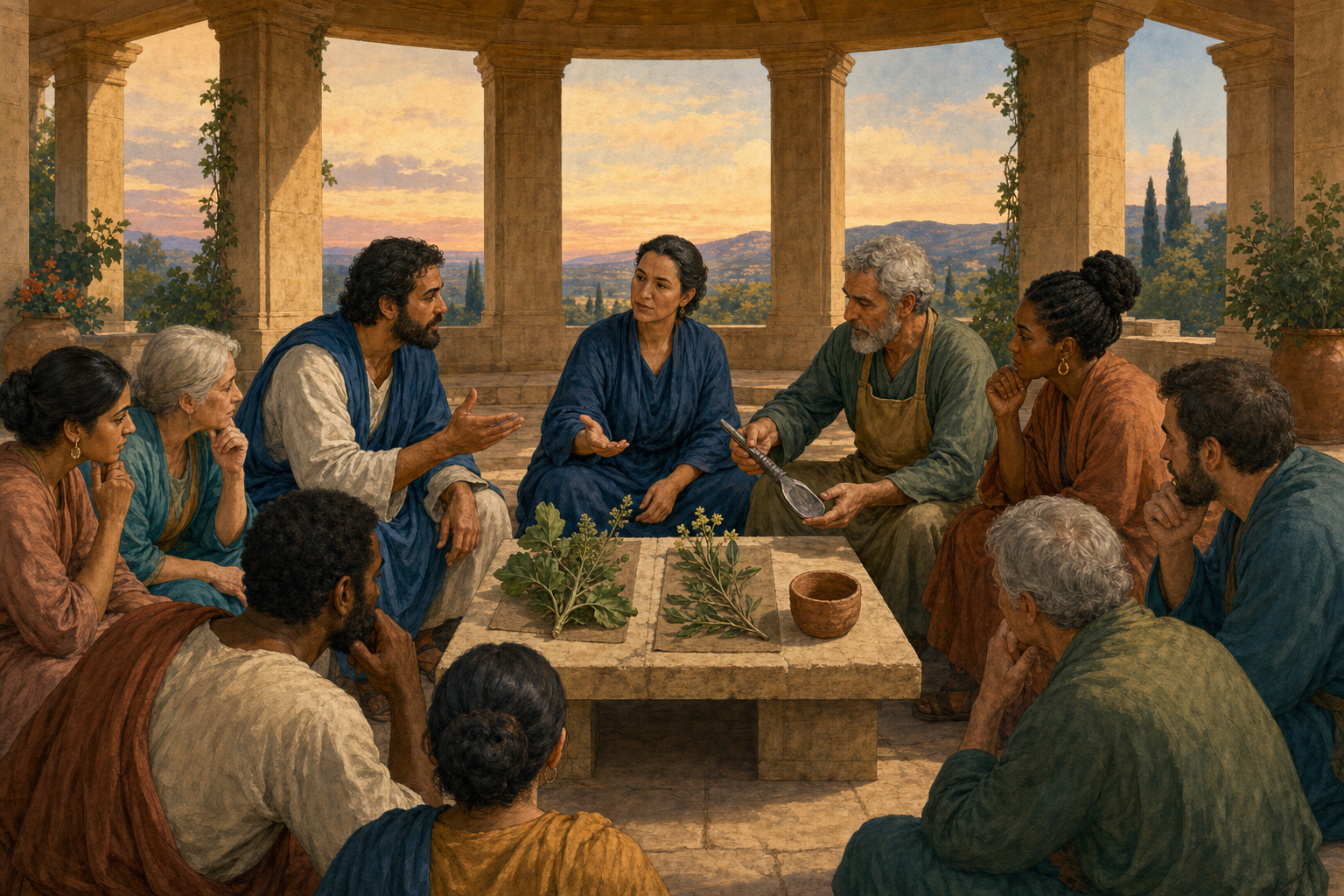
Test testimony within the speaker’s actual competence
Much of what you know cannot be reconstructed from personal perception. Language, geography, historical transmission, ritual procedure, and specialized disciplines all depend heavily on other people. Nyaya therefore treats shabda as an autonomous means of knowledge rather than as a disguised personal inference.
That does not turn testimony into blind obedience. Reliable testimony requires a speaker who is competent, sincere, and informed. Test all three conditions against the exact claim:
- Competence: Does the person possess the relevant ability or knowledge? Expertise in ritual performance does not automatically confer expertise in dating a manuscript.
- Information: Is the person in a position to know this fact, or merely repeating something that also requires verification?
- Sincerity: Is the person trying to communicate what they hold to be true, or selectively speaking to secure status, allegiance, or victory?
- Scope: Does the wording stay within what the speaker can support, or does a limited observation become a universal claim?
- Compatibility: Is the testimony defeated by clear perception or another stronger cognition, after defects in that cognition have also been considered?
Authority is claim-specific. You do not have to choose between trusting a person in everything and distrusting that person in everything. Accept what falls within demonstrated competence and sound transmission; reserve judgment outside it.
Use analogy for recognition, not unlimited transfer
The traditional example of upamana concerns the gavaya. A person is told that this unfamiliar forest animal resembles a cow. On encountering the animal and recognizing the instructed similarity, the person gains knowledge of what the word identifies.
The limit is as important as the success. Comparison establishes recognition through a relevant likeness; it does not make two things identical in every respect. When someone argues that a mind is “like a computer,” a state is “like a family,” or one historical event is “the same as” another, ask which feature is being compared. If the conclusion transfers properties unrelated to that feature, the analogy has exceeded its warrant.
Choose vada before entering the discussion
Nyaya distinguishes three very different modes of disputation. Vada is truth-oriented discussion. Jalpa is wrangling aimed at victory. Vitanda attacks another person’s position without accepting the burden of defending a position of its own.
You can usually identify the mode by asking four questions before the exchange grows:
- What is the precise thesis?
- Which pramana is offered for it?
- What counterexample or stronger cognition would require revision?
- What position is each participant prepared to defend?
A person engaged in vada can answer those questions and permit the same scrutiny of both sides. Jalpa changes definitions, accumulates debating points, and treats concession as humiliation. Vitanda demands proof from everyone else while remaining immune from comparable examination. If the exchange has become jalpa or vitanda, change your goal. Preserve the argument clearly for readers who still want to inquire; do not mistake continued combat for progress toward knowledge.
This debate ethic belongs to a larger Dharmic intellectual inheritance. Nyaya is an Astika school, yet its methods became a shared language of argument across Hindu, Buddhist, Jain, and later Sikh settings. Disputes with Buddhist thinkers such as Dignaga and Dharmakirti sharpened questions about perception and inference. Jain anekantavada and syadvada brought attention to many-sided reality and conditioned predication, while Nyaya insisted that perspectival sensitivity still requires accountable reasons. The lesson for you is not that every Dharmic school reached the same conclusion. It is that serious disagreement can refine knowledge when each side states its means, conditions, and limits.
Nyaya also places reasoning inside a spiritual purpose. Its objects of inquiry include the self, body, senses, mind, action, defects, suffering, and liberation. Raga, dvesha, and moha – attachment, aversion, and confusion – do not disappear merely because an argument has a formal structure. Before defending a cherished conclusion, ask whether you would accept the same standard of proof from an opponent. If not, the immediate defect may be in the inquirer rather than in the syllogism.
Key takeaways: a Nyaya check before you act
- State the thesis in one sentence. If its meaning changes during discussion, stop and define it again.
- Name the pramana. Decide whether the claim rests on perception, inference, comparison, testimony, or several layers that must be tested separately.
- Strip perception back to what was actually present. Check conditions and identify the remembered category added to the observation.
- Make inference public. State the thesis, reason, dependable relation with an example, application to the case, and conclusion.
- Test vyapti in both directions of inquiry. Look for confirming cases, relevant absences, counterexamples, and an omitted qualifying condition.
- Check the five apparent reasons: unproved, irregular, contradictory, counterbalanced, and overridden.
- Keep analogy tied to the exact similarity that permits recognition. Do not transfer unrelated properties.
- Judge testimony claim by claim. Competence, adequate information, sincerity, and proper scope all matter.
- Ask whether the exchange is vada, jalpa, or vitanda. Only the first is organized around discovering truth.
- When the grounds remain incomplete, retain doubt. Samshaya is a legitimate stage of inquiry; manufactured certainty is not.
Take one claim now in front of you and write its thesis, pramana, and strongest possible defeater. If you cannot yet name the means of knowledge or the relation connecting evidence to conclusion, mark the claim unresolved and do not forward it as fact. That single pause turns Nyaya from a chapter in intellectual history into a living discipline of discernment.