
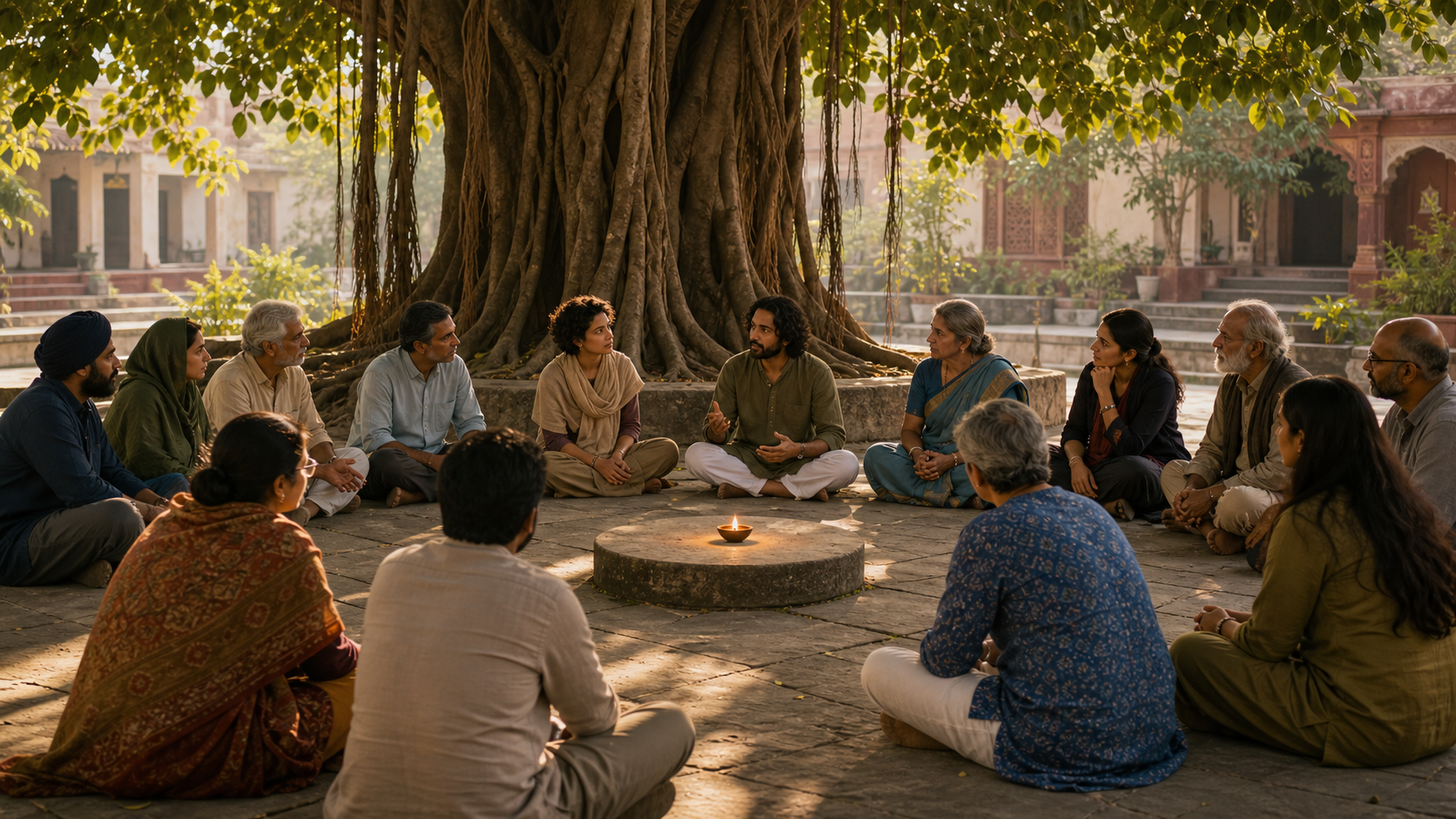
You may be defending a Hindu institution, deciding how to vote, moderating a community forum, or responding to hostility toward your tradition. The hard question is not whether to stand for Dharma. It is how to stand firmly without borrowing the contempt, exclusion, or dishonesty you oppose.
Dharmic inclusion gives you a practical answer. Protect every person’s dignity, judge conduct truthfully, reduce avoidable harm, and keep the common good in view. This approach does not require doctrinal sameness, political passivity, or silence about Adharma. It requires disciplined power.
Inclusion is a rule of conduct, not a demand for sameness

Public arguments often collapse four separate questions into one: Does this person possess dignity? Do they belong here? Are they right? Should they hold authority? Dharmic inclusion becomes clearer when you separate them.
- Dignity is not a prize for agreeing with you. Even an opponent must not be dehumanized, threatened, or blamed for acts they did not commit.
- Belonging grows through sincere participation, reciprocal responsibility, and respect for the community’s legitimate norms.
- Agreement must be tested through evidence, reasoning, and consequences. Inclusion does not make every claim equally sound.
- Authority carries duties. A leader who invokes identity, status, or spirituality to escape accountability has confused privilege with Dharma.
This distinction lets a Dharmic community remain hospitable without becoming shapeless. A temple can preserve its form of worship. A Sikh institution can remain distinctly Sikh. A Jain organization can apply its own discipline, and a Buddhist community can teach its particular path. Respecting another person does not require pretending that all doctrines, practices, or institutional purposes are interchangeable.
It also means that restrictions should follow relevant conduct rather than inherited identity. If someone repeatedly disrupts worship, threatens participants, misuses funds, or refuses a clearly stated rule, a community may set boundaries. Apply the same rule to insiders and outsiders, explain the evidence, and leave a path for correction where correction is possible. That is firmer and fairer than either indiscriminate exclusion or permissiveness disguised as compassion.
Older Hindu patterns of belonging offer a useful principle, though not a ready-made modern policy. In the absence of a single centralized conversion system, affiliation could deepen through practice, ethical commitment, kinship, festivals, temples, and shared responsibilities. Traditions also knew more explicit forms of reintegration, including Vratya-stoma and later discussions of Mlecchita-suddhih. The durable lesson is that belonging can grow through consent, conduct, learning, and mutual recognition. This should not be romanticized into a claim that every community in every period was equally open.
For your institution, the practical question is simple: Which requirements protect the sacred purpose of this community, and which merely preserve an inherited social barrier? Keep the first. Reconsider the second. If a rule cannot be connected to conduct, competence, safety, ritual purpose, or a real duty, its moral justification deserves scrutiny.
Compassion must change the way a decision is made

Compassion is often reduced to kind language after the important choices have already been made. Public ethics demands more. Karuna must affect who is heard, what harms are counted, which remedy is chosen, and whether the powerful bear any responsibility for failure.
Use compassion at three stages of a decision:
<!– wp:list {