

If you are trying to decide whether the CJP agitation was an examination protest, a partisan campaign, or a foreign-influenced operation, the most defensible answer is narrower than the loudest claims. The publicly described incidents justify scrutiny of political exploitation and attempted influence. They do not, by themselves, prove that outsiders created, funded, or controlled the movement.
You do not have to choose between dismissing every concern as a conspiracy theory and treating every suspicious coincidence as proof. Separate the alleged paper leak from the protest, the protest from its endorsements, and those endorsements from actual command. That method protects both Bharat’s security interests and the credibility of anyone raising them.
Key takeaways
- The central examination claim remains under-specified: Which examination was compromised, what paper was leaked, and what official or forensic record confirms it?
- A July 17 US Embassy demonstration alert ahead of a July 20 march shows advance awareness of a protest. It does not reveal how that information was obtained or prove covert coordination.
- A July 22 statement attributed to Gurpatwant Singh and Sikh for Justice is evidence of a separatist actor trying to attach itself to the agitation. An announced offer is not evidence that CJP accepted or received money.
- Comparisons with unrest in Bangladesh or Ladakh may generate questions worth investigating, but analogy cannot substitute for documents, authenticated communications, transactions, or testimony about CJP itself.
Separate the alleged leak from the political movement
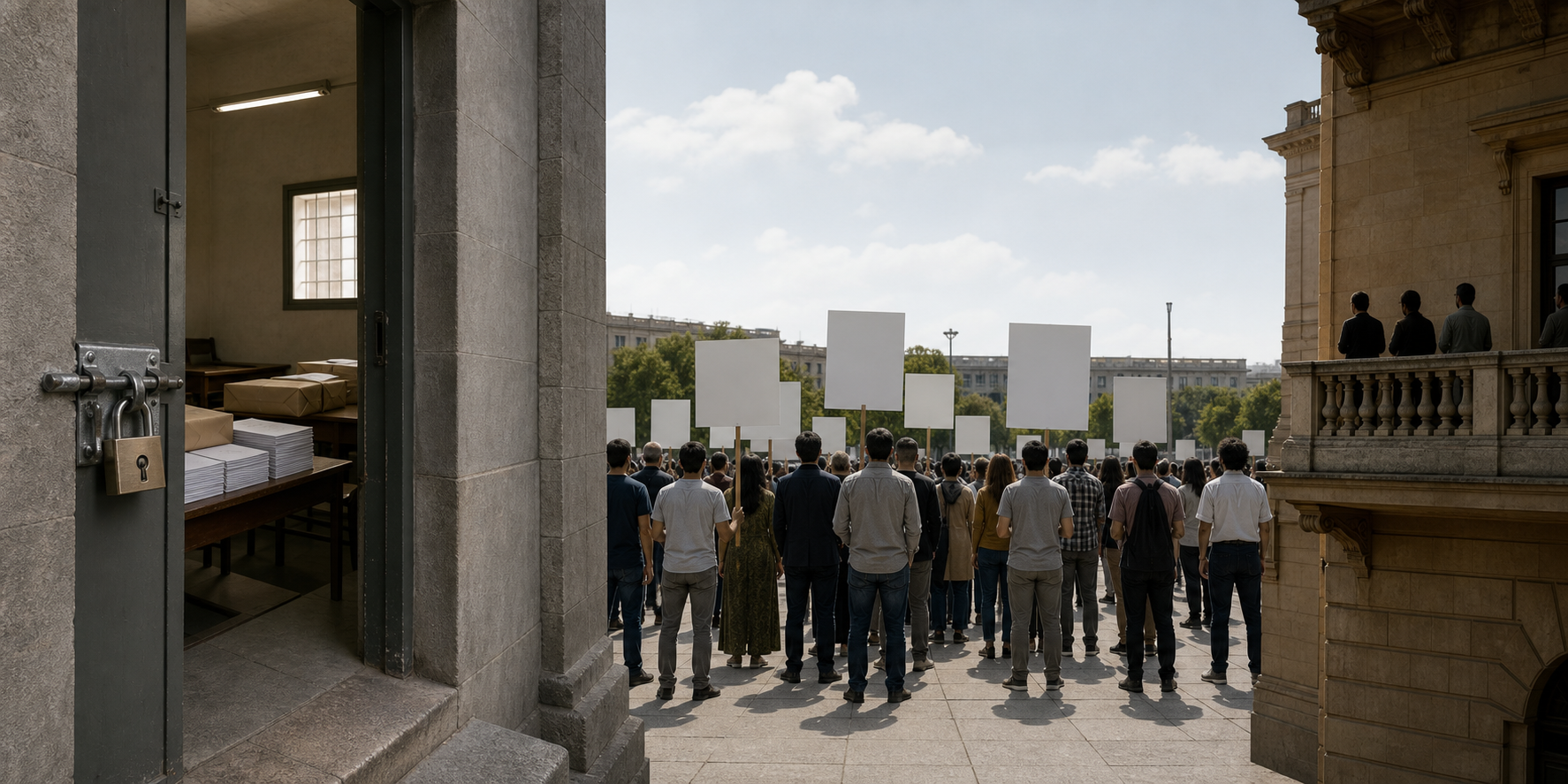
The political story has raced ahead of the examination facts. Before deciding who exploited the controversy, ask the first-order questions: Which examination was involved? Which paper or answer set was compromised? When did the breach occur? Did an examination authority acknowledge it? Is there an FIR, court filing, arrest record, technical audit, or documented chain of custody?
Those particulars are absent from the allegations under discussion. That absence does not prove that no leak occurred. It means you cannot responsibly move from an unspecified leak allegation to a conclusion about who engineered it. A genuine breach, a false rumour, an administrative irregularity, and a political campaign built around student anxiety would require different explanations and different remedies.
Run two inquiries in parallel. The first should examine the integrity of the examination: access controls, printing and distribution, digital logs, the first appearance of the allegedly leaked material, and whether it matched the actual paper. The second should examine the mobilisation: who announced the protest, who paid for logistics, who set its demands, and whether outside instructions changed those demands. Do not use uncertainty in one inquiry to fill gaps in the other.
This distinction matters to students. Candidates can suffer from a real administrative failure without knowing who later amplifies their grievance. Conversely, sincere participants do not make every claim promoted in their name true. Judge the examination allegation by examination evidence and the influence allegation by evidence of influence.
Test the three political-influence claims separately

The US Embassy alert establishes anticipation, not control
The US Embassy reportedly issued a demonstration alert on July 17 warning of expected crowds around Jantar Mantar and Parliament House on July 20. It also reportedly warned about a separate July 21 gathering at Kisan Ghat involving an alliance of approximately 250 farmer organisations and a planned motorcycle movement into New Delhi. The alert therefore concerned a wider protest environment, not only CJP.
An embassy security alert is a risk forecast for its citizens. Its existence establishes that the embassy anticipated disruption. It does not identify the inputs behind that forecast. Public organiser messages, media reporting, police information, diplomatic security monitoring, non-public tips, and covert coordination are all logically different possibilities. The alert alone cannot tell you which one applies.
To turn suspicion into a serious foreknowledge claim, obtain the archived alert, its exact timestamp, any earlier public protest notices, police traffic or security advisories, organiser posts, and comparable embassy alerts for other large demonstrations. If the supposedly secret details were already public, the inference of privileged knowledge weakens. If the embassy possessed specific non-public operational information, investigators would still need evidence showing where it came from.
The SFJ statement shows attempted appropriation, not proven funding
A social-media statement dated July 22 was attributed to Gurpatwant Singh of the US-based Khalistan separatist organisation Sikh for Justice. It allegedly announced an allocation of $1 million for CJP, called for removing the BJP from power, urged CJP not to negotiate with the Modi government, and pressed the agitation to continue through August 15 while rejecting the observance of Independence Day.
If authenticated, those demands are politically significant. They indicate an attempt by a separatist actor to redirect a student-facing grievance toward a broader anti-government and anti-India programme. That is a legitimate national-security concern. It still leaves three unanswered questions: Did CJP solicit the offer? Did anyone authorised to speak for CJP accept it? Did money, services, equipment, travel support, advertising, or any other benefit actually reach organisers?
An announced allocation is not a completed transfer. An endorsement is not an organisational alliance. A hostile actor may try to capture the publicity of a movement that it neither created nor controls. Proof of funding would require a transaction trail or evidence of an in-kind benefit. Proof of coordination would require authenticated communications, meetings, instructions, or conduct showing that organisers acted on the outside party’s direction.
CJP’s response also matters. A prompt rejection of SFJ’s demands would cut against a control theory. Silence might justify sharper questions, but silence alone would remain ambiguous. Acceptance, matching instructions, or financial evidence would be substantially stronger. Keep those possibilities distinct when you describe the case.
Bangladesh and Ladakh are analogies, not evidence about CJP
The political narrative compares the agitation with student-led unrest in Bangladesh and alleges that domestic grievances there were infiltrated by Islamist organisations and foreign regime-change interests. Even if every allegation about Bangladesh were independently established, events in one country would not prove an equivalent chain of command in Delhi. A historical parallel can help investigators form a hypothesis; it cannot authenticate that hypothesis.
The CJP controversy has also been linked to Sonam Wangchuk and the Ladakh agitation. A related claim says that the Ministry of Home Affairs cancelled the FCRA licence of the Student Educational and Cultural Movement of Ladakh, or SECMOL, citing financial irregularities and unauthorised activity. The cancellation order, its findings, and any appeal would be the proper records for evaluating that action. Even a valid regulatory finding against SECMOL would establish neither a transfer to CJP nor control of CJP unless a financial or operational connection were documented.
This is where guilt by association often enters. One person can participate in several causes; one organisation can face a regulatory action; and one foreign entity can endorse a protest. None of those facts automatically proves that every participant shares the same purpose. Ask for the connecting evidence rather than treating proximity as the connection.
Use an evidence ladder before repeating any conclusion

Political influence is not a single condition. A movement can be noticed, praised, opportunistically appropriated, materially supported, coordinated, or controlled. Each step requires stronger evidence than the one before it. Do not promote a claim higher than the strongest rung actually established.
- Establish the event. Preserve the examination notice, allegedly leaked material, protest announcement, embassy alert, or social-media statement in its original form.
- Authenticate the item. Confirm the account, domain, timestamp, unedited file, archive, or issuing authority. A screenshot without provenance is a lead, not proof.
- Build the chronology. Record what was public before each alert, endorsement, demand, meeting, or change in protest strategy. Timing can narrow explanations, but timing alone does not establish causation.
- Identify contact. Look for authenticated messages, calls, meetings, intermediaries, or acknowledgements linking the alleged outside actor to an authorised organiser.
- Trace value. Distinguish a promise from a transfer. Funding evidence should identify the sender, recipient, amount or in-kind benefit, date, channel, and use.
- Prove direction. The strongest influence claim requires evidence that an outsider’s instructions affected the movement’s decisions, demands, messaging, logistics, or conduct.
| Claim | What is presently described | What is still needed | Responsible wording |
|---|---|---|---|
| An examination paper was leaked | No examination identifier or primary breach record accompanies the political allegations | Official notice, matching leaked material, FIR, court record, audit, or forensic trail | Alleged paper leak |
| The US Embassy had improper foreknowledge | A July 17 alert anticipated July 20 and July 21 demonstrations | Alert archive, public-information timeline, and evidence identifying the information channel | The embassy anticipated the demonstrations |
| SFJ funded CJP | A July 22 social-media allocation was attributed to Gurpatwant Singh | Authentication, acceptance, transaction records, recipient identity, and use of funds or services | SFJ reportedly offered or announced support |
| An outside network controlled CJP | Political endorsement, hostile demands, and associations are alleged | Communications, meetings, transactions, instructions, and corresponding organiser conduct | Political influence is alleged but control is not established |
Apply the wording test before forwarding a claim. If your evidence shows an offer, write offer, not payment. If it shows advance awareness, write awareness, not conspiracy. If it shows association, write association, not control. Precise language does not weaken a national-security case. It prevents the weakest inference from discrediting the strongest evidence.
National interest requires a higher standard of truth

A Dharmic public culture should begin with satya and disciplined use of pramana: a claim should not outrun the grounds on which it is known. That standard is especially important when students, separatist politics, foreign influence, and Bharat’s security are placed in the same frame. Loose accusations may punish sincere candidates, obscure a real examination failure, and make legitimate foreign-interference concerns easier to dismiss.
You can hold four positions at once. A suspected examination breach deserves a transparent inquiry. Student participants should not inherit the guilt of every outside supporter. A separatist attempt to exploit the agitation deserves exposure and investigation. Claims of funding, coordination, or regime-change control still require direct evidence.
This also protects the pro-Bharat position from partisan inconsistency. If evidence standards change depending on which party governs or which movement is accused, the argument ceases to be about national interest. Apply the same tests to every government, NGO, foreign donor, political alliance, protest organiser, and ideological camp.
Before you share the next CJP claim, label exactly what has been established, link the closest available evidence, and state what remains unknown. Press separately for the examination record, the original embassy advisory, authentication of the SFJ statement, CJP’s response, and any financial trail. That is how suspicion becomes an answer – or is honestly retired when the proof does not arrive.
References
