
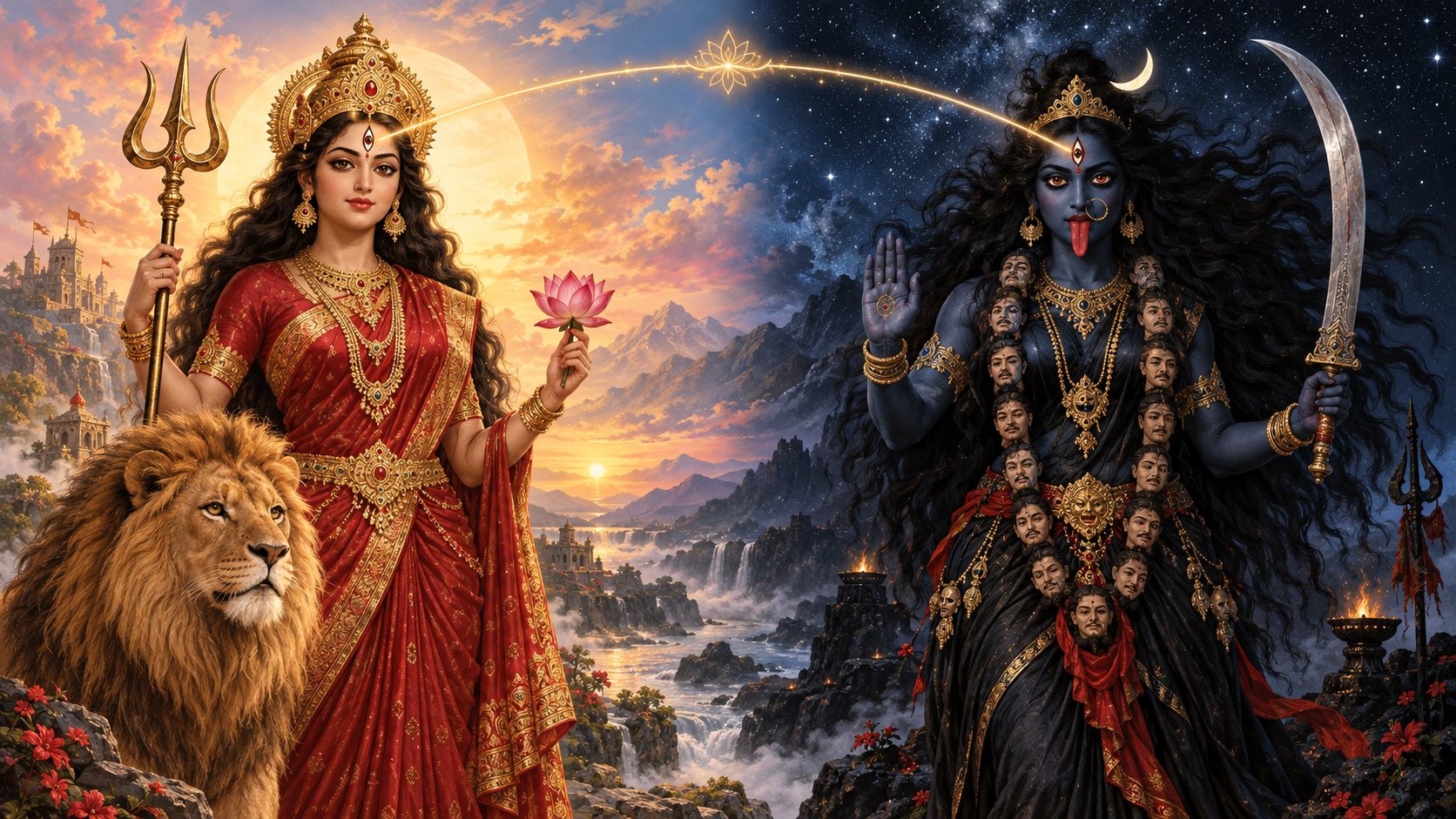
You are looking at an image of Durga or Kali, and one detail demands an explanation: why does the Devi have three eyes? The simplest answer is also the most important. Her sight is not limited to the partial viewpoint from which human beings normally judge a situation.
Tri-nayana is therefore more than an unusual feature of divine anatomy. It tells you who is looking through those eyes. Once you understand that, the third eye becomes a key to reading the Goddess’s power, fierceness and protective action.
The third eye changes the scale of seeing
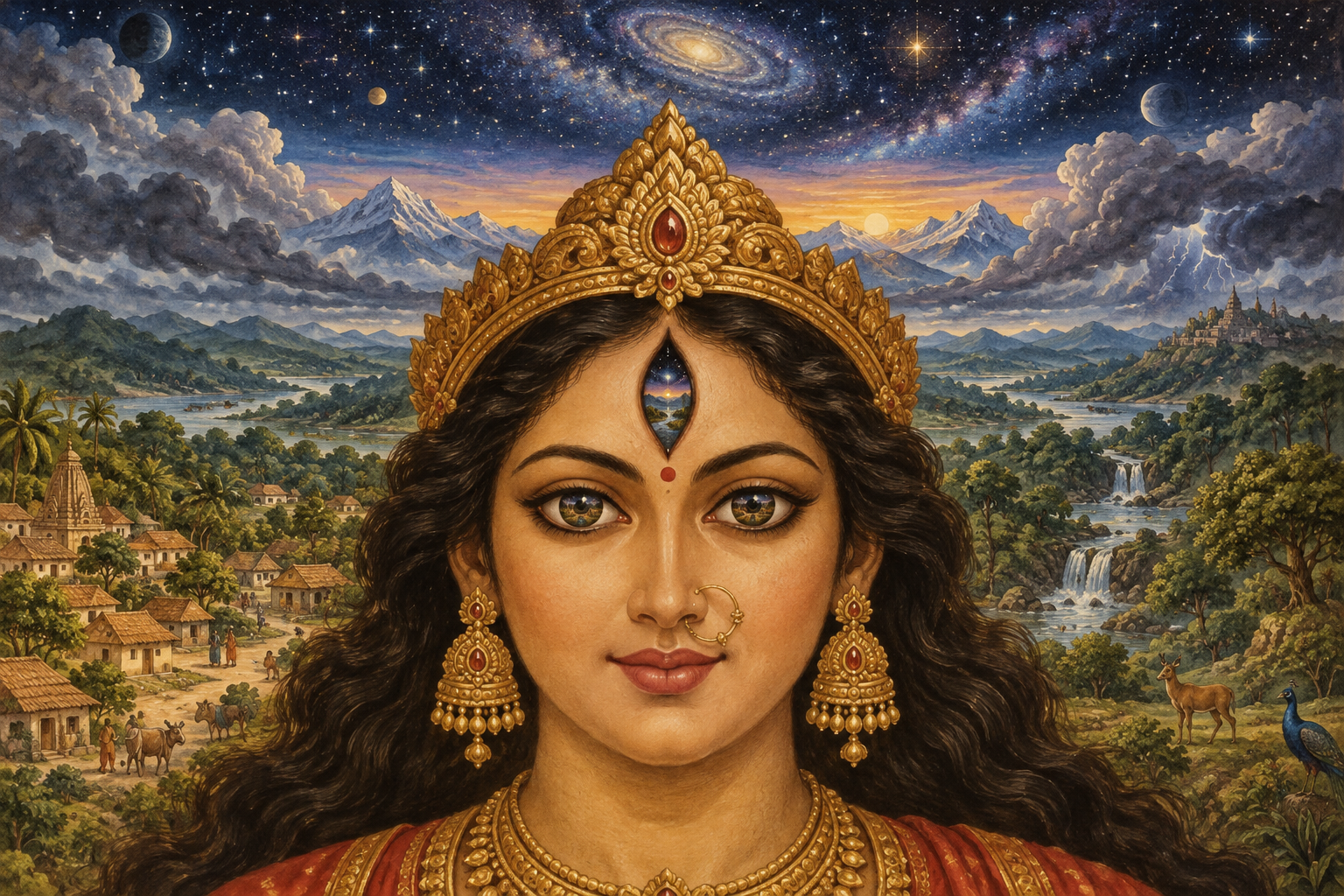
Human vision is necessarily partial. You see from one place, at one moment, through a mind affected by memory, desire, attachment and fear. Even when your eyes report something accurately, they cannot show you the whole meaning of what is happening.
The tri-nayana form points to supreme consciousness that perceives beyond ordinary human limits. The three eyes signify an awareness capable of apprehending the dimensions of existence together rather than mistaking one visible fragment for the whole.
That distinction matters. The third eye does not merely give the Goddess more information than a human observer possesses. It changes the category of the observer. Durga and Kali do not act from a narrow personal interest, a passing emotion or a single moment’s appearance. Their vision belongs to the divine level of consciousness.
When you look at the eyes together with a weapon, protective gesture or fierce expression, notice the relationship between awareness and power. The image does not present force operating blindly. It presents Shakti directed by a vision that exceeds the limits of the ordinary mind. The eyes tell you about the consciousness governing the action.
One sign connects Durga and Kali without making them identical
Durga and Kali do not offer the devotee the same visual encounter. Durga can appear martial yet composed, while Kali’s appearance can be radically fierce. Their shared third eye should not flatten those differences. It shows that the distinct forms express divine power from the same higher order of awareness.
A useful way to read Durga’s tri-nayana is to see power entering conflict without surrendering clarity. Her formidable appearance does not indicate agitation. The three eyes direct your attention to the complete awareness from which protection and resistance to adharma arise.
With Kali, the same sign prevents you from confusing a terrifying appearance with irrationality. Her fierceness does not mean that consciousness has been lost. The third eye remains the visual reminder that what unsettles ordinary perception may still proceed from a vision greater than ordinary perception.
This gives you two practical questions when approaching the images. Before Durga, ask what must be faced without losing inner command. Before Kali, ask what fear is preventing you from seeing clearly. Neither question reduces the Goddess to a psychological technique; each allows the icon to challenge the limitations you bring to it.
How to read a tri-nayana image without flattening it
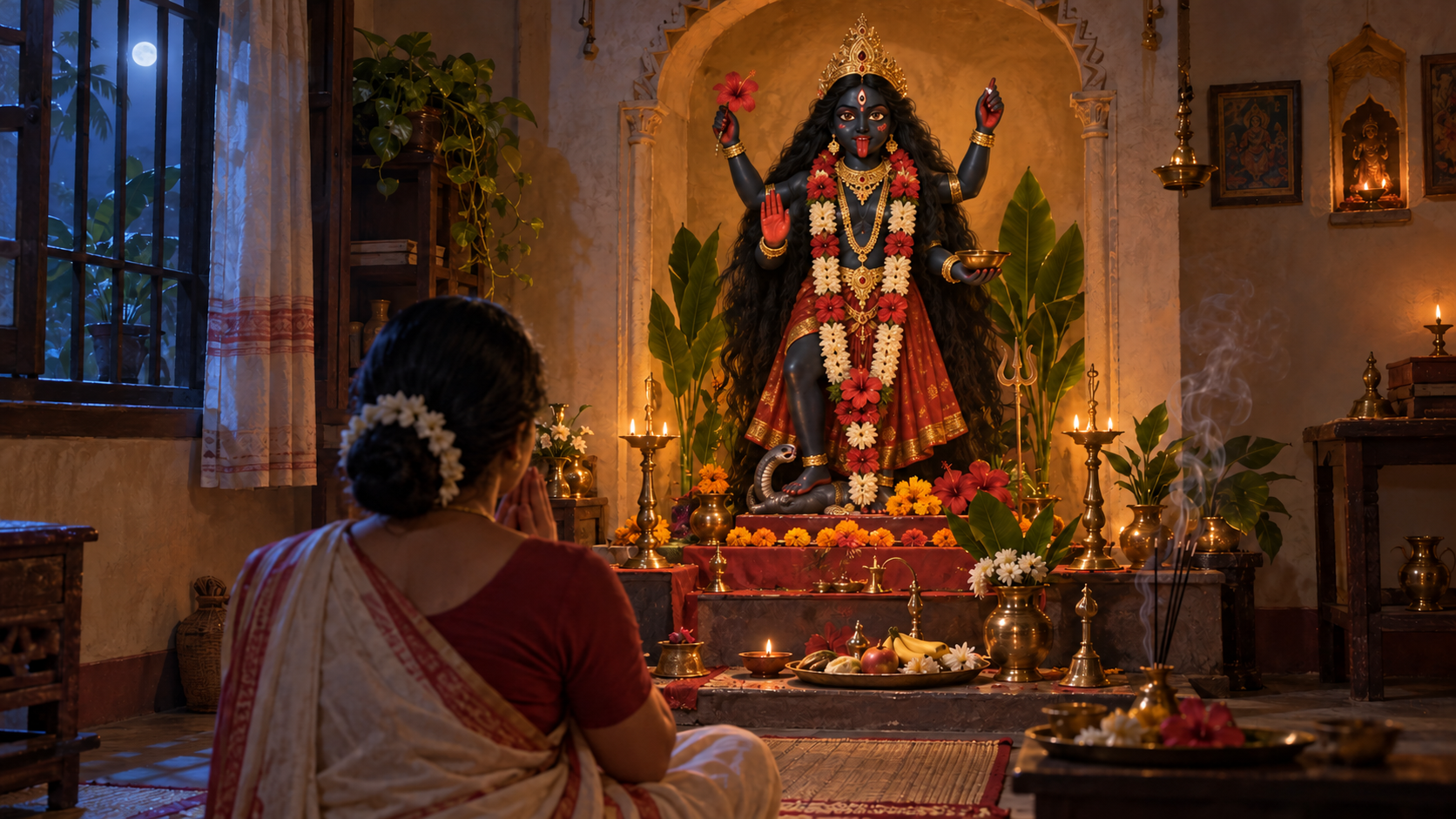
Symbols become less useful when they are reduced either to decorative curiosities or to rigid formulas. Use the following sequence when you encounter the three-eyed Devi in a murti, painting, print or digital image.
- Begin with the theological meaning. Tri-nayana identifies divine awareness that surpasses ordinary sight. Do not begin by translating the third eye into a generic slogan about instinct or intuition.
- Read the eyes with the entire form. Look at the face, posture, gestures and signs of action together. The third eye explains the quality of consciousness within the form; it is not an isolated puzzle pasted onto the forehead.
- Do not force a universal one-to-one code. It can be tempting to assign a separate object, faculty or period of time to each eye and then present that scheme as the only meaning. A more specific interpretation may belong to a particular teaching, but it should not displace the shared central idea without appropriate context.
- Let the particular tradition provide further detail. If a temple, sampradaya or teacher gives a more precise explanation of an image, hear that explanation within its own devotional setting. Hindu iconography is a living religious language, not a collection of symbols detached from practice.
- Return from interpretation to darshan. After understanding the symbol, stop treating the image merely as an object to decode. Allow the Goddess’s gaze to place your own limited way of seeing under examination.
This approach is especially useful when you are explaining the image to a child, writing about it or commissioning devotional art. Saying only that the third eye is “mystical” leaves the essential meaning unstated. Saying that it represents all-encompassing divine consciousness gives the listener a clear foundation without pretending that every tradition must explain every detail identically.
Key takeaways
- Tri-nayana means the three-eyed form of the Goddess.
- The third eye marks a mode of perception beyond the limitations of ordinary human sight.
- In Durga and Kali, it signifies supreme consciousness capable of perceiving existence in its greater wholeness.
- The shared symbol connects the two forms of Shakti without erasing their distinct appearances and devotional meanings.
- The eyes help you read divine power as conscious and directed, not blind or impulsive.
- The most useful personal response is to examine what attachment, fear or haste has excluded from your own view.
Turn the Goddess’s gaze into a dharmic pause
The next time you take darshan of three-eyed Durga or Kali, do not rush immediately to a request. Give the tri-nayana one deliberate pause. Ask yourself three questions:
- What part of this situation can I see clearly?
- What am I overlooking because of fear, desire, anger or attachment?
- What action would remain dharmic if I considered the whole situation rather than only my immediate interest?
This is a reflective use of the symbol, not a substitute for mantra, puja, scriptural study or guidance within your tradition. Its purpose is narrower: to prevent a sacred image from becoming so familiar that you cease to notice what it demands of your attention.
Let the gaze reverse direction. Instead of merely inspecting the third eye, stand for a moment as though you are being seen completely. Then choose one action that you could still defend if the whole situation, and not only your preferred part of it, were visible.
References

Leave a Reply
You must be logged in to post a comment.