

If you have paused before an image of Shiva and wondered why a thin moon rests in his hair, the useful question is not merely, “What does it represent?” It is, “What does it ask of me when my own mind is changing?”
The crescent in Shiva’s matted locks presents waxing and waning as a lesson in inner mastery. The moon changes, but Shiva is not displaced by its changes. That relationship gives you a practical way to meet desire, anger, confidence, fatigue, success, and disappointment without letting any passing state become your ruler.
The crescent makes change visible without making it supreme

A crescent is an unfinished appearance. It is neither the fullness of the moon nor its complete disappearance. It belongs to movement: the visible moon waxes, reaches fullness, wanes, and appears to withdraw before the cycle continues.
That makes the crescent especially useful as a spiritual symbol. A full circle could be read as completion. The crescent places you in the middle of a process. It reminds you that what is visible now is real, but it is not the whole cycle.
This matters when you confuse a phase with an identity. Discouragement can make you say, “My practice has failed.” Excitement can make you believe that your present certainty will never weaken. Anger can make one offence appear to define an entire relationship. In each case, a changing condition claims the authority of a permanent truth.
The crescent interrupts that mistake. It does not tell you that your present condition is imaginary. It tells you to see that condition in proportion. You can acknowledge a rising emotion without building your identity around it. You can accept a period of diminished energy without declaring your dharma impossible. You can enjoy a period of abundance without assuming that it exempts you from restraint.
When a state feels overwhelming, ask three questions:
- What is waxing in me right now: desire, irritation, ambition, fear, confidence, or attachment?
- What is waning: patience, attention, enthusiasm, certainty, or the need to control an outcome?
- What duty remains valid even while this state changes?
The first two questions help you notice the phase. The last prevents observation from becoming self-absorption. Dharma still requires an answer from you.
Shiva wears the moon; he does not erase it

The placement of the crescent carries the heart of the teaching. Chandra is present, visible, and held at Shiva’s head. In a practical reading of the image, change has not been denied. It has been given its proper place.
Inner mastery therefore should not be confused with emotional suppression. Suppression says that an unwelcome feeling must not exist. Mastery allows you to recognise the feeling while refusing to hand it command of speech and action.
- Suppression hides anger while allowing it to harden into resentment. Mastery recognises anger, examines what caused it, and chooses a response that does not multiply harm.
- Indifference avoids responsibility by pretending that nothing matters. Steadiness cares about the outcome without becoming frantic or manipulative.
- Passivity postpones a necessary decision. Stillness clears away the first surge of reaction so that the decision can be made cleanly.
- Numbness disconnects you from experience. Detachment lets you remain present without treating every mental movement as an order.
This distinction gives you a simple test. If your idea of calm prevents you from apologising, setting a boundary, completing a duty, or speaking a necessary truth, it is probably avoidance rather than mastery. Shiva’s stillness is not an excuse to leave dharmic action undone.
The image also corrects another common misreading: spiritual maturity does not require uninterrupted serenity. The moon is still waxing and waning. The lesson is not that change stops around the disciplined person. It is that change no longer occupies the throne.
Use the crescent when a passing state demands a permanent decision
The symbol becomes most useful at the point where mood is about to become conduct. That is the moment between feeling an impulse and sending the message, making the promise, abandoning the practice, or pronouncing a final judgement.
Use this sequence when you notice that moment:
- Pause the outward reaction. Do not force the inner movement to disappear. Simply decline to make it public before you have examined it.
- Name the phase. Say, “Anger is rising,” “confidence is peaking,” or “motivation is waning.” This is more accurate than turning the condition into an identity.
- Separate the event from the added story. Identify what actually happened, then identify what you are predicting, assuming, or remembering because of it.
- Recall the governing commitment. Ask which vow, responsibility, relationship, or principle should sit above the present mood.
- Choose a proportionate action. Do what the situation requires without letting the emotional intensity determine the scale of your response.
Suppose anger is waxing after an insulting message. Mastery does not require you to approve of the insult. It asks you not to let the first surge write the reply. Establish what needs to be corrected, decide whether a response serves any purpose, and use language that addresses the conduct rather than enlarging the conflict.
Suppose confidence is waxing after success. The same discipline applies. Enjoy the achievement, but do not make commitments that depend on the peak lasting. Give promises according to your actual capacity and duty, not according to the temporary feeling that every obstacle has disappeared.
Suppose enthusiasm for sadhana is waning. A changing level of inspiration does not by itself settle the value of the practice. Instead of making a dramatic declaration that the path has failed, return to the sincere observance you can actually complete. Let steadiness carry you when excitement cannot.
This is where stillness becomes a source of renewal. Stillness is not another mood that you must manufacture. It is the refusal to keep feeding a phase with immediate speech, exaggerated conclusions, and compulsive action. Once that extra movement settles, attention becomes available again. Renewal may then appear as clearer action, humbler expectations, restored practice, or an honest change of course.
Let the symbol question you during puja and ordinary life
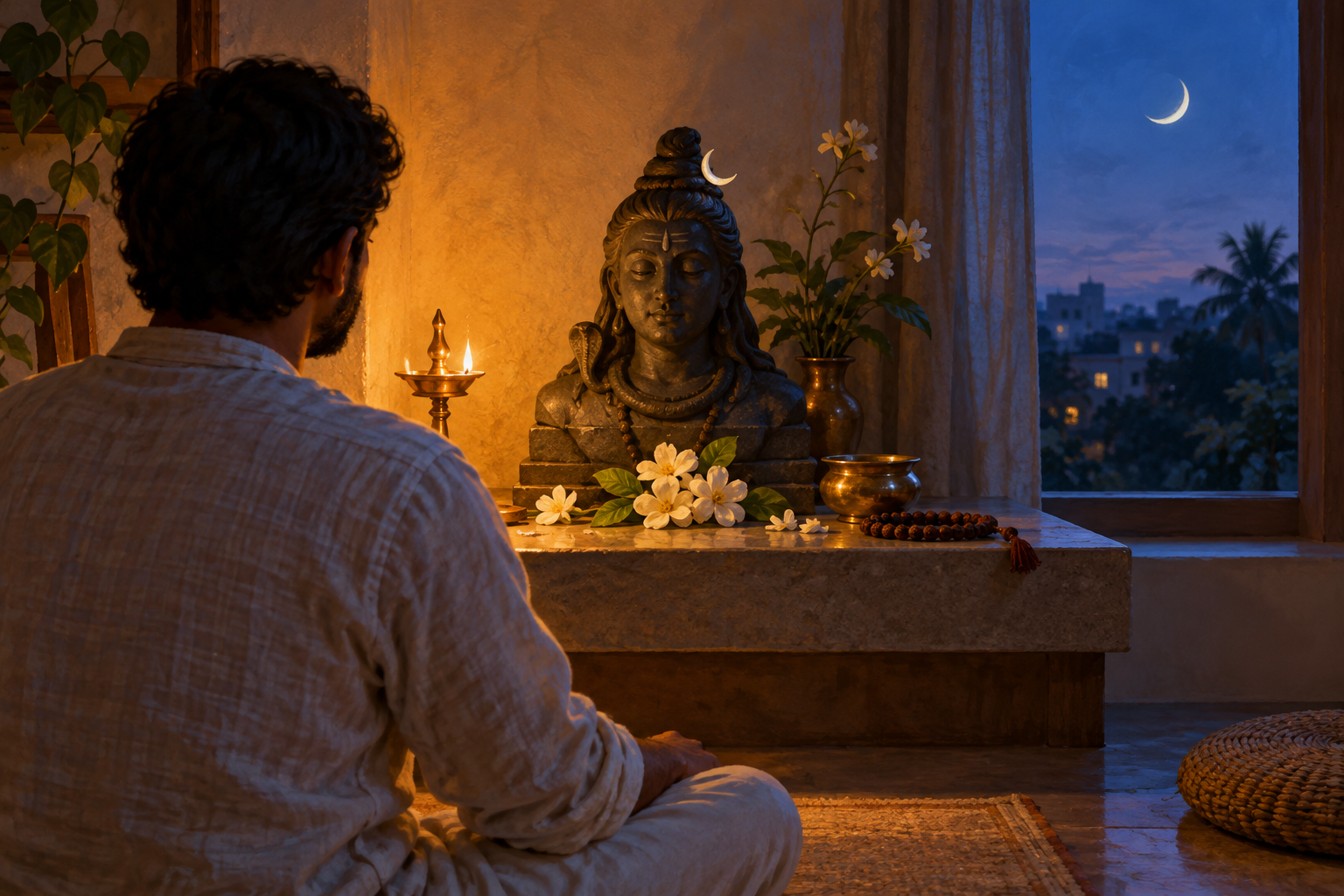
You do not need to reduce Shiva’s crescent to a slogan. Sacred imagery works more deeply when you stay with it long enough for it to expose a habit. The important movement is from seeing the crescent on Shiva to noticing the waxing and waning within yourself.
The following is a contemplative exercise, not a claim that every Shaiva tradition prescribes an identical ritual:
- Look at the crescent and notice that it is partial. Let that challenge your assumption that the present phase is the complete truth.
- Bring one changing condition to mind. Choose the one most likely to influence your conduct, not the one that is easiest to discuss abstractly.
- Imagine placing that condition where the crescent rests: acknowledged, visible, and held beneath a steadier awareness.
- Ask, “What would remain right if this feeling grew stronger, and what would remain right if it faded?”
- End the contemplation with one concrete act aligned with that answer.
That final act matters. If you recognise impatience, listen without interrupting. If pride is waxing, share credit or correct an exaggeration. If confidence is waning, complete the duty that does not depend on feeling confident. If attachment to an outcome is dominating your mind, act carefully on what is yours to do and release the demand to control everything else.
You can also use the crescent as a check on how you approach prayer. It is natural to ask for a difficult condition to change. The image invites a second request: the steadiness to remain rightly ordered while change unfolds. That request does not weaken action. It prevents action from being captured by panic, vanity, or despair.
No single interpretive formula exhausts a sacred symbol. The practical reading here is valuable because it remains faithful to what the image visibly presents: a changing moon carried by Shiva without disturbing Shiva’s centre. Do not use that insight to dismiss other theological, devotional, or traditional meanings. Use it to deepen the attention you bring to the murti.
Key takeaways
- The crescent represents a phase, so it warns you not to mistake a temporary condition for the whole truth.
- Shiva retains the moon rather than erasing it; inner mastery means ordering mental movement, not suppressing it.
- Stillness is active when it prevents a passing impulse from becoming harmful or disproportionate conduct.
- When emotion rises, name the phase, recall the duty that governs it, and choose an action proportionate to the facts.
- In contemplation, move from looking at Shiva’s crescent to identifying what is waxing or waning within you.
The next time your mind declares that a passing high or low is final, return to Shiva’s crescent. Name the phase, then name the duty. Allow the first to change while you act from the second.
References

Leave a Reply
You must be logged in to post a comment.