
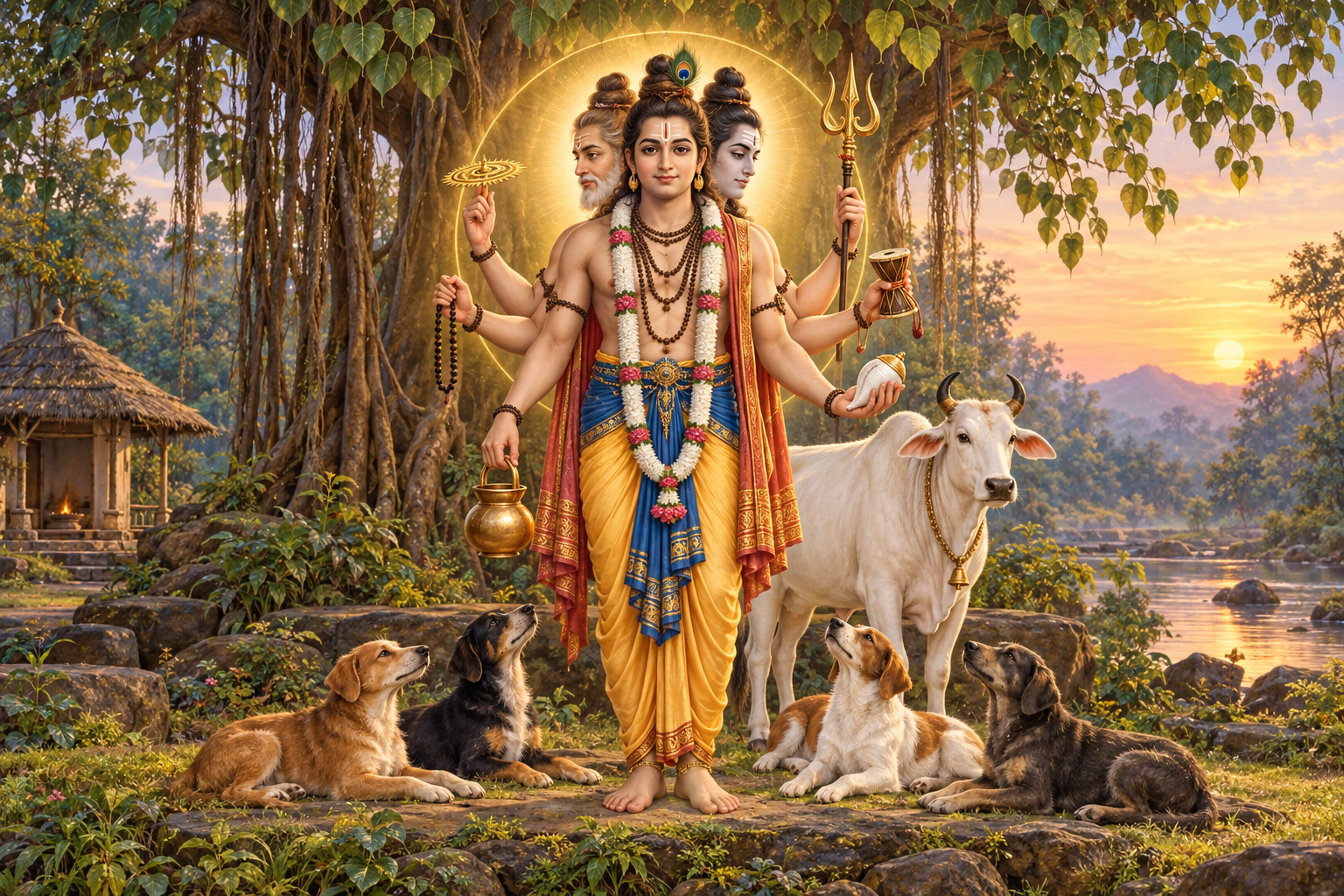
You are looking at Dattatreya’s three-faced form and wondering what, exactly, you are seeing. Is this Dattatreya, the Trimurti, or three deities combined into one image? The most reliable answer begins with a simple shift: look at the whole form before identifying its parts.
The image is not merely a convenient way to place Brahma, Vishnu and Shiva together. It presents Dattatreya as their embodied unity. Once you understand that distinction, the triune form becomes easier to recognize, explain and contemplate.
The first rule: read the whole before the three faces
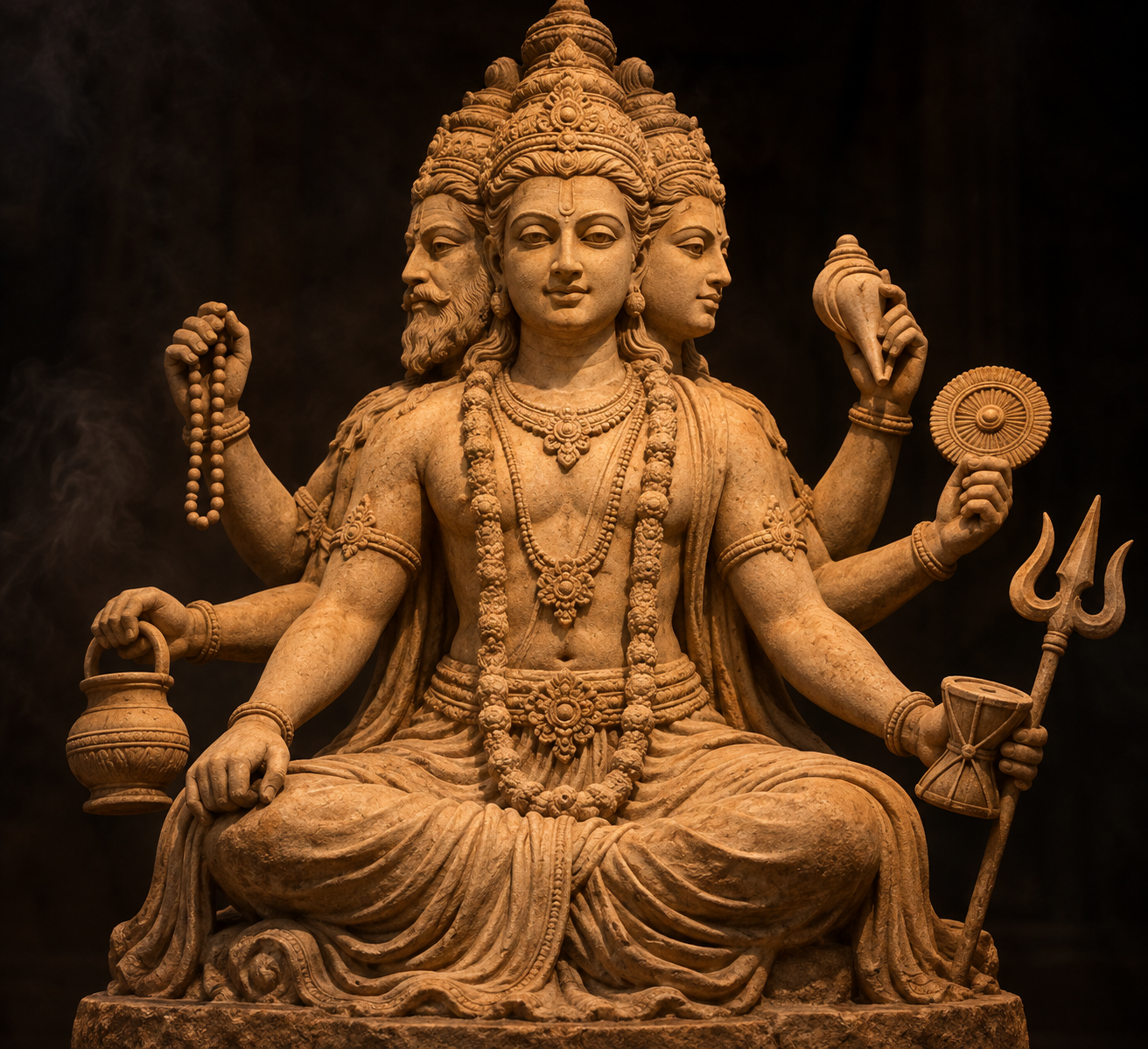
A common mistake is to treat each face as though it belonged to a separate figure. That turns a composite murti into a group portrait. Dattatreya’s iconography asks you to reverse that reading. One form comes first; the threefold manifestation comes second.
The familiar three-faced image points to Brahma, Vishnu and Shiva without breaking Dattatreya into three independent beings. Brahma represents creation, Vishnu preservation, and Shiva dissolution or transformation. These are distinguishable powers, but the murti locates them within one sacred presence.
This gives you a practical test whenever you encounter the image: if your interpretation ends with three separate gods standing beside one another, you have stopped too early. Return your attention to the single figure that contains the three. The theological weight lies in that compositional unity.
This also explains why the word “triune” is more helpful here than simply “triple.” A triple image may place three things together. A triune image expresses three real distinctions without surrendering the underlying oneness of the form.
Hari-Hara-Pitamaha gives you the key to the composition
In the image-making vocabulary associated with the Rupa-mandana, this composite form is called Hari-Hara-Pitamaha. The title functions almost like a reading key:
- Hari identifies Vishnu, the sustaining presence.
- Hara identifies Shiva, the dissolving and transforming presence.
- Pitamaha identifies Brahma, the creative progenitor.
The order of the compound should not tempt you into ranking the deities. Its purpose is identification and integration. Hari, Hara and Pitamaha are gathered into one designation because the icon gathers their powers into one embodied form.
This name is especially useful when you need to explain the murti to someone who assumes Hindu images are simply collections of unrelated attributes. You can begin with the compound itself: three divine identities are named, yet the name belongs to one composite manifestation. The grammar and the image make the same point.
The name also prevents an incomplete reading of Dattatreya as merely Vishnu-like, Shiva-like or Brahma-like. A viewer may notice one aspect first because of personal devotion or familiar visual cues. Hari-Hara-Pitamaha requires the viewer to restore the other two and then return to the unity that holds all three.
Unity does not erase the work of each divine power
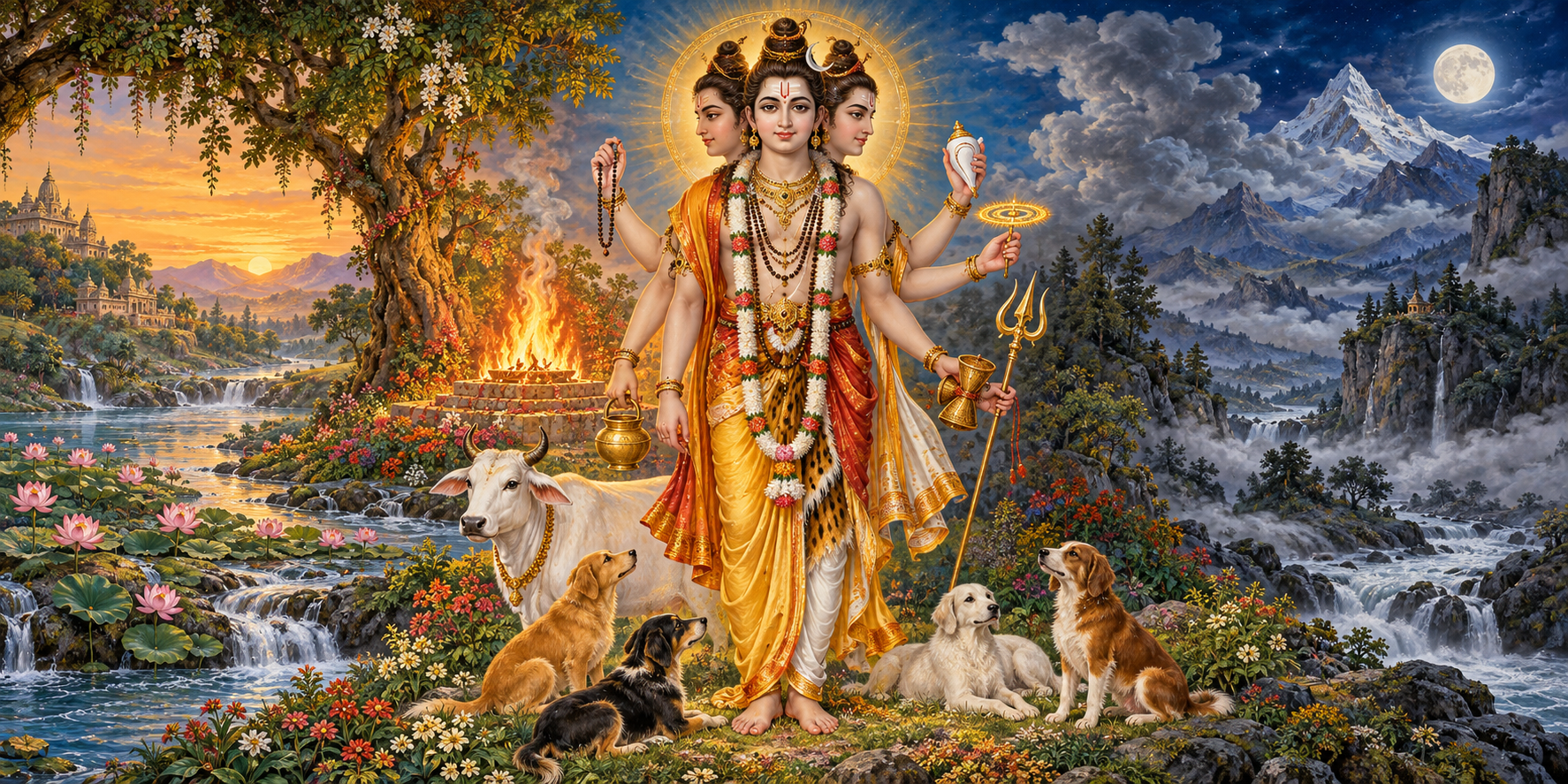
It is possible to overcorrect. After recognizing one form, you might conclude that the three faces have no meaningful distinctions. That reading also misses the icon’s precision. The composition depends on difference as much as unity: creation is not preservation, preservation is not dissolution, and dissolution is not creation.
What the murti rejects is not distinction but isolation. Creation cannot remain meaningful without continuity. Preservation cannot become permanent stasis. Dissolution is not mere negation, because the ending of one form clears the ground for another beginning. Read as a cycle, the three powers describe a complete movement of manifested existence.
This is where the image becomes more than a lesson in identifying deities. It trains you to notice a recurring error in ordinary life: welcoming beginnings, clinging to what must be maintained, and resisting every necessary ending. Dattatreya’s form places all three movements within one field of sacred order.
The icon therefore need not be used to flatten Shaiva, Vaishnava or other theological commitments into a vague statement that every form is identical. It makes a more disciplined claim: powers that can be named and approached distinctly can nevertheless be held within a deeper unity. You do not have to erase difference in order to see wholeness.
A four-step way to contemplate the murti
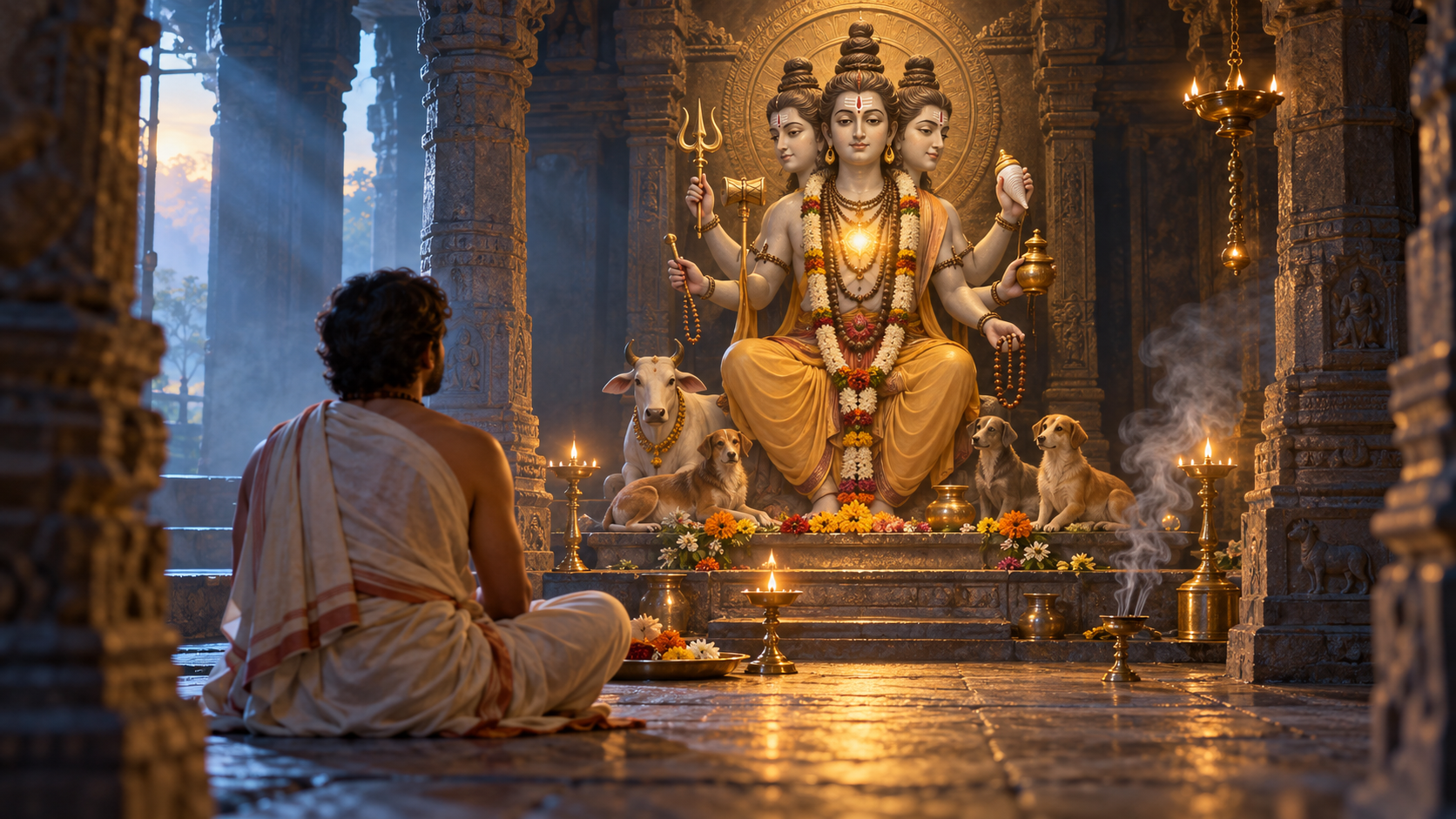
You can turn this iconographic reading into a short practice of darshan. This is a method for attentive contemplation, not a replacement for the worship procedures of a particular temple, guru or sampradaya.
- Begin with the single form. Before naming any face, take in the murti as one presence. This prevents the mind from fragmenting the image at the outset.
- Name the three functions. Recognize Brahma with creation, Vishnu with preservation, and Shiva with dissolution or transformation. Keep the functions distinct rather than blending them into a general idea of divinity.
- Apply the triad to one real situation. Ask what must be begun, what deserves steady care, and what has completed its role and should be released. Do not force all three answers to be dramatic; the value lies in seeing the full cycle.
- Return to the whole. End where you began. See the three powers held within Dattatreya rather than leaving them as separate mental categories.
The fourth step matters most. Without it, the practice becomes a checklist about three divine functions. Returning to the one form preserves the central insight of the icon: diversity of action can arise within unity of being.
If you are viewing the murti in a temple, let local practice set the ritual frame. Use this reading to deepen attention, not to correct a living tradition on the basis of a generalized diagram. Iconographic meaning and sampradaya-specific worship can illuminate one another without being treated as interchangeable.
Key takeaways
- Dattatreya’s triune image should be read from unity to distinction and then back to unity.
- The three faces point to Brahma, Vishnu and Shiva within one embodied form, not to three unrelated figures.
- Hari-Hara-Pitamaha names the same integration through Hari, Hara and Pitamaha.
- Creation, preservation and dissolution remain distinct powers; unity does not make them interchangeable.
- For contemplation, identify what must begin, what must be sustained and what must be released, then return your attention to the wholeness that contains all three.
The next time you stand before Dattatreya, resist the urge to decode every feature immediately. First receive the form as one. Then recognize the three divine powers, and finally see them reunited. That movement of attention is not incidental to the icon; it is how the icon teaches.
References

Leave a Reply
You must be logged in to post a comment.