

Vīrabhadra is readily associated with the moment of rupture in the Dakṣa Yajña: a formidable being enters an apparently sacred assembly after exclusion, contempt and grief have made its ritual order morally defective. Yet the meaning of the episode changes when attention moves beyond disruption to the restoration that follows.
Read as a complete arc, the narrative offers a demanding metaphor for Hindu cultural renewal. It connects the recovery of dignity with institutional correction, but it also makes reconciliation, restraint and renewed participation part of the standard by which that correction should be judged.
Why the complete narrative matters
The source essay places the Vīrabhadra episode within the wider role of Purāṇic narrative as a civilisational knowledge system. Such stories can join metaphysical ideas to ritual, kinship, sacred geography and ethical reflection. Their characters and images remain memorable in ways that abstract propositions often do not, especially when transmitted through family recitation, pilgrimage, festivals or regional performance.
That durability helps explain why a sacred narrative can enter modern cultural and political language. A sacrifice that appears magnificent but deliberately excludes Śiva provides an intelligible image of an institution whose outward legitimacy conceals an inner failure. Vīrabhadra, in turn, embodies the energy that exposes this contradiction when ordinary accommodation no longer suffices.
The source also stresses that the Dakṣa Yajña appears in multiple Sanskrit and regional traditions, with variations in sequence, emphasis and participants. The metaphor should therefore be grounded in the narrative’s broad moral movement rather than made dependent on one isolated detail or presented as the only possible interpretation. Textual plurality is not an inconvenience to be erased; it is part of the inherited tradition through which different communities have contemplated the episode.
Mythic interpretation nevertheless has limits. A sacred story can illuminate recurring patterns such as pride, humiliation, resistance and reconciliation. As the source cautions, it cannot by itself verify historical causation, resolve contested evidence or prescribe constitutional policy. Its proper contribution is to shape moral imagination and sharpen questions about public conduct.
From exclusion and grief to a repaired sacred order
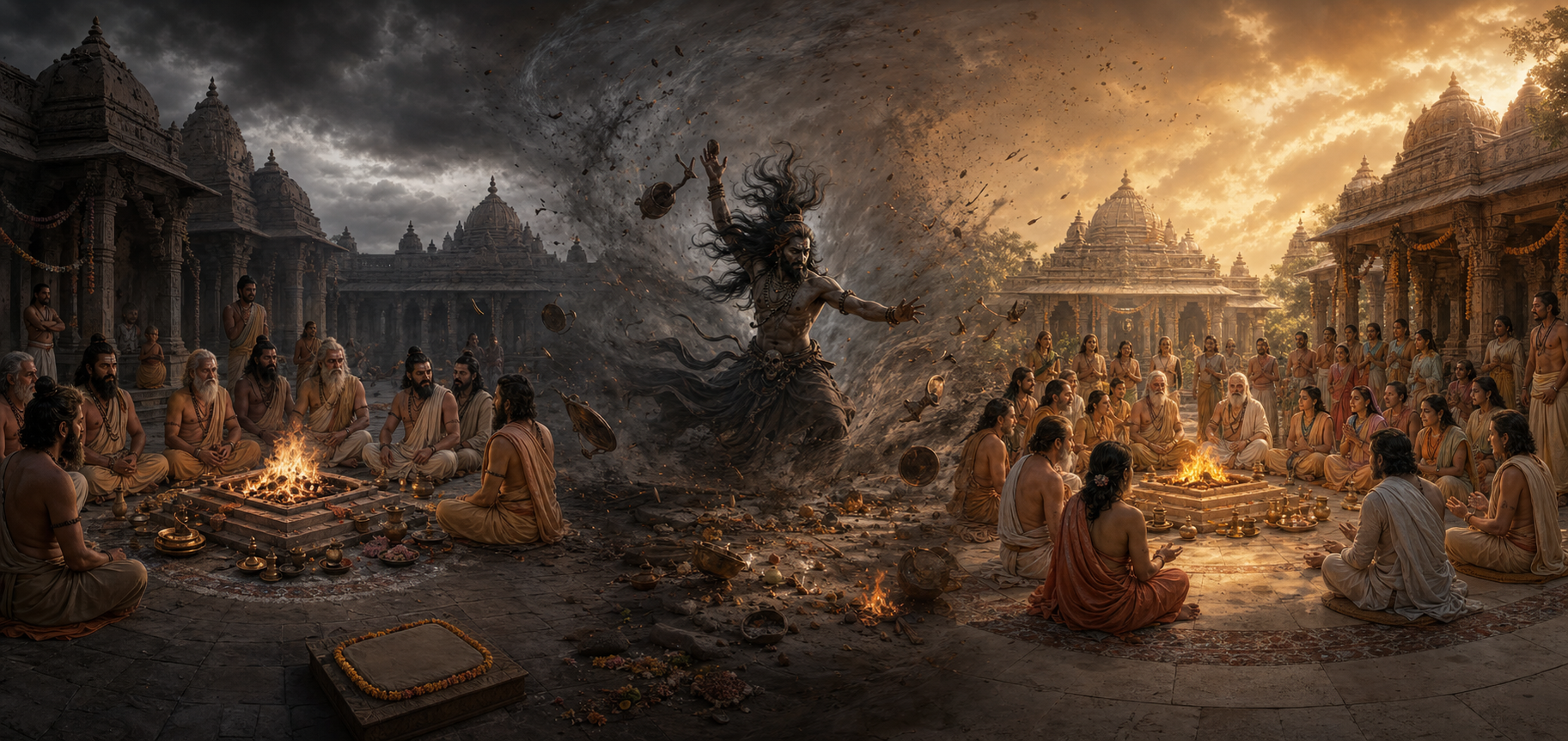
In the account synthesised by the source essay, Dakṣa’s sacrifice possesses prestige, ritual authority and distinguished participation, but it excludes Śiva as an expression of hostility. Dakṣa judges his son-in-law against standards of courtly respectability that leave little room for an ascetic associated with mountains, cremation grounds and beings outside polished society. The yajña is therefore procedurally impressive while remaining fundamentally incomplete.
Sati attends despite Śiva’s exclusion and encounters contempt directed at both of them. The source recounts that she relinquishes her body through yogic fire. Śiva’s grief then assumes a fierce public form: Vīrabhadra emerges from a lock of his matted hair, while some traditions also give prominence to Bhadrakālī. The sacrificial arena is disrupted, its defenders are overcome and Dakṣa is punished.
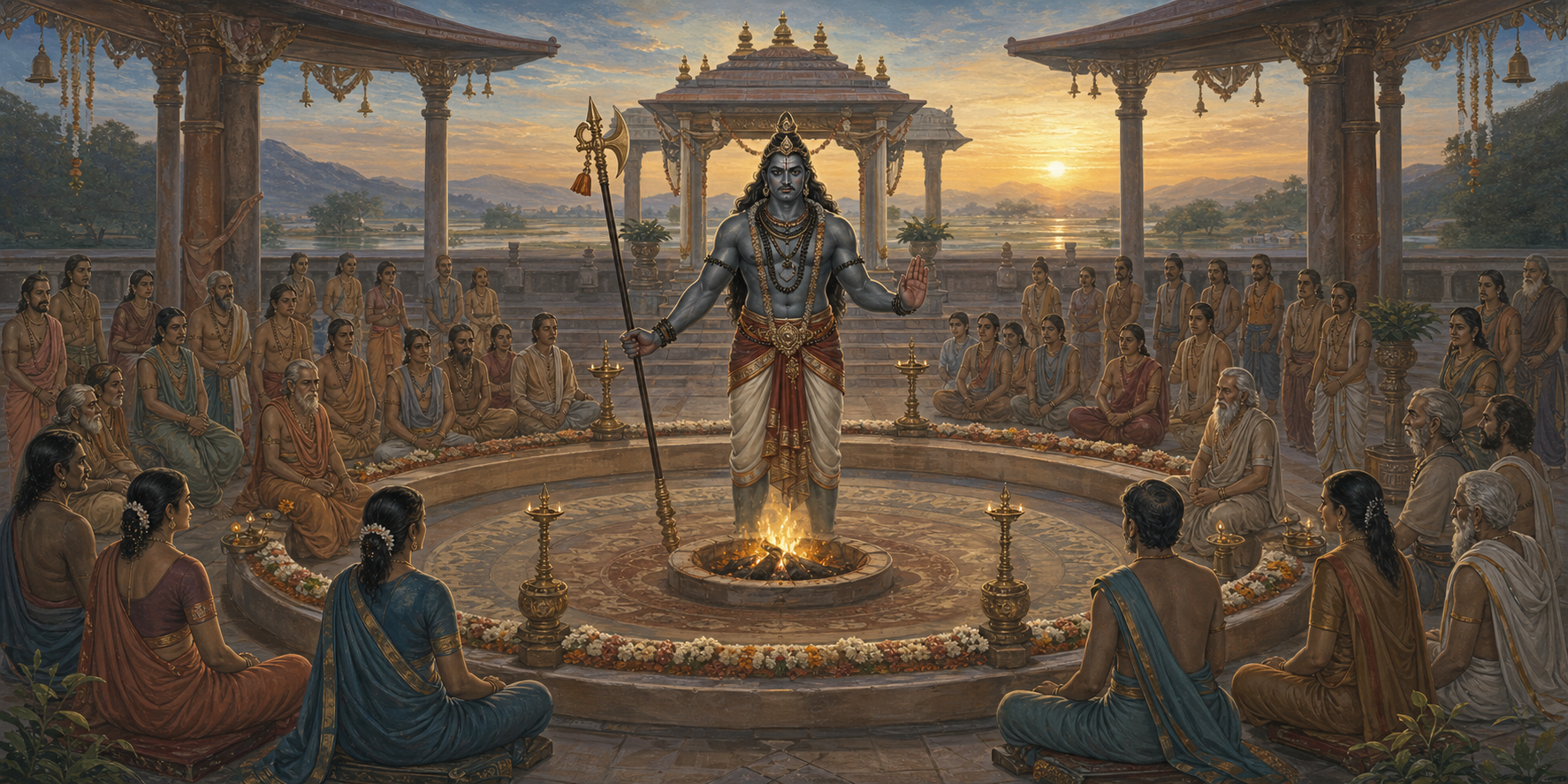
If interpretation stops there, Vīrabhadra becomes little more than an emblem of retaliatory force. The conclusion prevents that reduction. According to the source, Śiva restores Dakṣa with the head of a sacrificial goat; Dakṣa relinquishes his former arrogance, acknowledges Śiva and seeks forgiveness. Śiva pardons him, and the yajña can finally be completed in corrected form.
The resulting pattern is exclusion, protest, rupture, recognition and reintegration. Its destination is neither permanent disorder nor the elimination of everyone implicated in the defective institution. What is destroyed is the presumption that prestige can substitute for wholeness. What survives is an order capable of reform because it has learned to recognise what it previously rejected.
What the metaphor asks of cultural renewal
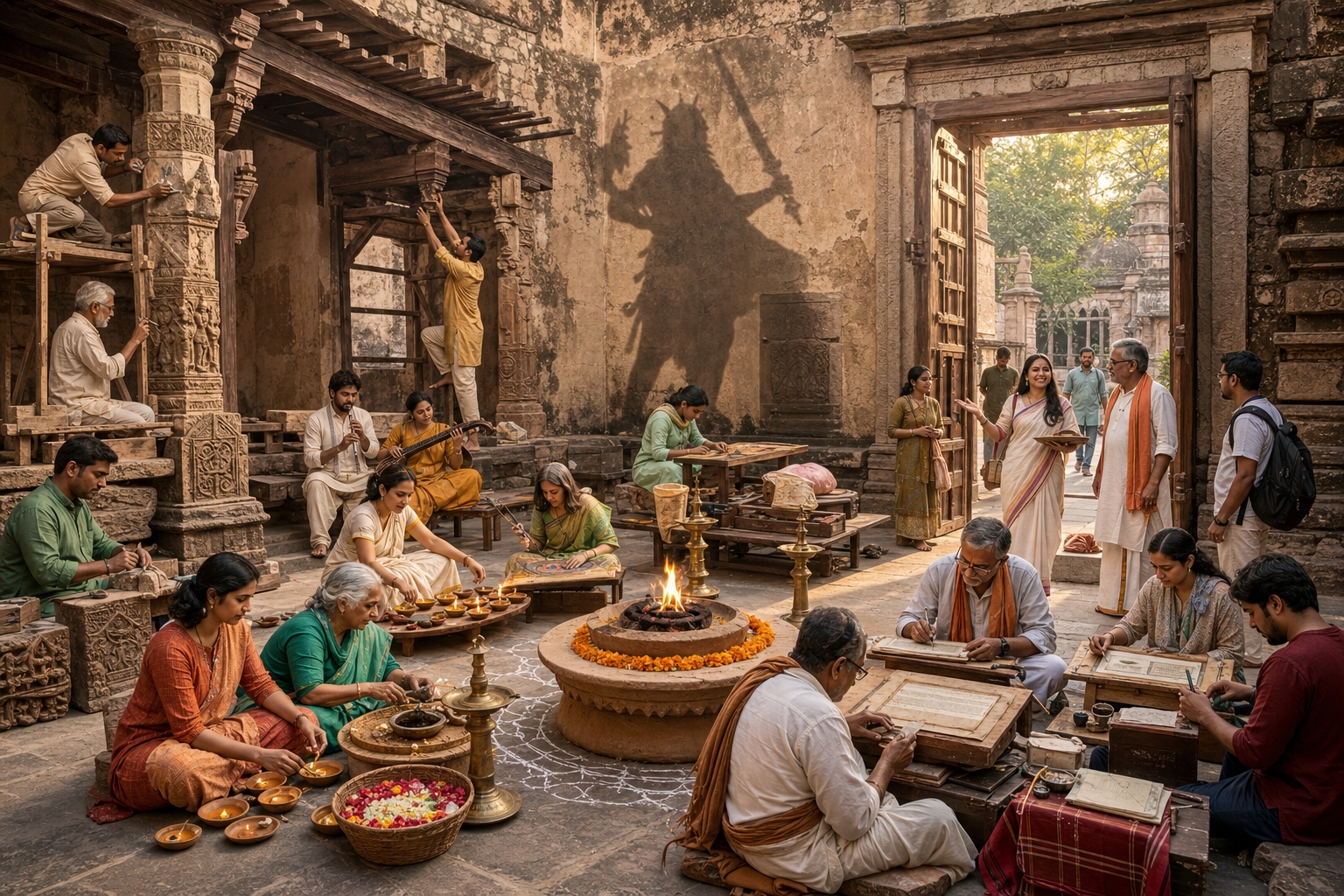
Applied to Hindu cultural renewal, Vīrabhadra signifies corrective energy rather than aggression as an end in itself. He does not appear as an independent sovereign of anger. He arises from Śiva, acts in response to a specific breakdown and remains connected to a divine reality that also encompasses contemplation, creation and compassion. Ferocity is consequently bounded by purpose.
This makes the metaphor as much an internal civilisational critique as a language of external resistance. Dakṣa is not wholly outside the sacred world; he occupies authority within it. His error is to use that authority in a manner distorted by pride and exclusion. Cultural confidence, on this reading, includes the capacity to examine institutions that bear respected names while failing to embody the larger order they claim to serve.
The restored yajña also supplies a measure of success. Renewal cannot be assessed solely by how forcefully a movement denounces humiliation. It must be assessed by whether neglected dignity is recognised, inherited institutions become more truthful, power accepts correction and cooperation becomes possible without simply reinstating the original injustice. Reintegration is not a return to the status quo; it is participation under repaired moral conditions.
Key takeaways
- Vīrabhadra represents force directed toward a defined correction, not rage treated as a permanent cultural identity.
- Dakṣa represents authority and prestige severed from the wholeness that would make them legitimate.
- The completion of the yajña makes recognition, reform and reintegration essential parts of renewal.
- The metaphor supports reflection on institutions and public conduct, but it does not independently prove historical claims or settle policy.
Guardrails for a responsible public reading
The first interpretive danger is to isolate Vīrabhadra’s violence from Śiva’s grief, Dakṣa’s transformation and the eventual completion of the sacrifice. That selective reading turns a situational manifestation into a general permission for fury. The fuller narrative instead requires force to remain answerable to justice, proportion and an attainable condition of peace.
A second danger is to collapse the sacred narrative into a single political programme. The source uses the three registers of adhyātma, adhibhūta and adhidaiva to preserve its breadth. At the inward level, Dakṣa can signify pride, Sati wounded dignity, Śiva neglected wholeness and Vīrabhadra the energy that breaks a false internal arrangement. At the embodied and institutional level, the episode concerns relationships, authority and material consequences. At the cosmic level, it concerns the incompleteness of creation when destruction, finitude and transcendence are denied.
A political application belongs primarily to the institutional register and cannot exhaust the other two. The inward reading is particularly important because it prevents every fault from being projected onto an outside enemy. Pride, exclusion and hollow ceremonialism can arise within a person, a community or an institution that considers itself Dharmic. Renewal begins to mature when the metaphor becomes a standard of self-scrutiny as well as a vocabulary of protest.
A third danger is to confuse reconciliation with weakness or, conversely, to confuse restoration with forgetting. Śiva’s pardon follows recognition and transformation; it does not pretend that no violation occurred. The narrative therefore holds memory and repair together. It permits resistance to a defective order while refusing to make permanent enmity the final purpose of resistance.
Future invocations of Vīrabhadra in discussions of Hindu renewal will be most constructive when they retain this discipline. The meaningful question is not how dramatically the symbol can express anger, but whether it can help cultivate institutions strong enough to accept correction, recover excluded dimensions of Dharma and complete their work on more legitimate foundations.