

Guliga is easily misunderstood when separated from the sacred landscape and community relationships that give his fierceness meaning. The source account presents him not as an embodiment of uncontrolled evil, but as a guardian whose capacity to inspire fear supports truth, protection and the punishment of serious wrongdoing.
Reading Guliga through place, oral transmission, ritual practice and moral responsibility makes this apparent paradox intelligible. His traditions show how dangerous power can become protective once it is bounded by duty.
Place and sacred vocabulary shape Guliga’s identity
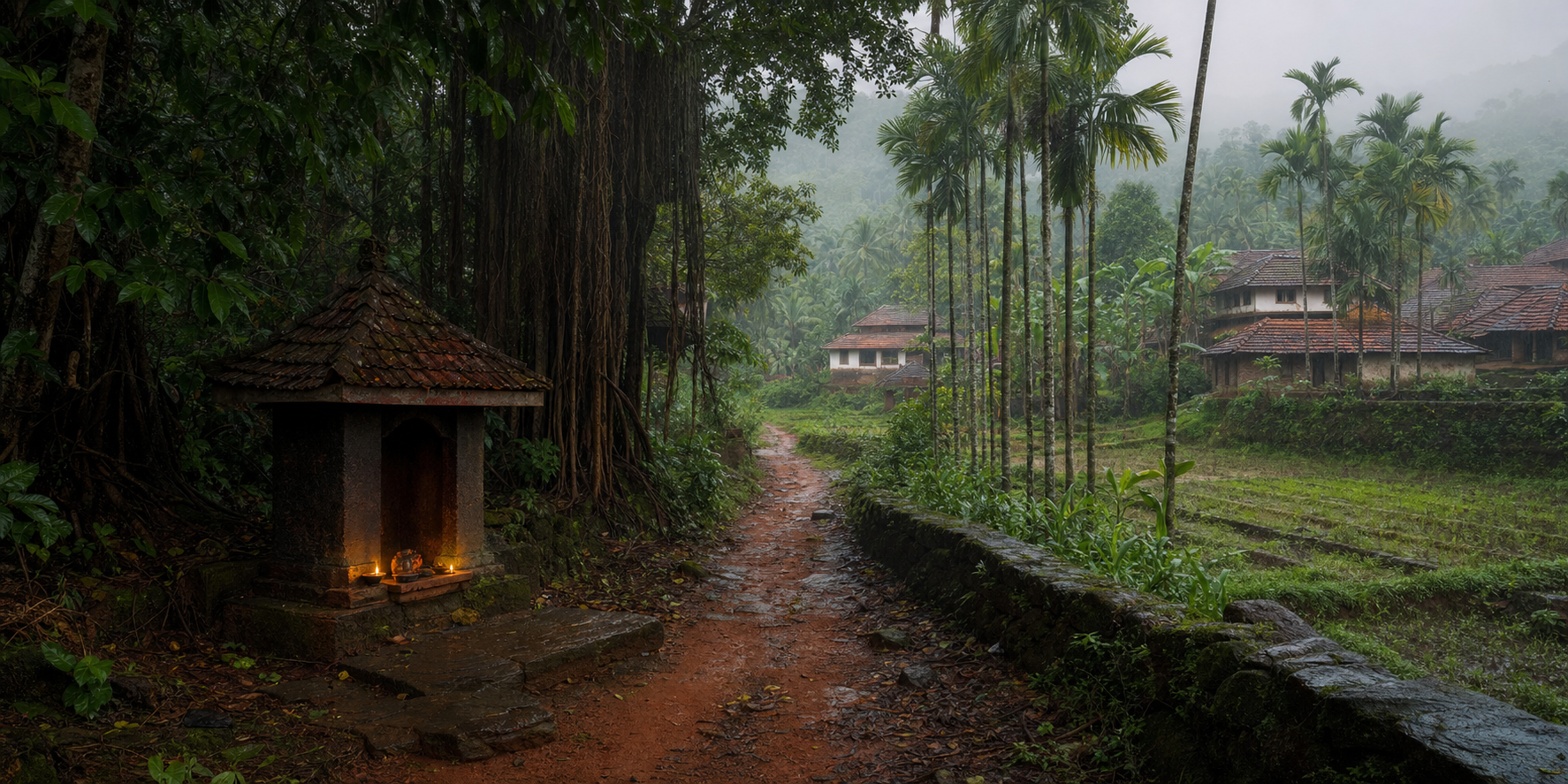
The DharmaRenaissance account locates Guliga within Tulu Nadu, the Tulu-speaking cultural region that includes coastal Karnataka and adjoining Kasaragod in northern Kerala. It describes a landscape formed by the Arabian Sea, the foothills of the Western Ghats, monsoon cultivation, paddy fields, gardens, ancestral houses and sacred localities. These are not merely the surroundings of the tradition. They help explain why Daivas are understood in connection with particular lands, families, occupations and communities.
English translations can obscure that relationship. Daiva Aradhane is often rendered as spirit worship, while Bhuta Kola may be described as a spirit dance. According to the source, these expressions are convenient but incomplete because the English word spirit can suggest a wandering ghost. A Daiva may instead be a sovereign guardian, an ancestral authority, a deified hero, an animal-associated protector or another sacred presence with an acknowledged domain.
The vocabulary matters especially in Guliga’s case. Calling him a demon reduces fierceness to malevolence and removes the moral framework surrounding it. Within the account presented by the source, devotees can fear Guliga’s response to deliberate wrongdoing while trusting his protection. Severity and benevolence are therefore not competing identities; they are different consequences of the same guardianship.
Oral variation is part of the tradition, not a defect

There is no single printed biography that can settle every detail of Guliga’s origin. The source describes sacred oral compositions called paddanas, also written as pad-danas in some scholarship, which recount a Daiva’s birth, journeys, powers, conflicts and establishment at particular shrines. Episodes may differ among villages, performer lineages and ritual settings while retaining religious legitimacy.
The account also places these narratives in more than one social setting. Portions may be sung while a ritual performer prepares and applies make-up, with another family member answering alternate lines to the rhythm of the tembare drum. Related songs have also circulated through agricultural work, including singing by women in paddy fields. Oral tradition consequently joins worship, labour, memory and locality rather than existing only as a story recited apart from daily life.
This mode of transmission changes how apparent contradictions should be read. One version need not invalidate another merely because its sequence or imagery differs. The more stable layer lies in recurring themes: extraordinary emergence, elemental force, immense hunger, an encounter with divine authority and the conversion of dangerous energy into guardianship. Local versions then give those themes their particular narrative form.
Hunger explains both Guliga’s danger and his discipline
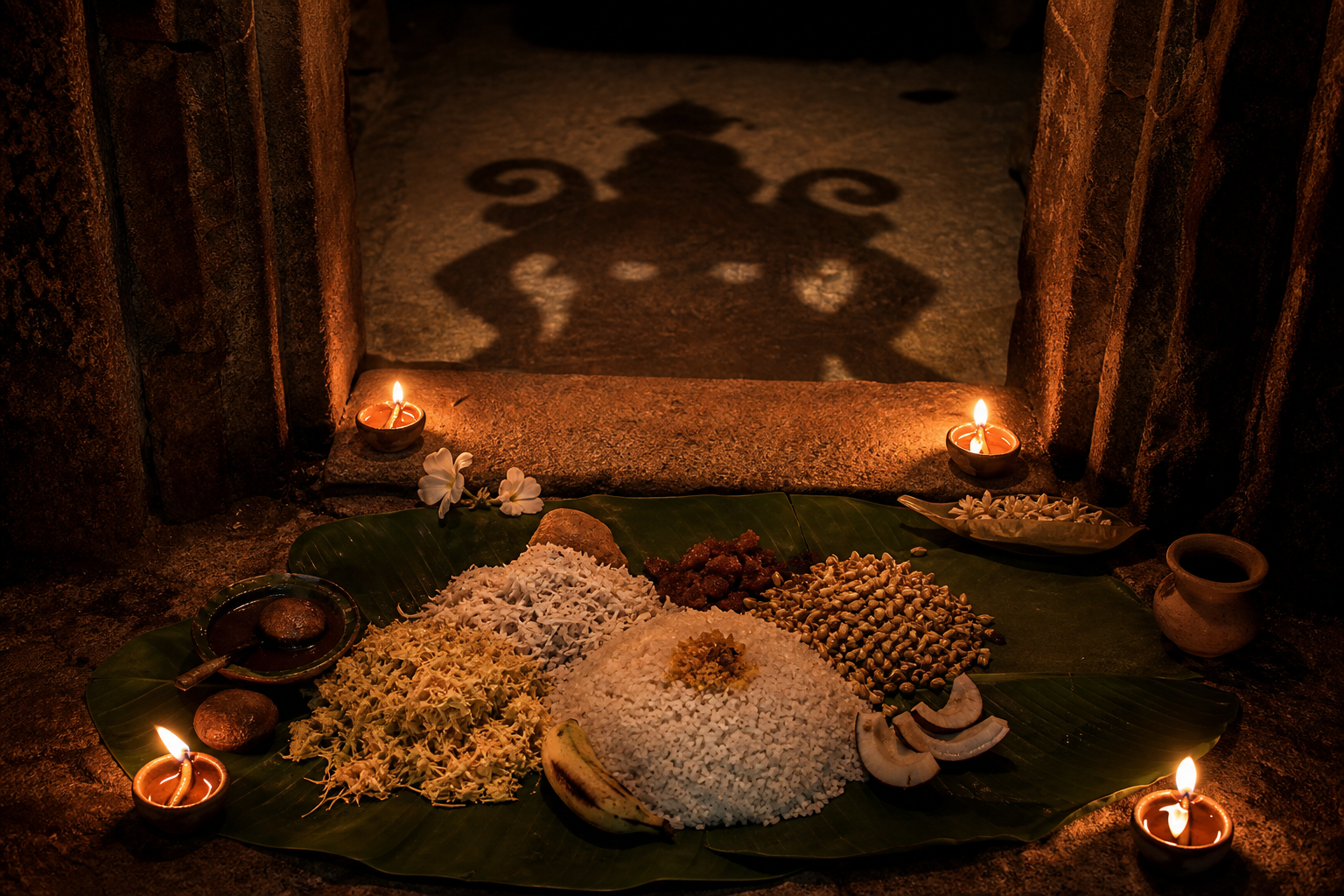
In a widely circulated origin pattern reported by the source, Parvati finds an unusual stone amid ash at Kailasa and takes it to Shiva. Guliga subsequently emerges when the stone, ash or both are cast away or placed in water, depending on the telling. Stone, ash and water give the episode an elemental character: endurance, destruction, transformation and emergence are combined in a birth that does not follow ordinary limits.
Some retellings add a further birth connected with Vishnu and Nelaulla-Sanke. The source characterises the imagery of that emergence as violent and transgressive. Such details are better read as signs that Guliga exceeds ordinary biological and social boundaries than as conduct offered for imitation. The narrative problem is not simply that he possesses power, but that his power initially lacks proportion and direction.
That problem is expressed through insatiable hunger. Different versions described by the source have Guliga consuming enormous quantities of food, draining water and devouring fish, or directing his appetite toward the sun. The changing details serve a common purpose: ordinary abundance cannot satisfy a force whose appetite is metaphysical in scale.
In one widely told resolution, Vishnu offers the tip of his little finger when material nourishment proves insufficient. Contact with divine power stills or redirects Guliga’s hunger, after which he receives an earthly role as a guardian of communities and an enforcer of promises. The episode is therefore more than a contest between divine figures. Shiva and Parvati are associated with Guliga’s elemental beginning, while Vishnu supplies a limit and an obligation. Regional sacred authority is connected to a broader Hindu universe without dissolving Guliga’s specifically Tulu identity.
Hunger also provides an ethical vocabulary. Read symbolically, it resembles any appetite that refuses legitimate boundaries: the drive to consume land, wealth, honour or life without restraint. Guliga becomes protective only when overwhelming capacity is placed under sacred responsibility. His ferocity is not erased; it is assigned a just purpose.
Guardianship joins ritual authority to community ethics

Guliga’s meaning is consequently larger than his origin narrative. In the source account, he stands for territorial order, truthful conduct, protection and accountability for grave wrongdoing. Offerings and vows acquire seriousness because they belong to a relationship in which promises have consequences. The guardian’s frightening aspect communicates that moral boundaries are not merely decorative ideals.
His reported association with Panjurli sharpens this point, although the source cautions that their relationship and ritual ordering differ by locality. Some narratives describe an initial conflict followed by reconciliation; others treat them as complementary guardians. As a broad interpretive pattern rather than a universal shrine rule, Panjurli is linked with fertility, land and nurturing protection, while Guliga represents sterner enforcement of boundaries.
Together, those roles express a practical understanding of communal order. Land and social life require fertility and care, but also limits, truthful obligations and remedies for deliberate harm. Guliga’s severity makes sense within this fuller ecology of protection. Removed from it, the visual intensity of Bhuta Kola can be mistaken for spectacle; restored to it, ritual appearance, oral narrative and ethical authority become parts of one relationship among Daiva, place and community.
Key takeaways
- Guliga’s fierceness signifies protective authority governed by responsibility, not uncontrolled malevolence.
- Daiva is more accurate than reductive labels such as ghost or demon because it preserves sacred status and recognised authority.
- Differences among origin stories reflect the local and performative character of paddana transmission.
- The recurring hunger motif presents power without proportion; divine restraint turns that power toward guardianship.
- Guliga’s relationship with land, vows, justice and other Daivas must be interpreted locally rather than forced into one universal scheme.
Future documentation of Guliga traditions will be most useful when it preserves local voices, identifies the setting of each version and treats variation as evidence of a living inheritance rather than something to be edited away.