

Unity across Dharmic traditions becomes meaningful only when it can accommodate real disagreement. Hindu, Buddhist, Jain and Sikh paths share a civilizational setting and several ethical concerns, but they do not offer interchangeable accounts of the self, ultimate reality, bondage or liberation.
A sounder approach looks for common directions of transformation while allowing each tradition to explain its own doctrines. This makes unity more than a slogan: it becomes a method for accurate comparison, respectful dialogue and practical cooperation.
A framework for unity without uniformity
The DharmaRenaissance Blog source frames the shared aim as movement away from ignorance, selfishness, harmful conduct and the instability of ordinary life toward greater freedom, moral clarity and responsibility. That formulation identifies a family resemblance rather than a single theology. Similar ethical outcomes can arise from substantially different understandings of reality and the person.
The article proposes four levels of comparison. Keeping them separate prevents an ethical similarity from being mistaken for metaphysical agreement:
| Comparative level | Question to ask | Why it matters |
|---|---|---|
| Diagnosis | What causes suffering, bondage or moral disorder? | Traditions may identify different roots even when they criticize similar conduct. |
| Goal | What constitutes liberation, awakening or fulfillment? | Moksha, nirvana and mukti should not be treated as automatic synonyms. |
| Method | What roles belong to knowledge, meditation, devotion, conduct and service? | Comparable disciplines may rest on distinct doctrinal foundations. |
| Social expression | How should a disciplined person treat other beings? | This is often where cooperation becomes most concrete. |
This framework also exposes two opposite errors. One reduces every path to the same destination and treats differences as decorative. The other assumes that doctrinal disagreement rules out shared ethical work. Unity requires neither conclusion. Communities can preserve theological boundaries while collaborating wherever their disciplines produce compatible responsibilities.
Four paths illuminate different dimensions of transformation

Hindu plurality resists a single formula
The source emphasizes that Hindu traditions contain multiple sampradayas and philosophical schools. Advaita Vedanta describes liberation through realization of the non-duality of atman and Brahman, while Visishtadvaita and Dvaita articulate different relationships among the Divine, individual selves and the cosmos. Yoga, Sankhya, Nyaya, Mimamsa, Shaiva, Shakta and bhakti traditions add further accounts of knowledge, grace, action and devotion.
Even within Hinduism, therefore, unity does not mean doctrinal uniformity. The source presents the Bhagavad Gita’s coordination of disciplined action, knowledge and devotion as a practical model: different dispositions can be addressed without turning every discipline into the same technique. Karma yoga is especially relevant to social cooperation because service performed without possessive attachment can become a means of inner formation rather than self-display.
Buddhist awakening cannot be translated into an eternal-self doctrine
The article describes Buddhism as beginning with dukkha and analyzing conditioned existence through impermanence, dependent origination and the absence of an independent, permanent self. Its presentation of the Noble Eightfold Path integrates ethical conduct, mental cultivation and wisdom. On this account, nirvana should not be recast as absorption into Brahman or as the release of an eternal soul.
The Buddhist contribution to Dharmic unity is therefore not a hidden endorsement of another tradition’s metaphysics. It is a disciplined attention to intention, interdependence, awareness and compassionate conduct. The source further associates the Mahayana bodhisattva ideal with concern for all sentient beings, showing how individual training can support an expansive social responsibility.
Jain non-harm joins ethical rigor to a distinct ontology
According to the source, Jain philosophy distinguishes jiva from ajiva and understands karma as a subtle material bondage adhering to the soul through passion and action. Liberation involves stopping further karmic influx and removing accumulated karma through right faith, right knowledge and right conduct. This differs from both Buddhist non-self and the varied Hindu accounts of atman.
Jain teachings nevertheless provide especially fertile ground for shared ethical work. The article presents ahimsa as attention not only to overt violence but also to speech, intention, livelihood, consumption and carelessness. Aparigraha questions the pursuit of security through unlimited possession. Anekantavada cautions that a complex reality cannot be exhausted by one finite standpoint; importantly, the source does not treat this as the claim that every assertion is equally true. Applied to dialogue, it encourages humility without surrendering judgment.
Sikh oneness belongs within the Sikh account of the Guru
The source situates Sikh thought around Ik Onkar and describes haumai as a self-centered orientation associated with separation, pride and possessiveness. It also stresses that Sikh understandings of hukam and the Guru form a theological framework of their own. The authority of the ten historical Gurus, Guru Granth Sahib and Guru Panth should therefore not be absorbed into another tradition’s model of spiritual instruction.
This distinction is central to responsible unity. Affirming oneness does not make every claim about ultimate reality equivalent, just as reverence for guidance does not make every understanding of Guruship interchangeable. Sikh participation in a wider Dharmic conversation remains most respectful when Sikh categories are allowed to speak in their own register.
Shared vocabulary records a conversation, not a consensus
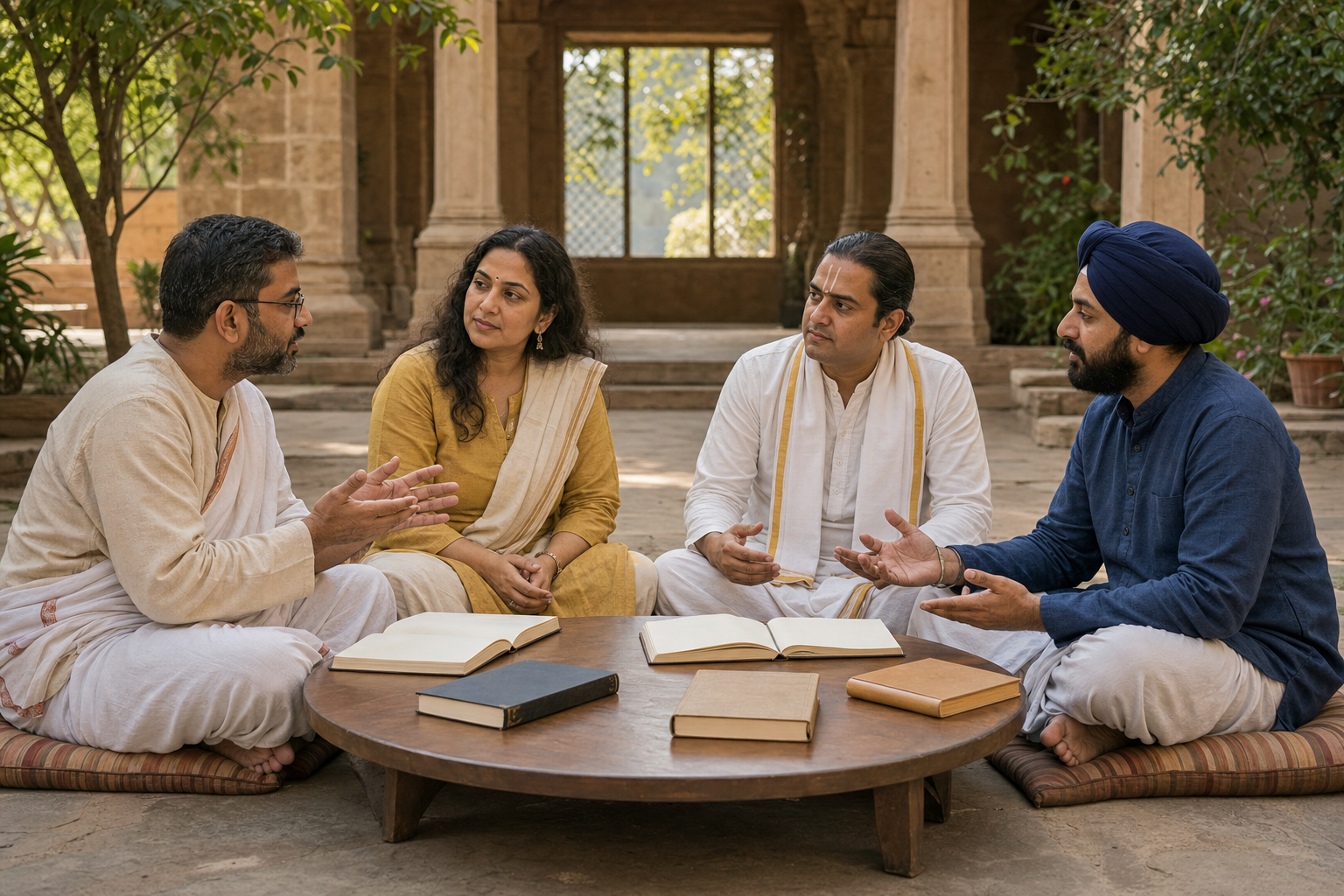
The source places Hindu, Buddhist, Jain and Sikh traditions within a long civilizational conversation in the Indian subcontinent. It points to overlapping vocabularies concerning dharma, karma, meditation, liberation, renunciation, household responsibility and disciplined conduct, while noting that their meanings developed across Sanskrit, Pali, Prakrit, Apabhramsha, Punjabi and regional languages.
Dharma illustrates the translation problem. As the article explains, the term can indicate duty, sustaining order, ethical conduct, teaching, truth, a quality or philosophically analyzed phenomena, depending on its setting. Buddhist dhamma, Sikh dharam, Jain usages and the range of Hindu usages occupy related historical terrain without collapsing into one definition.
A useful dialogue should consequently begin with context rather than a universal glossary. Participants need to ask who is using a term, in which textual or communal setting, and for what purpose. Only after that internal meaning is clear should comparison identify an analogy. This sequence protects minority interpretations and prevents familiar vocabulary from concealing unfamiliar doctrines.
July offers a practical test of precise solidarity

The source uses July as a seasonal example because it can overlap with Ashadha or Shravana under regional lunisolar calendars. It reports that the monsoon historically encouraged reduced travel, greater study and contemplative discipline. Hindu and Jain communities developed forms of Chaturmas observance, while Buddhist communities maintained the related but distinct rains retreat known as vassa.
The common ecological rhythm is significant, but the institutions are not interchangeable. Difficult travel and the multiplication of small forms of life gave renewed practical importance to restraint and non-harm. Here unity appears as comparable responses to shared conditions rather than evidence of one original ritual system.
The article applies the same precision to Guru Purnima. It notes the observance’s importance in several Hindu, Buddhist and Jain settings while warning against casually placing Sikh Guruship inside that festival structure. Communities can honor the broad human need for teaching and guidance without claiming that the identity, function or authority of the teacher is the same everywhere.
This seasonal case suggests a practical model for cooperation. Dharmic communities can support study, restraint, compassionate service, responsible consumption and care for living beings while explaining why each practice matters within its own tradition. Joint action then rests on an explicit ethical intersection, not an invented theological merger.
Key takeaways
- Dharmic unity is strongest when it describes a shared direction of ethical and spiritual transformation rather than identical doctrine.
- Diagnosis, goal, method and social expression should be compared separately; agreement at one level does not establish agreement at every level.
- Atman, anatman, jiva and Sikh teachings concerning Ik Onkar, hukam and the Guru must remain situated within their respective frameworks.
- Ahimsa, compassion, disciplined action, humility, truthful living and service can create meaningful areas of cooperation without requiring a common metaphysics.
- Shared words and seasonal practices should be interpreted contextually before they are used as evidence of unity.
The next stage of Dharmic dialogue lies in building forms of solidarity precise enough to survive disagreement. When each community can cooperate without surrendering its own vocabulary, authorities or account of liberation, plurality becomes a durable civic and spiritual strength.