
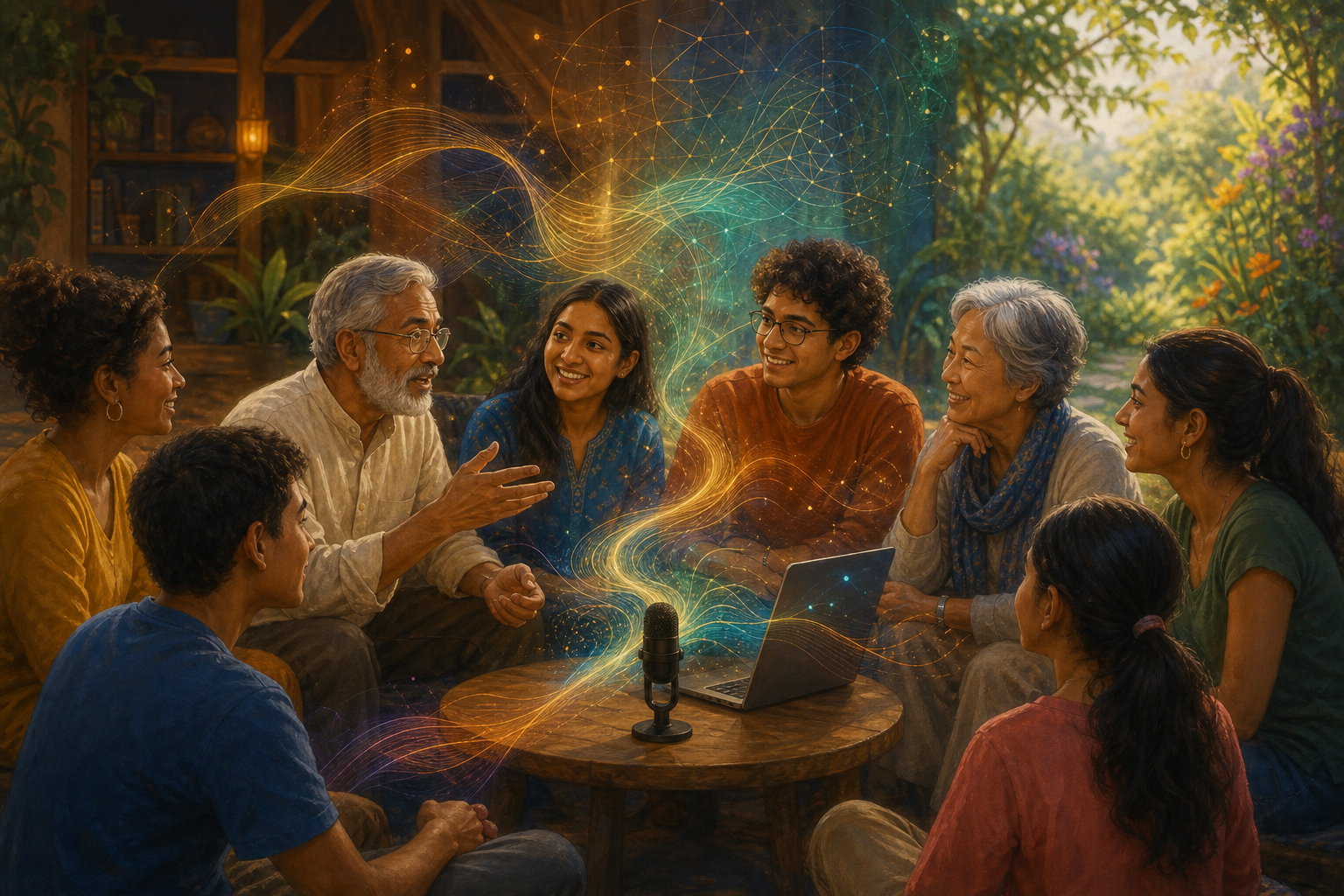
Sanskrit’s digital revival is taking shape at the meeting point of precise sound, machine learning and informal social use. Its significance lies not in recreating an earlier linguistic world, but in giving different kinds of learners more ways to hear, study and speak the language.
The available reporting brings two apparently different developments into view: an artificial-intelligence system trained to synthesize metrical recitation, and a community movement that treats Sanskrit as a language of walks, games, music and friendship. Together, they show why access, accuracy and participation must develop in tandem.
A revival with several overlapping lives
Sanskrit cannot be assessed through a single measure. It remains a language of sacred practice and philosophical inquiry, a subject of scholarship, a source for Indian Knowledge Systems, a field of computational research and, among a smaller community, a medium of everyday conversation. Digital tools now connect these spheres without making them identical.
This distinction matters when interpreting online attention. The DharmaRenaissance account, drawing on a July 10, 2026 Open Magazine report, says the Vagdhenu recitation project attracted roughly two million page hits and about 1,500 model downloads. Those figures indicate reach and curiosity, not verified proficiency. A person may listen to a verse, use repeated playback for practice or simply explore the technology without becoming a fluent speaker.
The more useful question is therefore not whether Sanskrit has suddenly become widely spoken. It is whether new channels can lower barriers to entry while directing sustained learners toward pronunciation, grammar, literature, meaning and living communities of practice.
Why Sanskrit makes unusual demands on speech AI
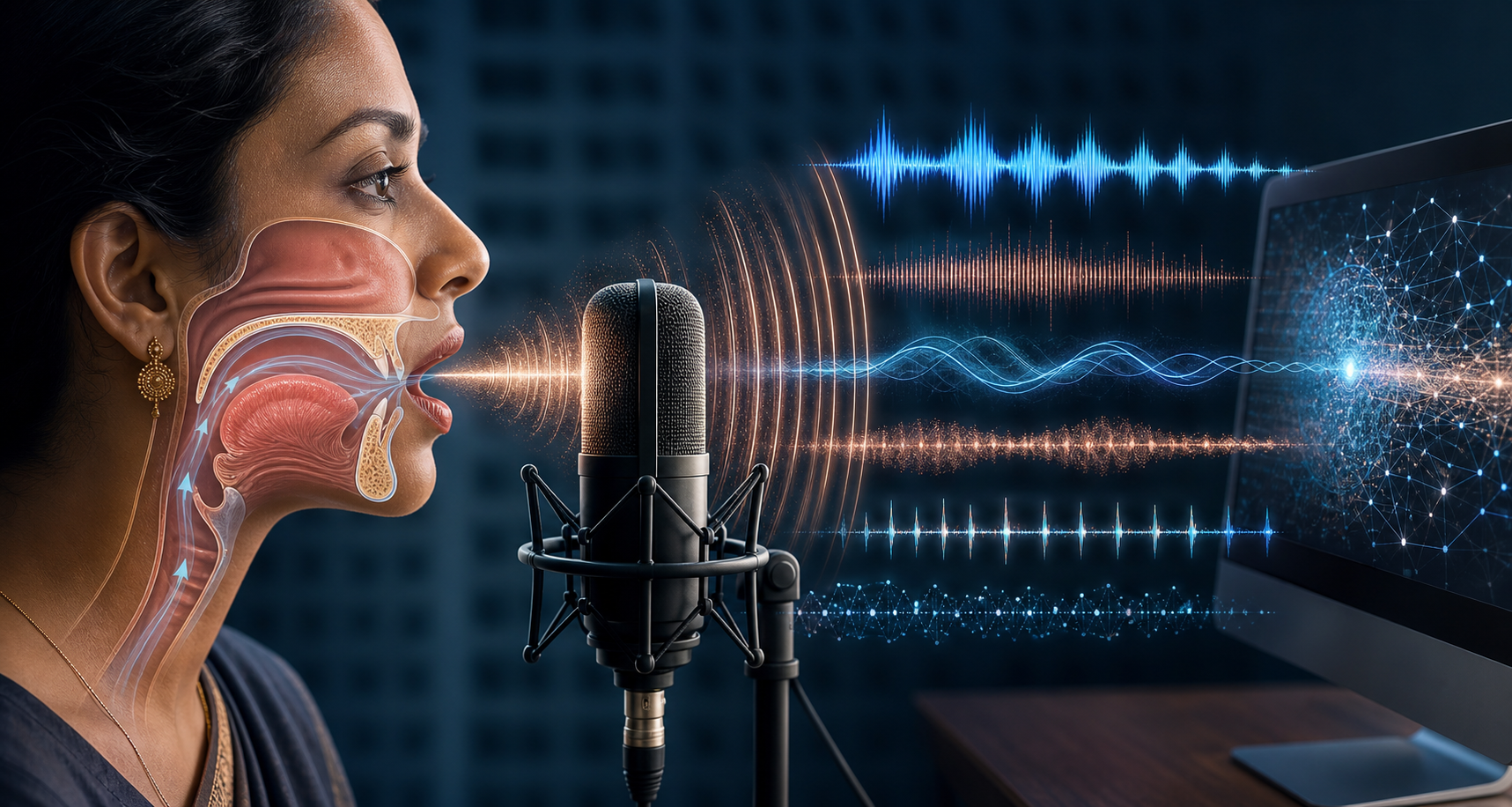
For Sanskrit recitation, intelligible speech is only a starting point. Short and long vowels, aspiration, retroflex consonants, pauses and metre all help determine whether a verse sounds and functions as intended. A synthetic voice can pronounce recognizable words yet remain unsuitable for learning if it compresses vowel length, substitutes consonants or ignores the temporal organization of a shloka.
The source reports that Prathosh AP, an assistant professor of machine learning at the Indian Institute of Science in Bengaluru, developed Vagdhenu to turn metrical Sanskrit verse into chant resembling traditional parayana. Reported deployments included approximately 18,000 verses of the Bhagavatam and 5,183 verses of Mahabharata Tatparya Nirnaya.
As described in the article’s account of the technical documentation, the system uses a flow-matching text-to-speech foundation: a model predicts an acoustic representation and a neural vocoder turns that representation into audible sound. Sanskrit-specific processing is then used to account for orthography, pronunciation and metre. This combination is important because a general-purpose speech model is trained to produce plausible audio, whereas a recitation system must preserve linguistically meaningful distinctions.
One design choice exposes a broader problem in multilingual AI. The article says Vagdhenu internally routes Sanskrit through Kannada orthography to reduce Hindi-influenced schwa deletion associated with Devanagari in the underlying model. This is presented as an engineering workaround for training bias, not as a judgment that one script is intrinsically better than another. The example demonstrates that a model does not encounter a script neutrally: associations learned from dominant training languages can affect how another language is pronounced.
The reported front end also attempts to retain aspiration, three distinct sibilants, retroflex sounds, vocalic sounds, homorganic anusvara and context-sensitive visarga. Metre detection and matched reference audio guide timing and prosody. In effect, statistical speech generation is constrained by knowledge drawn from phonology, textual form and recitational practice.
The training data illustrates the value of deliberate curation. According to the source, the corpus comprised about 1,467 clips and 5.3 hours of audio from one speaker, recorded with attention to noise, microphone distance, pitch stability and articulation. A fine-tuned BigVGAN-v2 vocoder was used because sustained chanting and long vowels exposed weaknesses in a more general vocoder. For a specialized task, a compact and consistent corpus can be more useful than a larger but poorly controlled collection.
The limitations are equally important. The source characterizes the reported mean-opinion score of about 4.6 as a creator-reported expert assessment rather than independent proof of universal accuracy. The corpus represents one voice, and the system does not reproduce Vedic svaras. It should therefore be understood as a substantial specialized implementation, not an authority covering every metre, region or recitation lineage.
Community use turns availability into participation
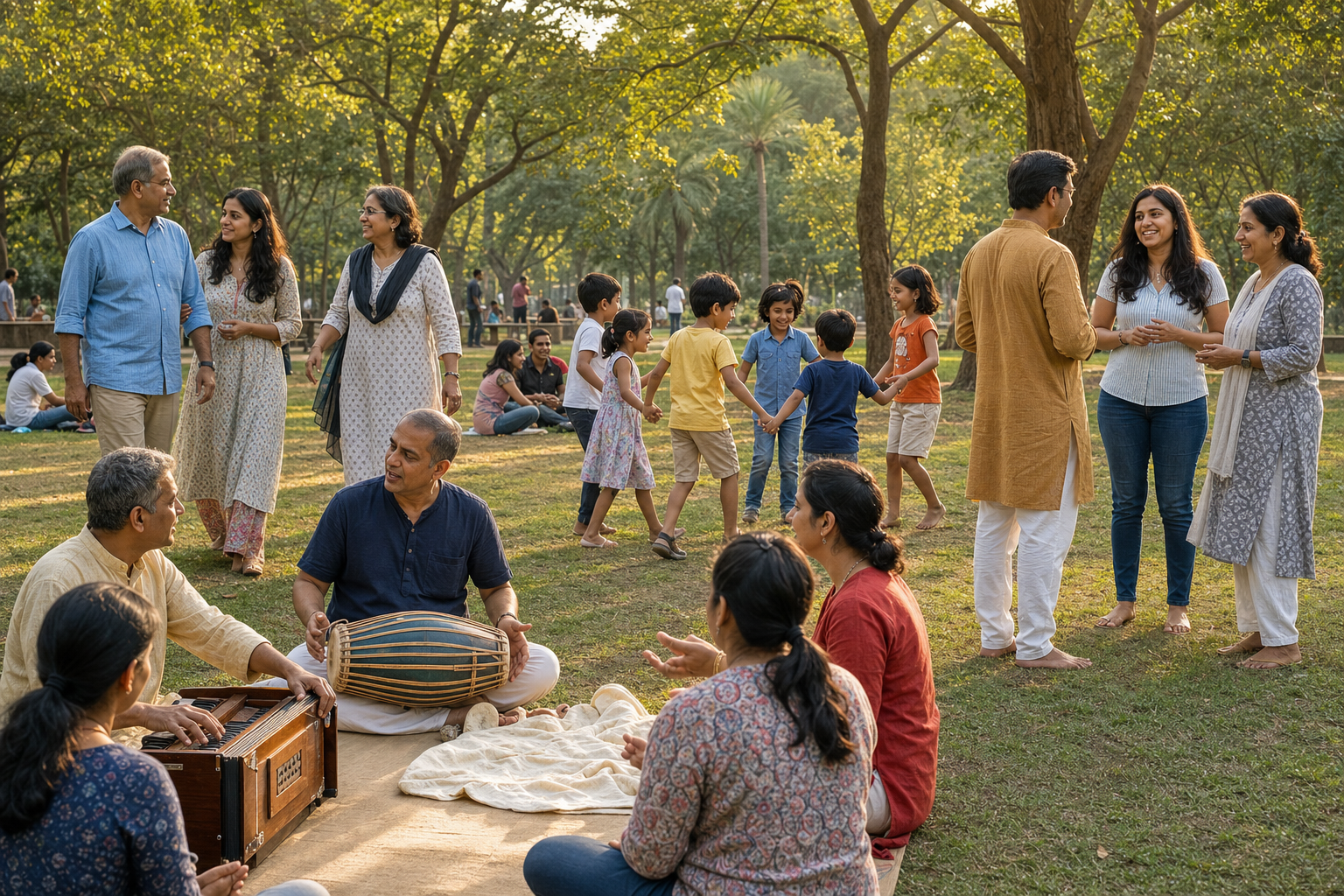
Accurate audio can make Sanskrit easier to encounter, but a language also needs settings in which people are willing to use it imperfectly. The same source describes Samashti Gubbi, known online as sanskritsparrow, helping present Sanskrit as a medium of leisure, humour, music and companionship rather than only formal examination.
At reported Sunday gatherings in Bengaluru’s Cubbon Park, participants converse while walking, count in Sanskrit and play antakshari with subhasitas. Such activities serve a different function from a pronunciation model. They reduce the social risk of beginning, create repeated opportunities for recall and attach the language to ordinary experiences.
The technological and communal strands are therefore complementary. Synthetic recitation offers repeatable listening at a learner’s chosen pace. Social practice supplies improvisation, mutual encouragement and the unpredictable exchange that recorded material cannot provide. Literature and sacred recitation offer depth and continuity, while contemporary music, humour and conversation give learners reasons to return between formal lessons.
This relationship also clarifies why online visibility alone is insufficient. Discovery becomes durable learning only when it leads toward practice, feedback and human connection. Conversely, local communities gain reach when recordings, online classes and social media make their activities discoverable beyond a single neighbourhood.
Key takeaways
- Sanskrit’s revival spans recitation, scholarship, computation, creative expression and conversation; no single participation statistic represents all of them.
- Chant synthesis must preserve vowel quantity, consonantal distinctions, pauses and metre rather than merely produce understandable words.
- Vagdhenu’s reported architecture combines a general speech model with Sanskrit-specific linguistic and metrical processing.
- Its reported reach shows substantial interest, but page views and downloads should not be treated as evidence of fluency.
- Informal gatherings complement digital tools by turning exposure into low-pressure, repeated social use.
From a capable model to responsible learning infrastructure

A recitation generator is not yet a complete tutor. Useful corrective instruction would also require Sanskrit-capable speech recognition, alignment at the sound or syllable level, detection of vowel length and aspiration, metrical analysis and feedback that communicates uncertainty. It would need to distinguish genuine errors from acceptable regional or sampradaya-specific realizations.
That distinction is both technical and cultural. A system trained on one speaker may unintentionally reward resemblance to that speaker instead of accuracy across legitimate traditions. Broader evaluation by reciters, teachers and linguists could reveal where a model performs reliably and where it should defer to human judgment.
The most durable model is likely to keep teachers inside the learning process. Machines can offer private repetition, immediate playback and access across distance. Teachers can explain why a form is pronounced in a particular way, connect sound to grammar and meaning, and correct the model when its confidence exceeds its competence.
Sanskrit’s digital future will be strongest if technical scale enlarges access while community practice supplies belonging and inherited disciplines preserve depth. The next phase should be judged not by novelty alone, but by whether more learners can move responsibly from hearing the language to understanding and using it.