
A habit, role, relationship pattern, or institution can outlive the purpose it once served. When that happens, you face a harder question than whether change is necessary: what should be released, what must be protected, and how can you act without turning pain into hostility?
Shiva’s Samhara offers a disciplined answer. It does not glorify wreckage. It teaches you to dissolve an exhausted form while preserving the truth, duty, and capacity for grace that the form was meant to carry.
Samhara is a passage, not a final catastrophe
Samhara is often translated as destruction, but dissolution is more precise. Destruction can be arbitrary, punitive, or driven by rage. Dissolution has a place within an ordered cycle: a formation reaches its limit, returns to its source, and clears space for another movement of life.
This becomes clear within the five divine acts, or pañcakṛtya: sṛṣṭi, emanation; sthiti, sustenance; saṁhāra, dissolution; tirobhāva, concealment; and anugraha, grace. No act stands alone. Creation without sustenance cannot mature. Sustenance without dissolution becomes stagnation. Dissolution without grace would leave only absence. In the full rhythm, Samhara removes an obstruction so that recognition, renewal, and right action become possible.
That distinction gives you a practical test. Before ending anything significant, ask what the ending is meant to make possible. If the honest answer is revenge, humiliation, escape from duty, or the defeat of a person you have turned into an enemy, you are not yet acting from Samhara. If the answer is greater truthfulness, freedom from compulsion, restoration of dharma, or renewed capacity to serve, the decision may be moving in the right direction.
Not everything difficult is exhausted. Some duties need repair, patience, or firmer boundaries rather than abandonment. Use three questions before you call for dissolution:
- Has this form stopped serving its rightful purpose, or am I resisting the discomfort required for it to mature?
- Can the obstruction be corrected without discarding the whole relationship, practice, or institution?
- Will the proposed ending protect dignity and reduce harm, or merely transfer my burden to someone else?
Key takeaways
- Samhara dissolves a completed or obstructive form; it does not treat destruction as a good in itself.
- Its proper target is ignorance, compulsive attachment, and harmful structure, not the humanity of an opponent.
- A sound ending preserves the dharmic purpose that an outdated form can no longer serve.
- Release must be joined to anugraha: clarity, compassion, and a concrete beginning that can occupy the cleared space.
Read Nataraja as a map of disciplined change

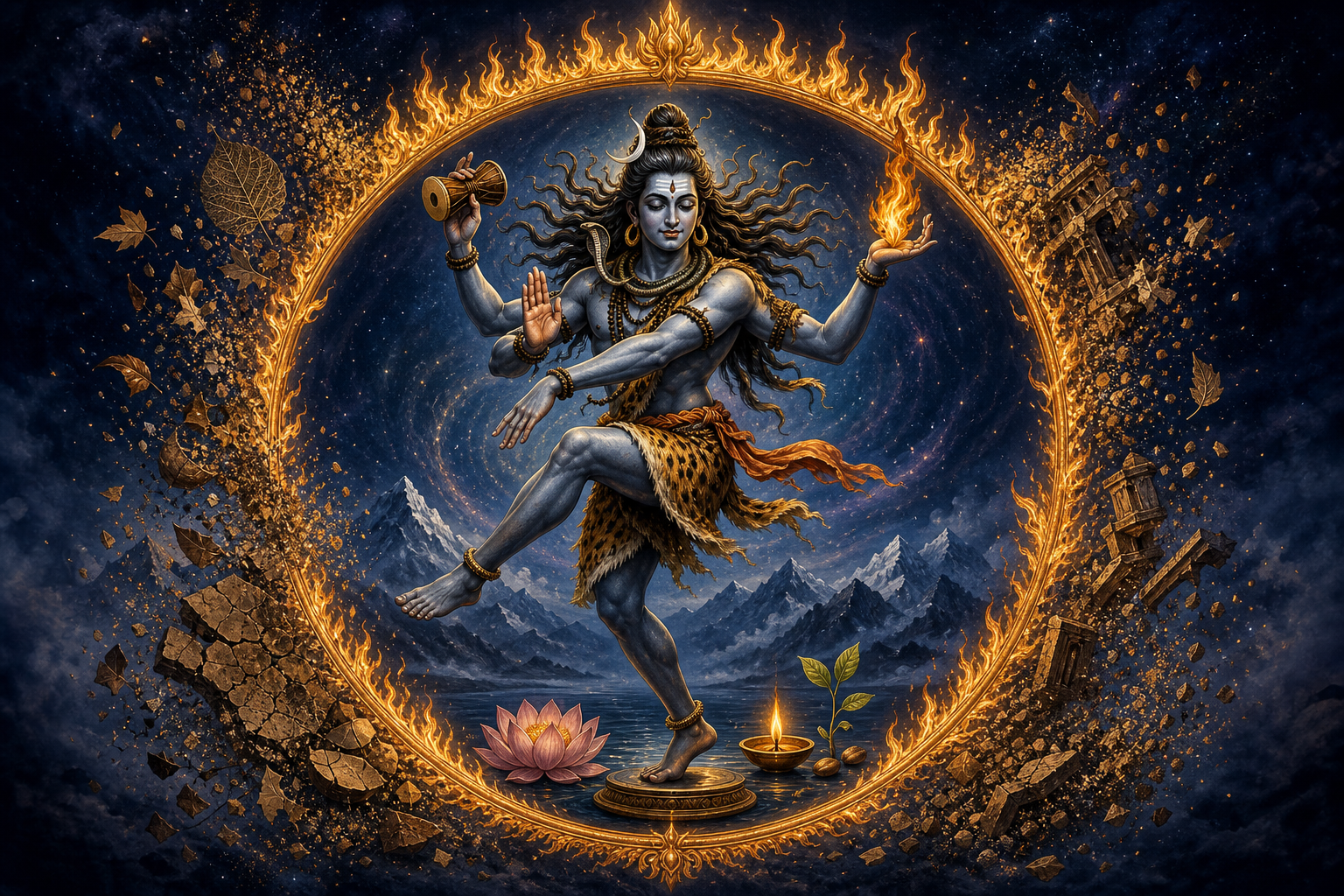
Nataraja does not portray dissolution in isolation. The entire image holds creation, change, fearlessness, ignorance, and liberation together. This is why it can help you think clearly when one part of life is ending.
- The ring of fire places every manifest form within continuous arising and return. It asks you to stop treating temporary arrangements as permanent possessions.
- The ḍamaru carries rhythm and genesis. Even while one form passes away, the possibility of a new expression remains.
- The flame signifies reabsorption. It directs the force of dissolution toward what has completed its work.
- The abhaya hand grants fearlessness. Courage here is not aggression; it is the steadiness to face impermanence without denial.
- Apasmara beneath Shiva’s foot represents forgetfulness and dullness. The adversary being overcome is the ignorance that hides reality, not a category of human beings.
- The raised foot offers grace. It prevents you from mistaking removal for the whole spiritual task.
You can use these symbols as a decision sequence. Notice the ring: this situation will change. Hear the drum: something still seeks a truthful expression. Face the flame: something specific must be released. Receive abhaya: fear need not choose for you. Identify Apasmara: name the confusion sustaining the problem. Then look to the raised foot: decide what act of grace should follow.
Other forms of Shiva sharpen particular aspects of the same teaching. Tripurāntaka brings down the three fortified cities, interpreted in Śaiva Siddhānta through the three impurities that constrain the soul. Andhaka’s defeat turns attention toward craving that multiplies when it is indulged blindly. Mahākāla and Kālābhairava confront you with time, death, and thresholds where familiar identities cannot be retained unchanged.
Cremation-ground imagery makes the lesson impossible to sentimentalize. Vibhūti recalls that compounded forms return to elemental simplicity. Serpents, tiger skin, and matted locks signify mastery over forces that ordinarily bind the mind. The triśūla can be contemplated as discernment cutting through identification with the three guṇas: sattva, rajas, and tamas.
Do not turn this iconography into a catalogue of people to conquer. When a demon is read only as somebody outside your community, the symbol becomes an excuse for projection. Begin with the obstruction in your own perception: the craving, resentment, vanity, fear, or inertia that prevents you from responding according to dharma.
Use a dharmic test before deciding what must go
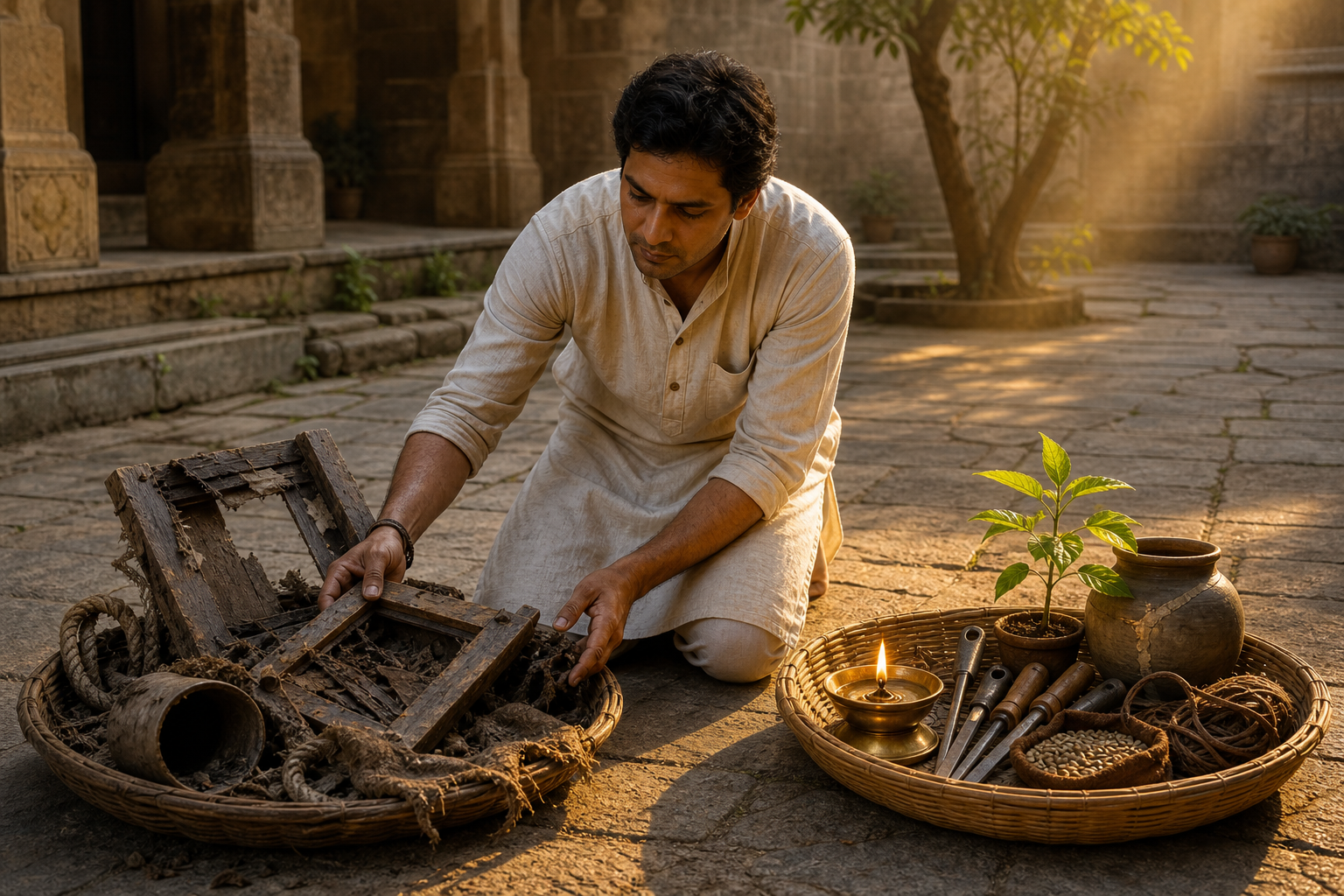
Samhara becomes useful when you can distinguish the container from what it contains. A family custom may be a container for gratitude. An organisational process may be a container for accountability. A daily routine may be a container for study or worship. When the container stops serving its purpose, you do not have to discard the value with it.
Work through the decision in this order:
- Name the form precisely. Avoid sweeping declarations such as everything must change. Identify the schedule, rule, role, habit, expectation, or pattern that is actually causing obstruction.
- State its original dharmic purpose. Ask what it was meant to protect or cultivate: trust, learning, devotion, livelihood, responsibility, social order, or care.
- Describe the failure as conduct, not identity. A repeated action can be confronted and changed. Declaring a person inherently impure or irredeemable closes the door to discernment and invites hatred.
- Preserve what remains life-giving. If a ritual still nourishes devotion but its administration excludes or humiliates people needlessly, correct the administration without treating the sacred purpose as disposable.
- Choose the least harmful adequate dissolution. A boundary may be enough where total separation is unnecessary. A periodic review may correct a policy that does not need abolition. Direct conversation may release resentment that silent withdrawal would deepen.
- Install a worthy successor. Replace an abandoned habit with a practice, a revoked rule with a clear standard, or an ended obligation with an honest allocation of time. Otherwise the old pattern often returns under another name.
- Judge the fruits. Look for less compulsion, greater truthfulness, stronger capacity to perform duty, and more compassion without loss of courage.
Ahimsa is essential to this test, but it does not require passivity before adharma. Non-harm and firmness can operate together. You can oppose a harmful act, defend a boundary, or reform an institution without cultivating delight in another person’s suffering. Vairāgya helps because it loosens the need to possess either the old arrangement or the emotional satisfaction of defeating an opponent.
Watch for false Samhara. It often announces itself through urgency, dehumanising language, indiscriminate rejection, or the belief that suffering inflicted on others proves moral seriousness. Authentic dissolution is more exact. It removes what obstructs dharma and accepts responsibility for what follows.
Practise release without suppressing what you feel

You do not have to wait for a dramatic crisis to practise Samhara. Small, deliberate acts of release train discernment before a larger transition demands it. Use the following contemplation with one actual pattern rather than a vague wish to become detached.
- Sit with a symbol of Shiva. A Nataraja image, Shiva liṅga, or remembered form is enough. Let it orient the mind toward the complete movement of dissolution and grace.
- Name what is passing. Complete this sentence inwardly: I am releasing my grip on this formation. Name a resentment, status, expectation, habit, or completed role. Do not name a human being as the object to be erased.
- Notice the difference between fact and formation. A thought, mood, or self-description may be present without being a final truth. Observe how it arises, changes, and loses intensity when it is not continually fed.
- Use the out-breath for japa. Recite Om Namaḥ Śivāya quietly as the breath leaves. Let the exhalation represent relinquishment, but keep the breath natural rather than forcing it.
- Ask what remains when grasping softens. Look for the duty, value, or awareness that does not depend on maintaining the old identity.
- Choose one visible act. Have the overdue conversation, remove the recurring distraction, revise the unworkable commitment, return an object you no longer need, or resume the neglected duty that resentment displaced.
The point is not to suppress grief, anger, or fear. Suppression keeps a formation active while denying its presence. Samhara asks you to see the formation clearly, refuse to let it rule your conduct, and release the attachment that keeps reproducing it.
Traditional disciplines give this inward movement a ritual body. Mahāśivarātri, observed on kṛṣṇa pakṣa caturdaśī, brings vigil, fasting, chanting, and alert stillness together. Recitation of Śrī Rudram can orient worship toward Rudra-Shiva’s presence throughout the changing world. Applying vibhūti after prayer can serve as a bodily reminder that status, possession, and self-image are temporary. These practices mature when their effect appears in your conduct: less reactivity, cleaner speech, and greater readiness to serve.
Śaiva traditions explain the inward process in distinct ways. Kashmir Śaivism understands reabsorption through recognition of one’s luminous nature as Shiva, as limiting superimpositions subside. Śaiva Siddhānta describes the attenuation of āṇava, māyīya, and kārma malas through disciplined worship, ethical action, and grace. The formulations should not be collapsed into a single doctrine, but both direct attention away from annihilating the essential self and toward removing what obscures spiritual freedom.
Carry Samhara from personal change into public dharma
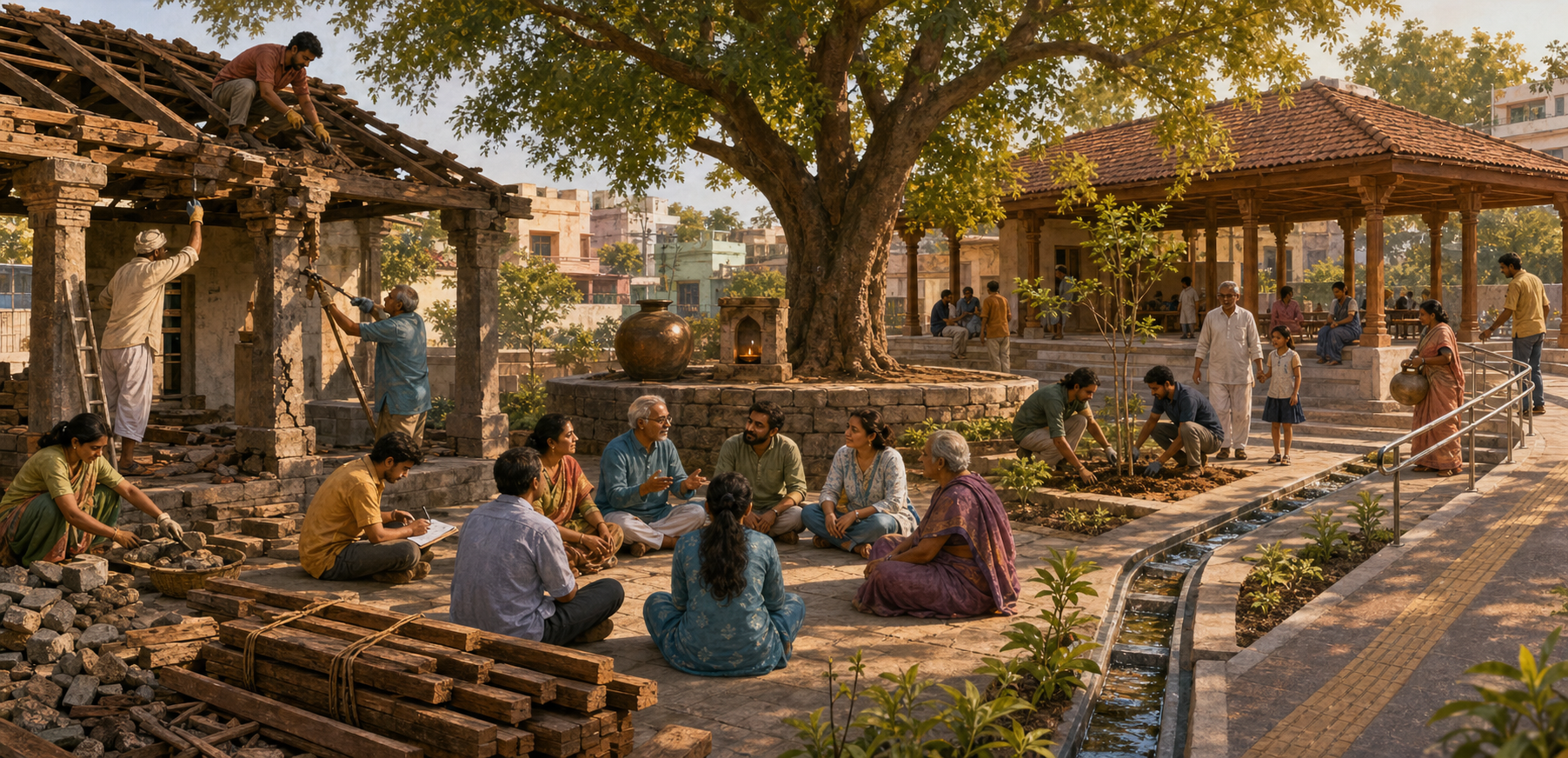
A society needs continuity, but continuity is not the same as freezing every inherited form. Dharmic renewal requires the ability to protect what is sacred while retiring arrangements that have become unjust, wasteful, or incapable of carrying their purpose.
- In a household, preserve care and responsibility while ending routines that create needless exhaustion or resentment. Do not confuse an old schedule with the family value it was designed to serve.
- In a temple or community organisation, distinguish the sanctity of worship from administrative habits. Procedures can be reviewed without treating the tradition itself as a disposable obstacle.
- In ecological conduct, accept limits on consumption and build cycles of repair, reuse, and regeneration. Endless acquisition denies the rhythm of return on which renewal depends.
- In civic life, use periodic review, evidence-based reform, and sunset provisions where a rule should not continue merely through inertia. Ending a failed mechanism should be followed by a clear account of the duty that still needs to be fulfilled.
- When confronting adharma, direct firmness toward actions and structures. Refuse language that turns whole populations into embodiments of evil, because dehumanisation destroys the discernment a just response requires.
Related insights appear across Dharmic traditions without becoming interchangeable. Buddhist attention to anicca trains awareness of arising and passing without clinging. Jain nirjarā concerns the shedding of karmic accretions, while anekāntavāda loosens the dogmatism that mistakes one perspective for the whole. Sikh trust in hukam cultivates steadiness within divine order as circumstances change. These resonances give Hindus, Buddhists, Jains, and Sikhs a basis for serious conversation about impermanence, discipline, and ethical renewal while respecting their doctrinal differences.
Before your next consequential ending, write three lines: the form that has completed its work, the dharmic value that must survive, and the practice or structure that will carry that value forward. If the third line remains blank, pause. Clearing space is only half of Samhara; what you allow to arise in that space reveals whether the dissolution served dharma.