

If you have ever stood before a Shivalinga and wondered why the limitless is represented in stone, you have reached the central question of Shiva worship. How can Shiva be beyond every name and quality, yet also be Mahadeva: named, imaged, adorned, loved and approached through ritual?
You do not have to choose between the formless Absolute and the sacred form before you. Shiva and Parvati reveal why both belong together. Their unity gives you a way to understand the images in a shrine, deepen an ordinary puja and carry its meaning into your relationships and decisions.
Nirguna and saguna are not two competing realities
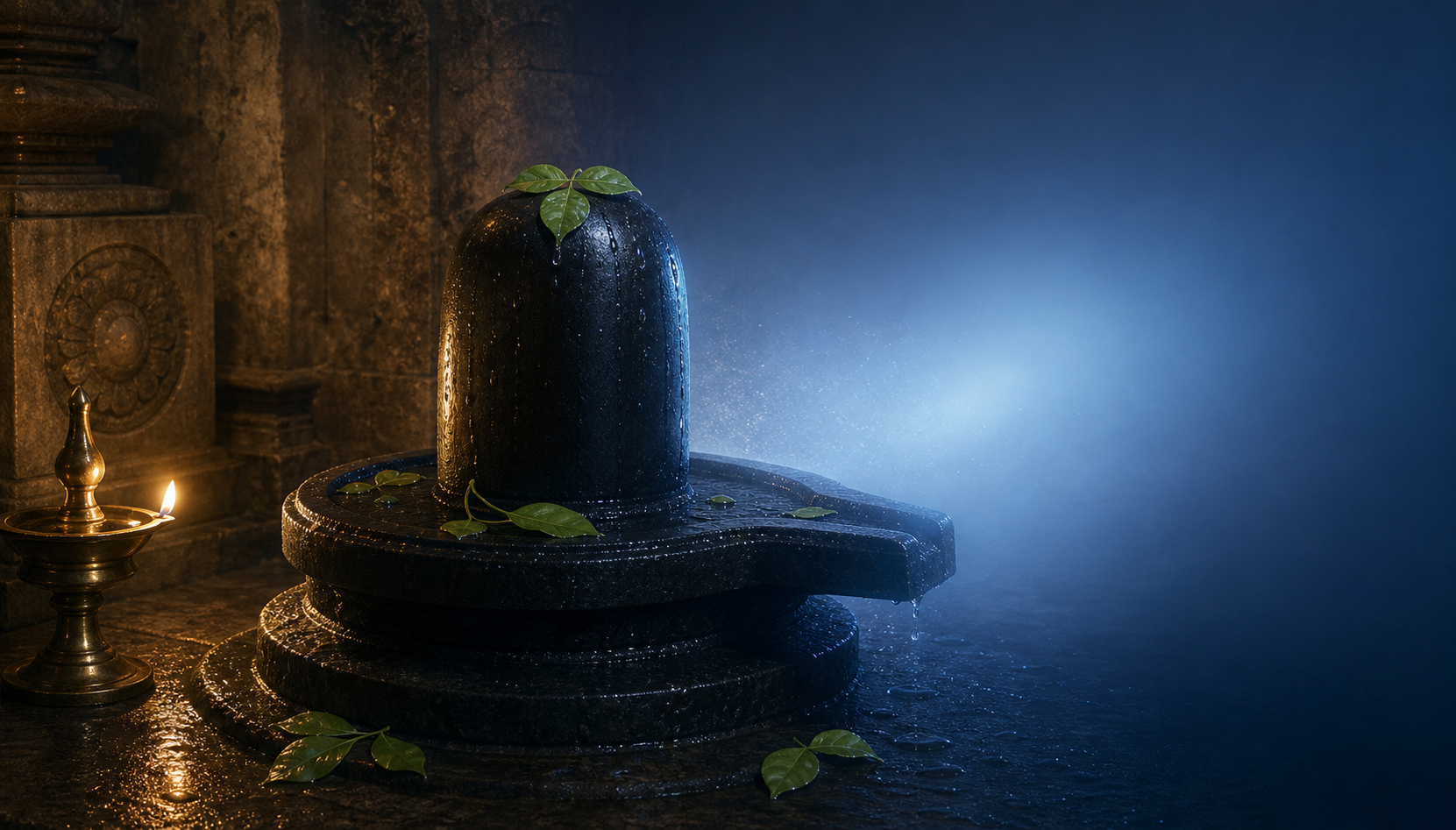
The apparent contradiction begins to dissolve once you distinguish between a form and a limit. A sacred form gives your attention somewhere to rest; it does not claim to contain the whole of Reality.
Nirguna means that no finite attribute can exhaust the Absolute. Saguna means that the same Absolute can become present to human consciousness through qualities, names, relationships and images. These are two modes of approaching one inexhaustible Reality, not two deities occupying separate levels of existence.
Within this Shaiva vision, Shiva is pure awareness: the unbounded field in which every perception, thought and action becomes known. Parvati is Shakti: the power through which awareness appears as life, movement, perception, devotion and transformation. She is not an ornamental addition to an otherwise complete philosophy. She is the divine potency by which the unmanifest becomes manifest and the unknowable becomes available to love.
Nor are Shiva and Parvati two independent substances that must later be joined. Their difference gives us a language for contemplating Reality from complementary directions. Shiva names its changeless ground; Shakti names its capacity to appear and act. Their relationship resembles fire and heat, the moon and its light, or a word and its meaning. You can distinguish the aspects in thought, but you cannot remove one without losing the living reality of the other.
This gives you a practical diagnostic. If spirituality makes you contemptuous of the body, the world, ritual or compassionate action, you may be using the formless to escape Shakti. If your worship becomes a stream of gestures performed without attention, you may be handling Shakti’s forms while forgetting Shiva, their conscious ground. The correction in either case is integration: bring awareness into action and allow action to express awareness.
Unity does not mean sameness. Shiva and Parvati remain fully meaningful as a divine pair, and personal devotion need not be dissolved into abstract philosophy. Their love, difference and intimacy are precisely what make a difficult metaphysical truth available to the heart.
How to read the sacred forms without stopping at the image
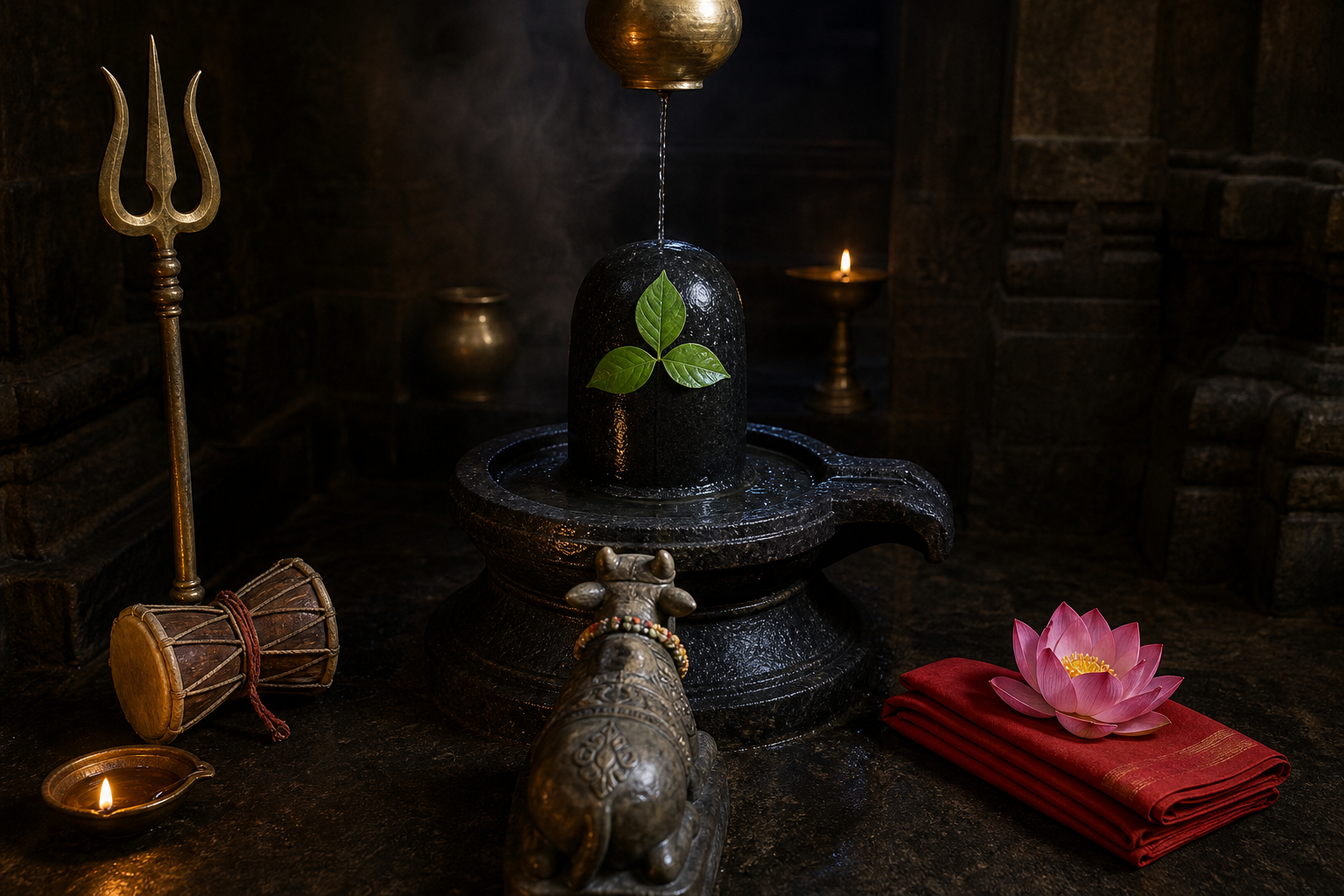
Shaiva iconography is a contemplative language. Instead of asking only what an image depicts, ask what relationship it teaches you to notice.
Ardhanarishvara: begin from the wholeness
Ardhanarishvara presents Shiva and Parvati in one body. In this theological reading, the image is not a claim that human personality or social duty can be divided neatly into male and female halves. It is a diagram of consciousness and creative power as an indivisible whole.
Read the image from its unity outward. Difference appears within wholeness; wholeness is not manufactured by forcing separate pieces together. When you contemplate Ardhanarishvara, ask two questions: What gives my activity clarity and direction? What turns my inward understanding into effective care? The first question recalls Shiva; the second recalls Shakti.
Shivalinga and yoni: the sign and its power to manifest
The Shivalinga is a linga, a sign. Its non-portrait form directs the mind beyond physical likeness toward what cannot be confined within an image. The yoni or pedestal signifies Shakti, the matrix of manifestation. The complete symbol therefore joins the unmanifest ground with the power through which existence takes form.
Do not mentally isolate the linga from its base. Their relation is the teaching. During abhishekam, let the outward offering train the inward movement of your attention. Notice the form, perform the gesture with care, and then become quiet enough to recognise the awareness in which the whole act occurs. Puja has then done more than produce a devotional mood; it has led you from form toward its ground.
Nataraja: stillness does not exclude movement
Nataraja makes the same unity visible as dance. The movement encompasses emergence, maintenance, concealment, revelation and repose. Parvati need not appear separately in the image for Shakti to be present: the power of the dance is Shakti, while the conscious dancer is Shiva.
You can observe this rhythm without constructing a grand theory. A thought arises, persists and disappears. Confusion conceals what is present; insight reveals it; silence remains when the movement subsides. The changing experience and the awareness of change are distinguishable, but never encountered apart. Nataraja turns that ordinary fact of experience into a sacred vision.
A practice that moves from form to the formless
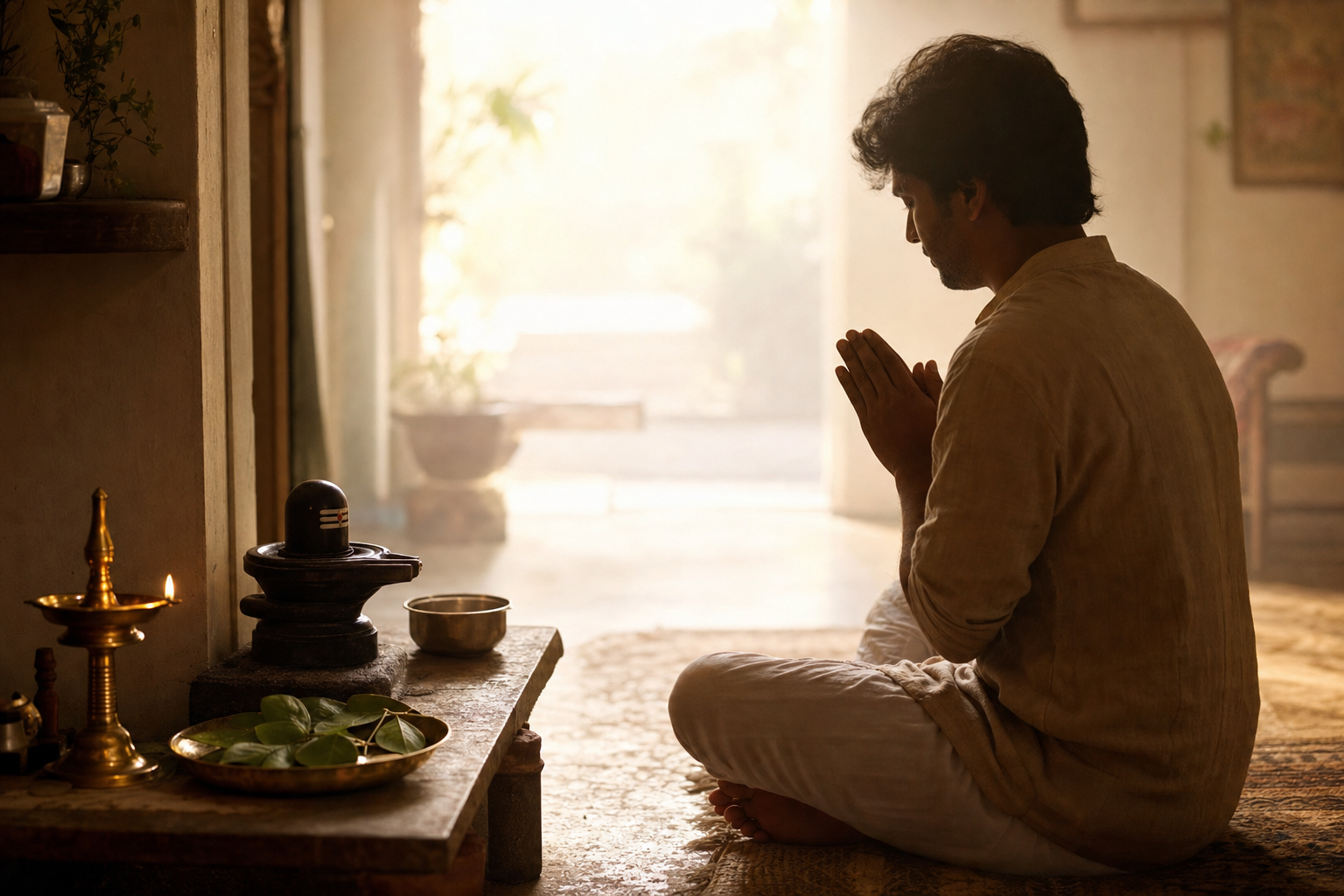
You do not need to abandon puja for philosophy, or abandon philosophy for ritual. Use a sequence that lets each complete the other: approach through form, engage through devotion, rest in awareness and return to action.
- Choose a form deliberately. Sit before an image of Uma-Maheshvara, Ardhanarishvara or Nataraja, or before a Shivalinga. Look without rushing. Recognise that the form is a doorway, not a boundary around the Divine.
- Make one embodied gesture. If abhishekam or the five-offering Panchopachara belongs to your established practice, perform it according to your family, temple or lineage tradition. Otherwise, a respectful bow or joined palms is enough for this contemplation. The point is to let devotion involve the body rather than remain a private idea.
- Repeat Om Namah Shivaya. Attend both to the mantra’s vibration and to the awareness that knows the sound. The arising sound can remind you of Shakti; the knowing presence can remind you of Shiva.
- Allow silence after the mantra. Do not force the mind into blankness. Notice breath, sensation, sound and thought appearing within awareness. Forms may continue to arise; the practice is to recognise their ground, not to wage war against them.
- Give the recognition a form in conduct. Choose the next duty in front of you and do it attentively. A spiritual insight that never enters speech, work, service or restraint has not yet been honoured as Shakti.
If your practice feels dry and distant, place more attention on the form, offering and devotional relationship. If it feels hurried or mechanical, reduce the inner commentary and preserve a period of silence after the gesture. If meditation leaves you passive, complete one necessary action. If activity scatters you, pause before beginning it. These are not rival paths; they are adjustments that restore the balance between consciousness and power.
Kundalini Yoga expresses this integration through a more specialised map: Shakti rests at the muladhara, ascends through the chakras and unites with Shiva at the sahasrara. You can understand the journey from the root to the crown as a language of integration without turning dramatic sensations into a measure of spiritual worth. Breath, attention and mantra are meant to mature recognition, not furnish experiences with which to rank yourself or others.
Bring Shiva-Shakti unity into household decisions

Gauri-Shankar is often honoured as a household ideal because a home needs both steadiness and warmth, discernment and care, inward composure and outward effort. This symbolism should not be converted into a rule that men must represent Shiva while women must represent Shakti. Every person requires both capacities, and a healthy partnership permits both people to exercise awareness, initiative, restraint and compassion.
Use the unity as a three-question test when a conversation or decision is difficult:
- What must remain steady? Name the truth, value or commitment that should not be traded away. This is the Shiva question.
- What must now take form? Identify the sentence, boundary, apology, service or decision through which that value must become real. This is the Shakti question.
- Does the action preserve both clarity and care? If it has care without truth, it may become avoidance. If it has force without reflective awareness, it may become injury rather than resolution.
Saying that you value harmony while refusing a necessary conversation leaves the value formless. Acting in the heat of emotion without first seeing clearly gives energy no trustworthy direction. The Uma-Maheshvara pattern asks you to pause without withdrawing and act without losing your centre.
The same discernment helps when different forms of worship meet. One person may approach Shiva through elaborate puja, another through japa and another through silent contemplation. The principle of Ishta, the chosen form of the Divine, allows a form to be loved wholeheartedly without treating it as the only door available. You do not have to erase distinctions among paths. Look instead at what a practice produces: clearer attention, less ego-driven conduct, greater compassion and a more faithful discharge of duty.
Key takeaways
- Formless and formed describe two ways of encountering one Reality; a sacred form reveals the limitless without containing it.
- Shiva names consciousness, while Parvati names its power to appear, know, act and transform. They can be distinguished in thought but not divided in reality.
- Ardhanarishvara, the Shivalinga with its yoni and Nataraja each teach the same unity through a different visual grammar.
- A complete practice moves from sacred form to mantra, from mantra to silence and from silence to deliberate action.
- In daily life, ask what must remain steady and what form it must now take. This joins clarity to care instead of sacrificing one for the other.
At your next puja, do not add complexity merely to feel more religious. Add one attentive pause. See the form, make the offering, repeat the name, become silent and then carry that steadiness into one concrete duty. In that movement, Parvati does not lead you away from Shiva; Shakti makes Shiva’s presence livable.