

You may be asking two different questions as you age: Can your body still learn demanding movement, and do you still belong among younger surfers or yoga practitioners? The first requires honest training. The second should never have been in doubt.
You do not have to choose between denying bodily change and withdrawing from the activities that make you feel alive. Surfing can become more deliberate, Ashtanga can become more attentive, and Dharmic practice can free you from treating youthfulness as proof of worth.
Key takeaways for older surfers and yoga practitioners
- Return to surfing as a learner, even if you were once experienced. Rebuilding paddling, board control, pop-up timing and ocean awareness is more useful than trying to recover an old identity.
- Use manageable waves and repeatable drills to retrain fear after an accident. Increase the challenge only when attention and judgment remain available.
- Let Ashtanga develop breath, concentration, mobility and steadiness. Do not turn another practitioner’s series or schedule into a test of your own adequacy.
- Judge ageing by function as well as appearance. Weathered skin cannot tell you how well someone balances, moves, learns or meets a difficult wave.
- Practise acceptance without passivity: acknowledge the body you have, train it intelligently, protect it from avoidable harm and release the demand that it look young.
Rebuild surfing as a skill, not a performance of youth
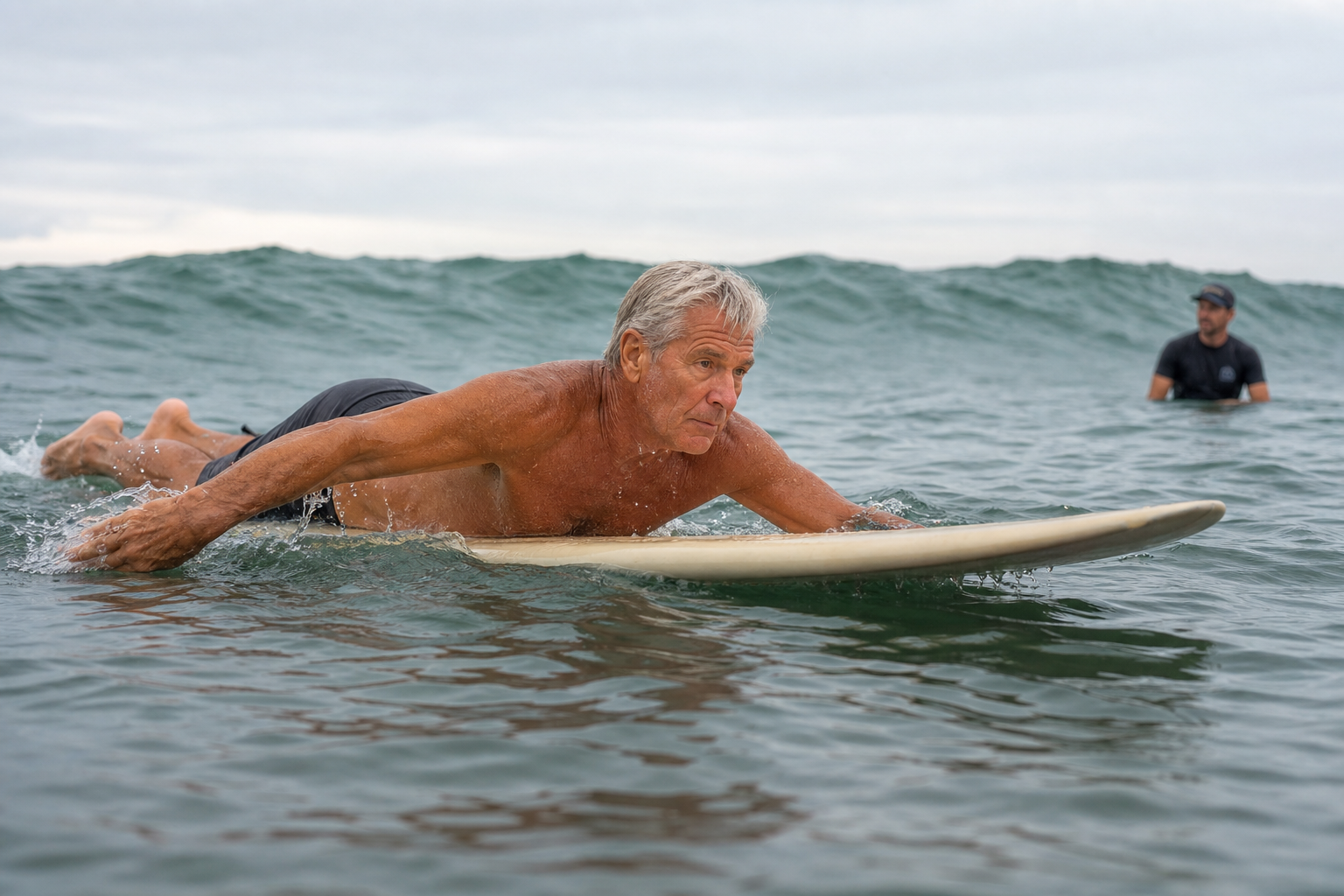
A previous level of ability can become a trap when you return after years away. Memory says you should already know how to surf. Your timing, conditioning and threat response may disagree. If you try to settle that argument in powerful surf, pride will make decisions that attention should be making.
One return to the water began at fifty with ten foundational lessons after a decade away. That reset mattered because the earlier chapter had ended with a serious accident that nearly damaged the surfer’s teeth. Two years of consistent practice did more than one dramatic act of courage could have done: it restored skill while giving the body repeated experiences of manageable risk.
If fear remains after a fall, it is not evidence of weakness. The nervous system has learned that a particular combination of speed, water, impact and loss of control may be dangerous. A forceful return can reinforce that lesson. Graded exposure gives it new information.
- Begin in conditions that leave enough attention for learning. Rehearse paddling mechanics, board control, the pop-up and safe exits before chasing larger waves.
- Repeat the fundamentals until they no longer consume all your concentration. You need spare attention to read the wave, notice other surfers and revise a bad decision.
- Introduce variation deliberately. Different breaks, tides and wind angles build adaptable skill, but variety is useful only after you have recovered a reliable baseline.
- Use coaching early, then gradually depend less on external cues. The aim is to recognise trim, timing and balance through your own sensory feedback.
- Assess the actual break before every paddle-out. Rip currents, the impact zone, crowd behaviour, bathymetry, swell period and the available exit matter more than what your birthday supposedly permits.
This approach is neither timid nor age-specific. It is how durable motor learning works: repeat a task, vary its context, receive useful feedback and slowly develop an internal feel for the movement. Age does not make those principles obsolete. It makes careless comparison even less useful.
Do not use breathwork or determination to override an unsafe situation. If a past injury still causes pain or loss of function, get an appropriate clinical assessment before loading it in the surf. If fear produces severe or persistent panic, especially away from the triggering situation, a surf coach or yoga teacher is not a substitute for a licensed mental health professional.
Let Ashtanga support the surf instead of competing with it

Ashtanga and surfing ask for different kinds of responsiveness. The fixed sequence of the yoga practice gives you a stable field in which to observe breath, effort and habitual reactions. The ocean removes that predictability. Used together, one practice can sharpen the attention required by the other.
Breath-led vinyasa coordinates effort with respiration. Drishti steadies attention. Bandha work asks for organised rather than indiscriminate tension. Pranayama can support regulation when excitement begins to become agitation. None of these tools makes the sea safe, but they can help you notice your internal state before it takes control of a decision.
A practitioner completing the full Ashtanga Intermediate Series, Nadi Shodhana, six days a week while surfing daily demonstrates a possibility, not a prescription. The useful lesson is not that you must copy that volume. It is that chronological age alone cannot tell you what a carefully trained person can do.
Before combining a demanding yoga practice with a surf session, ask three concrete questions:
- What does the ocean require today? A powerful or unfamiliar break calls for judgment and available energy, not a need to prove that the morning practice did not affect you.
- What is ordinary effort, and what is a warning? Instability, sharp pain, dizziness or a loss of normal control should not be turned into a spiritual endurance test.
- Can the breath remain steady enough for attention to stay clear? When strain makes the breath ragged and awareness narrow, reduce the demand rather than romanticising the struggle.
Ashtanga becomes unhelpful when the series is used as a ranking system. A pose attained, lost or modified is information about the present body. It is not a verdict on discipline. Abhyasa means returning to practice; it does not mean forcing every day to resemble your strongest day.
The same distinction applies in the lineup. A clean takeoff reflects positioning, timing and execution. It does not become more or less real because the surfer is twenty-five, fifty-two or grey-haired. Train the capability that the activity actually requires instead of performing an age category imagined by other people.
Refuse ageism without making appearance your new project
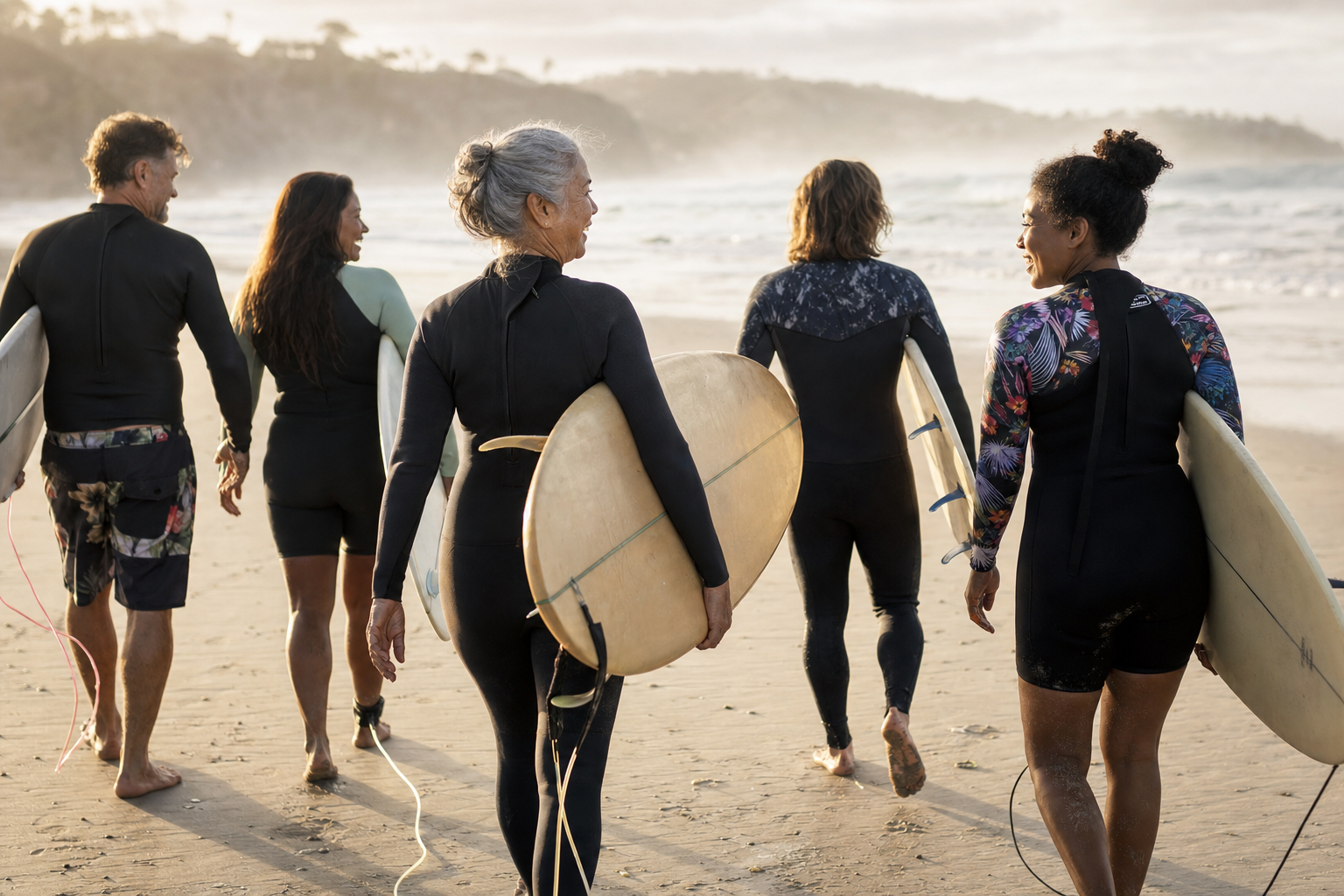
Ageism often arrives disguised as admiration. Someone says that they hope to be doing what you do when they reach your age. The compliment still assumes that capability has become surprising. A harsher remark about wrinkles or skin makes the assumption explicit: your visible age is being treated as the most important fact about you.
You do not need to win an argument about how old you look. That keeps appearance at the centre of the exchange. Correct the premise, set a boundary if necessary, and return your attention to the life being interrupted.
- For a curious but clumsy remark: “Age does not decide whether this wave is right for me. Skill and conditions do.”
- For unwanted appearance criticism: “I am not asking for an assessment of my skin.”
- For repeated commentary: “Let us discuss the practice, not my age or appearance.”
- For your own internal comparison: “What can I do, learn or recover today?”
Direct questions about age or appearance can carry different social meanings. In some Indian settings, they may be intended as familiarity rather than hostility. Context can explain a remark without making its effect harmless. You can recognise the probable intention, name the boundary and avoid turning one person’s bluntness into a judgment about an entire culture.
It also helps to understand why appearance is such a poor measure of vitality. Genetics and long exposure to equatorial sun can visibly weather the skin. UVA reaches into the dermis and can increase enzymes that degrade collagen and elastin; UVB contributes to pigment changes. Those processes say little about balance, endurance, motor learning, neuroplasticity or joy.
Separating appearance from worth does not require neglecting health. Shade, UPF clothing and broad-spectrum sun protection can reduce avoidable exposure. Use them because skin deserves care, not because wrinkles revoke your right to be seen.
Accept change without surrendering your agency
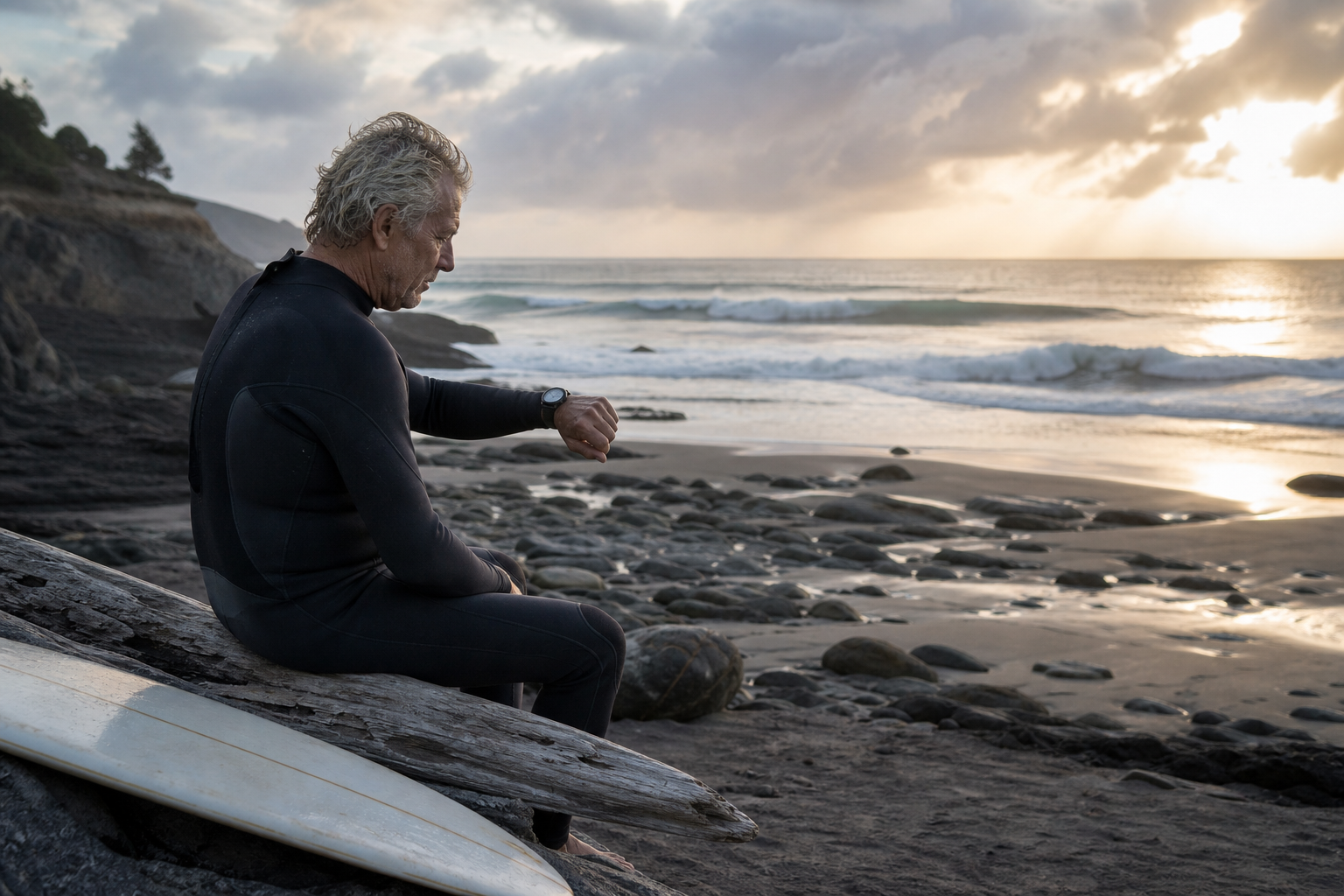
Dharmic acceptance is frequently mistaken for resignation. The difference is practical. Resignation says that change has happened, so effort is pointless. Acceptance says that change is real, so effort must begin from reality.
The Dharmic traditions are distinct and should not be collapsed into one doctrine. Yet each offers a discipline that can loosen the cultural demand to remain young.
- Hindu thought pairs abhyasa, steady practice, with vairagya, non-attachment. Train wholeheartedly without making a particular wave, posture or appearance the condition of self-respect.
- Buddhist anicca places bodily change within impermanence rather than personal failure. Metta asks you to meet the changing person with goodwill instead of contempt.
- Jain aparigraha challenges grasping, including the attempt to possess a permanently youthful image. Ahimsa applies to the language you direct toward your own body as well as to your conduct toward others.
- Sikh teachings on hukam and sehaj invite you to meet the natural order with equipoise. Acceptance does not remove duty, service or disciplined action; it removes the fantasy that dignity depends on defeating time.
You can turn those principles into a short practice around every session. Before entering the water or stepping onto the mat, choose one honest intention. During the practice, notice when effort becomes aggression. Afterwards, record what improved, what needs care and what outcome you need to release. This keeps reflection tied to conduct rather than vague inspiration.
Community helps when it is organised around practice rather than display. In a shala, pay attention to steadiness and generosity, not only advanced postures. In a lineup, respect sound positioning, clean takeoffs and responsible choices across generations. Belonging becomes ordinary when competence and conduct matter more than a youthful surface.
At your next session, choose conditions modest enough that you can pay attention, set one technical intention, and release any demand to look young while doing it. Then return and practise again. That is ageing with agency: neither denial nor retreat.