
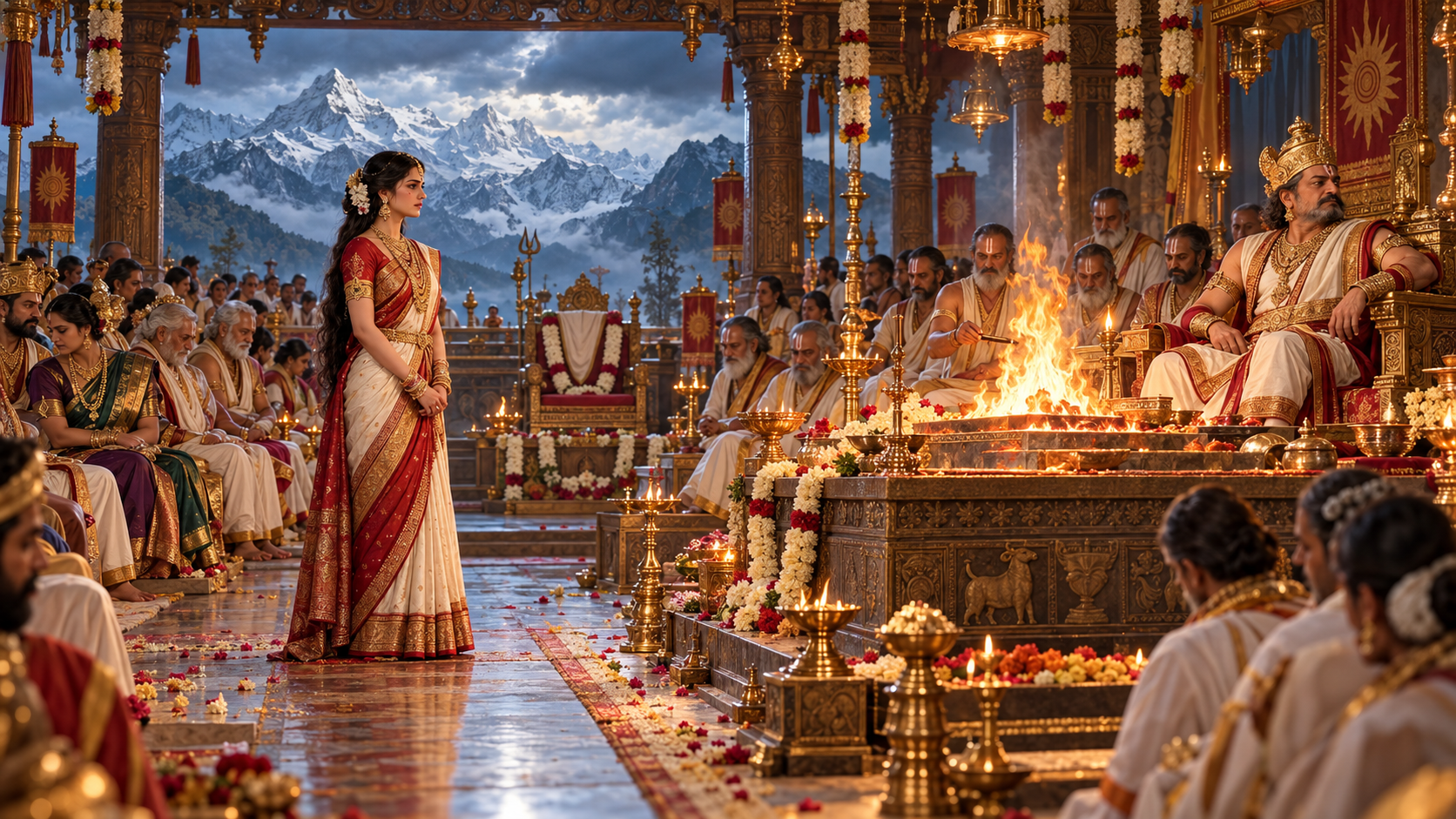
If you read Daksha’s sacrifice only as a story about Shiva losing his temper, the episode becomes easy to dismiss and difficult to use. The harder question is why a carefully arranged yajna could become so adharmic that its destruction carried more truth than its completion.
That question matters whenever a family, temple, or institution preserves the appearance of order while humiliating someone in the process. The story gives you a precise test: ritual remains sacred only while it serves right relationship, reverence, and dharma.
The conflict is not ritual against spirituality
Daksha’s yajna is more than a private religious ceremony. It is a public display of an ordered society: the host has authority, places are assigned, distinctions are observed, and recognition is distributed. Daksha Prajapati represents confidence in this visible structure.
Shiva stands beyond the structure by which Daksha measures worth. He dwells apart from settled society, bears ash rather than conventional signs of prestige, and keeps company with beings a polished social order would rather leave outside. He cannot be ranked by the very system whose limits he exposes.
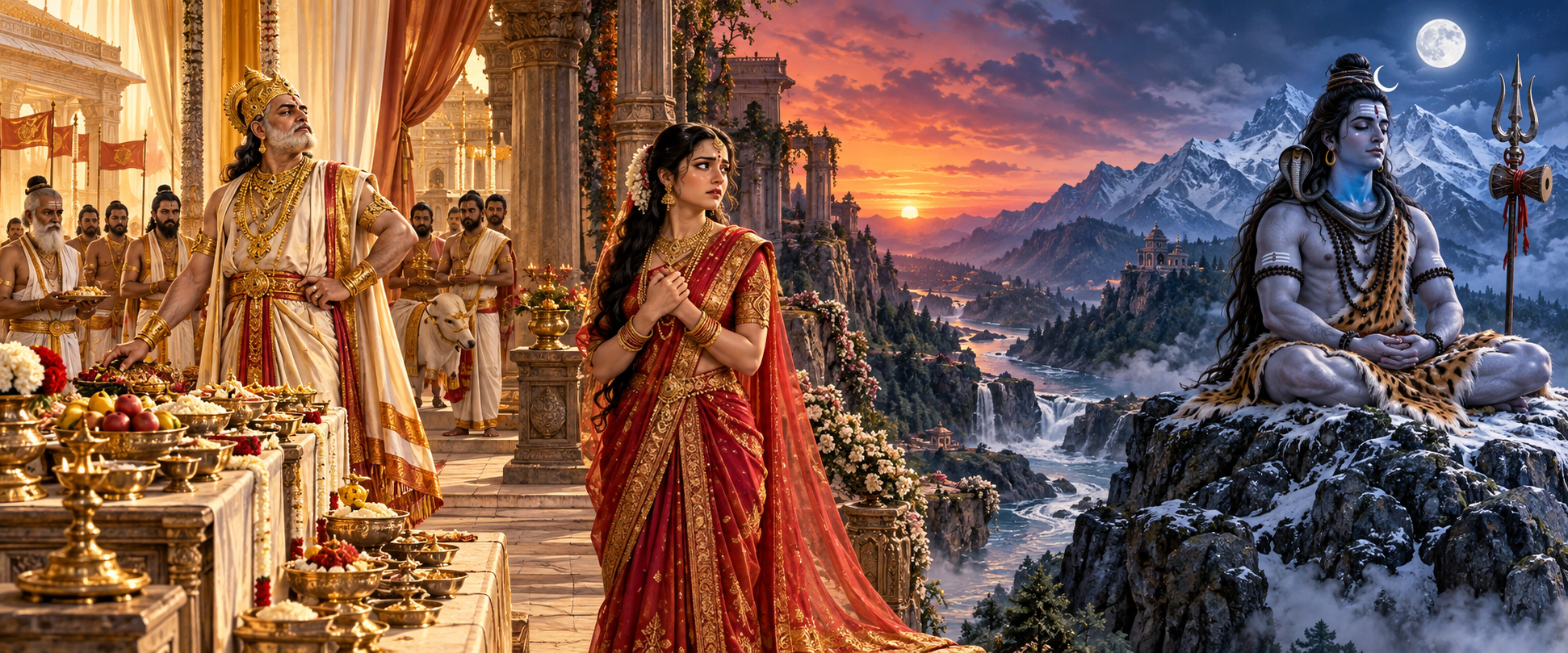
Sati stands at the point where these worlds meet. She is Daksha’s daughter and Shiva’s consort. The conflict therefore cannot remain an abstract disagreement between a householder and an ascetic. Contempt directed at Shiva passes through a living relationship, and Sati bears its cost.
The fall of Daksha’s yajna begins before its physical destruction. The ceremony is already broken when exclusion, pride, and contempt become part of its organising principle. A rite may still have a fire, offerings, guests, and correct procedure while losing the dharmic purpose that makes those forms meaningful.
Three things must therefore be kept distinct:
- Ritual is a form through which reverence, offering, and obligation are expressed.
- Social status is recognition granted by a community and its institutions.
- Dharma asks whether conduct sustains truth, responsibility, dignity, and right relationship.
These can support one another, but they are not interchangeable. A high office does not make every judgement righteous. Formal correctness does not purify contempt. Public recognition does not determine spiritual reality. Daksha’s error is not that he values order; it is that he mistakes his authority within an order for authority over what is sacred.
Daksha, Sati, and Shiva reveal three different failures
Daksha tests the person who holds authority
Daksha embodies competence without humility. He can convene a great event and occupy an honoured position, yet still fail at the relationship closest to the dispute. His ritual power does not correct his contempt; it gives that contempt a larger stage.
This is the Daksha test for anyone who leads: are you using a role to carry responsibility, or using responsibility to demand personal submission? The distinction becomes visible when someone who does not flatter you still deserves fairness. If disagreement automatically becomes disrespect, authority has begun to protect the ego rather than the institution.
Notice the mechanism. Pride rarely announces itself as pride. It presents itself as standards, decorum, eligibility, or concern for tradition. Those things can be legitimate, but the leader must still ask whether the same rule is applied consistently and whether it serves the rite’s purpose. A rule used selectively to diminish an unwelcome person is no longer merely a rule; it has become an instrument of status.
Sati tests whether you can see the human cost
Sati must not be treated as a device that moves a quarrel between two men toward its violent climax. Her presence reveals where the injury actually lands. Daksha’s contempt for Shiva also dishonours the choice, bond, and dignity of his own daughter. What he treats as a judgement about another man becomes a wound inside his family.
This gives you a second diagnostic question: who is being required to absorb the pain so that everyone else can keep calling the occasion orderly? A ceremony can appear successful because the injured person remained silent, left the room, or was described as oversensitive. Sati prevents that convenient accounting. The hidden cost is part of the moral result.
Her name in this narrative should also not be carelessly collapsed into the later historical practice commonly called sati. Here Sati is a divine figure with moral agency in a mythic conflict about kinship, dignity, and the sacred. Confusing the proper name with a later social custom prevents a careful reading of either subject.
Shiva tests the limits of respectability
Shiva does not depend on Daksha’s approval, invitation, or ranking for his reality. That independence is precisely why he unsettles a status-conscious order. He represents what cannot be domesticated merely by declaring it improper.
This does not make every outsider righteous or every convention false. It means that appearance and truth must be judged separately. Ash, solitude, wild companions, and distance from social hierarchy make Shiva difficult to assimilate, but strangeness is not evidence of spiritual inferiority. A society that recognises only polished respectability will eventually exclude truths it needs.
Apply the Shiva test when a person’s clothes, caste location, manner, community, or lack of institutional polish begins to determine whether you will hear them. You need not approve every claim. You do need to examine the claim without making conformity the price of attention.
Why the destruction of the yajna is morally significant

A yajna is an act of offering. Its outward form points beyond possession and ego: something is given, relationships are acknowledged, and human action is placed within a larger order. Daksha turns that logic inward. The sacrificial gathering becomes a means of displaying who belongs under his terms.
The result is a contradiction. A rite of offering is governed by possessiveness. A sacred assembly becomes a theatre of exclusion. Formal order conceals relational disorder. The yajna’s destruction makes visible what its grandeur had hidden.
Shiva’s response follows Sati’s death and must be read through bereavement as well as cosmic judgement. The story does not ask you to pretend that grief is mild. Nor does it give ordinary people permission to convert personal injury into revenge. Myth enlarges the consequence so that the moral structure cannot be missed: when an institution protects contempt long enough, it can lose the legitimacy that held it together.
In ordinary life, that collapse usually arrives without a divine confrontation. It appears as children withdrawing from a family, volunteers abandoning an organisation, worshippers losing trust in a committee, or members obeying publicly while disengaging inwardly. By the time the rupture is visible, the decisive injury may have happened much earlier.
The practical sequence is worth noticing:
- A person with authority turns dislike into a judgement about worth.
- The group protects the authority because preserving the occasion feels easier than confronting the insult.
- The injured person is expected to carry the cost quietly.
- Procedure continues, allowing everyone to mistake continuity for health.
- Trust finally collapses, and the institution experiences the consequence as sudden.
The story directs your attention to the first two stages, when correction is still possible. Do not wait for visible destruction before admitting that the sacrifice has gone wrong.
Key takeaways for reading the story clearly
- Daksha’s failure is not ritual observance itself; it is the use of ritual authority to legitimise pride and exclusion.
- Sati reveals that a public contest over honour produces a private and embodied cost.
- Shiva’s unconventional form exposes the weakness of judging spiritual worth by social respectability.
- The yajna fails inwardly before it is destroyed outwardly because its form no longer serves its dharmic purpose.
- The narrative is a warning against institutions that defend procedure after reverence, fairness, and relationship have been abandoned.
Use the story before your own ritual reaches a breaking point

You can use this episode as a practical examination before a family ceremony, temple programme, religious festival, or community meeting. The aim is not to remove all rank or procedure. Complex events need roles. The aim is to stop a legitimate role from becoming a shield for adharma.
- Name the purpose. State what the gathering is meant to honour. If a decision does not serve that purpose, ask why it belongs.
- Identify the concealed cost. Ask who must accept humiliation, silence, or unequal treatment so that the event can proceed without discomfort.
- Separate requirement from preference. Distinguish an actual ritual obligation from a host’s wish to control recognition, seating, speaking, or prestige.
- Repair the relationship before defending the programme. Completing the schedule does not cure an insult. A pause, acknowledgement, or correction may protect the rite better than flawless timing.
- Make room for the Shiva principle. Hear the inconvenient person without first demanding that they look, speak, or behave like the established circle.
- Judge the result by its residue. After the event, look for greater trust, humility, and shared obligation. If fear and resentment have increased, outward success is not enough.
Two opposite misreadings should be avoided. The first uses Daksha to condemn every institution, elder, or convention. That misses the need for responsible order. The second uses the sanctity of tradition to excuse whatever an office-holder does. That repeats Daksha’s confusion of position with dharma.
There is also a subtler danger in romanticising destruction. By the time Shiva’s fury dominates the story, prevention has already failed. The useful moment for you comes earlier: when contempt is still being called etiquette, when an injured person is still being told to endure, and when a leader can still choose humility without losing the institution.
At your next sacred or communal gathering, ask the uncomfortable question before the formalities begin: does this arrangement honour the purpose of the rite, or merely the prestige of its organisers? That pause is small, but it is where Daksha’s yajna could have taken a different course.
References

Leave a Reply
You must be logged in to post a comment.