
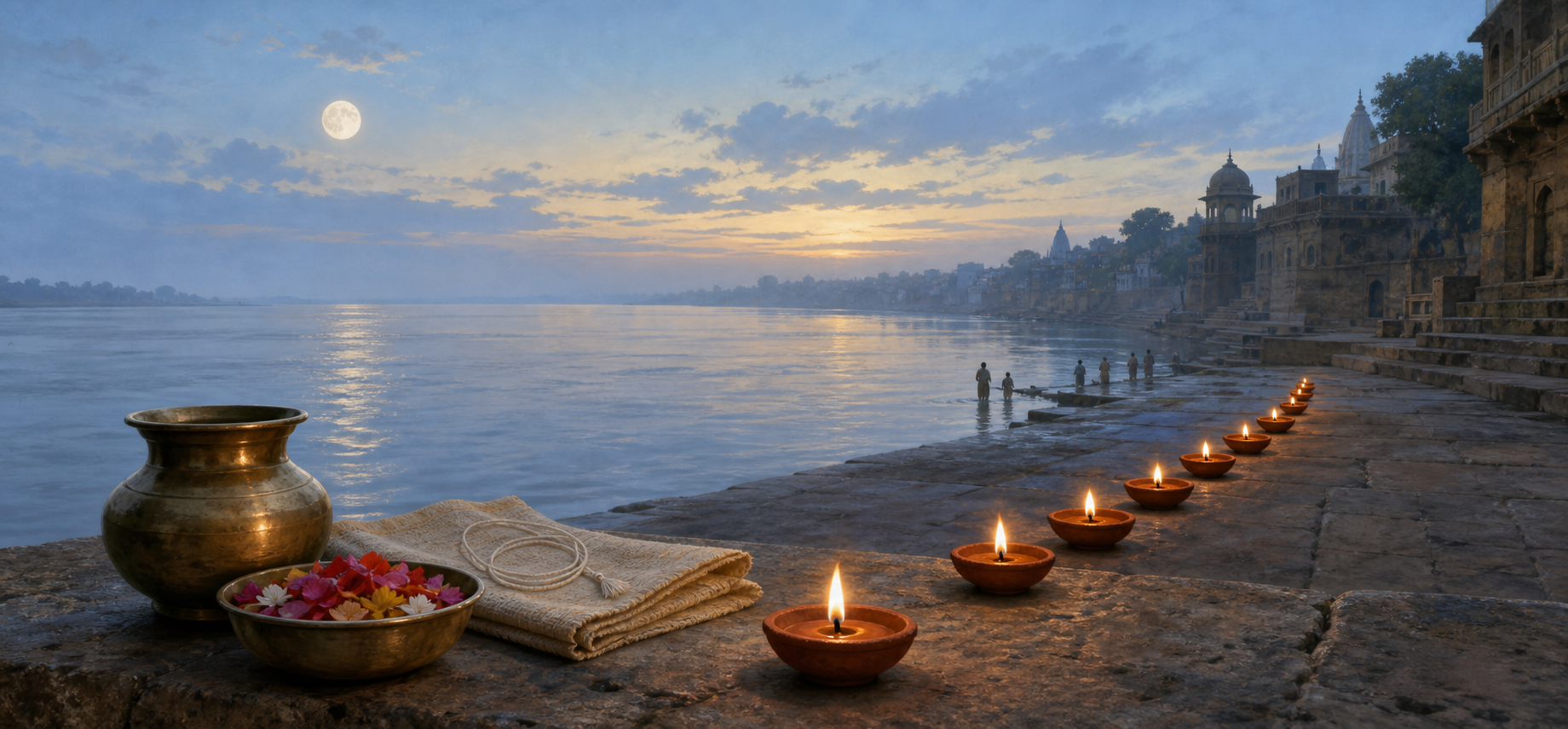
If you are setting your family’s Jyeshtha calendar for 2026, reserve two periods first: 15-24 June for Ganga Dussehra and Monday, 29 June for Jyeshtha Purnima. Those dates give you the structure; your sampradaya, region, and local panchang determine how you fill it.
You do not need to compress every custom into one crowded puja. A more faithful plan is to understand what each observance asks of you: disciplined purification during Ganga Dussehra, service to water and community on Dashami, and a lineage-appropriate vrata or darshan on the Full Moon.
The Jyeshtha 2026 dates to reserve now
Key takeaways
- 15-24 June: The traditional ten-day Ganga Dussehra observance, beginning with Jyeshtha Shukla Pratipada and culminating on Dashami.
- Wednesday, 24 June: Ganga Dussehra’s principal day for snana, Ganga puja, dana, environmental seva, and community aarti.
- Monday, 29 June: Jyeshtha Purnima, observed as Dev Snan Purnima in the Jagannath tradition and as Vat Purnima in several western regions. Many households also perform Sri Satyanarayana Vrata.
- Outside India: Jyeshtha Purnima may fall on 28 or 29 June according to the local time zone and the rule used for the vrata. Confirm the date for your city rather than converting an Indian temple schedule mechanically.
Treat these as planning anchors, not substitutes for a regional almanac. A tithi is an astronomical interval and does not begin neatly at midnight. The applicable civil date can depend on whether Dashami or Purnima prevails at sunrise, during the evening puja period, or at another time prescribed by the vrata.
Make Ganga Dussehra a ten-day discipline, not a one-day dip
Ganga Dussehra remembers Bhagiratha’s tapas and Ganga’s descent, with Shiva receiving her tremendous force through his matted locks. The name is traditionally associated with the removal of ten forms of wrongdoing: three expressed through the body, four through speech, and three through the mind. That framework gives the ten days a practical purpose. You are not merely preparing bathing materials; you are examining conduct.
From 15 through 23 June, choose one restraint you can actually sustain. It might be greater care with angry speech, a sattvika diet, daily japa, a Ganga stotra, or a deliberate reduction in wasteful water use. Keep the practice modest enough to repeat every day. The value lies in continuity, not in announcing an austerity that collapses halfway through the festival.
A workable plan for Dashami on 24 June
- Begin in the morning. Make a sankalpa and perform snana. At a river or ghat, follow the designated bathing rules and offer arghya to Surya without obstructing other pilgrims. At home, bathe normally and establish a clean kalasha containing fresh water, with Gangajal if you have it.
- Invoke the sacred rivers. The familiar prayer beginning with Ganga and Yamuna also remembers Godavari, Sarasvati, Narmada, Sindhu, and Kaveri. Its geographical breadth matters: reverence for Ganga should deepen your respect for every life-sustaining river.
- Keep the puja focused. Offer a lamp, incense, flowers, and naivedya according to your household practice. Recite a hymn to Ganga Devi or spend the time in attentive japa rather than multiplying unfamiliar procedures.
- Complete dana while the day is still young. Sets of ten lamps, fruits, grains, garments, or other useful items carry the festival’s tenfold symbolism. Ten is a devotional form, not a demand for expensive display. Clean drinking water, food support, and assistance to elders make the symbolism tangible.
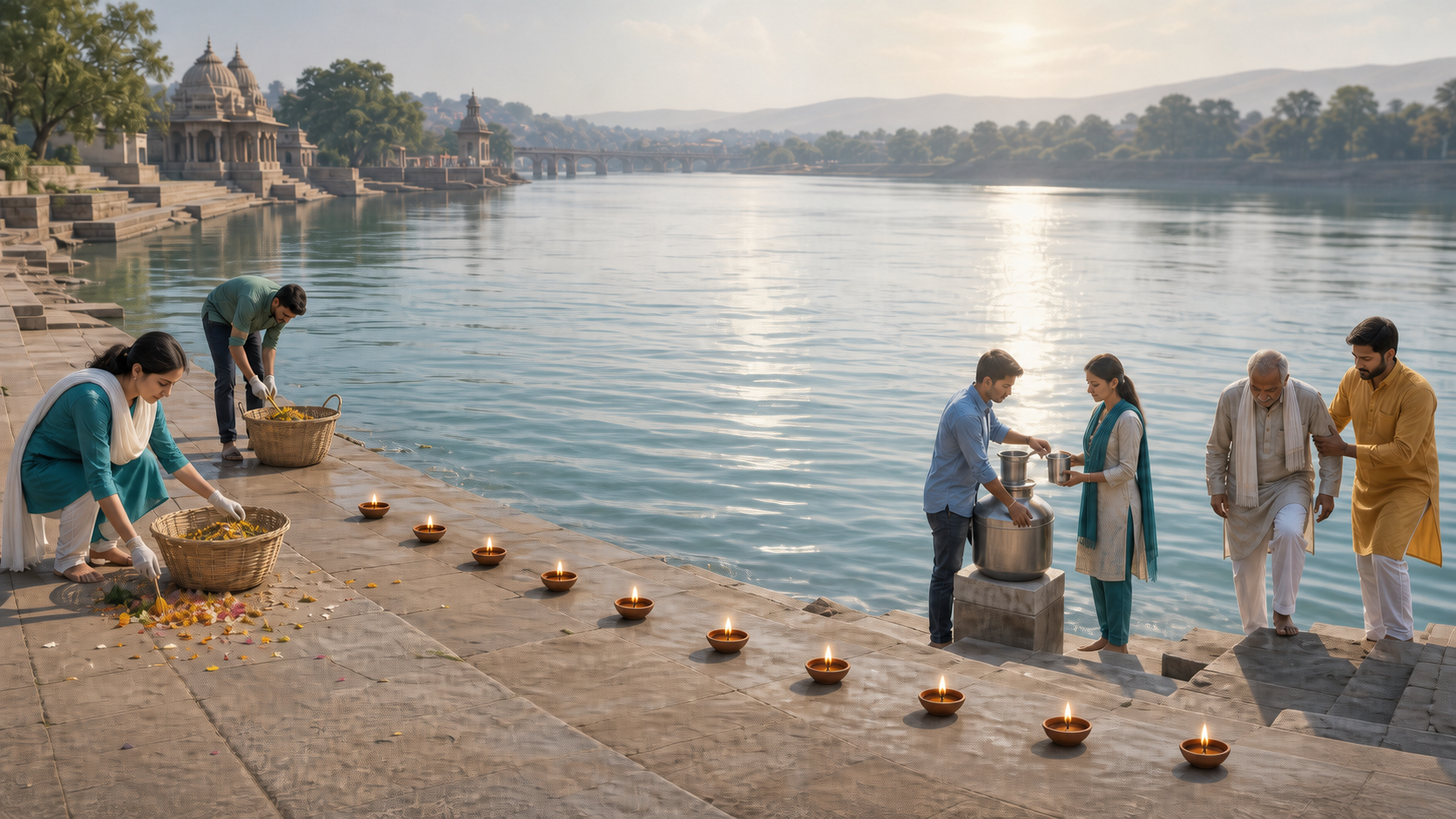
- Close with gratitude. Join an evening Ganga aarti if one is available locally, or offer a lamp safely at your home altar. Do not leave lamps, plastic, cloth, food packaging, or puja debris in a river.
If you cannot travel to Varanasi, Haridwar, Rishikesh, Prayagraj, Gangotri, or another tirtha, do not treat distance as spiritual failure. A kalasha puja, sincere restraint, and useful dana create a complete home observance. Pilgrimage adds the atmosphere of a sacred place; it does not excuse neglect of the people and waterways where you already live.
At a crowded ghat, safety is part of dharma. Follow local administration and temple instructions, use designated access points, and do not enter strong or unfamiliar water if you cannot swim. Seasonal flow, crowd pressure, and slippery steps can turn ritual enthusiasm into danger. A respectful shore-side sankalpa is preferable to an unsafe immersion.
Eco-seva should be concrete. Carry offerings in reusable containers, remove everything you brought, support a drinking-water initiative, or join a supervised cleanup. A ritual intended to honour water becomes internally contradictory when its residue is left for the river or sanitation workers to absorb.
Jyeshtha Purnima carries three distinct forms of worship
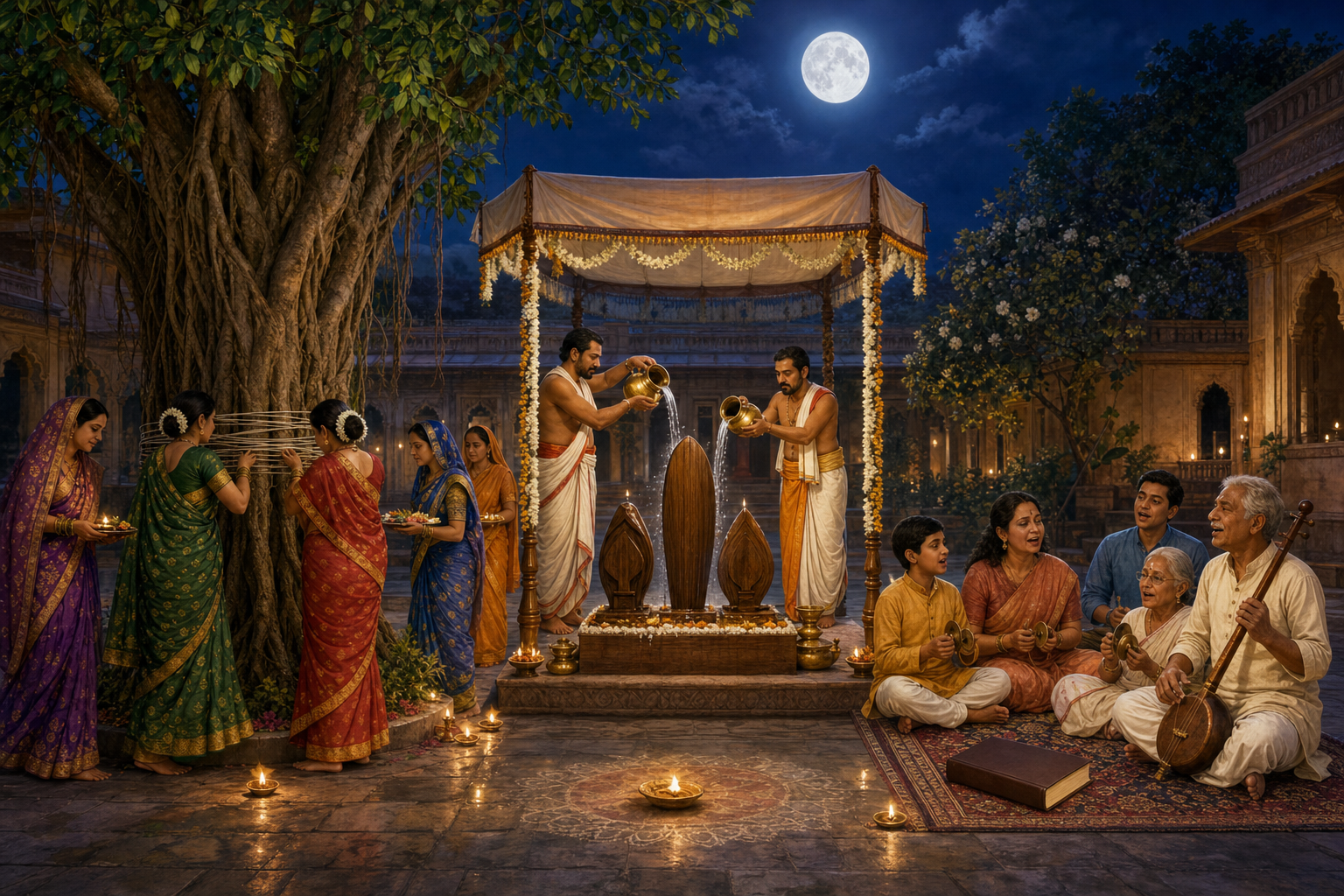
The Full Moon of Monday, 29 June brings several observances onto the same tithi. They are related through purification, fidelity, and renewal, but they are not interchangeable ceremonies. Choose the form grounded in your family’s parampara or temple community. You may honour another tradition through darshan or katha without pretending that every regional vrata belongs to every household.
Dev Snan Purnima and the renewal of Jagannath darshan
At Puri Srimandir, Jagannath, Balabhadra, Subhadra, and Sudarshana are taken in procession to the Snana Bedi. The ceremonial abhisheka traditionally uses sanctified water drawn in 108 pitchers from the Suna Kua, together with fragrant and cooling substances. The deities then appear in Hati Besha, the beloved elephant attire associated with Ganesha’s wisdom, auspiciousness, and removal of obstacles.
Dev Snan Purnima also changes the rhythm of pilgrimage. After the bathing festival, the deities withdraw from public darshan during Anavasara. Internal seva and renewal continue in preparation for Netrotsava and the approaching Ratha Yatra. If you are travelling to Puri primarily for darshan, understand this sequence before booking later dates; the period after Snana Yatra is not an ordinary public-darshan window.
For devotees away from Odisha, the sensible observance is to follow an authorised temple programme, community gathering, or livestream and make a simple offering at home. The 108-pitcher rite belongs to the temple’s established seva system. You do not need to reproduce its scale to participate in Jagannath bhakti.
Vat Purnima and the discipline represented by Savitri
In Maharashtra, Goa, parts of Gujarat, and related communities, the Full Moon is observed as Vat Purnima Vrat. Its central narrative is that of Savitri and Satyavan. Savitri meets Yama with courage, clarity, devotion, and principled speech, ultimately securing the restoration of Satyavan’s life. The lesson is stronger when it is understood as reciprocal household dharma: steadfast companionship, truthful speech, mutual protection, and the capacity to remain discerning under pressure.
The banyan is not a decorative backdrop. Its long life, spreading canopy, and pillar-like aerial roots make it a living image of endurance and interdependence. A customary puja may include water, turmeric, kumkum, akshata, flowers, a lamp, circumambulation with sacred thread, recitation of the Savitri katha, and the distribution of fruit or grain. Follow the number of circumambulations and the detailed offering order used by your family rather than borrowing an arbitrary sequence from another region.
One calendar distinction prevents a common mistake: Vat Purnima in western India is aligned with the Jyeshtha Full Moon, while many northern communities observe the allied Vat Savitri Vrat on Jyeshtha Amavasya. The shared Savitri narrative does not erase the difference in tithi. Ask which form your family keeps before purchasing materials or announcing the date.
Tree care is an appropriate extension of the vrata, but do it responsibly. Water an established tree where local conditions permit, support the care of a community green space, or plant a suitable native sapling with a plan for its long-term survival. Planting a tree that no one will water after the ceremony turns a symbol of endurance into a short-lived gesture.
Satyanarayana Vrata, fasting, and chandra-darshan
Many households also perform Sri Satyanarayana Vrata on Purnima. Prepare a clean altar for Vishnu as Satyanarayana, offer the upacharas customary in your home, hear or read the Satyanarayana katha, and distribute prasada such as offered fruit or sheera. Evening worship is common when Purnima remains in effect and the Moon can be seen.
Fasting ranges from nirjala upavasa to a sattvika fruit-based observance. Do not treat the harshest option as the only sincere one. Pregnant people, older adults, anyone managing a health condition, and those who have been advised to maintain hydration should use a moderated observance and obtain appropriate medical guidance. A vrata should cultivate steadiness and clarity, not create avoidable harm.
Where family practice prescribes it, conclude after chandra-darshan by offering arghya to the Moon and praying for clarity of mind, household well-being, and concord. If clouds prevent visual darshan, follow the established guidance of your priest or elder; do not invent a new timing rule on the spot.
Resolve panchang differences before the festival begins
Two calendars can display different civil dates without disagreeing about the underlying lunar event. Amanta calendars end the month with Amavasya, while Purnimanta calendars end it with Purnima. Both can identify the same astronomical Full Moon as Jyeshtha Purnima, yet the vrata date may still depend on local sunrise or evening prevalence.
Use this order when checking your date:
- Enter your actual city. A panchang for Delhi, Mumbai, or Puri is not automatically valid in Toronto, London, Singapore, or another location.
- Check the tithi at local sunrise. Ganga Dussehra commonly follows the day on which Shukla Dashami prevails at sunrise. Some Vat Purnima traditions likewise give priority to sunrise prevalence.
- Check the evening separately. Satyanarayana Puja and chandra-darshan may depend on Purnima remaining operative during the local evening period.
- Confirm daylight-saving treatment. A one-hour clock adjustment can matter when a tithi begins or ends near sunrise or the intended puja time.
- Use your community’s declared rule. When a local temple, priest, or family parampara applies a specific vrata convention, follow that convention consistently instead of combining the most convenient times from several calendars.
This is especially important outside India, where Jyeshtha Purnima may be observed on 28 or 29 June. Ask your temple for the local date several days in advance. If its schedule differs from an Indian calendar, first check location and vrata rule; the difference is not necessarily an error.
Build one coherent observance for your household
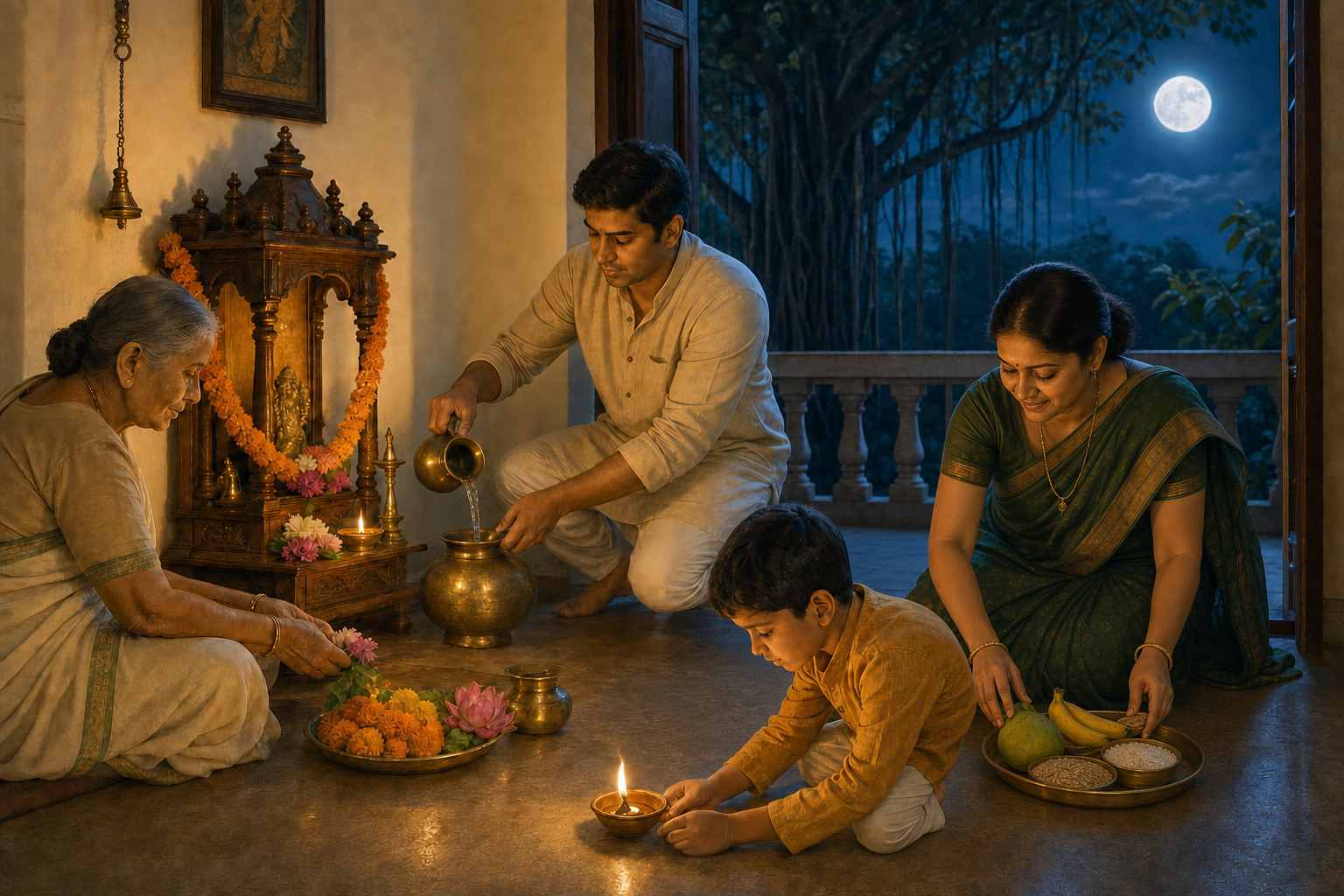
The easiest way to lose the spirit of Jyeshtha is to collect rituals faster than you can practise them. Build the month around one discipline, one act of dana, and one primary Purnima observance.
- Before 15 June: Confirm your local Dashami and Purnima dates, decide whether you will attend a temple or remain at home, and obtain only the puja materials you will use.
- From 15 June: Begin a repeatable restraint or daily practice connected with body, speech, or mind.
- On 24 June: Give priority to snana, Ganga puja, useful dana, and water-conscious seva.
- Before 29 June: Identify whether your household keeps Dev Snan darshan, Vat Purnima, Satyanarayana Vrata, or another lineage-specific observance. Do not assume a regional custom solely from an online festival name.
- On 29 June, where locally applicable: Perform the chosen vrata without rushing, share prasada, and carry its ethical meaning into a concrete act of family care or community service.
A family containing several Dharmic traditions can share the ethical ground without flattening their disciplines. Buddhists may keep Uposatha through meditation and ethical reflection. Jains may observe pakkhi poshad or special pratikraman at a lunar milestone. Sikhs may centre seva and sangat without treating the Hindu tithi as a doctrinal requirement. A shared water-service project or meal dana can accompany these distinct forms of practice.
Mark 24 and 29 June now, then contact your local temple or trusted panchang keeper with one precise question: which civil date and timing rule apply in your city? Once that is settled, choose the smallest observance you can perform with full attention. Jyeshtha’s water, shade, fasting, katha, and dana all point in the same practical direction: purify conduct, protect what sustains life, and make devotion useful to someone beyond yourself.
References
- DharmaRenaissance Blog – Jyeshtha Purnima 2026: Sacred Dev Snan and Vat Purnima Rituals, Significance, and Observance
- DharmaRenaissance Blog – Ganga Dussehra 2026: Sacred Dates, Shukla Dashami Significance, Puja Vidhi, and Eco-Seva