

In Hindu thought, sacred does not necessarily mean safe. A forest may contain hunger, dangerous creatures, severe weather and uncertainty while remaining a setting for contemplation, revelation and the testing of dharma.
Read together, forest literature, epic exile, animal-associated deities, serpent traditions and animal-form avatars reveal a consistent principle: humanity participates in a wider living order that it neither created nor fully controls. This perspective distinguishes reverence for wilderness from romanticizing it and provides a foundation for ecological restraint.
What makes wilderness sacred without making it idyllic
The source essay presents the forest and the temple as complementary rather than competing sacred spaces. A temple gives sacred presence an architectural form and a ritual rhythm. The forest confronts the seeker with sacredness before architecture, institutional authority or human ownership. Rivers, trees, mountains, animals, winds and other beings belong to an order that exceeds the human community.
This distinction is especially visible in the Sanskrit term aranya and in the Aranyakas, the forest-associated layer of Vedic literature. The source places these texts between the ritual concerns of the Brahmanas and the more interior philosophical inquiry of the Upanishads. Their literary position suggests a transition: outward offering begins to become inward realization, while inherited ritual understanding is subjected to contemplation.
The forest therefore matters not because it is untouched, gentle or automatically virtuous. It matters because familiar forms of security become less reliable there. Status cannot prevent hunger, political authority cannot command the weather, and social reputation offers little protection from fear or darkness. Wilderness becomes a discipline in decentering the human person.
This is a demanding view of sacred nature. It allows beauty and danger to coexist, and it does not turn wild creatures into harmless ornaments. Reverence begins with acknowledging that other forms of life possess meanings and places within the cosmic order that are not exhausted by their usefulness to people.
Why epic forests test public claims about dharma

The Ramayana and Mahabharata make wilderness a setting in which declared principles must become lived conduct. According to the source essay, their forests are not empty scenery outside the supposedly important worlds of court and kingdom. They contain hermitages, rivers, sages, animals, threatening beings, grief, instruction and revelation. Political exile consequently becomes moral exposure.
In the Ramayana, Rama, Sita and Lakshmana must sustain their commitments beyond the palace and its ceremonies. The forest reveals the limits of human plans without reducing exile to meaningless suffering. It asks whether dharma remains binding when recognition, comfort and institutional support fall away.
Sita’s presence complicates any attempt to interpret wilderness merely as a frontier for heroic conquest. The source emphasizes her tenderness toward the natural world alongside courage, vulnerability and endurance. Through her, the forest becomes an intimate moral environment shaped by attachment, fear, memory and responsibility, not just a stage for masculine demonstrations of strength.
The Pandavas’ exile in the Mahabharata develops another dimension of the same theme. Former rulers must learn restraint and endure grief while receiving instruction from sages and unexpected encounters. The source highlights Yudhishthira’s exchange with the Yaksha as an example of wisdom arising away from the noise of power. The forest does not simply reject civilization; it becomes a vantage point from which civilization can be judged.
Across both epics, wilderness performs a kind of ethical audit. Courtly environments allow people to state what they value. Exile tests whether those values survive loss of position, certainty and control. Sacred geography is therefore inseparable from moral formation.
How animals widen the field of divine meaning

Animals in the source essay do not form a simple moral alphabet in which gentle species represent goodness and fierce species represent evil. Bulls, birds, mice, lions, tigers, serpents and other creatures acquire different meanings according to their relationships, narratives and ritual settings. Fierceness can serve protection, smallness can expose hidden desire, and stillness can signify disciplined strength.
The vahanas, or animal vehicles associated with deities, demonstrate this relational symbolism. Nandi expresses devotion, patience and stillness in association with Shiva. Garuda conveys vision, liberation and protection in association with Vishnu. Durga’s lion or tiger suggests formidable power governed by divine intelligence. Ganesha’s mouse can represent restless or concealed impulses brought beneath wisdom. The animal is neither incidental decoration nor an independent code with a single fixed meaning; significance emerges through its relationship with the deity.
Serpents make the refusal of simple categories especially clear. The source associates them with danger as well as fertility, subterranean waters, guardianship, death, time, cosmic support and kundalini energy. Vishnu reclines upon Ananta Shesha, Shiva wears serpents, and Nag Panchami expresses reverence toward serpent beings. Fear is not denied, but fear does not become a license for metaphysical demonization.
The avatar tradition goes further by locating divine manifestation in animal and hybrid forms. The source discusses Matsya the fish, Kurma the tortoise, Varaha the boar and Narasimha the man-lion. Together, these forms challenge the assumption that divinity must appear in an exclusively human shape.
Narasimha gives this challenge a particularly sharp form. His identity crosses the human-animal boundary, while the circumstances of his appearance cross several other fixed categories. In the source’s interpretation, this boundary-crossing form defeats an arrogant attempt to manipulate rigid conditions. Wildness here is not irrational disorder. It is an intelligence that exceeds a closed system when that system is used to shelter adharma.
Ecological restraint as a consequence of dharma
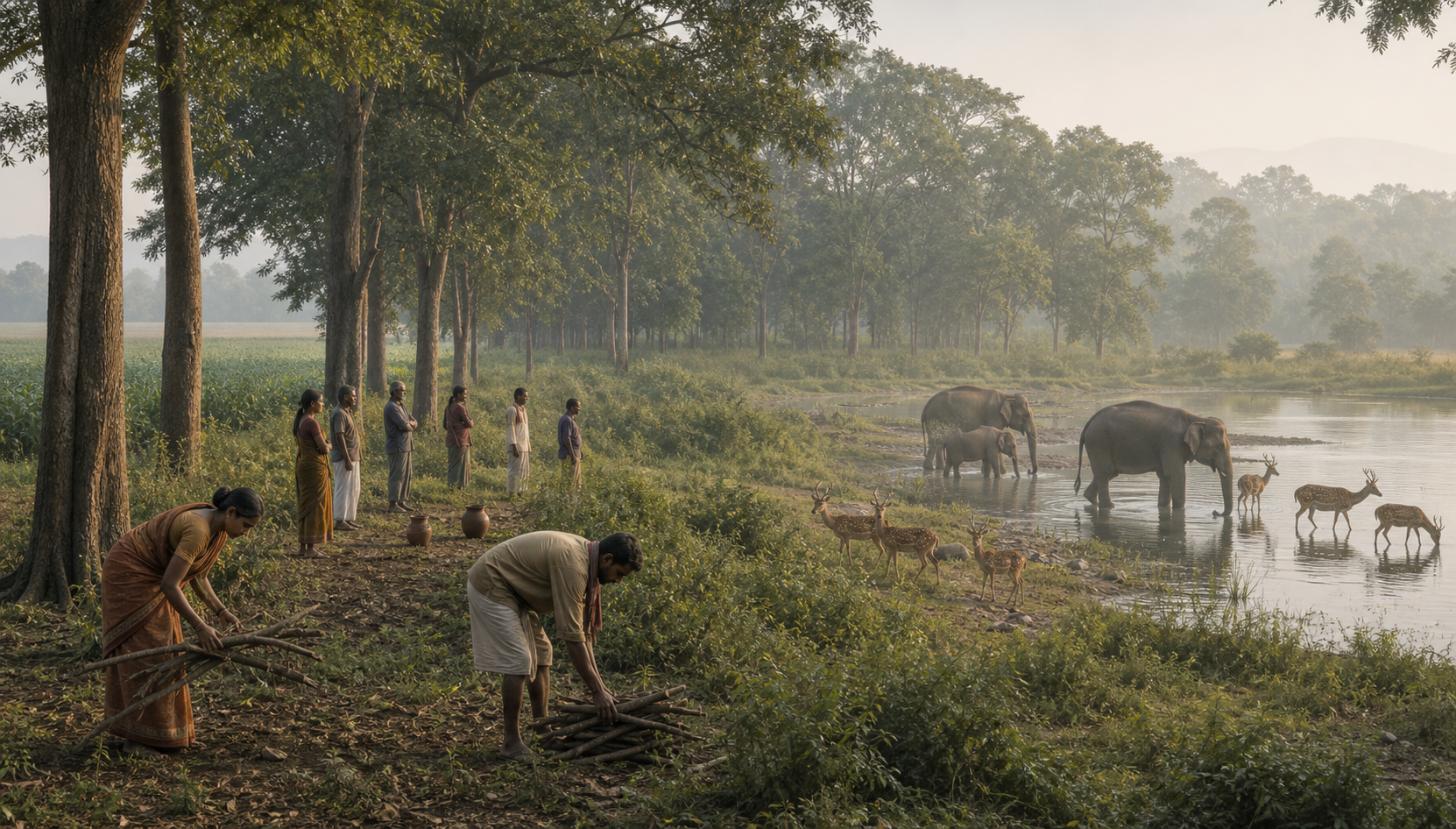
The ecological implications of these traditions rest on a metaphysical claim rather than on sentiment alone. The source connects them with Upanishadic teaching about the Self in living beings and with the Bhagavad Gita’s vision of divine presence across diverse forms of life. Such teachings do not erase differences among species or eliminate every practical distinction. They do, however, challenge the idea that human convenience is the sole measure of value.
Dharma, in this account, includes right relation and the principles that sustain an interconnected order. Human communities, animals, forests, rivers and seasons are not interchangeable, but neither are they isolated. Damage to the living world can therefore be understood as a disturbance of relationship, conduct and consciousness as well as a material loss.
This framework is compatible with ahimsa, commonly understood as the discipline of non-harm, but it is broader than a single prohibition. It asks how desire is governed, how power is exercised and whether other beings are recognized as participants in a morally meaningful world. It also avoids two shortcuts: symbolic reverence alone does not amount to environmental protection, while ecological concern need not depend on portraying nature as uniformly peaceful.
A contemporary application would therefore require both cultural interpretation and practical judgment. Traditional stories can shape motives and moral imagination, but decisions about habitats, wildlife and human needs still require knowledge of actual conditions. The enduring contribution of the sacred-wilderness perspective is its insistence that those decisions begin from humility rather than automatic human supremacy.
Key takeaways
- Hindu traditions can treat the forest as sacred without denying its danger, hardship or unpredictability.
- Epic exile tests whether dharma survives when status, comfort and institutional support disappear.
- Vahanas, serpent traditions and animal-form avatars give animals theological roles that cannot be reduced to usefulness or simple moral labels.
- An ecological ethic follows from right relationship within a wider order, not from sentimental claims that nature is always gentle.
Future Hindu ecological reflection can build on this vision by joining scriptural imagination to informed care for living systems. Its most productive question is not whether the modern world can recreate an idealized ancient forest, but whether human power can again learn to recognize limits, relationships and forms of value beyond itself.