
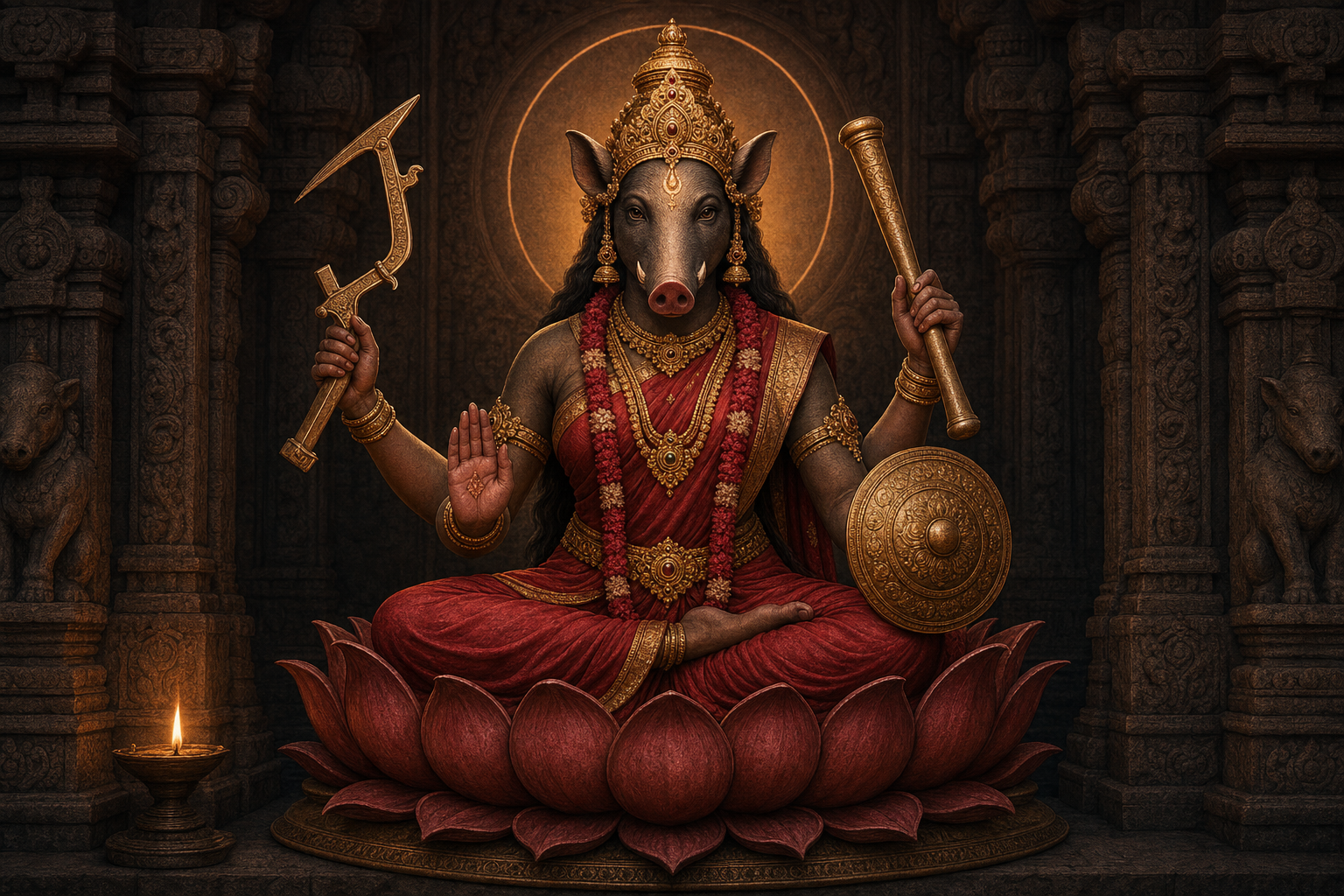
Varahi becomes easier to understand when three dimensions are considered together: her place among the divine mothers, the symbolism of her boar form, and her commanding role in some Tantric traditions. Together, these dimensions disclose a goddess of protection, restoration, and disciplined power rather than a figure defined only through Varaha.
The supplied source approaches Varahi through Shakta, Puranic, and Tantric frameworks. Its most useful contribution is not a single label but a method: relationship with another deity, independent divine agency, iconography, and ritual context must be distinguished before they can be meaningfully connected.
Key takeaways
- Varahi is presented primarily as a Matrika, or divine mother-power, whose functions include protection, discipline, and the restoration of order.
- Her association with Varaha can signify Shakti – the operative power of a divine function – without necessarily reducing her identity to that of a wife or companion.
- Her boar face, martial attributes, and earth-related imagery connect fierceness with the recovery of what has become buried, endangered, or disordered.
- Her titles in several Sri Vidya streams place her within a sacred structure of command, while reports of guarded or nocturnal worship underline the seriousness of her ritual traditions.
From association with Varaha to Matrika identity
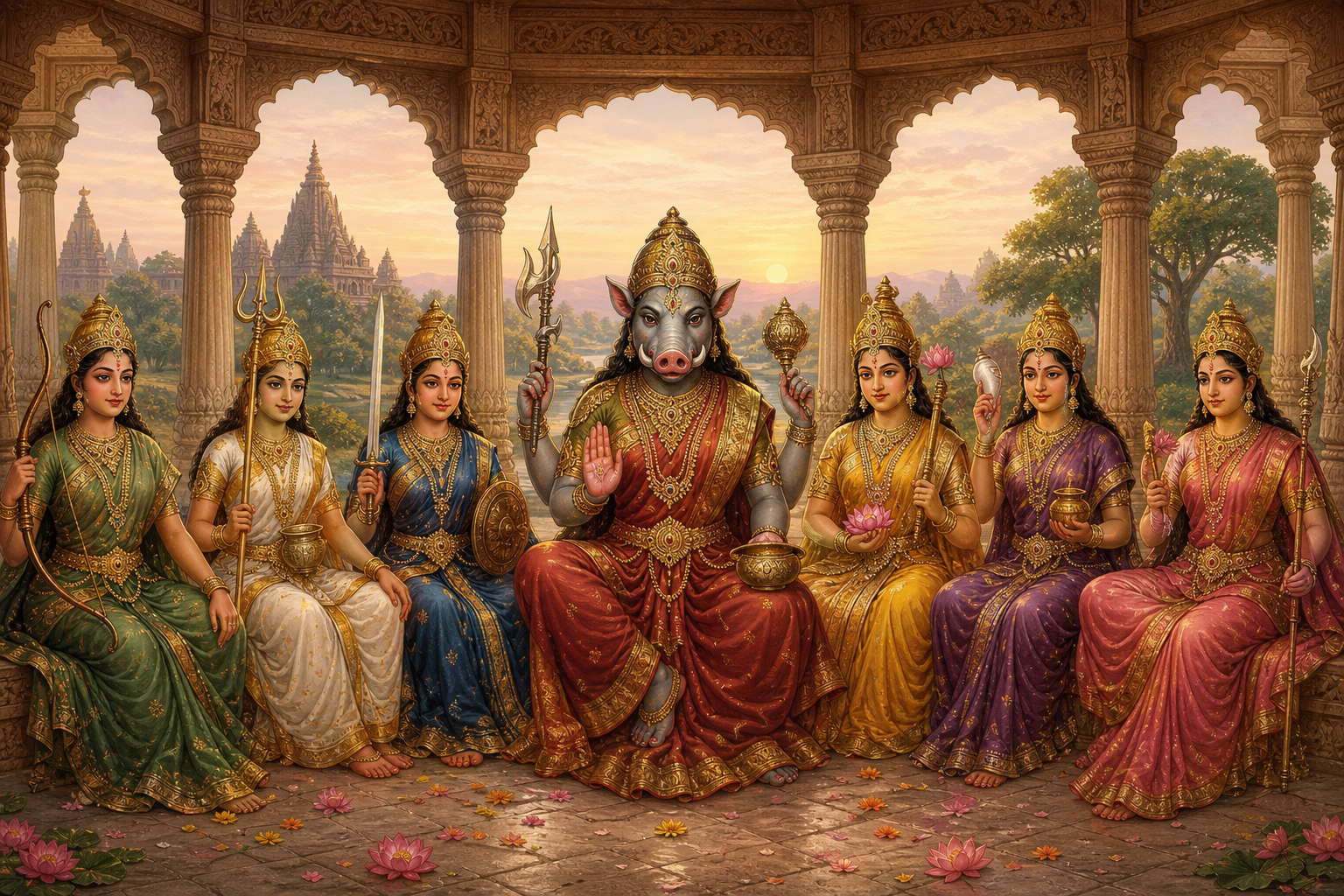
The source essay identifies a common interpretive problem: Varahi is sometimes introduced simply as the female counterpart or consort of Varaha, the boar incarnation of Vishnu. That association is relevant, but treating it as a complete definition obscures the theological category in which Varahi frequently appears.
Varahi belongs to the group known as the Sapta Matrikas or Ashta Matrikas, depending on the textual or regional enumeration. These divine mothers are associated with major deities and their powers: the article mentions figures such as Brahmani, Vaishnavi, Maheshvari, Kaumari, Indrani, Varahi, Chamunda, and Narasimhi across different arrangements. Yet the group is characterized not by domestic spousehood but by maternal, martial, protective, and cosmological agency.
This distinction changes the meaning of Varahi’s connection with Varaha. In the source’s Shakta reading, Shakti denotes power, capacity, motion, and manifestation. To call Varahi the Shakti associated with Varaha can therefore identify her with the active force of the earth-restoring function represented by the boar. It need not mean that her significance is borrowed from a male deity.
The language of relationship still matters, but it must be used precisely. Hindu traditions can describe divine figures as spouses, mothers, daughters, sisters, emanations, aspects, guardians, attendants, teachers, or sovereign deities. Substituting “consort” for all these relationships removes distinctions that the traditions themselves preserve. In Varahi’s case, Matrika and Shakti provide a fuller interpretive starting point.
How the boar form joins fierceness with restoration
Varahi’s iconography gives visible form to this agency. The source describes her with a boar’s head and a goddess’s body, sometimes dark, red, or golden, and frequently armed. It also reports variations in her physical appearance, implements, and vehicle. These differences caution against treating any one image as an exhaustive portrait of the goddess.
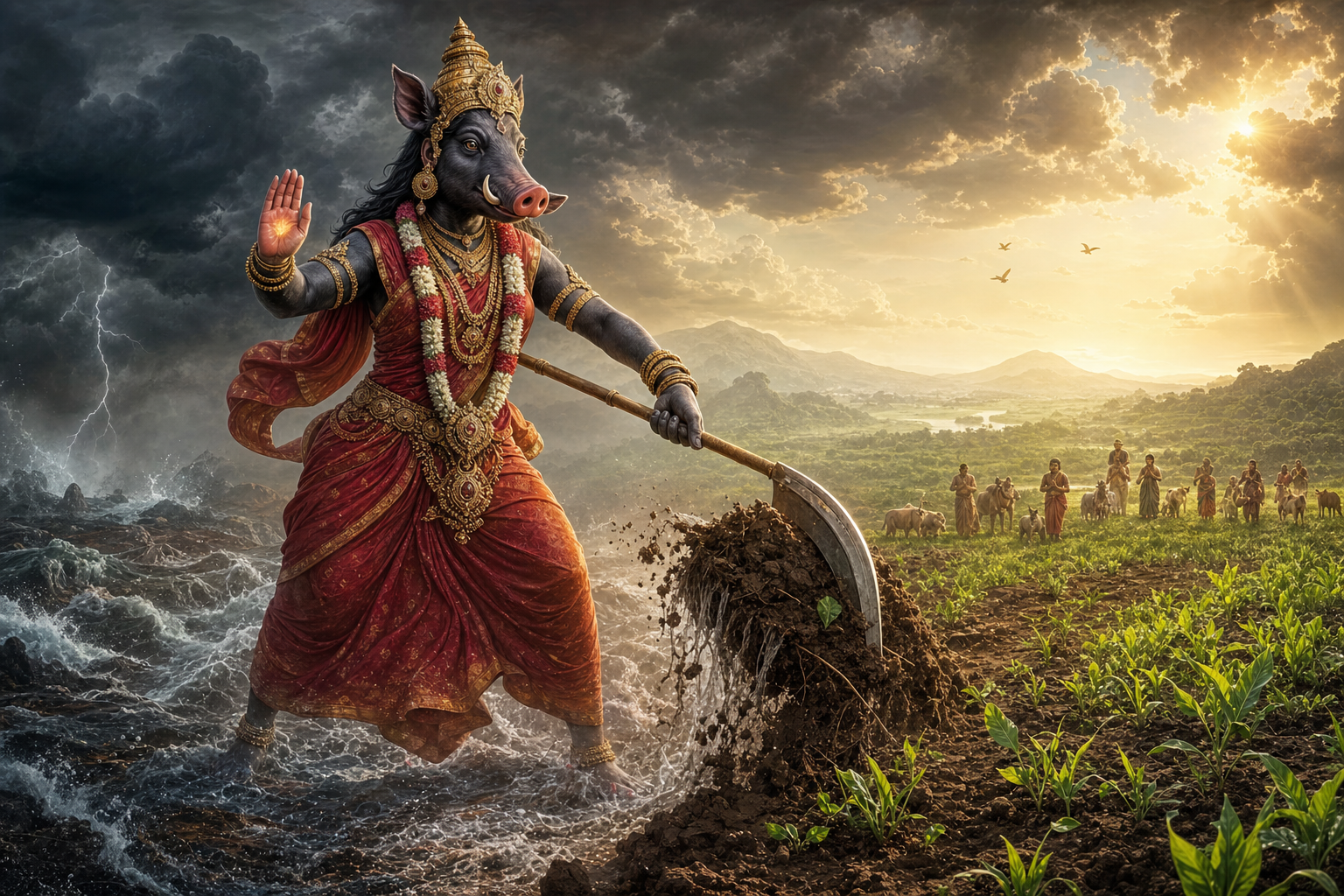
Across those variations, the attributes form a coherent symbolic field. The article mentions agricultural and martial objects such as the plough, mace, sword, shield, noose, and goad, alongside other ritual or divine emblems. The plough evokes cultivation and the breaking of resistant ground; weapons and instruments of restraint communicate the capacity to confront danger, uproot impurity, and enforce order. The resulting image is active rather than ornamental.
The source interprets the boar through its ability to dig, root, exert force, and enter mud without being overcome by it. It then connects that imagery with the Varaha narrative in which the Earth is raised from the cosmic waters. Applied to Varahi, the symbolism suggests power capable of entering damaged or concealed regions of existence and bringing what is endangered toward restoration.
This earth-facing symbolism also clarifies why fierceness and motherhood are not opposites here. The source uses “mother” in a theological sense that includes generation and nourishment but also protection, correction, and the removal of danger. It situates Varahi alongside a wider Goddess vocabulary in which Durga can be mother and warrior, Kali mother and time-force, Lakshmi mother and abundance, Saraswati mother and wisdom, and Bhudevi mother and earth.
Varahi consequently represents care expressed through intervention. Her appearance does not offer gentleness as the only measure of compassion. It portrays maternal power willing to enter difficult terrain, oppose destructive forces, and recover what passive reassurance cannot reach. This is why the source reads her fierceness as protective intelligence rather than as negativity.
Sovereignty in Sri Vidya and disciplined worship
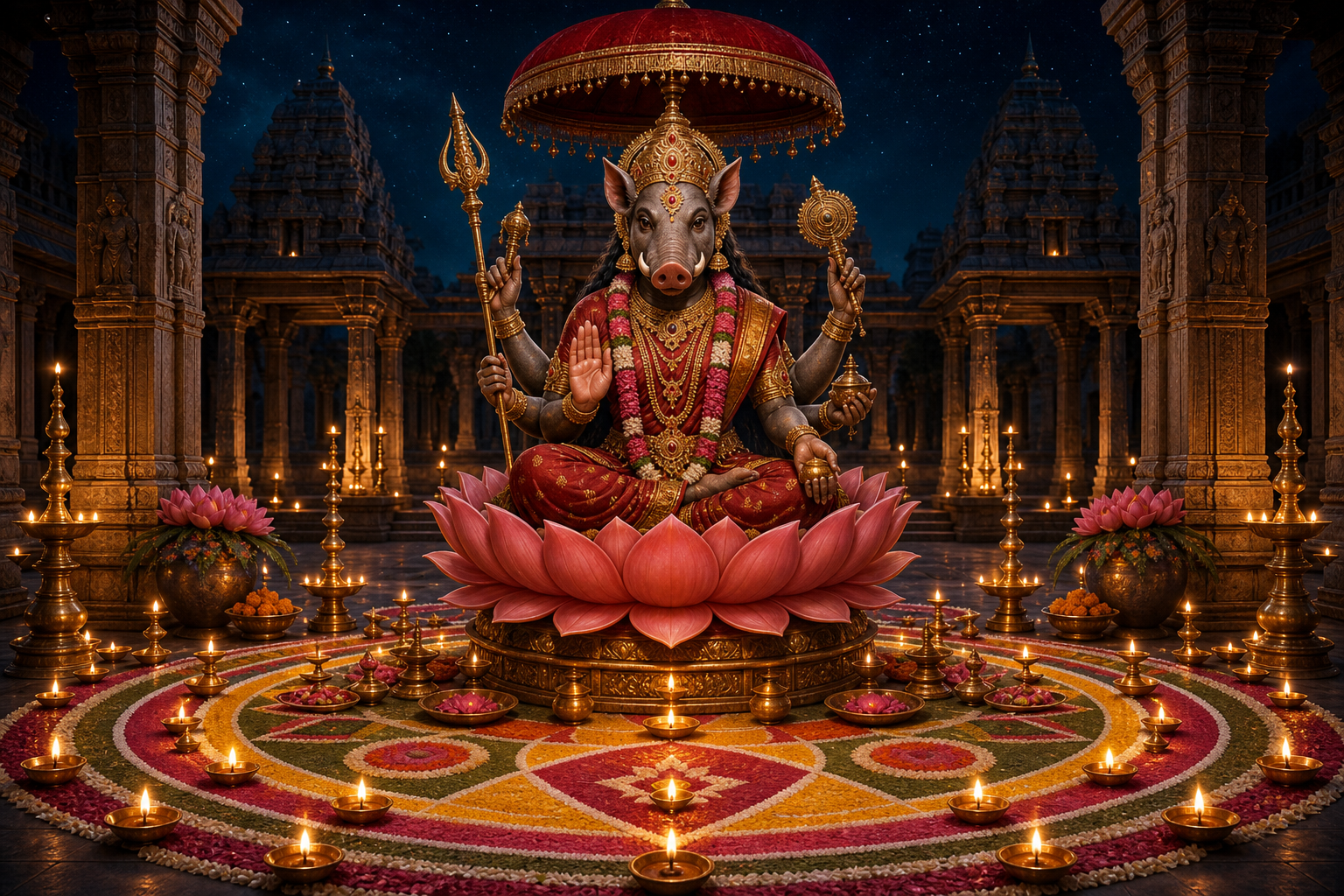
Varahi’s role in several Sri Vidya streams adds a political and organizational dimension to her theology. The source reports that she is revered as Dandanatha or Dandanayika, commander of the forces of Lalita Tripura Sundari. These titles present her as an authority concerned with command, strategy, protection, and the enforcement of sacred order.
This commanding role reinforces the limits of the consort-only interpretation. A goddess entrusted with disciplined action in a sacred polity possesses an identifiable office and function. Her relationship with a larger divine order does not erase that agency; it establishes the field in which her agency operates.
The source also reports that devotees approach Varahi for courage, protection, the removal of fear, and strength amid hostile or unsettling circumstances. It notes that some living traditions approach her at night or through ritually guarded forms because her energy is regarded as intense. These observations describe particular devotional and Tantric settings, not a universal procedure for every worshipper.
That qualification is important. Theological interpretation can be offered publicly, but specialized ritual practice may depend on boundaries, preparation, and guidance within a lineage. Varahi’s accessibility as a divine mother should not be confused with permission to detach esoteric practices from their disciplines. The intensity attributed to her worship is best understood as a call to seriousness rather than sensationalism.
A vocabulary that preserves theological difference
A sound account of Varahi should begin by identifying the context in which she appears. Matrika theology highlights collective maternal and martial power. The Varaha association emphasizes an earth-rescuing function. Sri Vidya gives prominence to command and sacred governance. Devotional interpretation foregrounds protection and courage. None of these perspectives has to cancel the others, but neither should they be collapsed into one imprecise label.
The same care should govern readings of her images. An attribute reported in one representation may not appear in another, and a symbolic interpretation should not be mistaken for a fixed historical claim. The source’s variations in color, vehicle, bodily form, and implements show that continuity can reside in a pattern of functions – depth, force, protection, discipline, and restoration – even when visual details differ.
This framework also makes Varahi relevant without turning her into a generic symbol of personal empowerment. Her significance lies in a particular Hindu sacred grammar: Shakti as effective power, the Matrika as fierce mother, the boar as an image of earth-facing restoration, and the commander as guardian of order. Contemporary readers may find emotional meaning in these themes, but that meaning remains strongest when connected to their theological setting.
Further study can build on this foundation by comparing textual settings, temple representations, regional devotion, and lineage-based interpretations while keeping their differences visible. Varahi then emerges neither as an appendage nor as an isolated abstraction, but as a deity whose relationships reveal distinct forms of agency.
References
- DharmaRenaissance Blog – Varahi as Divine Mother: A Powerful Scholarly Guide Beyond the Consort Myth