

You may bow before a sacred form, know its story, and still wonder what it asks of you when a family dispute turns bitter, a convenient half-truth presents itself, or courage carries a personal cost. That gap between recognition and action is where symbolism either becomes lived dharma or remains religious decoration.
The answer is not to reduce a deity or consecrated form to a motivational device. A sacred form belongs first to worship, relationship, and transmitted tradition. Yet reverence should cross the threshold of the shrine. It should become a quality you cultivate, a restraint you accept, a duty you perform, or a wrong you repair.
A sacred form is more than an object and more than a metaphor
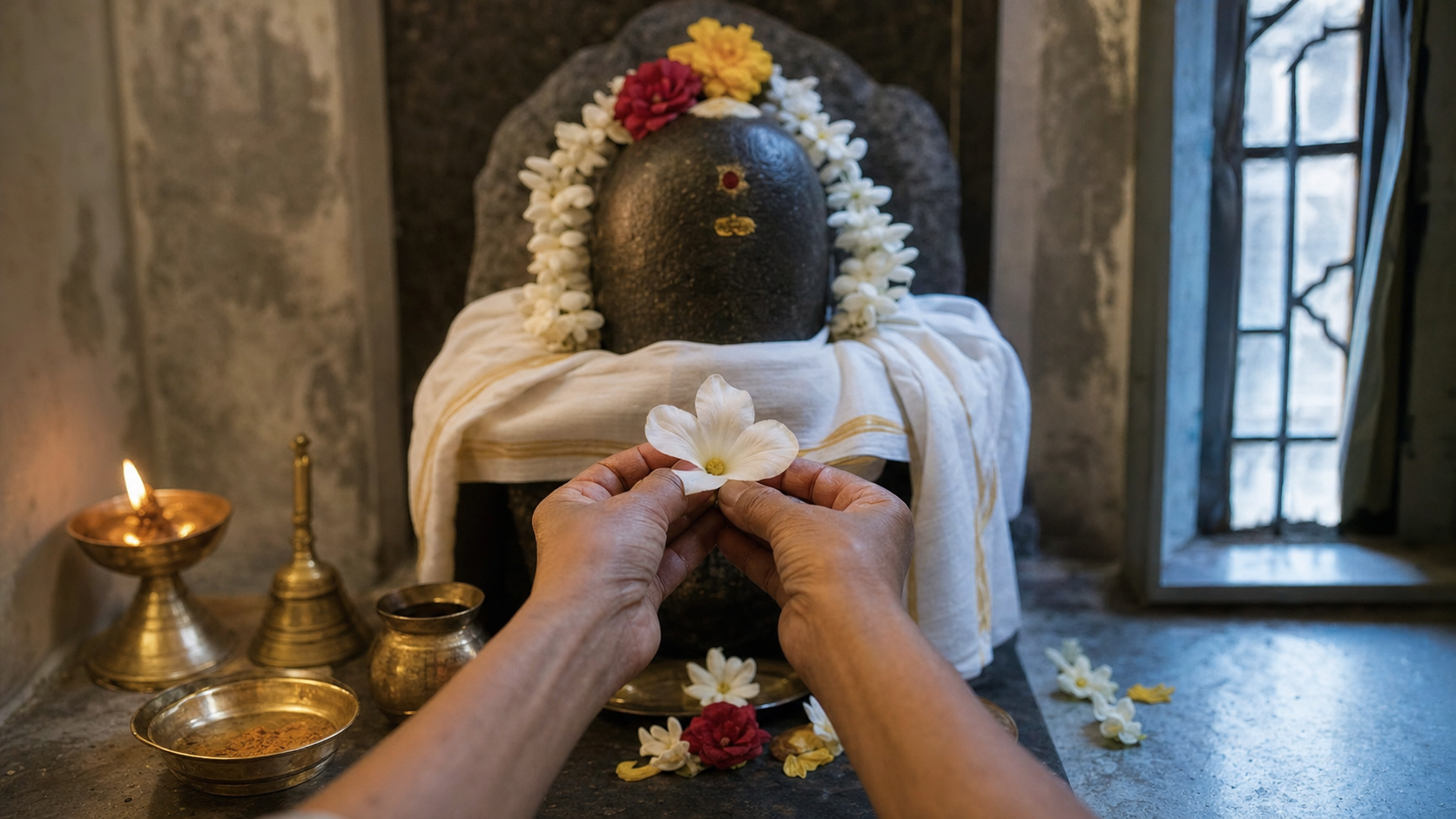
The familiar question – what does this symbolize? – is useful, but incomplete. It can turn Hindu sacred life into a collection of visual riddles, as if every form were merely a coded diagram waiting for an explanation. That approach misses both devotion and discipline.
A sacred symbol can work through several movements at once. You encounter a form. The form recalls a divine presence, power, teaching, or history. That remembrance reorients your attention. The reorientation places a demand on your conduct. If you stop at recognition, you have understood the vocabulary without speaking the language.
This does not mean inventing a private moral for every murti, emblem, mantra, or temple feature. Begin with the meaning received through your family, temple, sampradaya, teacher, or ritual context. Hindu traditions can preserve several legitimate meanings around the same form. Personal application should grow from that inheritance rather than replace it.
- What divine reality, power, or relationship does this form direct you toward?
- What inherited story or ritual setting protects its meaning from arbitrary interpretation?
- What quality does sustained attention to it ask you to cultivate?
- What observable action would embody that quality in your present circumstances?
The final question is the bridge to lived dharma. The answer must be concrete enough to affect a conversation, decision, promise, boundary, or act of repair. Admiration alone cannot do that work.
Three sacred forms reveal three tests of conduct

The Ashvini Kumaras on a warrior’s banner
A war standard is not hidden in private contemplation. It is raised above action, publicly associating the warrior with the power or principle represented upon it. Among the Upapandavas, Shatanika, the son of Draupadi and Nakula, carried the twin Ashvini Kumaras on his banner. Their presence joins healing and valor in a single emblem.
That pairing corrects two common errors. Courage can become aggression when it forgets restoration. A desire to heal can become avoidance when it refuses necessary confrontation. The emblem therefore gives you a demanding question: can you defend what must be defended without becoming attached to injury, humiliation, or destruction?
Use that question in the conflict already in front of you. Before sending the harsh message or entering the difficult conversation, identify what genuinely requires protection. Then identify the harm you do not want to enlarge. Finally, name the repair you are prepared to pursue. You may still need to speak firmly, refuse a demand, expose wrongdoing, or impose a boundary. Healing does not require passivity. It requires that courage remain answerable to restoration rather than anger alone.
A practical sankalpa drawn from this emblem could be: when conflict begins, state what you are defending and what repair you seek. That commitment is narrow enough to remember and visible enough to test.
The Daivika linga and the discipline of steadiness
The Shiva linga cannot be exhausted by calling it a symbol of an abstract idea. It is a sacred form through which Shiva as Supreme Reality is approached and worshipped. Within traditional classifications, Daivika lingas are associated with establishment by the devas and belong among the Achala, or immobile and self-established, forms.
That inherited classification matters before any personal application. A Daivika linga is not sacred because an observer finds a useful metaphor in it. Its sanctity is received, not manufactured by individual preference. You approach it through reverence rather than treating it as raw material for self-expression.
For daily practice, the quality of achala can also discipline your attention toward steadiness. This is an application of the form, not a replacement for its theological meaning. You go to the sacred presence and orient yourself around it; you do not demand that it revolve around every passing mood.
Carry that orientation into a duty that has become vulnerable to mood. Complete the promise you made when enthusiasm has faded. Keep a transaction honest when nobody is watching. Maintain the cleanliness and dignity of the space entrusted to you. Refuse to let the calm of puja vanish in the first impatient exchange afterward. Steadiness becomes dharmic when it supports a rightful obligation, not merely when it makes you feel composed.
Satyam vada, dharmam chara as an embodied command
Some sacred meaning arrives not as an image but as a sentence that must be lived. In the instruction attributed to Dronacharya’s training of the Kuru princes, Yudhishthira confronts the demand contained in Satyam vada, dharmam chara: speak truth and walk in dharma. He does not treat memorizing the words as proof that he has mastered them.
The two imperatives belong together. Truth without dharmic responsibility can be used as a weapon: a person may disclose something accurate solely to humiliate, provoke, or evade a duty of care. Dharma-language without truth can become an excuse: a person may invoke a supposedly noble purpose to conceal self-interest or mislead others. Truth tests your claim to righteousness, while dharma tests how and why you speak the truth.
Before a consequential statement, ask whether it is factually true, whether you are omitting something to create a false impression, whether it is your responsibility to speak, and whether you can say it without turning accuracy into cruelty. These questions do not guarantee an easy answer. They do expose the evasions that often hide beneath technically correct words.
If you discover that you have misled someone, the practice is not completed by privately regretting it. Correct the false impression with the person affected. Lived truth includes repair.
A practical method for carrying a symbol across the threshold

Choose a sacred form or teaching that is already present in your religious life. Do not select something unfamiliar merely because its appearance is dramatic. Depth comes from sustained relationship, not from collecting meanings.
- Receive the inherited meaning. Recall the associated narrative, worship, or teaching as it has been transmitted to you. If you do not know the context, ask a trusted elder, priest, or teacher within the relevant tradition before constructing a personal interpretation.
- Name the demand. Complete this sentence in plain language: this form calls me toward a particular quality or duty. Use a word that can guide action, such as truthfulness, courage, healing, steadiness, restraint, gratitude, or service.
- Locate the friction. Identify where that quality currently fails under pressure. It might be a family disagreement, workplace claim, financial promise, recurring gossip, neglected responsibility, or habit of contempt. A general wish to improve is too vague.
- Write an observable response. Use the pattern: when this situation occurs, I will take this action because the sacred form recalls this duty. The action should be something you can either perform or fail to perform.
- Attach remembrance to a natural threshold. A short recitation, a respectful glance toward the shrine, the conclusion of puja, or a pause before a recurring duty can recall the commitment before habit takes control.
- Review and repair. Ask where the commitment held, where it failed, and what correction is now owed. Repair may mean correcting a statement, apologizing without self-justification, completing a delayed duty, restoring something damaged, or approaching the next encounter with a narrower and clearer commitment.
Keep the practice modest and exact. A commitment inspired by the Ashvini banner might be to name both the necessary boundary and the desired repair during conflict. A commitment inspired by the linga might be to carry steadiness from worship into the next duty without deception or contempt. A commitment inspired by Satyam vada might be to correct any misleading claim from which you benefit.
Do not casually call this exercise a formal vrata. A vrata can carry religious requirements that depend on tradition and guidance. This method is a discipline of reflection and conduct unless you have received instructions for a formal observance.
How to know whether reverence is becoming lived dharma

The clearest evidence appears under pressure. Symbolic practice is not measured by how eloquently you can explain a form, but by whether remembrance changes your conduct when convenience, reputation, anger, or gain pulls in another direction.
- Pressure test: does the commitment still govern you when keeping it carries inconvenience or embarrassment?
- Visibility test: would you make the same choice if nobody in your religious community knew about it?
- Translation test: can you name the behavior produced by your reverence, or only the feeling and interpretation surrounding it?
- Repair test: after failure, do you correct the harm, or do you use devotional language to soothe yourself without addressing the person or duty affected?
- Humility test: does the symbol make you more accountable, or does it repeatedly seem to confirm that your preferences are divinely approved?
Failure does not prove that the symbol or teaching is ineffective. Sacred remembrance does not mechanically erase habit. Make the lapse specific, perform the repair, and narrow the next commitment until it can genuinely govern a moment of choice. Honest correction is more dharmic than an impressive promise that remains untested.
Key takeaways for turning reverence into conduct
- Begin with the sacred meaning received through worship and tradition; do not reduce a divine form to a private metaphor.
- Translate meaning into a verb: protect, heal, speak, restrain, complete, restore, or serve.
- Let paired principles correct each other: valor needs healing, steadiness needs rightful purpose, and truth needs dharmic responsibility.
- Connect remembrance to a recurring moment of friction so that it arrives before the decision, not only after regret.
- Judge the practice by accountable conduct and concrete repair, not by display, emotion, or interpretive cleverness.
At your next encounter with a sacred form, do not rush to gather another explanation. Ask what rightful action its presence places before you. Carry that answer into the next conversation, promise, conflict, or duty. That crossing from reverence to action is where symbolism becomes lived dharma.
References
- Hindu Blog – Ashwini Kumars on the Flag of Shatanika: Healing, Valor, and Divine Symbolism in the Mahabharata
- Hindu Blog – Daivika Linga: The Divine Shivlings Established by the Devas
- Hindu Blog – Satyam Vada, Dharmam Chara: The Lesson Only Yudhishthira Truly Learned