
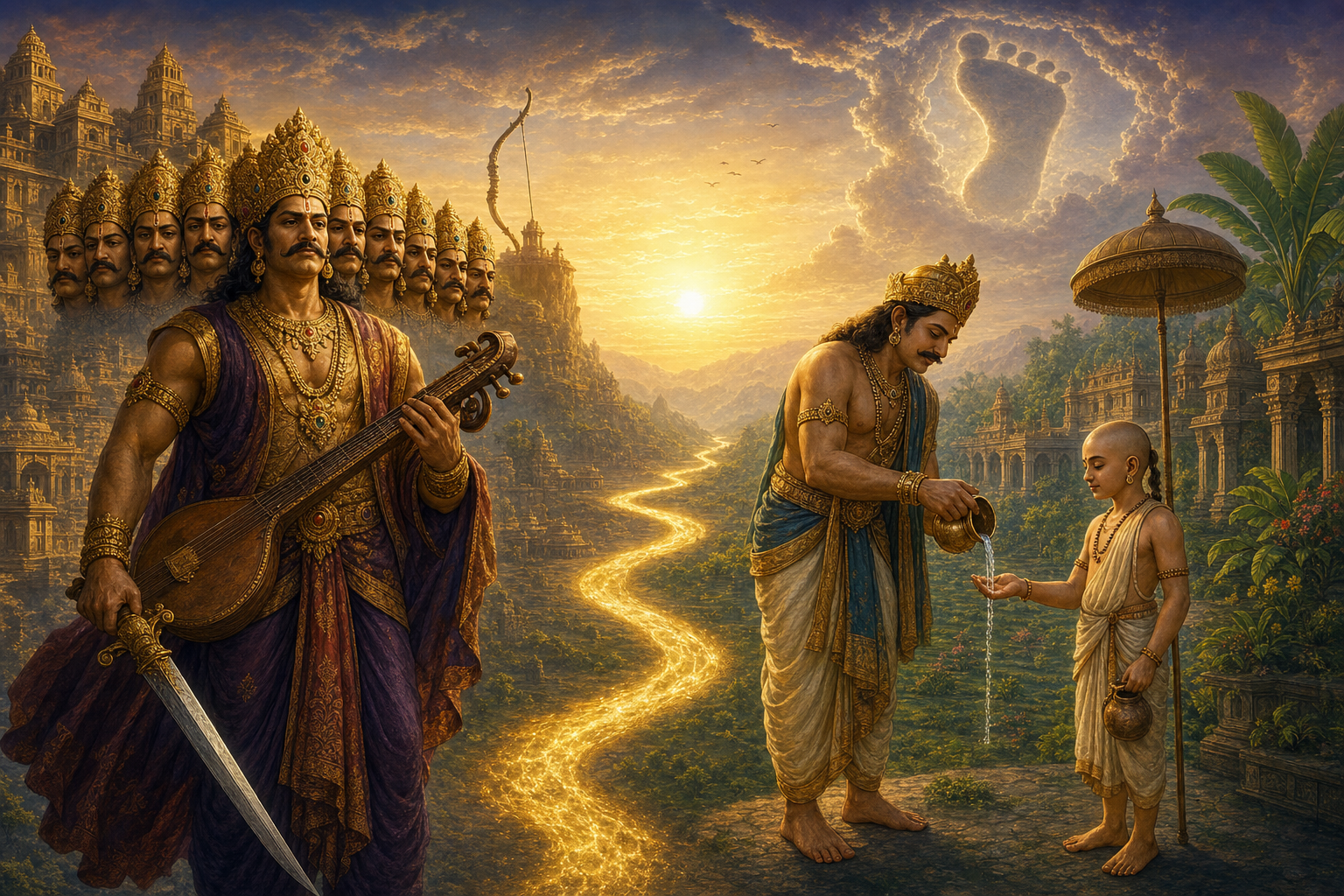
If you are trying to understand why Mahabali is welcomed home while Ravana is remembered chiefly through defeat, the word asura will mislead you. Both are powerful, learned rulers from distinguished lineages. Their legacies diverge because dharma judges what power does when desire, duty, truth, and ego collide.
This distinction resolves two common confusions. You can acknowledge Ravana’s devotion and brilliance without excusing his violation of Sita. You can honor Mahabali without turning Vamana into a villain. The comparison is not an identity trial between two lineages; it is an exercise in moral discernment.
Key takeaways
- Neither rakshasa nor asura lineage functions as a complete moral verdict. Conduct remains decisive.
- Ravana shows why learning, devotion, prosperity, and strength cannot compensate for a grave violation of dharma.
- Mahabali is honored because he keeps his promise when doing so becomes personally costly and ultimately surrenders his ego before Vamana.
- Rama’s defeat of Ravana and Vamana’s blessing of Mahabali are not interchangeable endings. One follows defiant transgression; the other follows truthful surrender.
- Buddhist, Jain, and Sikh ethical concepts can illuminate the stories, but they should be used as comparative lenses rather than flattened into identical doctrines.
Lineage tells you who they are, not whether they are right
Ravana is the rakshasa king of Lanka, born to the sage Vishrava and Kaikesi. Mahabali is an asura king, the son of Virochana and grandson of Prahlada, the celebrated devotee of Vishnu. These are not insignificant genealogies. Both rulers inherit religious formation, authority, and considerable civilizational prestige. Yet their distinguished lineages lead to sharply different moral legacies.
| Question | Ravana | Mahabali | What you should notice |
|---|---|---|---|
| What is his inherited identity? | Rakshasa king; son of Vishrava and Kaikesi | Asura king; son of Virochana and grandson of Prahlada | Lineage establishes context, not final moral worth |
| What gifts does he possess? | Learning, mastery of the Vedas and arts, devotion to Shiva, music, and statecraft | Generosity, truthfulness, sacrificial discipline, and fidelity to his word | Possessing a virtue is different from allowing it to govern a crisis |
| What is the decisive act? | He abducts Sita and places personal desire above righteous restraint | He grants Vamana three paces of land and offers his head for the final step | Dharma becomes visible when keeping a boundary or promise carries a cost |
| How does the encounter with Vishnu’s avatar end? | Rama defeats him and restores cosmic order | Vamana blesses him with rule over Sutala and an annual return to his people | The moral meaning of an ending depends on the conduct that precedes it |
| How is the reign remembered? | Prosperous Lanka, shadowed by fear and the ruler’s ambition | A golden age of fairness, equality, and social harmony in Kerala’s Onam memory | Material success alone does not establish just rule |
The practical rule is simple: do not turn a narrative category into a moral shortcut. If asura automatically meant evil, Mahabali’s integrity would become unintelligible. If learning or devotion automatically meant righteousness, Ravana’s transgression would have to be ignored. The stories refuse both errors.
When you assess either ruler, separate inherited identity from chosen conduct. Ask what the person knew, what power he held, what boundary confronted him, and what he chose when obedience became costly. That sequence gives you a more reliable dharmic judgment than beginning with clan, title, prosperity, or sectarian allegiance.
The decisive divide is what each ruler does with power
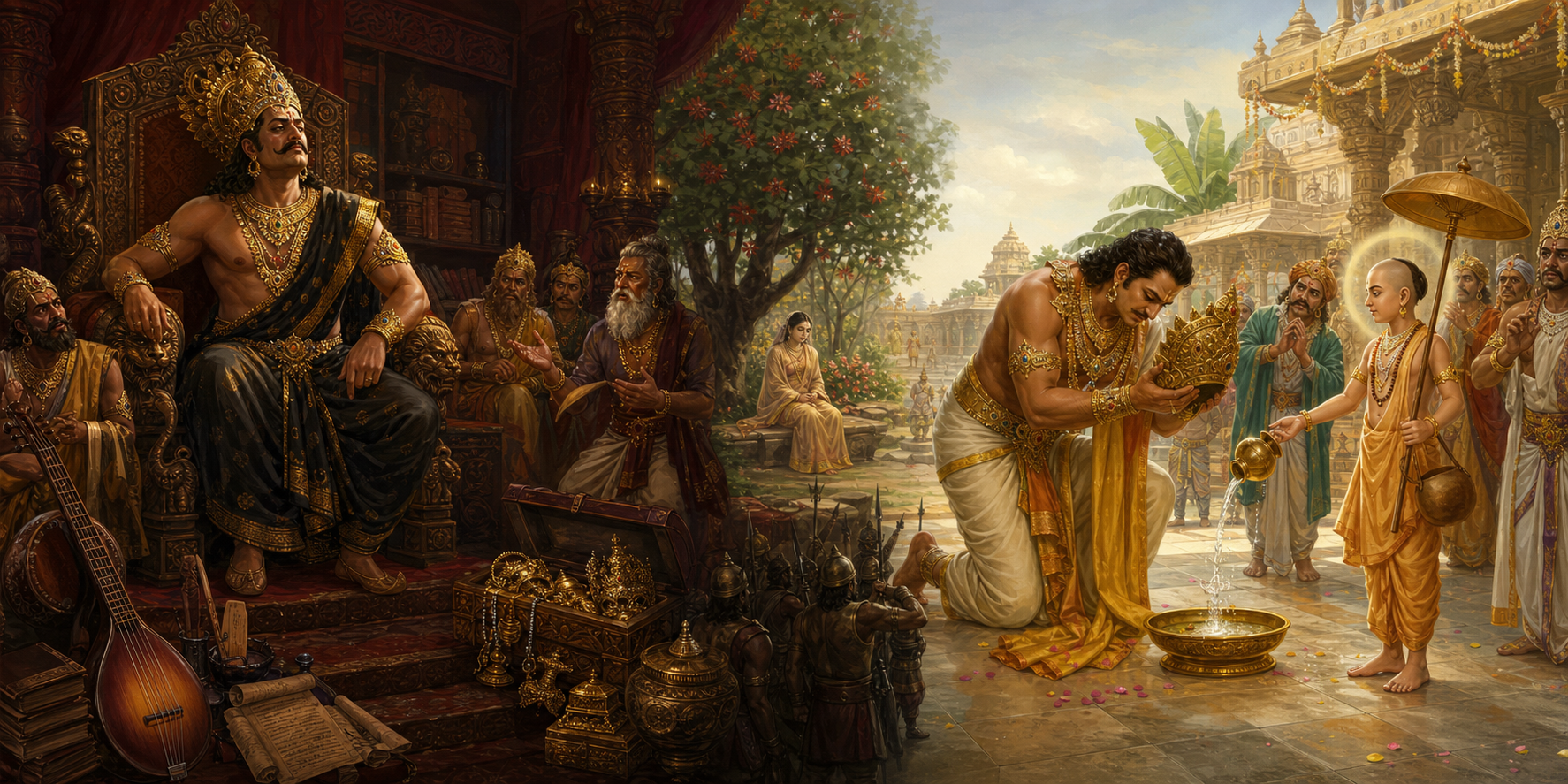
Ravana’s complexity matters. He is not portrayed as an ignorant brute. He is learned in the Vedas and arts, accomplished in music and statecraft, and renowned as a devotee of Shiva. Tradition also credits him with the Shiva Tandava Stotram. These qualities explain his stature, but they do not acquit him. In fact, they sharpen the warning: knowledge can enlarge a person’s capacities without governing his desires.
The abduction of Sita is therefore not an incidental flaw attached to an otherwise impressive record. It is the act that reveals how Ravana uses sovereignty when desire meets a moral limit. Instead of restraining himself, he makes his will the measure of what may be done. His learning remains real, but it does not become wisdom at the moment wisdom is required.
Mahabali faces a different test. Guided by Shukracharya and known for yajnas and generosity, he promises Vamana three paces of land. The apparent size of the request changes when Vamana assumes a cosmic form. Mahabali could treat the unexpected cost as a reason to escape his word. Instead, he offers his own head for the third step.
That act gives Mahabali’s generosity its moral weight. Easy giving may display abundance; costly giving reveals alignment. His promise survives the disappearance of personal advantage. Within the Vamana narrative, surrender is not mere defeat. It is the point at which royal power stops defending itself and submits to a truth greater than possession or status.
Three distinctions keep the comparison honest
- Ability is not authority. Being capable of taking or controlling something does not create a rightful claim to it.
- Devotion is not ethical immunity. Worship, austerity, and religious knowledge do not cancel harm done through unrestrained desire.
- Prosperity is not justice. A rich kingdom can remain morally disordered if the ruler’s ambition overrides the security and dignity of others.
You can apply these distinctions beyond epic characters. When evaluating a ruler, teacher, institution, or public figure, make two columns. In the first, list learning, piety, charisma, wealth, and achievements. In the second, list the choices made when a boundary, promise, or vulnerable person stood in the way. Admire what belongs in the first column, but base your moral judgment on the second.
Rama and Vamana reveal two different moral endings
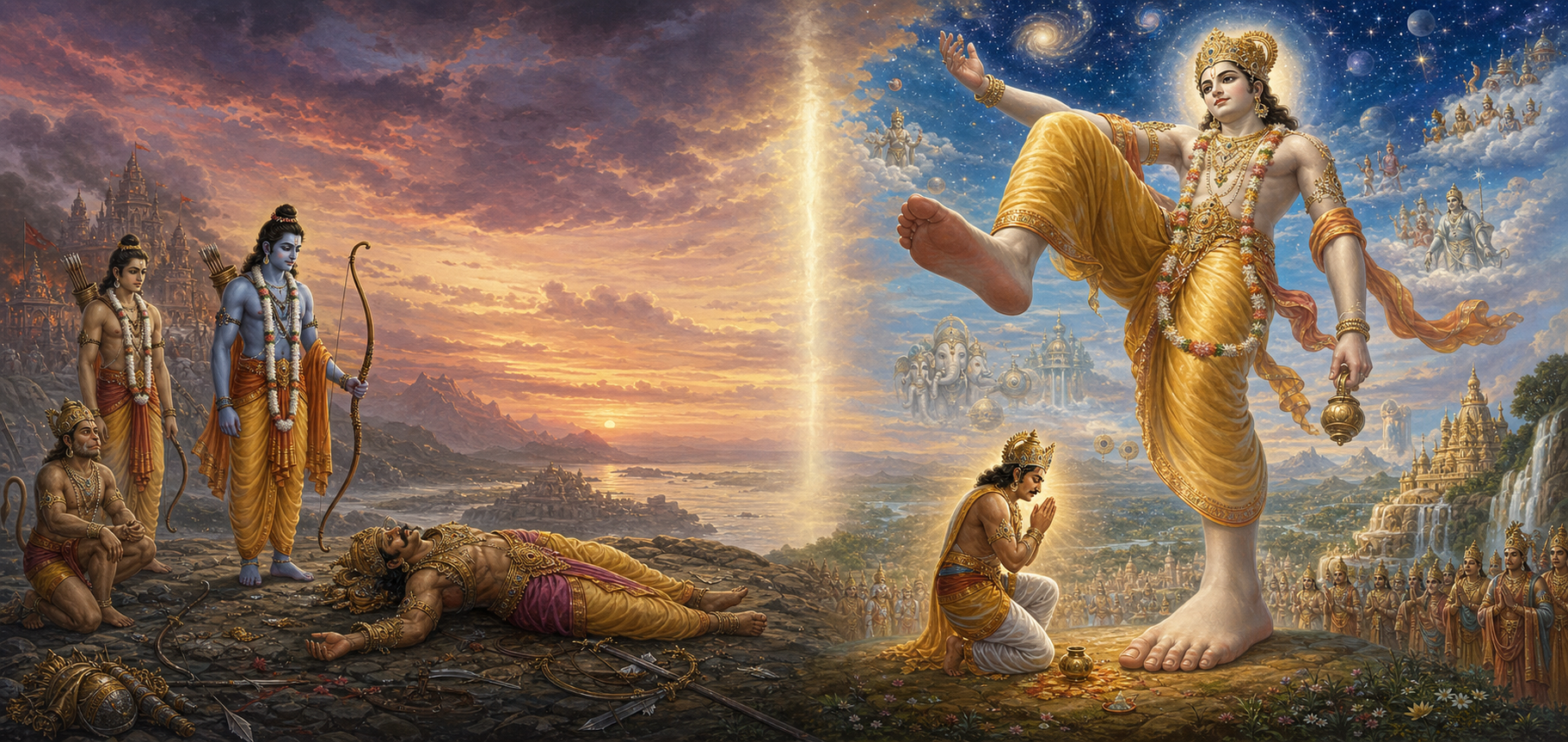
Both rulers encounter an avatar of Vishnu, but the resemblance ends there. Ravana confronts Sri Rama after a transgression and persists until his defeat. His fall restores an order that his desire and use of power have violated. Mahabali meets Vamana through an act of giving, remains faithful to his promise, and receives a blessing after surrendering his last claim.
Vamana first asks for three paces of land. He then expands into a cosmic form, covering what has been granted and leaving Mahabali to supply the final step with his own head. Vishnu subsequently blesses him to rule Sutala and to visit his people each year. This movement from promise to surrender and then grace is central to Mahabali’s cultural memory.
Reducing both episodes to a generic formula in which Vishnu defeats an asura erases the ethical architecture. Ravana’s end follows refusal to honor a moral boundary. Mahabali’s blessing follows refusal to abandon his word. Both lose worldly supremacy, but they do not lose it in the same moral condition.
Do not rehabilitate Ravana by deleting Sita
Ravana’s accomplishments deserve accurate acknowledgment. Yet a reading that uses his Shiva bhakti, scholarship, or Lanka’s prosperity to push Sita out of view has reversed the story’s scale of values. The relevant question is not whether a transgressor possesses admirable qualities. Many consequential people do. The question is whether those qualities restrain the misuse of power. In Ravana’s decisive crisis, they do not.
Do not honor Mahabali by turning Vamana into a villain
Mahabali’s place in Onam memory need not be built upon hostility to Vishnu. The narrative itself joins his honor to his encounter with Vamana: Mahabali keeps his word, relinquishes his ego, is blessed with Sutala, and receives the privilege of returning to his people. The king’s humility and divine grace belong to the same ending.
This gives you a better way to discuss a question that can otherwise become needlessly sectarian. You do not have to choose between reverence for Vamana and affection for Mahabali. The story allows you to see the avatar as the revealer of Mahabali’s deepest virtue. The severe test is precisely what makes his truthfulness memorable.
Cultural memory asks what kind of ruler people should welcome

Ravana’s Lanka is remembered as prosperous and formidable. Yet prosperity remains shadowed by the king’s ambition and the fear created when personal desire commands public power. This is a warning against a familiar political temptation: mistaking visible achievement for moral legitimacy.
Mahabali’s reign survives differently in Kerala’s imagination. Onam evokes a remembered age of fairness, equality, harmony, and shared well-being. Families welcome the annual return of Maveli not merely because he once possessed a vast kingdom, but because the kingdom is remembered as serving its people. The ruler returns because the bond with the people outlives the throne.
These memories offer a practical test for leadership. Do not ask only whether a ruler produced wealth, commanded impressive systems, or projected strength. Ask who could live without fear, whether the ruler treated himself as exempt from restraint, whether promises survived political cost, and whether ordinary people experienced the order as just. A golden city and a golden age are not the same thing.
Festival and performance keep that distinction alive. Onam turns Mahabali’s return into hospitality, gratitude, and communal participation. Ramayana reading, kirtan, and dramatic performance return communities to the consequences of desire, the necessity of restraint, and the duty to use strength for the restoration of order. One memory welcomes a just king; the other warns that brilliance cannot save a ruler who places himself above dharma.
How to compare the stories across Dharmic traditions
The safest comparative method begins by preserving difference. Ravana and Mahabali arise from Hindu narrative worlds shaped by the Ramayana, Puranic traditions, Vaishnava and Shaiva devotion, and Kerala’s living celebration of Onam. Buddhist, Jain, and Sikh teachings should not be made to retell an identical plot or endorse every detail of one interpretation.
What these traditions can provide are distinct ethical lenses. Their vocabularies converge at certain practical questions while retaining their own doctrinal settings:
- A Hindu lens asks whether power, desire, bhakti, dana, and satya remain ordered by dharma. Ravana demonstrates that bhakti without restraint can coexist with grave wrongdoing; Mahabali shows truthfulness becoming surrender.
- A Buddhist lens can examine craving and attachment. Ravana’s insistence upon possessing what he desires reveals the destructive expansion of craving, while Mahabali’s relinquishment directs attention toward release from status and control.
- A Jain lens emphasizes self-restraint and aparigraha. The contrast then falls between power used to cross another person’s boundary and power capable of releasing its own claims.
- A Sikh lens brings humility and seva into view. Leadership is measured by service and the public good, not by the ruler’s self-magnification. Mahabali’s remembered concern for his people stands against sovereignty organized around personal ambition.
These are resonances, not equations. Buddhist freedom from craving, Jain aparigraha, Sikh seva, and Hindu surrender to Vishnu are not interchangeable doctrines. Comparison becomes useful when it clarifies a shared moral problem; it becomes careless when it erases the path-specific meaning of the answer.
A five-step method for discussion or teaching
- Anchor the conversation in the decisive event: Ravana’s abduction of Sita or Mahabali’s promise to Vamana.
- Name the precise moral pressure: desire against restraint, possession against surrender, or self-interest against truthfulness.
- Separate gifts from choices. Learning, devotion, prosperity, and lineage belong in the account, but they do not decide the verdict.
- Introduce one comparative lens at a time. Ask what craving, aparigraha, seva, humility, or dharma helps you notice that was previously hidden.
- Return to conduct. Ask what the story changes about the way you judge leadership, keep a promise, respect a boundary, or hold authority.
The next time someone asks whether Ravana was admirable or Mahabali was defeated, resist the one-word answer. Write down what each ruler possessed and then what each ruler surrendered, violated, or protected. Judge the decisive choice first. That habit lets you honor complexity without allowing complexity to become an excuse for adharma.
References
