
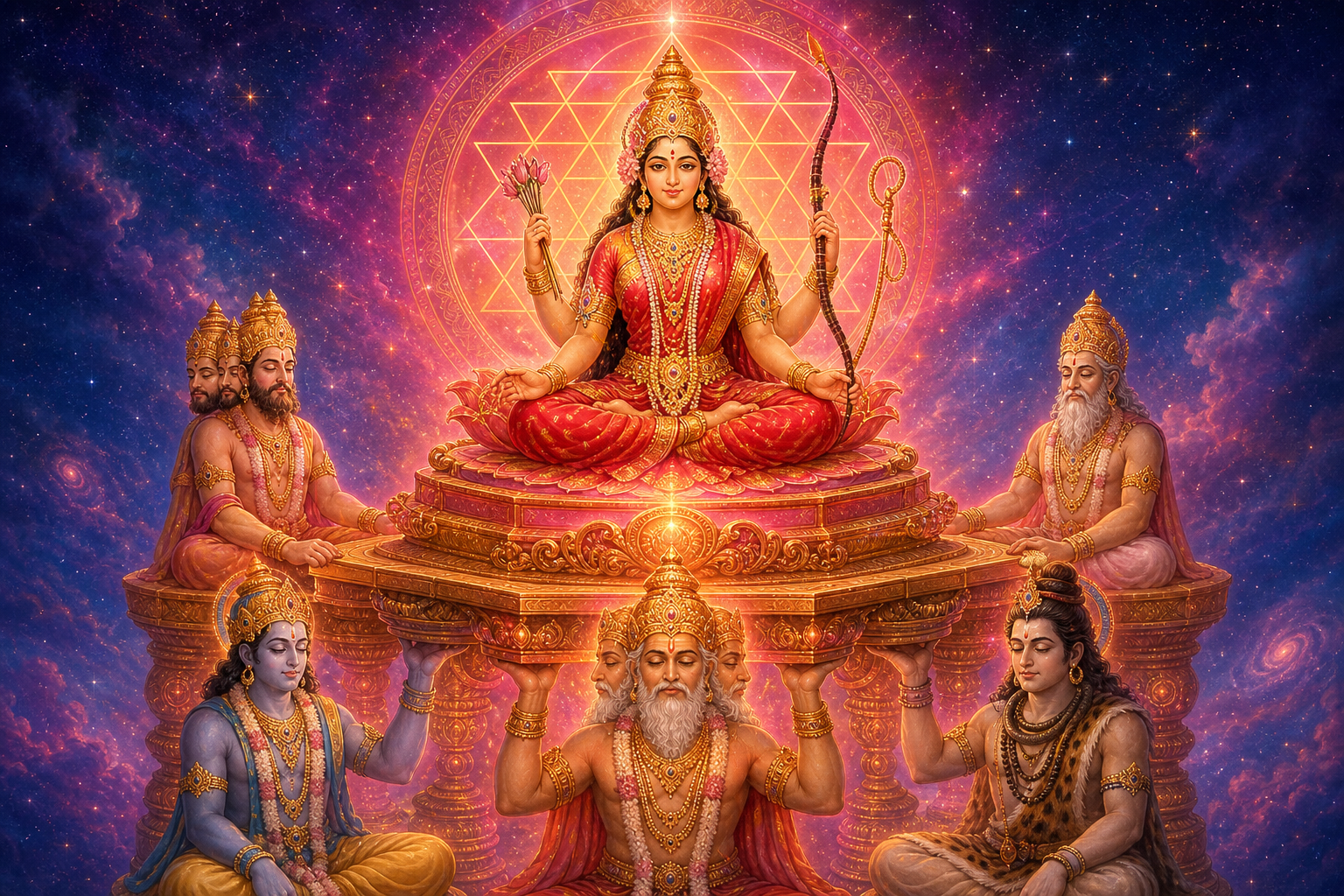
You may have seen Lalita Tripura Sundari enthroned above five divine figures and wondered why Tantra would call Brahma, Vishnu, Rudra, Ishvara, and Sadashiva “corpses.” Is the image subordinating other deities to Devi, or using death to make a sectarian claim?
Neither reading reaches the heart of Panchapreta. The image gives you a precise way to understand divine agency: a name, form, office, or cosmic function cannot act independently of Shakti, the living power of Consciousness. Once you see that distinction, Panchapreta becomes a practical guide to worship, self-examination, and responsible action.
Begin with the image’s grammar, not its shock value
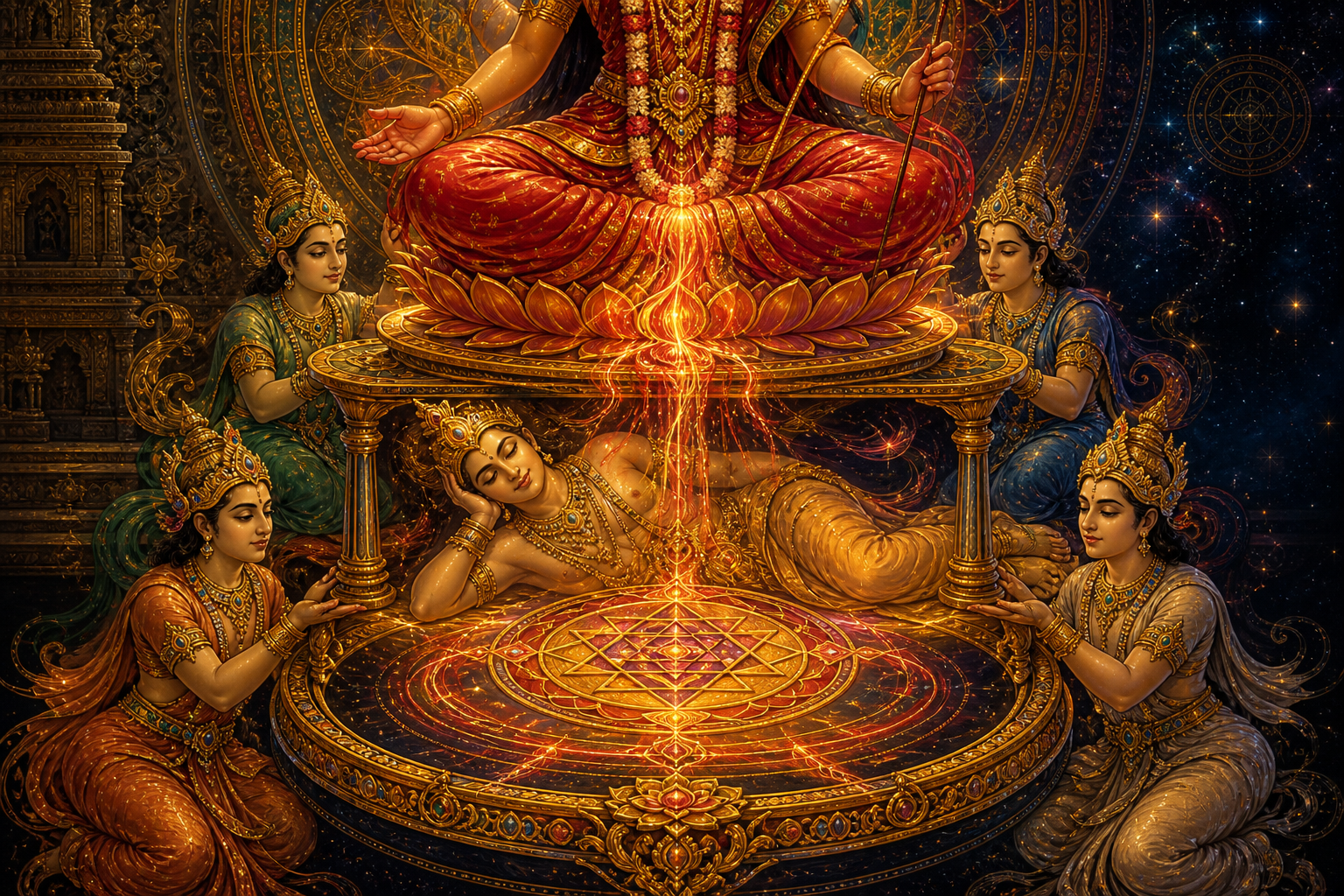
The Sanskrit word preta ordinarily evokes a corpse or departed being. In Panchapreta, however, the decisive meaning is inertness rather than morbidity. A corpse retains structure and recognisable form, but it no longer possesses the power to act. Tantra applies that contrast to the highest possible level: even a divine function is only an intelligible structure when considered apart from the Consciousness-Power that makes it effective.
This is why “five corpses” must not be read as “five dead gods.” The word preta qualifies the five only to the extent that we imagine them as independently acting powers. Brahma is not being declared lifeless, Vishnu powerless, Rudra defeated, Ishvara irrelevant, or Sadashiva stripped of divinity. Their functions are being shown as inseparable expressions of Shakti.
Three interpretive errors commonly follow when that qualification is missed:
- Literalising the metaphor: Panchapreta is a contemplative schema, not a scene in which five deities have physically died.
- Turning the image into a sectarian ranking: Lalita’s position does not produce a league table in which Devi wins and other deities lose.
- Treating Shakti as an external fuel: Shakti is not a separate substance added to otherwise independent gods. She is the intrinsic power through which Consciousness manifests and acts.
The distinction between form and animation is the key. A lamp can be beautifully fashioned and still give no light without the condition that makes illumination present. In the same way, a cosmic title names a capacity, while Shakti is its living actuality. The force of the corpse metaphor lies in refusing to confuse an office with its power of fulfilment.
The five “corpses” are five coordinated cosmic functions

Panchapreta becomes much clearer when you stop treating the five names merely as separate personalities and read them as the Pancha Brahma functions. Together they describe the full movement of manifestation: bringing forth, sustaining, withdrawing, concealing, and bestowing grace.
| Divine name | Cosmic function | What to notice in contemplation |
|---|---|---|
| Brahma | Srishti: creation | What is being brought into form, and what gives that beginning life? |
| Vishnu | Sthiti: preservation | What must be nourished, protected, or held in right order? |
| Rudra | Samhara: dissolution | What has completed its course and must be released or transformed? |
| Ishvara | Tirodhana: concealment | What remains veiled, limited, or not yet understood? |
| Sadashiva | Anugraha: grace | Where can liberating clarity, compassion, or blessing enter? |
The sequence prevents a narrow view of divine action. Creation alone would not make a cosmos; what appears must also be sustained. Preservation cannot mean freezing every form forever; dissolution belongs to the same order. Concealment acknowledges that manifested beings do not apprehend reality without limitation. Grace opens the movement beyond limitation rather than leaving it closed within veiling.
Tirodhana is often the least intuitive of the five. Creation, preservation, and dissolution are readily visible as a cycle, while concealment can sound like an alien or negative intrusion. Panchapreta places it within the same coordinated field. Limitation and obscuration are not evidence that an equal anti-divine power has escaped the reach of Consciousness. Yet this cosmic meaning must not be misused as an excuse for dishonesty. In personal reflection, tirodhana should first make you ask what you cannot see clearly, not give you permission to hide what another person has a right to know.
Anugraha completes the schema by preventing concealment from becoming the final word. Grace is not merely another event alongside making and unmaking. It indicates the possibility of release, recognition, and restored alignment. This is why the five functions are more than a cosmological inventory: they form a map of bondage and awakening as well as manifestation.
The familiar formula “Shiva without Shakti is shava” compresses this logic into a memorable contrast. Its purpose is not to insult Shiva. It denies that Consciousness and its power can be separated into two self-sufficient realities. Remove Shakti conceptually, and what remains is not the living fullness signified by Shiva but an abstraction without expression.
Lalita’s throne is a diagram of inseparability
In Sri Vidya imagery, Lalita Tripura Sundari seated upon the Panchapreta should be approached as a visual teaching. The throne gathers the five functions into one ordered support. Devi’s presence reveals why those functions are alive, coordinated, and capable of accomplishing anything at all.
If you read the throne only as domination, you remain at the level of spatial arrangement: one figure is above, others are below. Tantric iconography asks for a subtler question: what metaphysical relationship is the arrangement making visible? The answer is dependence without humiliation and unity without erasing functional distinction. Creation remains creation and preservation remains preservation, but neither possesses an isolated source of agency.
Shakti here is not a rival deity competing for cosmic territory. She is the immanent dynamism through which the One creates, preserves, dissolves, conceals, and grants grace. The five therefore do not become less sacred when their dependence is disclosed. Their sacred character becomes intelligible as participation in one indivisible Consciousness-Power.
This also clarifies the Shiva-Shakti relation. Shiva can name Being-Consciousness, while Shakti names its inherent power of manifestation and action. The distinction helps thought and devotion, but it should not be hardened into a split between a passive male principle and an independently active female principle. The teaching depends on inseparability. Power is the power of Consciousness; Consciousness is not encountered here as sterile or incapable of expression.
Panchapreta can therefore illuminate a non-dual insight associated with Advaita Vedanta: forms and functions do not possess independent reality apart from Consciousness. Tantra places a characteristic emphasis on that Consciousness as intrinsically powerful and expressive. You do not need to collapse Tantric and Advaitic vocabularies into one undifferentiated doctrine to recognise the shared refusal to grant ultimate independence to names and forms.
This distinction matters in worship. Non-duality does not require you to look past a murti as though form were an embarrassing concession for beginners. Panchapreta trains you to encounter the living Presence through form without mistaking the form for an autonomous object. The image remains worthy of devotion precisely because it educates vision.
Use Panchapreta as a disciplined contemplation
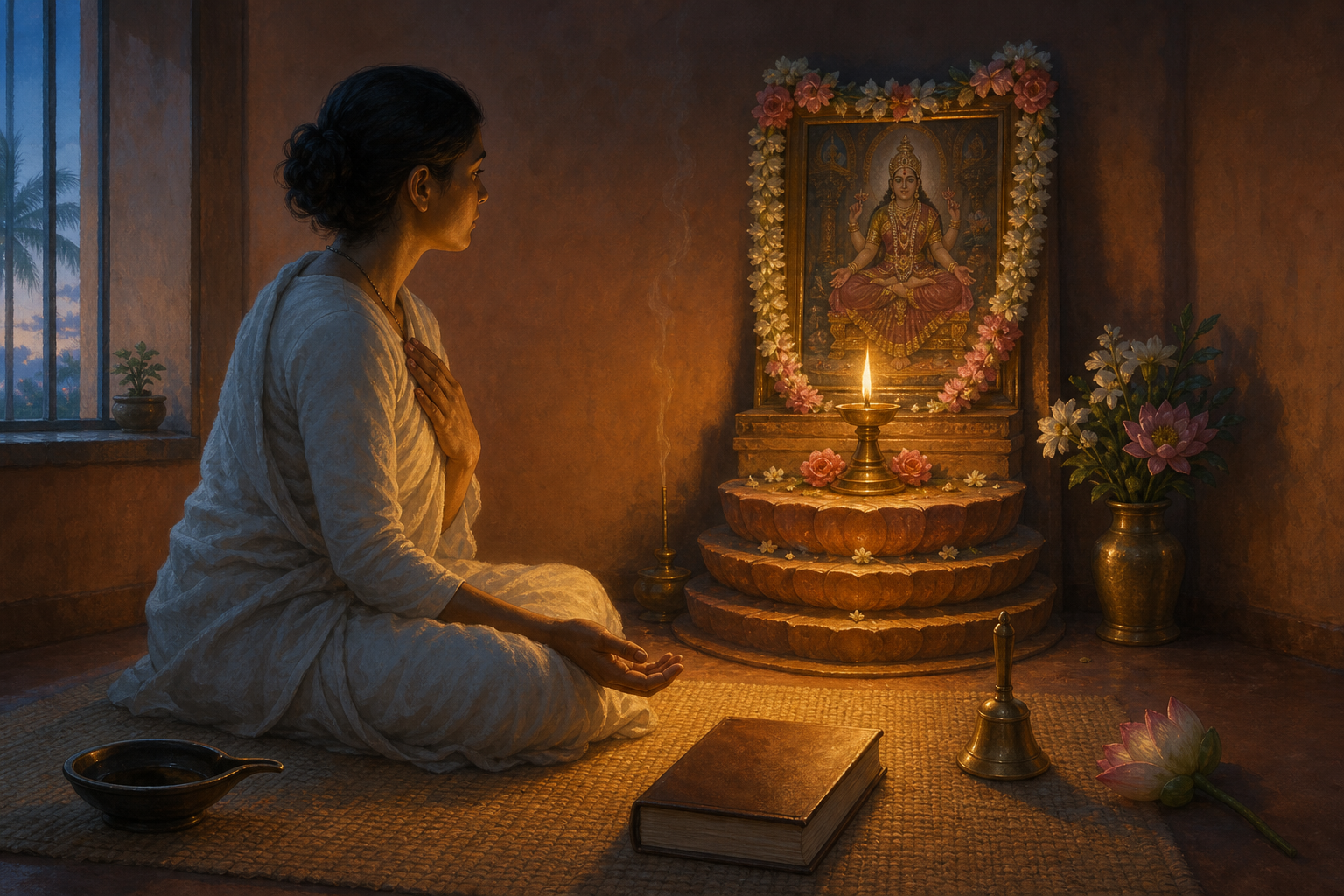
Knowing the five correspondences is useful, but memorisation alone leaves the teaching inert in its own way. The image is meant to redirect attention. You can use the following as a non-initiatory reflection on the symbolism; it does not replace the mantras, visualisations, or ritual procedures of a lineage-specific Sri Vidya practice.
- Establish the right frame. Look at the image, or hold its structure in mind, without asking which deity has defeated another. Recall that you are contemplating five dependent functions and the one Power animating them.
- Name each function deliberately. Move through srishti, sthiti, samhara, tirodhana, and anugraha. Do not rush past concealment and grace merely because creation, maintenance, and ending feel more concrete.
- Bring one real responsibility into view. Choose a family duty, a community commitment, a piece of work, or an aspect of sadhana. A single situation reveals more than a vague attempt to contemplate your whole life at once.
- Examine all five movements. Ask what you are creating, what will sustain it, what may need to end, what remains hidden from your understanding, and where grace or compassionate clarity is needed.
- Locate the inert structure. Notice where a title, routine, plan, ritual, or institution still has outward form but no longer carries attentive purpose. Apply the metaphor to the structure, not as a contemptuous label for a person.
- Choose an action that restores alignment. Begin what genuinely needs beginning, maintain what deserves care, release what has completed its role, admit what you do not see, or make room for forgiveness and correction.
- Return agency to its sacred ground. Complete the reflection with gratitude rather than self-congratulation. Your capacity to act is real, but Panchapreta asks you not to mistake delegated or participated power for isolated authorship.
The fourth step is where the symbol becomes especially practical. Many decisions fail because we honour one function while neglecting the others. We become enthusiastic about srishti but make no provision for sthiti. We preserve a form long after samhara is due. We act confidently while ignoring tirodhana—the limits and blind spots shaping our judgment. Or we turn responsibility into a mechanical system with no room for anugraha, the grace that allows insight, repair, and humane response.
“Align with Shakti” should not become a grand way of saying “do whatever feels powerful.” Shakti is not identical to impulse, forcefulness, ambition, or personal preference. Within Panchapreta, her power is recognised through the coordinated fulfilment of all five functions. An action that creates while refusing maintenance, destroys without discernment, or invokes concealment to avoid accountability does not become Dharmic merely because it feels energetic.
The ethical test is therefore concrete: does your action bring awareness into the function you are performing? Creation calls for responsibility toward what you bring forth. Preservation calls for sustained care rather than possessiveness. Dissolution calls for discernment rather than rage. Concealment calls for humility about limited perception. Grace calls for compassion without abandoning truth.
Let the symbol reshape worship, dialogue, and responsibility
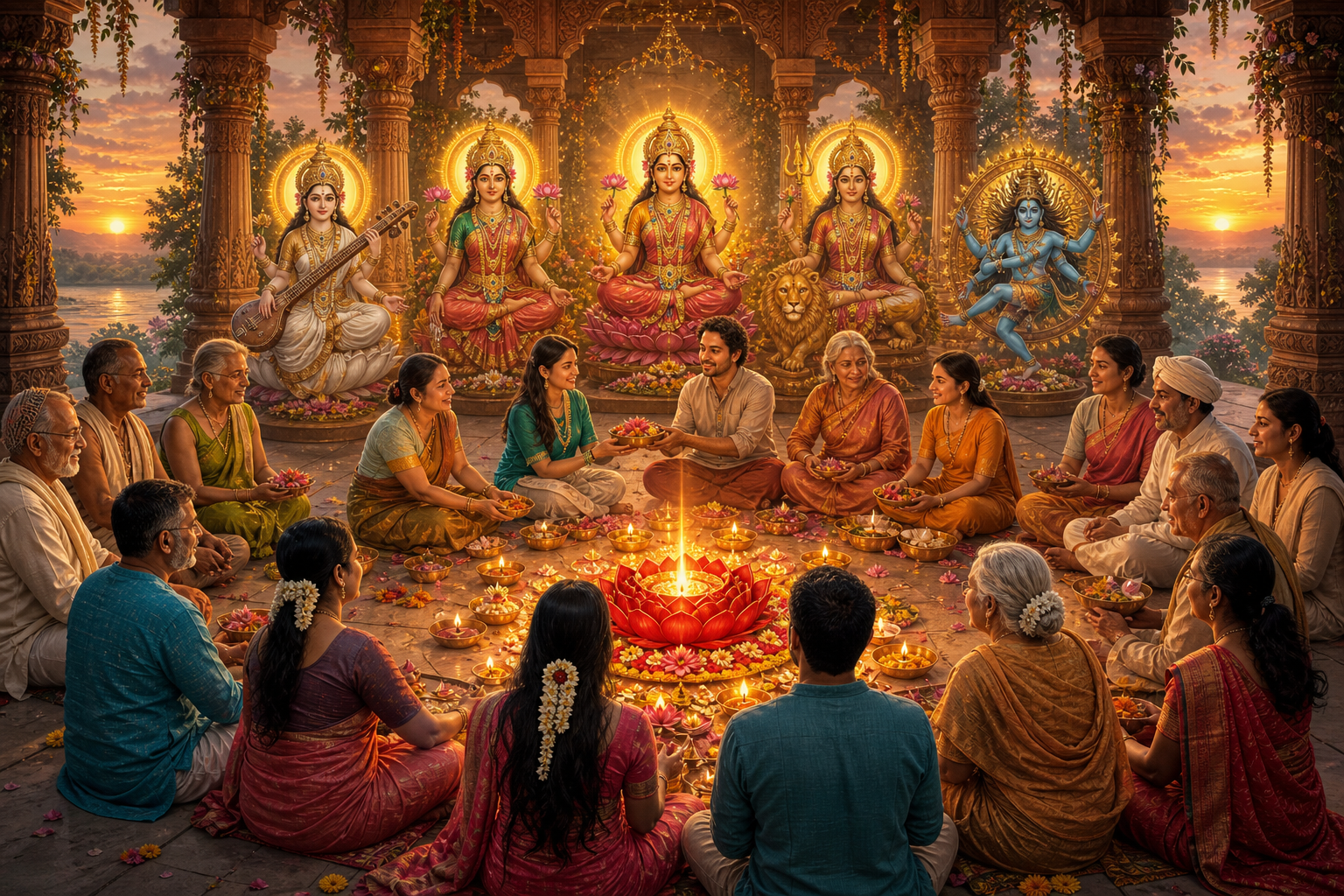
Worship without a contest among deities
Panchapreta gives Shaiva, Vaishnava, and Shakta devotees a way to disagree without reducing Hindu theology to factional rivalry. A Shakta can revere Lalita as the animating Power without treating Vishnu, Shiva, or Brahma as defeated outsiders. A devotee centred on another form can recognise that the image speaks in the theological language of Shakti while pointing toward coordinated divine functions rather than a collection of mutually independent gods.
When a sectarian argument begins, ask whether the participants are confusing theological emphasis with exclusive ownership of the Divine. Different sampradayas may organise names and relationships differently; Panchapreta does not erase those real differences. It does, however, challenge the assumption that honouring one form requires stripping sacred meaning from another. The practical response is neither forced uniformity nor polemical ranking, but disciplined attention to what each symbol is designed to reveal.
Dharmic resonance without flattening distinct traditions
The pattern of inseparable wisdom and effective power has recognisable resonances across the Dharmic family. In Buddhism, the relationship of prajna and upaya joins wisdom with skilful means. Jain anekantavada cautions against treating one standpoint as the exhaustive whole. Sikh affirmation of Ik Onkar and the transformative presence of Shabad likewise directs attention beyond isolated names and forms toward living divine reality.
These are resonances, not interchangeable definitions. Prajna is not simply another name for Shiva, anekantavada is not a Jain version of Panchapreta, and Shabad should not be absorbed into Sri Vidya terminology. If you are speaking across traditions, begin with the structural affinity—a refusal to separate truth from its living efficacy—then preserve the distinctive vocabulary and commitments of each path. Unity becomes meaningful only when it does not demand sameness.
A five-function audit for ordinary commitments
The metaphor also exposes a common weakness in personal and community life: we can preserve an outer structure after its animating purpose has faded. A ritual can become mechanical, an office can become a title without service, and an institution can continue its schedule while forgetting why it exists. Panchapreta does not tell you to discard structures. It tells you to examine what makes them living vehicles of Dharma.
Before beginning a substantial commitment, ask five questions. What exactly are we creating? Who or what will sustain it? Under what conditions should it change or end? Which assumptions and limitations are concealing part of the situation? How will grace appear as correction, compassion, or renewed clarity? That sequence turns Panchapreta from an intriguing image into a demanding standard of responsibility.
Key takeaways
- “Preta” means functional inertness in this symbol: it does not announce the literal death or inferiority of five deities.
- The five names identify a complete field of divine action: creation, preservation, dissolution, concealment, and grace.
- Lalita’s throne expresses dependence on Shakti: it is a contemplative diagram of animation and integration, not a sectarian scoreboard.
- Shiva and Shakti cannot be divided into self-sufficient substances: Consciousness and its intrinsic power are distinguished for understanding but united in reality.
- The practical test is living purpose: examine whether your roles, rituals, and commitments are animated by awareness, responsibility, humility, and compassion.
The next time you encounter the Panchapreta image, resist the immediate question of who is above whom. Name the five functions, recognise the Power that makes each effective, and then turn the image toward the responsibility in front of you. Identify which function you are being asked to serve and bring conscious, Dharmic intention into it. That is where a startling Tantric image begins to live.
References
