
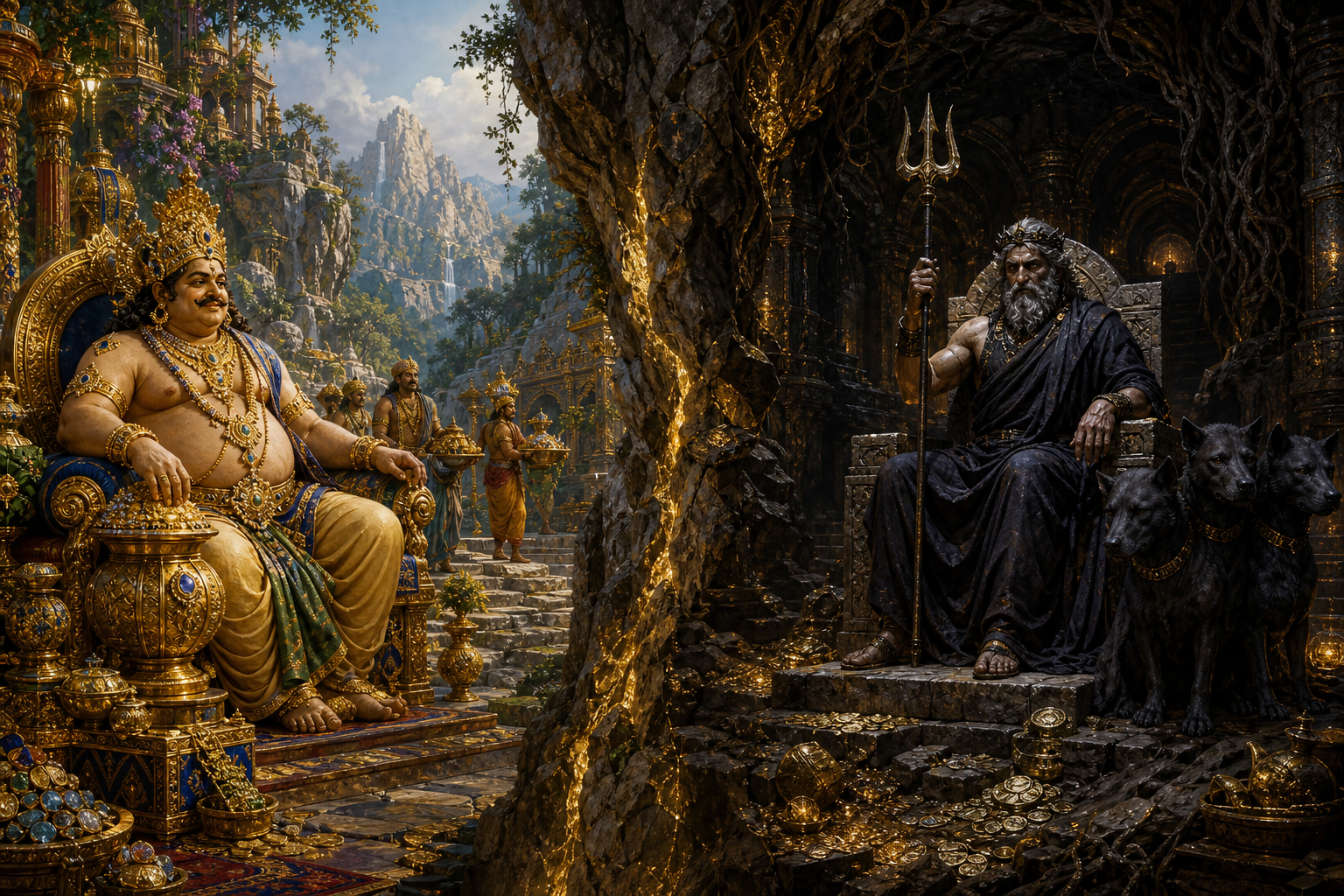
If someone tells you that Kubera is simply the Hindu Pluto, the reliable short answer is: only in a narrow symbolic sense. Both can direct your attention toward hidden or guarded wealth, but the resemblance breaks as soon as you ask who rules the dead, what devotees seek, and how each deity fits into cosmic order.
You do not have to choose between declaring them identical and refusing comparison altogether. A better method is to identify the exact point of overlap, preserve the differences around it, and then ask what each tradition teaches through its own arrangement of wealth, duty, and mortality.
The safe short answer: analogous wealth, different offices
Kubera is the lord of wealth, king of the Yakshas, and guardian of the northern direction. His sphere is prosperity, treasure, guardianship, and the responsible circulation of abundance. Pluto, corresponding to the Greek Hades, is the sovereign of the underworld. His association with wealth arises partly from the minerals, fertility, and other riches concealed beneath the earth.
That gives us a genuine parallel at the level of motif: both figures connect wealth with what is hidden, guarded, or rooted in the earth. Their functions overlap only partially, however, and their identities do not merge. Kubera is not the Hindu ruler of the dead, while Pluto is not primarily a divine treasurer who grants household prosperity.
Key takeaways
- The comparison works best around guarded wealth and the riches associated with the earth.
- Kubera’s primary office concerns prosperity and stewardship; Pluto’s primary office is sovereignty over the underworld.
- Yama, not Kubera, governs death and judgment in the Hindu cosmic order.
- The strongest ethical bridge is not that the deities are the same, but that wealth remains accountable to a larger moral order.
Test the comparison with four concrete questions
Whenever two deities appear similar, compare their offices before comparing their objects or visual symbols. Four questions usually prevent a superficial resemblance from becoming a false equivalence: What is the deity’s primary jurisdiction? How does wealth enter that jurisdiction? What relationship does the deity have to death? What does a worshipper or community expect from the deity?
| Comparison question | Kubera | Pluto | What you should notice |
|---|---|---|---|
| What is the primary office? | Lord and guardian of wealth, king of the Yakshas, and protector of the north | Sovereign of the underworld and its inhabitants | Wealth is central to Kubera’s office but secondary to Pluto’s underworld sovereignty. |
| How is wealth represented? | Treasure that can be guarded, bestowed, and used under dharma | Minerals, fertility, and abundance latent in the earth’s concealed depths | One image emphasizes custodianship and distribution; the other emphasizes possession through jurisdiction. |
| Who governs the realm of the dead? | Not Kubera; death and judgment belong to Yama | Pluto directly rules the underworld | This is the decisive limit of the analogy. |
| What is the ritual posture? | Propitiated in household and temple settings for prosperity and stability | Respected as an underworld ruler, but not normally the central giver in public prosperity rites | Similar wealth symbolism does not produce the same devotional relationship. |
| What do the familiar symbols communicate? | Money bag, jewel-filled vessel, mongoose, treasure, and a prosperous bodily form | Bident, cap of invisibility, threshold hound, and sometimes a cornucopia | The symbols belong to different narratives of treasure, concealment, authority, and boundary. |
If a proposed comparison matches only the wealth row, state that limitation explicitly. Say that Kubera and Pluto share a wealth motif, not that one is merely another culture’s version of the other. This small change in wording protects both traditions from being flattened.
Symbolic resemblance also cannot, by itself, establish historical borrowing or a common origin. That conclusion would require separate historical evidence. Comparative mythology first tells you where two patterns resemble one another; it does not automatically tell you how the resemblance arose.
Kubera’s treasure moves; Pluto’s wealth remains below
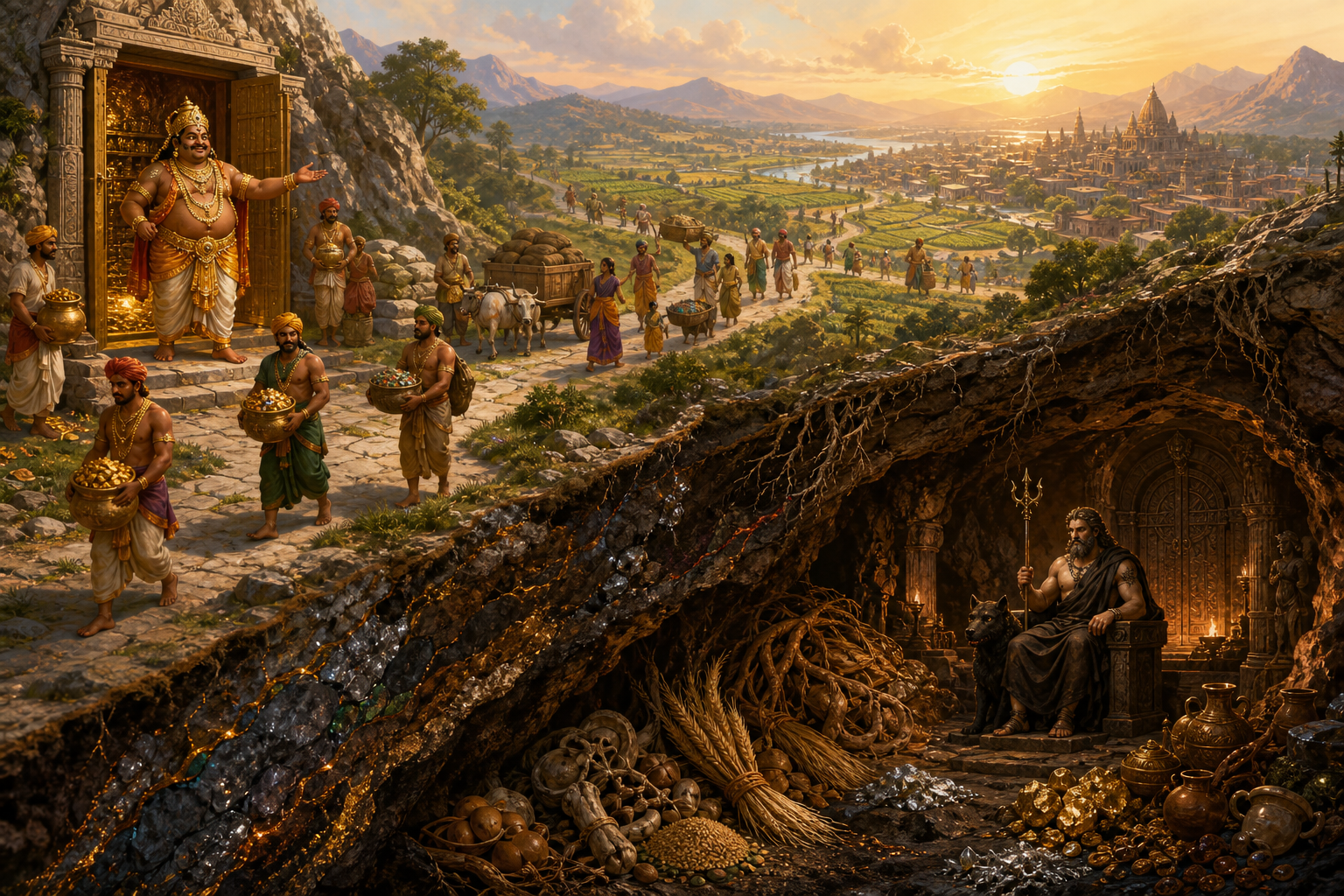
The most revealing difference lies in the implied movement of wealth. Kubera’s abundance can be guarded, granted, distributed, and put to use. His residence at Alaka or Alakapuri and his money bag or overflowing vessel place him within the imagery of a royal treasurer. Prosperity is not merely present around him; it is under custodianship.
This is why Kubera should not be reduced to a mascot for accumulation. His prosperous form and treasure-bearing symbols express controlled abundance, generosity, and restraint. The important question is not simply how much treasure exists, but whether it is guarded and used in a way compatible with dharma.
Pluto’s wealth is more indirect. His name is associated with ploutos, or wealth, while his realm contains the earth’s concealed riches. Minerals lie underground, and fertility also emerges from hidden depths. Pluto therefore embodies wealth through possession of the chthonic domain, not usually through the role of a personal benefactor handing fortune to devotees.
A useful interpretive shortcut is to notice the verbs each figure invites. Kubera guards, holds, and bestows. Pluto rules, contains, and keeps boundaries. These verbs are not complete definitions, but they stop a money bag and a cornucopia from being treated as interchangeable props.
When you encounter an image, ask whether its object represents possession, jurisdiction, circulation, or a boundary. Kubera’s vessel of jewels points toward treasure under stewardship. A cornucopia associated with Pluto points toward abundance contained within the generative earth. The visible objects may both indicate wealth, yet they place the deity in a different relationship to it.
The ethical parallel is stronger than the deity match
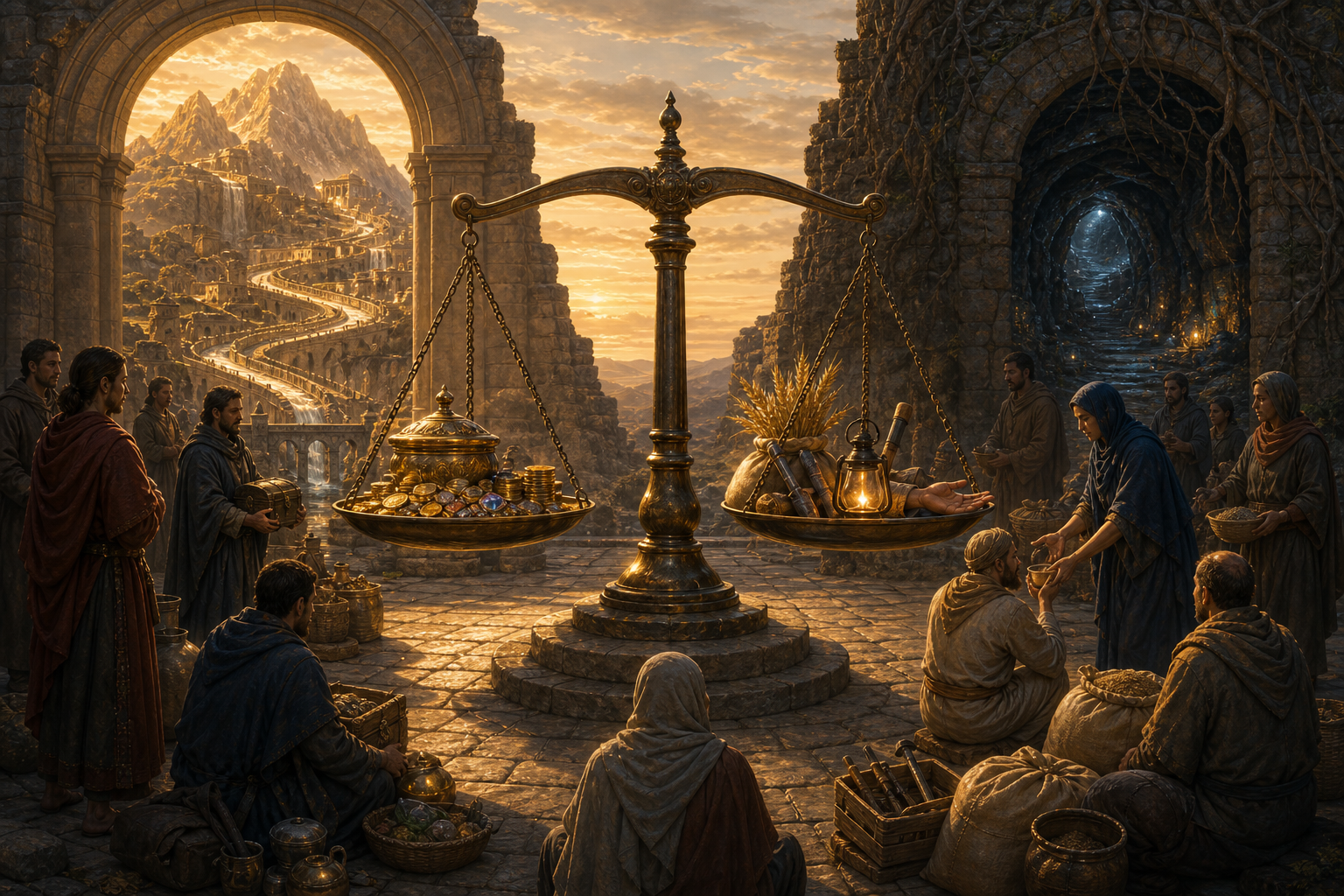
Hindu thought recognizes artha, material prosperity, as a legitimate human aim, but it does not isolate artha from dharma. Kubera’s significance is clearest within that relationship. Wealth may support household stability, duty, generosity, and social order; acquisition without restraint or rightful purpose distorts the very prosperity being sought.
Roman moral vocabulary approaches the issue through a different structure. Pietas emphasizes duties toward the gods, family, and community, while mos maiorum invokes inherited custom and public conduct. Pluto’s orderly realm, governed by law, oath, and fate, places even hidden riches and the dead within an established cosmic boundary.
The comparison is therefore ethically useful without making the two moral systems identical. Hindu dharma and Roman pietas are not alternative names for one doctrine. They do, however, prevent wealth from being imagined as morally self-justifying. In both settings, abundance remains situated within obligations that exceed the appetite of its possessor.
Keep the pan-Dharmic connection precise
Kubera also appears as Vaiśravaṇa or Vaisravana in Buddhism, where he is guardian of the north and a protector of the Dharma. This is more than a loose comparison based on similar symbols: it is a recognizable Dharmic continuity in the figure’s protective and directional role.
Jain and Sikh traditions likewise give serious weight to integrity, honest work, disciplined conduct, and service. That shared ethical ground can sustain a pan-Dharmic conversation about responsible prosperity. It should not be turned into a claim that every tradition has the same deity or expresses the value through the same theology. Shared values become more meaningful when their distinct foundations remain visible.
Turn the mythology into a four-part wealth audit

A comparative myth becomes useful when it changes what you notice in an actual decision. It cannot promise a financial outcome, but it can expose the moral questions that disappear when wealth is measured only by quantity. Before you pursue, hold, spend, or distribute resources, run the decision through four checks.
- Examine acquisition. Ask whether the gain comes through honest and fair exchange. If its apparent success depends on deception, exploitation, or an ignored obligation, it fails the dharmic test before questions of generosity even begin.
- Name the hidden cost. Pluto’s subterranean association is a reminder that valuable things have concealed origins. Ask what land, labor, material, or community bears the cost that your balance sheet does not show.
- Define your custodial duty. Kubera’s imagery invites you to distinguish ownership from stewardship. Identify what must be preserved for genuine stability, what obligations must be paid, and what resources can responsibly circulate.
- Specify the beneficiary. A claim about prosperity is incomplete until you can say who becomes more secure because of it. Family care, fair obligations, community support, and environmental responsibility are more concrete answers than accumulation for its own sake.
This audit also sharpens institutional choices. A temple committee, business, household, or community body can possess ample resources while neglecting its duties. The relevant measure is not whether wealth has been amassed, but whether its acquisition and use strengthen the order that made prosperity possible.
If you need to explain the comparison in two sentences, use this formulation: Kubera is a guardian and benefactor of wealth whose abundance is placed under dharmic stewardship. Pluto is sovereign of the underworld and is associated with the riches concealed within its depths; Yama, not Kubera, occupies the Hindu office connected with death and judgment.
Then take the comparison back to your next decision about resources. Ask what is being guarded, what remains hidden, which duty limits your freedom, and who benefits when the wealth moves. That is where the mythology stops being a catalogue of similarities and begins to refine conduct.
References
