

You can assemble willing volunteers, devotional music, sacred books and a promising public location, yet still conduct sankirtan that leaves people feeling managed rather than welcomed. The weakness usually appears when outward activity grows faster than the inner habits needed to sustain it.
Bhakti formation and sankirtan outreach therefore belong to one cycle. The attention, humility and reverence cultivated in private become the atmosphere others meet in public. This field guide will help you prepare devotees for that responsibility, design a humane path from first contact to community, and evaluate outreach without reducing people to distribution totals.
Formation comes before visibility

Bhakti formation is more than transferring information about philosophy, ritual or institutional history. It forms the way a person pays attention, receives correction, speaks about others, handles sacred things and serves when recognition is absent. Knowledge matters, but knowledge without a corresponding discipline of character can make an outreach worker articulate without making that person trustworthy.
Public service exposes whatever private formation has left unresolved. A volunteer may meet indifference, a sincere challenge, a dismissive remark or someone whose spiritual vocabulary is unfamiliar. In that moment, memorized answers matter less than the ability to listen without becoming defensive. The field does not manufacture pride or patience; it makes them visible.
Before assigning a public-facing role, look for observable readiness rather than personality or seniority:
- The volunteer can explain the purpose of chanting or literature distribution without promising an experience that no one can guarantee.
- The volunteer listens long enough to discover what a visitor is actually asking, instead of delivering a prepared answer to a different question.
- The volunteer can say that an answer is not known and offer to find someone better equipped to respond.
- The volunteer accepts a private correction without turning it into a dispute about status.
- The volunteer treats books, chanting and fellow devotees with care when no guest is watching.
- The volunteer can end an unproductive conversation courteously rather than trying to win it.
Do not turn this into a purity test that excludes new devotees. A beginner can serve well in a bounded role alongside an experienced person. The useful question is not whether someone has completed formation. No one reaches such a final point. Ask whether the person has enough steadiness for the responsibility being assigned and enough teachability to keep growing through it.
Connect every outward assignment to an inward discipline. A person entrusted with welcoming visitors should practise attentive listening. Someone caring for literature should learn why shastra is handled reverently. A person leading chanting should also learn how to notice the congregation, support other voices and avoid turning leadership into performance. The role then becomes a setting for sadhana rather than a reward for visibility.
Make aparadha prevention operational
Within bhakti practice, freedom from aparadha is a condition for steady devotional progress, expressed through humility, guarded speech, respect for Vaishnavas and careful engagement with shastra. That principle cannot remain a sentence heard in class. It needs to shape briefing, conduct, correction and follow-up.
Agree on conduct before going into public space:
- Do not ridicule another lineage, teacher, community or form of worship to make your own practice appear stronger.
- Do not turn a visitor’s confusion into entertainment after the program. Discuss difficult encounters only when doing so helps the team learn or protect someone.
- Do not claim that distribution success proves greater spiritual worth. A service total describes activity, not the inner standing of the people involved.
- Correct mistakes privately unless immediate intervention is needed to stop harm, public humiliation or careless treatment of a sacred object.
- Ask permission before photographing or identifying visitors. Participation in a public kirtan is not automatic consent to become promotional material.
- Do not use aparadha as a label for every sincere question or disagreement. Respond to the actual conduct: contempt, ridicule and personal attack are different from a person trying to understand.
Reverence also applies when shastra is read on a phone or tablet. The same screen that displays a sacred verse can interrupt it with messages, advertising and unrelated scrolling. Put the device into a quiet mode, open the text before the session begins, keep it in a clean and intentional place, and finish the reading before returning to ordinary use. The point is not to confuse hardware with shastra. It is to stop casual handling and digital distraction from training the mind in the opposite direction from devotion.
When a breach occurs, address the action without declaring the person’s entire character corrupt. Stop what needs to be stopped, protect the affected person or sacred object, acknowledge the mistake, make an appropriate apology, and decide whether the volunteer needs instruction, accompaniment or reassignment. Repeated disregard after correction is a readiness problem, even when the person is enthusiastic.
Build a pathway that does not depend on charisma
Sankirtan can include public chanting, devotional conversation and the circulation of sacred literature. These activities open different doors. Some people will listen from a distance. Some will accept a book but decline a conversation. Some will ask a serious question without joining the chanting. Good outreach permits those different depths of engagement instead of treating one visible response as the only successful one.
Design the encounter as a pathway. Each stage needs an owner and a clear next step:
| Stage | Common failure | Field practice |
|---|---|---|
| Threshold | The group is audible but a newcomer cannot tell what is happening or whether approaching is welcome. | Keep the public edge of the gathering open, calm and easy to enter without obligation. |
| Welcome | A volunteer begins explaining before discovering whether the person wants a conversation. | Offer a greeting, allow observation, and ask before moving into a longer exchange. |
| Encounter | The visitor receives a speech instead of an answer to the question asked. | Listen first, reflect the question accurately, and give the shortest honest response that serves it. |
| Access | A book is handed over without enough context to help the recipient use it. | Match the literature to the expressed interest and briefly identify what the reader will find inside. |
| Continuity | Contact information is collected, but no one owns the follow-up. | Obtain explicit permission, identify the agreed channel, and assign responsibility before the team disperses. |
| Return | The invitation is too vague for a curious person to act on. | Offer a concrete next setting appropriate to the interest shown, such as chanting, study, temple worship or community service. |
This pathway changes how you organize the team. The most musical or philosophically fluent person does not have to carry every interaction. Give someone responsibility for the devotional sound, someone for the welcoming edge, someone for literature, someone for substantial questions and someone for consent-based continuity. A smaller group may combine responsibilities, but it should never leave them ambiguous.
Prepare graceful exits as carefully as openings. A person who declines a book, disagrees with a teaching or has no time to speak should be able to leave without being followed, shamed or treated as a failed target. A courteous ending preserves dignity and keeps the public presence consistent with the devotional message.
Count distribution without reducing people to a count
Scale matters because it shows what coordinated service can accomplish. In October 2025, more than 385,000 pieces of literature were distributed through the worldwide sankirtan network, with leading results reported across large, medium, small and maha-small temple categories. That breadth also prevents a convenient excuse: a modest base does not make disciplined outreach meaningless.
A distribution total is still only an activity measure. It can help you plan inventory, recognize sustained effort and see where participation is growing. It cannot tell you whether a recipient understood what was offered, felt pressured, returned to the community or encountered a volunteer whose conduct reflected bhakti. Treat the total as one field in a larger service record.
Review these dimensions side by side rather than collapsing them into a single score:
- Reach: literature accepted and people who chose to participate in chanting or conversation.
- Engagement: questions asked, subjects that drew sustained interest and explanations that repeatedly caused confusion.
- Continuity: people who explicitly requested further contact, attended a later program or sought another resource.
- Formation: whether volunteers attended preparation, accepted correction and completed reflection after service.
- Care: damaged or misplaced literature, complaints about pressure, privacy concerns and unresolved interpersonal incidents.
- Learning: questions the team could not answer, roles that lacked ownership and changes to test during the next outing.
Protect the people behind those records. Collect contact details only with explicit permission, explain what kind of message will follow, use the agreed channel and make refusal easy. Notes about recurring questions can usually be recorded without identifying the person who asked them. Outreach does not need unnecessary personal data to learn well.
Welcome dharmic diversity without pretending sameness
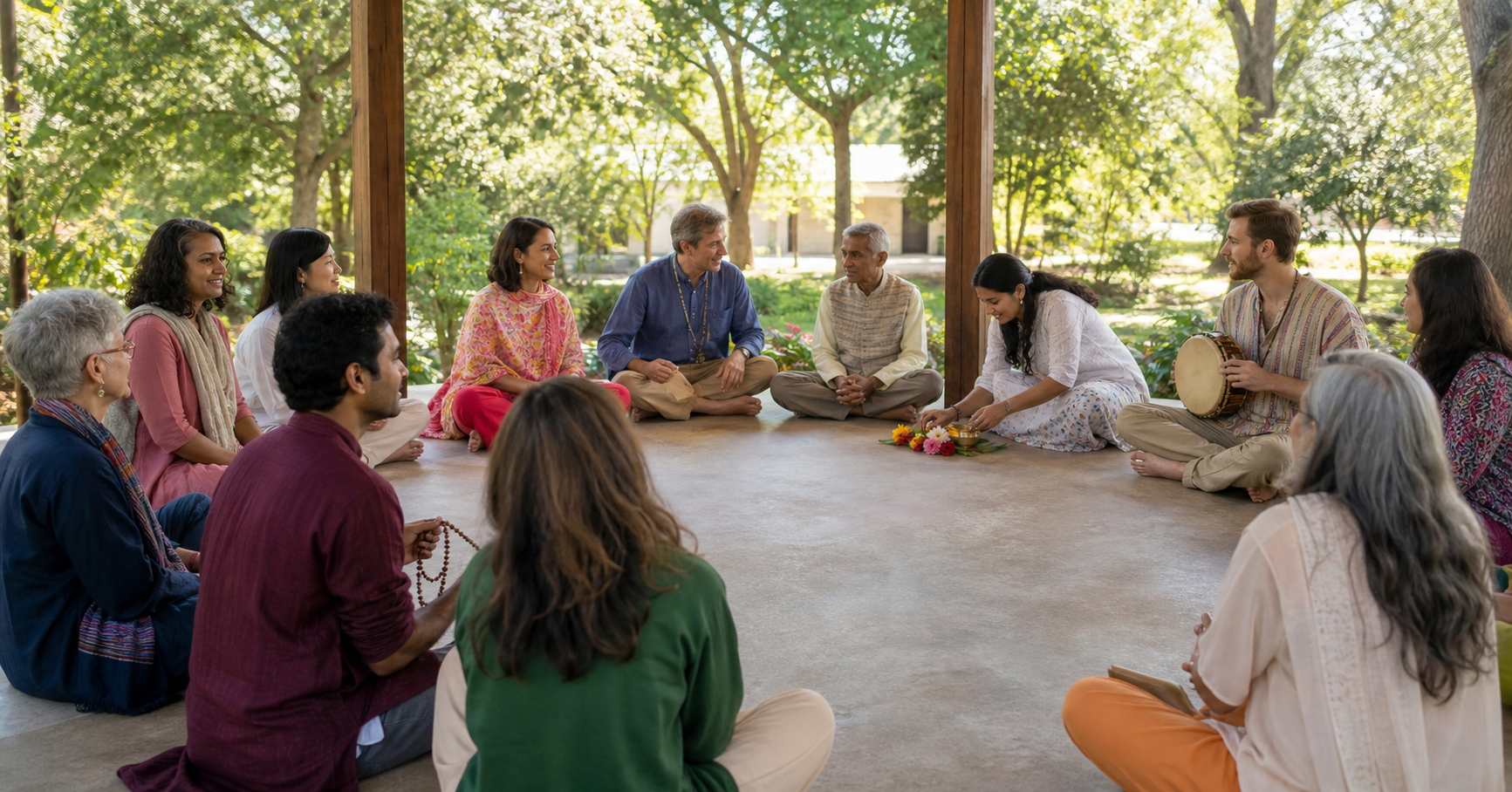
A public sankirtan may be encountered by Vaishnavas from another sampradaya, Hindus formed by a different mode of worship, Buddhists, Jains, Sikhs, people from non-dharmic religions, and people who claim no religious identity. You do not serve this range of visitors by hiding your own devotional location. Nor do you serve them by treating difference as hostility.
There are genuine ethical resonances across the dharmic family: ahimsa, disciplined speech, mindful conduct, seva, and reverence for the Guru or sacred teaching all provide possible points of recognition. Yet shared values do not erase different understandings of the self, liberation, divine reality, authority or practice. Unity in spiritual diversity means meeting without contempt; it does not require declaring every doctrine identical.
Use a disciplined method when speaking across those differences:
- Locate yourself clearly. Name the practice or lineage you are representing rather than speaking as though your explanation exhausts all of Hinduism or all Dharma.
- Ask before interpreting. Familiar terms can carry different meanings in different traditions, so find out how the other person is using a word.
- Begin with conduct where common ground is real. Careful speech, compassion and selfless service can support a respectful conversation without forcing doctrinal agreement.
- State differences accurately and calmly when they matter. Do not manufacture agreement, and do not sharpen a distinction merely to provoke a contest.
- Distinguish inquiry from abuse. Patiently answer good-faith questions; set a boundary when an exchange becomes demeaning or prevents others from participating.
- Never recruit through caricature. Confidence in bhakti should be visible in the quality of attention and service, not in distorted descriptions of another path.
This approach also improves conversations within Hindu traditions. A visitor may already have a guru, family deity, temple discipline or inherited practice. Find out what commitment is already present before offering another obligation. Hospitality begins by seeing a practitioner rather than an empty space to fill.
Use a field cycle that brings outreach back into sadhana

An event becomes formative when the team carries what happened in public back into study, correction and service. Without that return, organizers repeat the same avoidable weaknesses while interpreting continued activity as progress. Use the following cycle for a temple program, neighborhood gathering or mobile team.
- Ground the team. Chant or read together, clarify the devotional intention, and let each volunteer name the conduct they need to guard. This makes the ethical standard explicit before public pressure arrives.
- Prepare the field. Confirm the location, relevant requirements, literature, devotional materials, team responsibilities and a plan for respectful handling. Make sure a curious visitor can understand how to approach and where to ask a question.
- Serve the encounter. Keep the sound devotional, the welcome unforced and the conversation responsive. Offer literature with enough context to make it usable, and accept refusal without changing tone.
- Record what helps learning. Reconcile literature, retain only consented contact details, and note recurring questions or points of confusion without turning visitors into gossip.
- Reflect before dispersing. Ask where the team showed patience, where pride or haste entered, which handoff failed and which question requires further study. Let junior volunteers speak before senior voices settle the interpretation.
- Repair what can be repaired. Correct careless handling, apologize for an inappropriate interaction, clarify a misleading statement and change a role when someone was placed beyond current readiness.
- Continue the relationship. Follow up through the agreed channel, provide the promised resource and invite the person into a suitable next setting. Do not send repeated messages merely because contact information was provided once.
The pattern of failure will tell you where to work. If people stop to listen but no one feels able to approach, strengthen the threshold and welcome. If literature moves but readers receive no useful context, strengthen access. If people request contact but hear nothing, continuity lacks ownership. If activity rises while volunteers become harsh, competitive or careless, the formation layer is not keeping pace with visibility.
Pay special attention to what the team starts excusing. Pressure can be rationalized as enthusiasm, argument as boldness, exhaustion as sacrifice and careless handling as efficiency. A healthy review asks whether the method still expresses the devotional purpose. If it does not, higher activity cannot repair the contradiction.
Key takeaways
- Treat sankirtan as a test and extension of bhakti formation, not as a separate promotional department.
- Assign public responsibility according to observable steadiness and teachability, while giving beginners bounded ways to serve and grow.
- Turn freedom from aparadha into explicit practices for speech, correction, sacred literature, digital devices and inter-devotee conduct.
- Design a complete pathway from welcoming presence to consent-based continuity; do not assume chanting or book distribution completes the relationship.
- Track reach alongside engagement, formation, care and learning. A large total can describe effort, but it cannot certify devotional quality.
- Meet dharmic diversity through honest self-location, real common ground and accurate differences rather than either hostility or artificial sameness.
Before your next sankirtan program, settle three matters with the team: the inner quality you intend to practise, the person responsible for each public handoff, and the questions you will use when reviewing the service. Then let the next outing reveal what formation needs next. When the field sends you back to sadhana, outreach stops being a performance of devotion and becomes one of its disciplines.
References
- Dandavats – Reverence and Bhakti in Practice: H.H. Guru Prasad Swami’s ISKCON Dwarka Teaching on Offense-Free Devotion
- Dandavats – WSN October 2025: Powerful Sankirtan Achievements, Temple Leaders, and Global Outreach
