

If someone has told you that maya means everything around you is unreal, you may be left with an uncomfortable choice: either take ordinary life seriously and remain worldly, or call it an illusion and become spiritual. That choice is based on a misunderstanding.
Krishna bhakti asks you to distinguish the thing in front of you from the false independence you project onto it. Your body, work, relationships, abilities, and material surroundings are not blank nonentities. Maya enters when you see them as self-existing, self-sufficient, or valuable apart from Krishna. Once you grasp that distinction, remembrance of Krishna becomes a way of seeing and acting accurately rather than a retreat from reality.
The mistake is separation, not existence
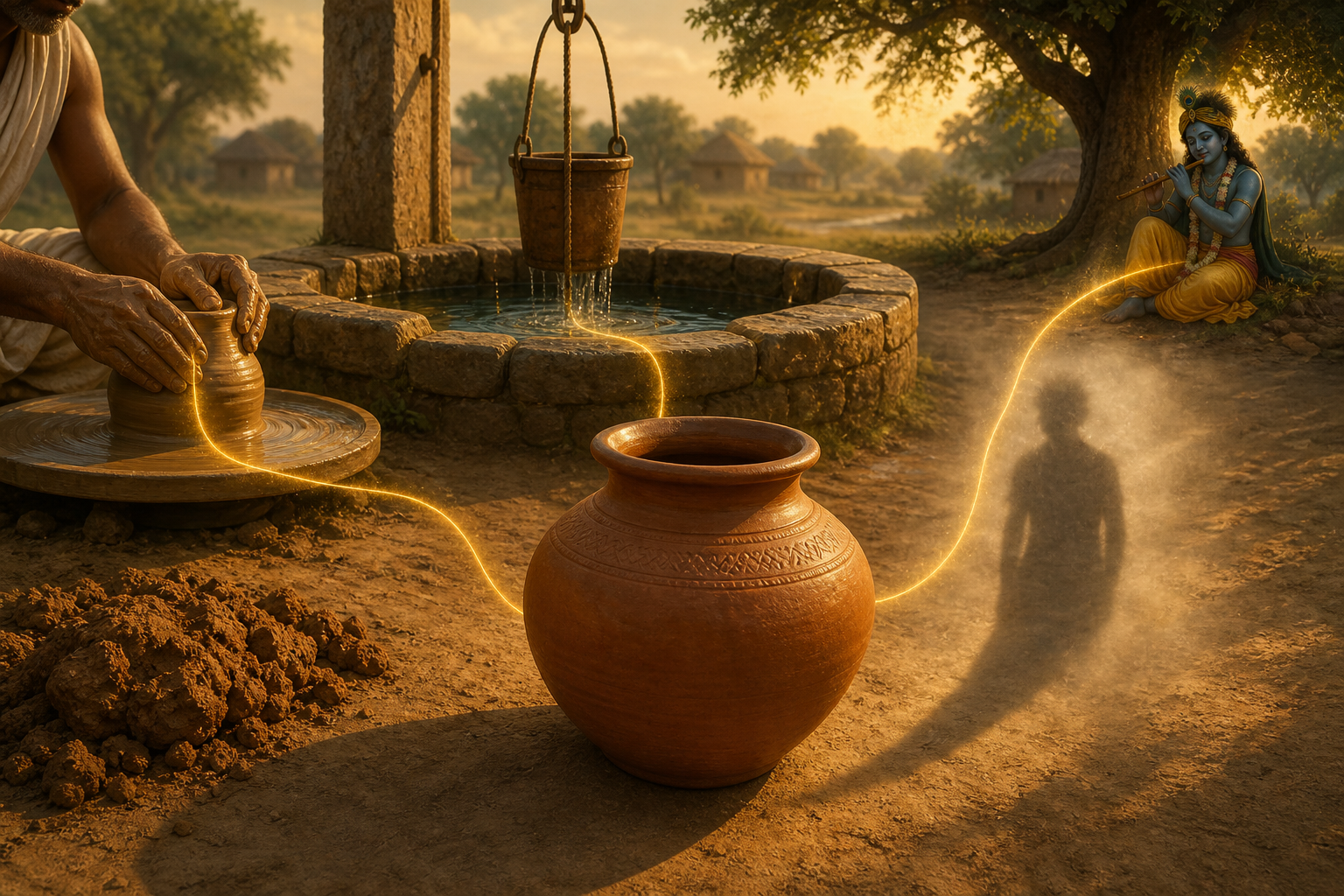
Krishna’s instruction to Brahma provides the central test:
Whatever appears to be of any value, if it is without relation to Me, has no reality.
Srimad-Bhagavatam 2.9.34
Read the words without relation to Me carefully. They do not mean that a physical object is produced out of nothing by your imagination. They mean that the object is misunderstood when it is regarded as independent of Krishna. The cosmic manifestation, its changes, and the living beings within it all depend on the Supreme. Nothing can actually stand outside that dependence.
This resolves an apparent contradiction. If everything exists through Krishna’s energy, how could anything truly be unrelated to him? It cannot. The relation is always present; maya is the failure to recognize it. You may mentally detach a thing from Krishna, claim it as absolutely your own, and use it as though it possessed an independent purpose. That interpretation is illusory even though the thing being interpreted is present.
- Your body exists, but the belief that you are nothing more than the body mistakes a temporary embodiment for your complete identity.
- Your ability exists, but treating yourself as its absolute and self-created source mistakes dependent agency for supreme independence.
- Your possessions exist, but treating ownership as unlimited and intrinsic mistakes stewardship for sovereignty.
- Your social role exists, but making that role the final measure of the self gives a changing designation more reality than it can bear.
The useful question, then, is not simply, Is my work maya? Ask instead, What am I believing about this work that depends on forgetting Krishna? The task may be real, necessary, and capable of becoming service. The illusion may lie in believing that its result will make you self-sufficient, that its success belongs to you alone, or that its failure destroys your real identity.
This Krishna-centered account also preserves the distinction between the living being and the Supreme. In Bhagavad-gita 2.12, Krishna distinguishes himself, Arjuna, and the assembled warriors across past, present, and future. Individual personality is therefore not treated as a disposable illusion that realization must erase. The claim I am the Supreme is rejected as another form of false independence.
That point marks a real boundary of interpretation. Hindu schools do not all employ the word maya in exactly the same way. The account here is the personalist, Bhagavata-based understanding centered on an enduring relation between Krishna and the jiva. It should not be flattened into a supposedly universal definition shared without qualification by every school of Vedanta.
The rope is real even when the snake is not
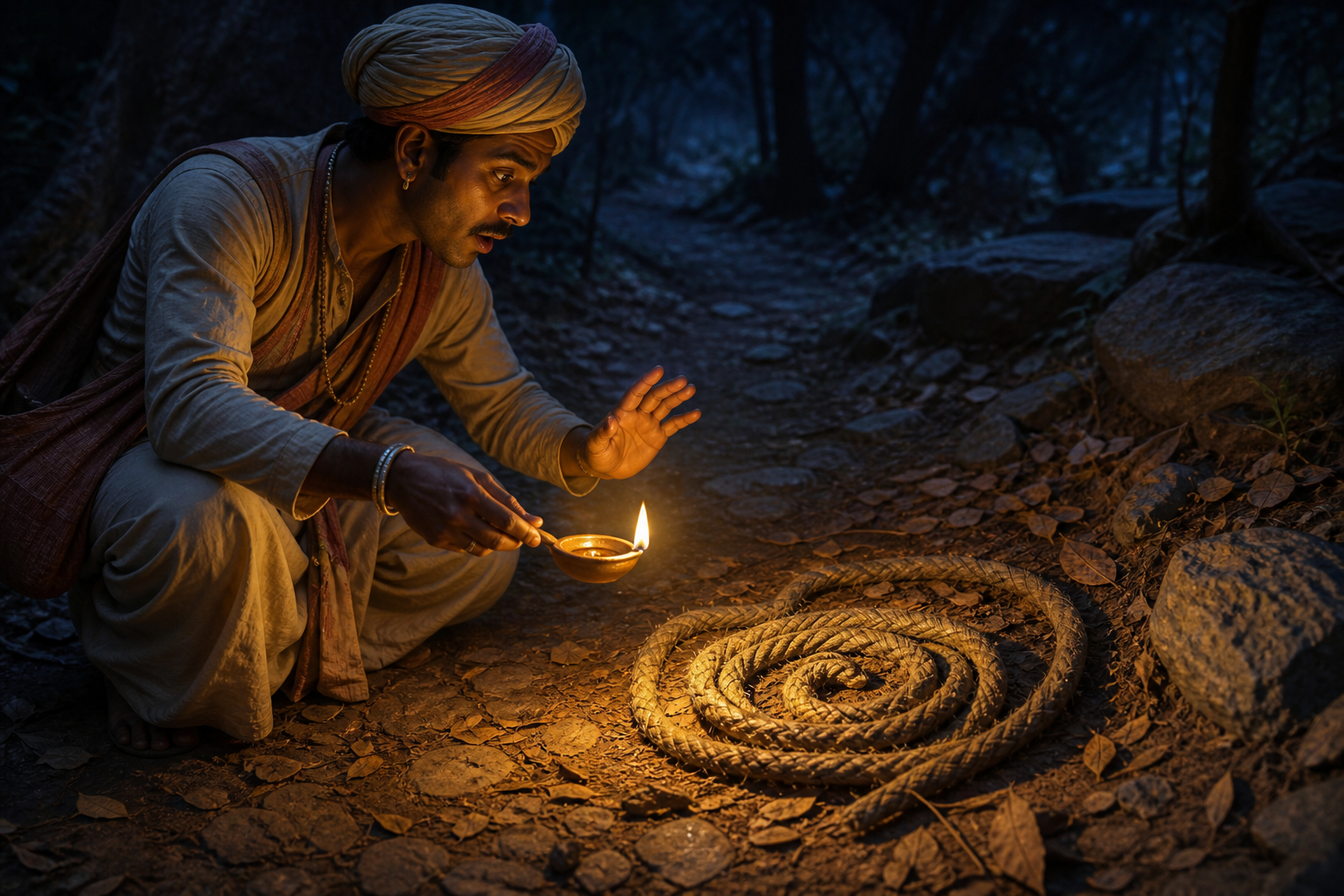
The rope-and-snake analogy prevents the doctrine of maya from collapsing into nihilism. In poor light, you see a rope and mistake it for a snake. The rope supplies the real basis of the experience. The imagined snake is the false interpretation. Better light does not annihilate the rope; it corrects your vision of what was there all along.
The analogy maps neatly onto Krishna-centered reality:
- The rope is the reality that actually confronts you: Krishna, the jiva, and Krishna’s energies.
- The snake is the projected claim that the self or the world exists independently of Krishna.
- The darkness is ignorance of the underlying relation.
- The arrival of light is knowledge and mercy that reveal the relation as it is.
The imagined snake can still produce fear. That consequence does not make the snake real, but it shows why illusion cannot be dismissed as nothing. A mistaken view influences choices, habits, attachments, and reactions. You behave differently when you think a rope is a snake, and you live differently when you think dependent beings and resources are absolutely independent.
Use the analogy as a three-part diagnostic whenever a situation seems spiritually confusing:
- Identify the rope: What is actually present, without denial or exaggeration?
- Identify the snake: What independent identity, ownership, permanence, or value are you projecting onto it?
- Bring light: How does the situation depend on Krishna, and how should that relation alter your response?
This is why temporary should not be used as a synonym for nonexistent. A changing condition is not an ultimate foundation, but it still calls for an appropriate response. Your body needs care. A promise creates responsibility. Another person’s distress should not be brushed aside with the phrase it is all maya. Dismissing what is present merely replaces one misreading with another.
A world understood as Krishna’s energy deserves more careful attention, not less. The object is not rejected; the false claim attached to it is. The point of spiritual vision is to stop mistaking the snake for the rope while continuing to handle the rope according to what it really is.
Maha-maya conceals the relation; yoga-maya restores it
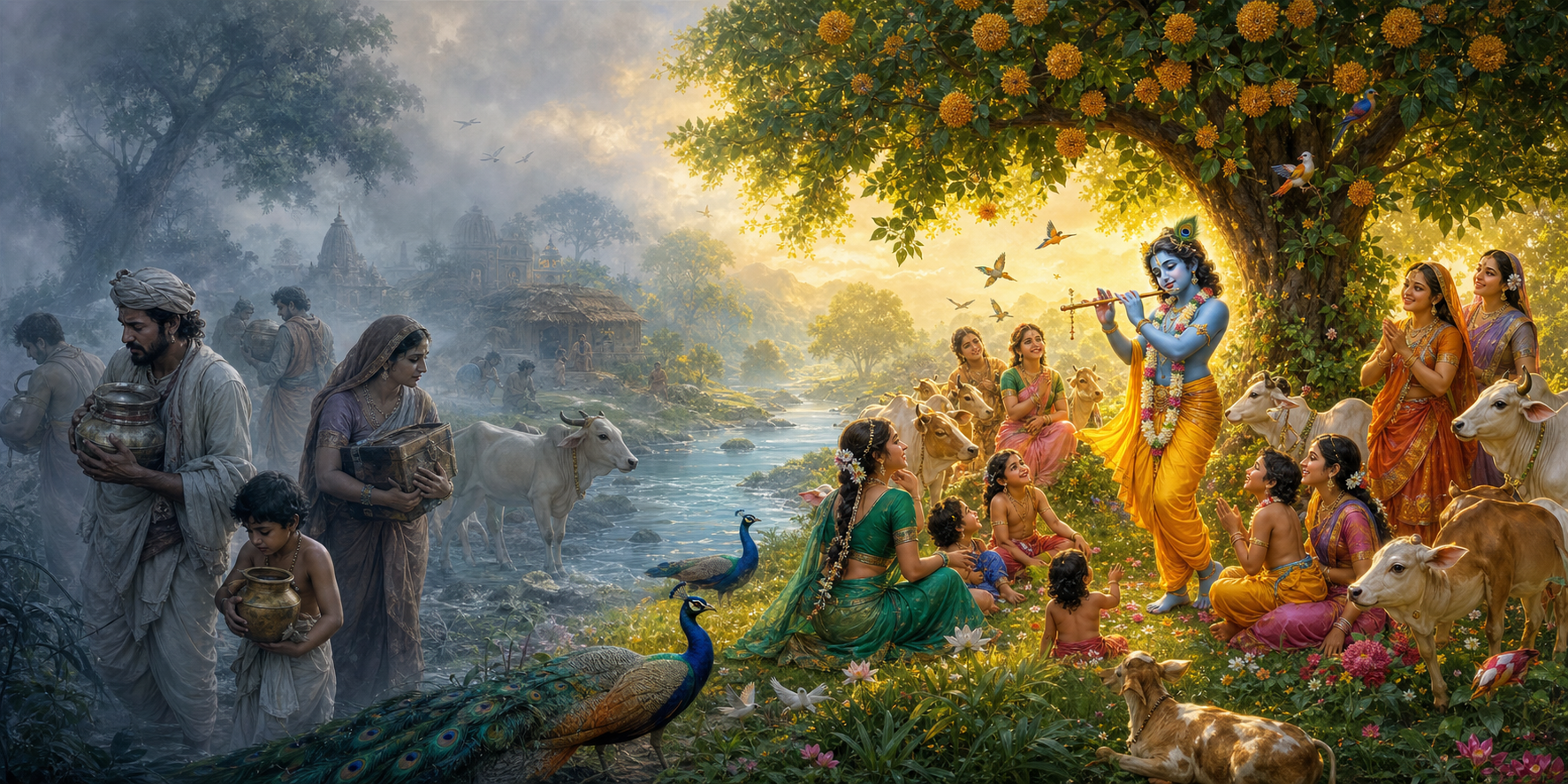
Maya is not an independent rival power competing with Krishna. It is Krishna’s energy. The decisive difference lies in orientation. The wrong conception that detaches something from Krishna is described as maha-maya, while the vision that joins everything to its proper relation with him is described as yoga-maya.
This means the same activity can be approached through two very different understandings. Work may become an arena for proving absolute self-sufficiency, or it may become the responsible use of abilities that have a dependent source. A possession may be treated as an extension of ego, or it may be cared for and used in service. Knowledge may become a claim to superiority, or it may clarify your place in relation to Krishna.
Merely placing a spiritual label on an activity does not restore the relation. Saying this is for Krishna while retaining the same claim of absolute ownership leaves the central error untouched. A Krishna-related conclusion must change at least your understanding of origin, identity, or purpose. Otherwise, the vocabulary has changed but the vision has not.
The illusory energy is also described through covering and throwing influences. The covering influence hides recognition of the Supreme Person and the living being’s dependence. The throwing influence carries the living being further into ignorance. In practical terms, the sequence often begins with forgetfulness and proceeds into a false claim:
- First, you overlook the source and supporting conditions of your existence or ability.
- Then, ahankara converts limited agency into the claim that you are the sole owner, cause, or controller.
- Finally, a finite result is made to carry an absolute burden: it must establish your identity, security, or worth.
The earliest point is usually the clearest place to interrupt the sequence. Remember dependence before the claim of ownership hardens. This does not require denying that you made a choice or performed work. The jiva has agency, but not self-originating sovereignty. Krishna bhakti corrects the claim of absolute independence; it does not erase accountability.
That distinction also blocks a convenient misuse of theology. Krishna is the ultimate source cannot honestly mean my conduct is not my responsibility. If you caused avoidable harm, relation to Krishna should make the need for truth and repair clearer. Blaming maya while protecting ahankara is still maya.
Use a Krishna-relation test in ordinary decisions

You do not need to settle every metaphysical question before applying this teaching. Use the following test when a decision carries unusual attachment, fear, pride, or confusion.
- Name what is actually present. Describe the situation without spiritual shorthand. Is it work that must be completed, a possession that requires care, a role that may change, an achievement, a loss, or a conflict? Accurate perception comes before interpretation.
- Find the claim of independence. Ask what you are treating as self-created, absolutely yours, permanent, or sufficient without Krishna. Be specific. The object itself may not be the problem; the imagined status you have assigned to it may be.
- Restore origin, identity, and purpose. Recognize the situation as occurring within Krishna’s energies. Remember that you are a dependent jiva rather than the Supreme controller. Then ask what purpose the object or ability can serve when it is no longer enclosed within self-interest.
- Choose a visible action. A corrected relation should affect conduct. It may mean doing the work honestly, caring for what has been entrusted to you, relinquishing an unjust claim, keeping a commitment, making an offering, or refusing to turn another person into an instrument of your ego.
- Examine the result without making it ultimate. Take responsibility for the quality of your action, but notice whether success increases the fantasy of independence or failure makes you forget your identity beyond the role. Neither outcome changes the foundational relation to Krishna.
At work, this test does not tell you to abandon competence or ambition. It tells you not to convert competence into proof that you are self-created. In success, it permits gratitude without false modesty and achievement without self-deification. In failure, it permits an honest assessment without treating a damaged role as the destruction of the self.
With possessions, the test shifts the question from Do I have this? to What kind of ownership am I claiming? Practical ownership can organize care and responsibility. Absolute ownership forgets that the object, the capacity to acquire it, the time available to use it, and the body using it all exist dependently.
In relationships, remembering Krishna prevents affection from turning into possession. The other person is not merely a supporting character in your identity. The relationship becomes clearer when neither party is treated as self-sufficient, supreme, or reducible to the satisfaction of the other’s ego.
In spiritual practice, apply the same scrutiny to piety itself. Chanting, worship, and scriptural learning can restore relation, but prestige attached to religious knowledge can feed the old claim of superiority. If practice makes you more possessive of status while leaving your claim of independence intact, the language is devotional but the underlying misidentification still needs light.
Key takeaways
- In this Krishna-centered understanding, maya does not mean that the world is sheer nonexistence. It means that Krishna’s energies are misperceived as independent of Krishna.
- The rope is real; the imagined snake is not. Spiritual knowledge corrects the mistaken interpretation without denying the reality that supports it.
- Nothing is actually unrelated to Krishna. Maya is the living being’s forgetfulness, projection, and misuse of a relation that remains present.
- Maha-maya describes the vision of separation, while yoga-maya describes the restored vision of relation and union with Krishna’s purpose.
- The jiva’s individuality is not abolished in this personalist reading. Dependence on Krishna corrects false sovereignty without eliminating agency or responsibility.
- The practical test is whether remembrance changes your view of origin, identity, ownership, purpose, and conduct. A devotional slogan by itself is not enough.
Begin with a recurring activity that easily becomes entangled with pride or anxiety. Before acting, identify the real thing and the false claim attached to it. Then reconnect its origin, your identity, and its purpose to Krishna. If your conduct becomes more accurate, responsible, and service-oriented, remembrance is doing more than decorating the activity; it is bringing the rope back into view.
References
