
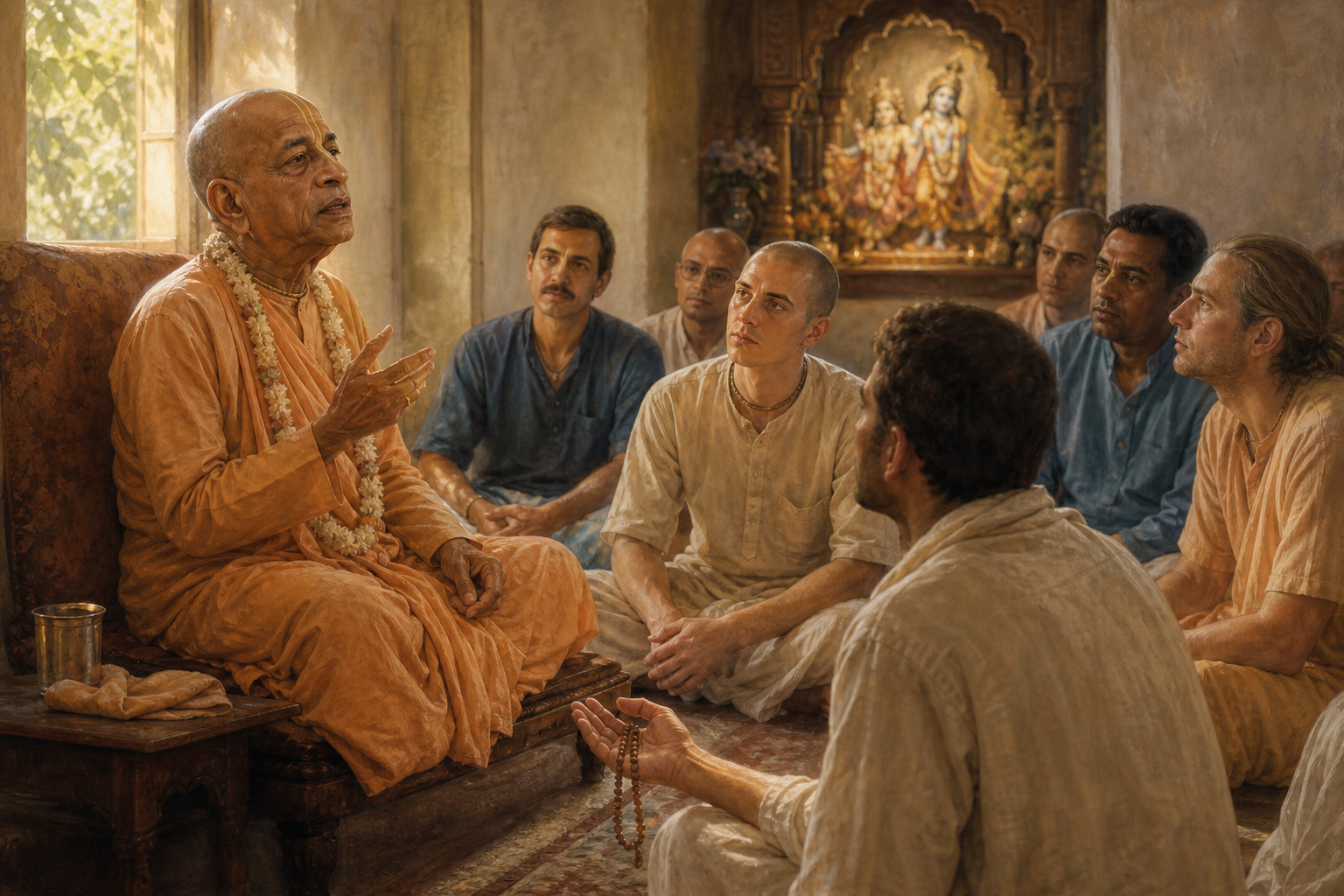
You can listen to an absorbing account of Srila Prabhupada, feel admiration for him, and still return to your day with the same restless mind and the same resistance to service. The missing element is usually not another story. It is a way of hearing that carries the story into your conduct.
Prabhupada-lila becomes devotional hearing when you listen for his relationship with Krishna, receive the instruction within the event, and let it govern one real choice of your own. Here is a practical way to do that without reducing his life to either biographical information or devotional entertainment.
Hear the life in order to follow its devotional direction
Hearing, or shravanam, is the first and most important of the nine forms of devotional service. But merely receiving sound through the ears is not shravanam. The proper subject is Krishna: His names, activities, qualities, teachings, and devotees. The proper purpose is to approach Him, not merely to acquire religious information or enjoy a moving performance.
That distinction tells you how to hear Srila Prabhupada’s life. The devotee must not displace the Lord at the centre of the narration. Listen for the way the devotee takes shelter of Krishna, carries Krishna’s teaching, depends upon Krishna, and spends his life in Krishna’s service. Admiration then has somewhere to go: it becomes a desire to serve in the same direction.
As you hear an episode, follow three movements:
- Event: What situation did Srila Prabhupada face, and what did he actually do?
- Devotional principle: What does his response reveal about surrender, dependence, remembrance, faith, instruction, or service?
- Personal consequence: What should change in the way you hear, speak, remember Krishna, relate to devotees, or perform your present duty?
If you retain the event but miss the principle, you have collected biography. If you praise the principle but refuse its consequence, you have collected inspiration. Devotional hearing joins all three.
The expected fruit is not simply an emotional high during a narration. Proper hearing is associated with becoming more resolute, peaceful, tolerant, free from doubt, able to restrain anger, and inclined to remember Krishna. These are not instant rewards that every session must produce. They are directions in which sustained hearing should gradually turn you. After hearing, ask whether remembrance and service have become easier to choose. That is a more useful test than asking how entertained or moved you felt.
Systematic hearing means knowing Him gradually in truth and fact.
Srila Prabhupada, purport to Srimad-Bhagavatam 1.18.10
The word systematic matters. One isolated anecdote may warm the heart, but a life heard with context shows how devotion governs different circumstances. Gradual hearing also protects you from making one striking incident carry a meaning it was never meant to bear.
Choose what, whom, and how you hear

Good intention alone does not make every narration equally nourishing. Devotional hearing requires discernment about the material, the speaker, and your own posture as a listener.
Choose connected narration rather than a diet of highlights. Vaishnava teaching cautions conditioned listeners against skipping foundational portions of the Srimad-Bhagavatam merely to reach its most intimate or exciting passages. The governing principle is that we should hear according to our actual condition, with devotion and proper sequence, rather than selecting only what gratifies us. Apply the same discipline to Srila Prabhupada’s life. Do not consume only the most emotionally charged episodes. Look for the surrounding instruction, the purpose of the service, the difficulty being faced, and the devotional conclusion.
If you are following a series, continue in sequence when possible. If you hear a stand-alone episode, establish enough context to answer four questions: What was happening? What service was at stake? Which teaching directed the response? What followed? If the narration does not supply an answer, leave the gap open rather than filling it with imagination.
Choose a speaker by devotional alignment, not performance alone. A qualified speaker follows Krishna’s teaching, stands within a bona fide disciplic succession, has taken shelter of Krishna, dedicates life and work to Him, and understands dependence upon Him. You may not be able to judge another person’s inner life, but you can notice the direction of the speech:
- Does Krishna remain the centre, or does the personality of the speaker take over?
- Are Srila Prabhupada’s choices connected to guru, scripture, and service, or presented merely as dramatic incidents?
- Does the narration encourage obedience and remembrance, or mainly promise excitement, prestige, influence, or special status?
- Does the speaker treat the subject with affection and gravity rather than using sacred life as material for self-display?
You can begin by hearing HG Daivi Shakti Mataji speak on Srila Prabhupada Lilamrita, then apply these same questions as you listen. A familiar name, polished presentation, or devotional label should not replace attentive discernment.
Prepare your own posture before pressing play or opening a book. Proper hearing calls for attention, humility, sincerity, seriousness, curiosity, eagerness, patience, gratitude, persistence, affection, faith, and a service attitude. You do not need to pretend that all these qualities are already mature. Begin with an honest intention: “Let me hear in order to understand and serve.” That intention immediately distinguishes shravanam from passive consumption.
Give the narration one uninterrupted field of attention. Put aside the unrelated feed, conversation, or task. Keep a simple note nearby, but do not attempt to transcribe everything. Record the devotional hinge of the episode: the moment at which instruction, surrender, or service determined the response.
Turn one Prabhupada-lila into one act of service

A large collection of remembered stories can coexist with very little transformation. To prevent that, process each episode through four deliberate passes. You can use these steps with a spoken class, an audio recording, or a written life account.
- Reconstruct what happened. State the situation in plain words. Separate details actually given from assumptions you brought to the narration.
- Locate the devotional choice. Identify the decision that reveals dependence upon Krishna, fidelity to instruction, persistence in service, humility, or another specific devotional quality. Avoid settling for “Srila Prabhupada was great.” Name the choice that shows the quality.
- Let the choice expose you. Ask where your conduct moves in the opposite direction. Do you abandon service when it becomes inconvenient? Seek recognition before cooperating? Defend your preference before hearing an instruction completely? Make the question concrete enough that it can uncover behaviour.
- Select one proportionate response. Carry the principle into the next relevant situation. Choose a small act you can actually complete, not an impressive vow generated by a passing emotion.
Your note after hearing can be as short as this:
- The circumstance: one sentence describing what was faced.
- The devotional hinge: one sentence describing the choice that mattered.
- The instruction: the teaching expressed or embodied by that choice.
- My next service: one observable action and the situation in which you will do it.
Suppose an episode places persistence in service at its centre. “Become more persistent” is too vague to guide you. A usable response might be to complete one duty you have been repeatedly postponing, to hear an instruction without interrupting, or to protect your next period of chanting from the distraction that usually displaces it. The historical circumstances need not be reproduced. The devotional principle must be translated faithfully into your own scale of responsibility.
Before beginning another episode, briefly review the action chosen from the previous one. Did you remember it when the relevant moment came? If not, make the response smaller and more visible. This prevents a common pattern in which fresh devotional content continually replaces unfinished devotional application.
If you find that you have little taste for hearing, do not wait passively for taste to appear. Srimad-Bhagavatam 1.2.16 connects service to devotees who are free from vice with the growth of affinity for Krishna’s messages. Serving devotees is therefore not a distraction from hearing. It helps prepare the listener. Perform a concrete service, return to the narration, and notice whether attention has become less self-centred.
Recognise the habits that empty hearing of its force
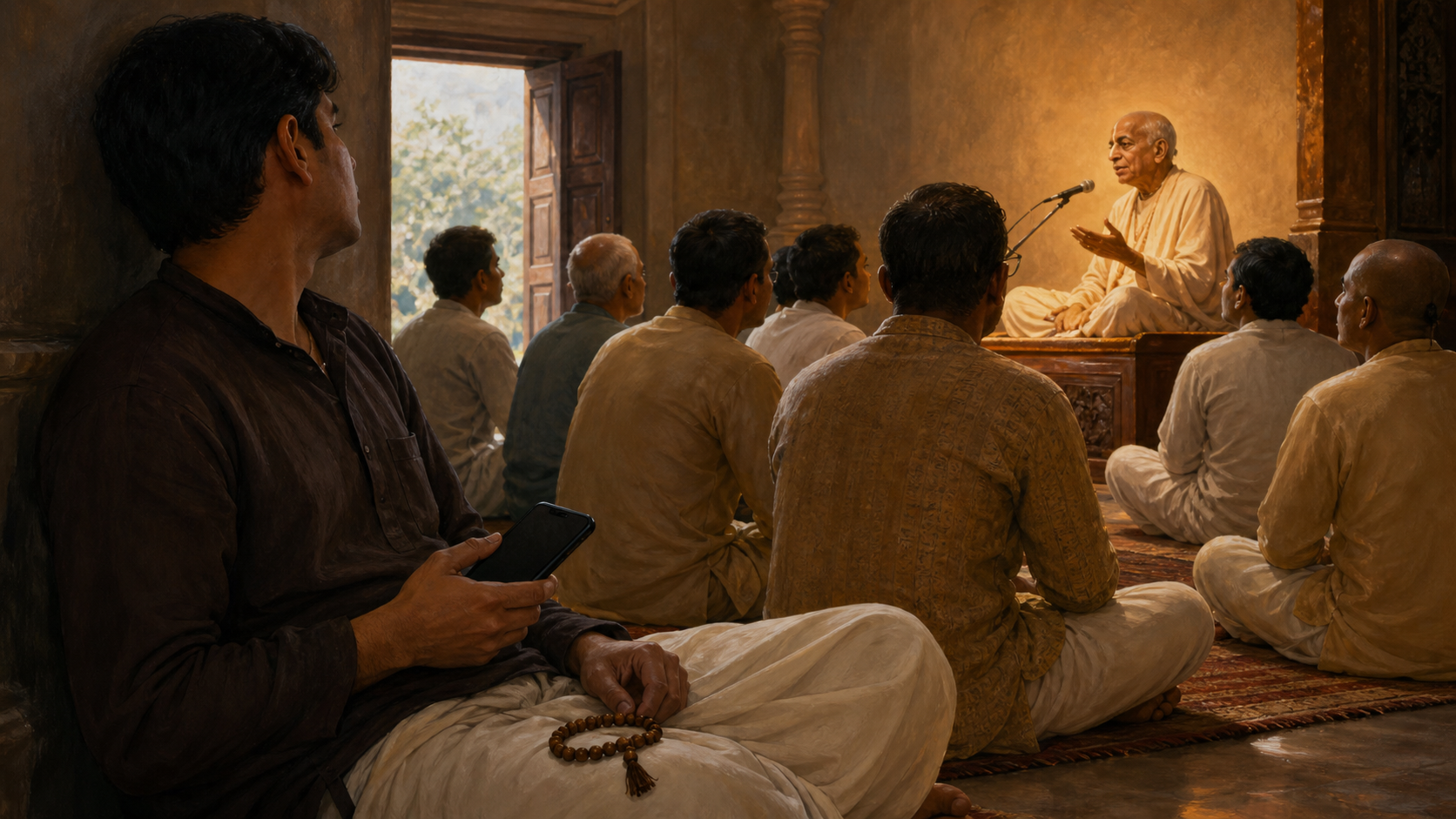
When hearing does not seem to affect you, the answer is not always to consume more. First identify the obstruction.
- You are listening mainly for stimulation. If you continually skip context, familiar instruction, or quieter portions to reach the next remarkable moment, entertainment has probably become the organising motive. Resume the sequence and ask what the less dramatic material requires you to understand.
- You think imperfection disqualifies you. It does not. Eligibility to hear includes the distressed, inquisitive, skeptical, materially motivated, and spiritually serious. Even temporary motives can diminish as Krishna-katha purifies desire. Bring your actual questions, but bring them with respect and a willingness to be corrected.
- You confuse emotion with surrender. Tears, admiration, or excitement may accompany hearing, but none by itself proves that the instruction was received. Look for the next decision. If nothing in your conduct is allowed to be challenged, the heart may have enjoyed the narration without yielding to it.
- You judge the speaker chiefly by charisma. Eloquence can hold attention, but the essential test is alignment with Krishna’s teaching and parampara. Prefer speech that increases dependence upon Krishna and willingness to serve over speech that increases fascination with the speaker.
- You hear fragments without a framework. Short clips can remind you of a principle, but fragments make it easy to lose circumstance, sequence, and conclusion. Return regularly to connected narration so that isolated sayings are not forced to carry invented meanings.
- Your surrounding habits scatter attention. Rapt hearing does not remain separate from conduct. Purity of action and regulation in ordinary life support purity of mind and attention. Begin with the immediate environment of the hearing: remove the competing activity, sit deliberately, and finish the selected portion before moving elsewhere.
- You are bargaining for a result. Hearing may bring peace, courage, clarity, remembrance, and freedom from lower impulses, but approaching it only to obtain status, comfort, influence, or even a display of spiritual advancement keeps the listener at the centre. State the motive honestly, then add a better one: “Whatever else I desire, let me hear so that I may know Krishna and serve.”
Do not turn this diagnosis into another reason to postpone. The qualities required for good hearing also grow through the sincere attempt to hear. Eagerness, even when still small, is a real beginning.
Key takeaways
- Hear Srila Prabhupada’s life as the life of a devotee carrying you toward Krishna, not as personality-centred entertainment.
- For every episode, identify the event, the devotional principle, and one consequence for your own conduct.
- Prefer connected, contextual narration over a steady diet of emotionally charged fragments.
- Choose speakers by fidelity to Krishna’s teachings, parampara, dependence, and service rather than presentation alone.
- Use a simple discipline: one episode, one clear instruction, and one proportionate act of service.
- If taste is weak, combine hearing with practical service to devotees instead of waiting for ideal attention to arrive.
At your next hearing, do not try to collect the whole life at once. Take one episode. Find its devotional hinge. Write one action beneath it, and carry that action into the next situation where your convenience competes with service. That is where hearing about Srila Prabhupada begins to become hearing through his life.
References
- Dandavats — The Magic of Hearing About Krishna and His Devotees
- Dandavats — Today’s Featured Video: HG Daivi Shakti Mataji || Srila Prabhupada Lilamrita || 16.08.2026
