
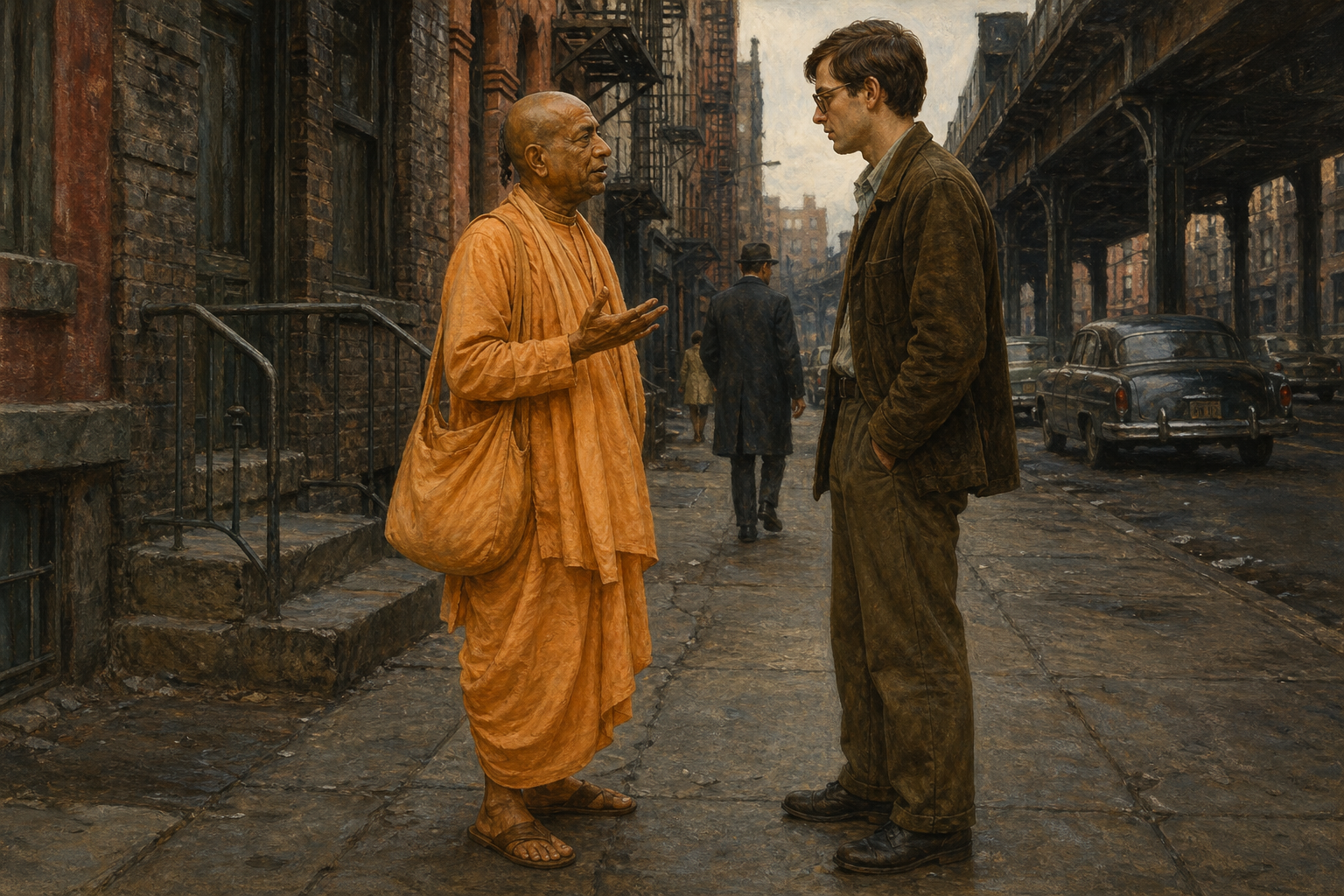
If you want to understand Srila Prabhupada’s early New York presence, set aside the scale of everything that followed. The useful starting point is smaller: an elderly sannyasi walking near the Bowery, a stranger willing to stop, and a nearby room prepared for Bhagavad-gita classes.
What made that encounter consequential was not spectacle. It was the conversion of curiosity into a clear next step. The stranger received a place, a schedule, and permission to bring friends. If you want to see how a Dharmic teaching can become present in unfamiliar surroundings, watch that sequence.
The street encounter reveals the actual scale
Hayagriva Dasa first noticed Prabhupada near Houston Street after crossing the Bowery. The saffron robes, cloth bead bag, shaved head, and distinctive white shoes caught his attention amid traffic and the disorder of the neighborhood. He had returned from India seven months earlier after an unsuccessful search for a guru, so the unexpected sight of an Indian renunciant on a Manhattan pavement carried immediate significance for him.
Their opening exchange was disarmingly ordinary. Dasa asked whether he was from India. They discovered that both had recently been in Calcutta. Prabhupada asked whether Dasa had visited Vrindaban and then whether he lived nearby. When Dasa pointed toward his home on Mott Street, Prabhupada answered that they were neighbors. Shared geography led directly to a local invitation: Prabhupada wanted to offer Bhagavad-gita classes and asked the young man to look at the place he had found.
This is where careful reading helps. The language of aura, radiance, and a smile compared with moonlight conveys how the witness experienced Prabhupada. The intersection, clothing, questions, route, storefront, and posted timetable are remembered particulars that reconstruct how contact occurred. The spiritual impressions explain why Dasa crossed the street; the practical details explain what happened after he did. You do not have to discard either kind of testimony, but you should not silently turn one into the other.
Prabhupada did not begin with a sweeping claim about himself. He established points of connection: India, Calcutta, Vrindaban, the neighborhood, and an existing interest in Hindu philosophy. He then offered a specific action. Spiritual authority became socially reachable because the invitation answered the newcomer’s simplest questions: where should I go, when should I arrive, and what will be taught?
A storefront turned curiosity into a public habit
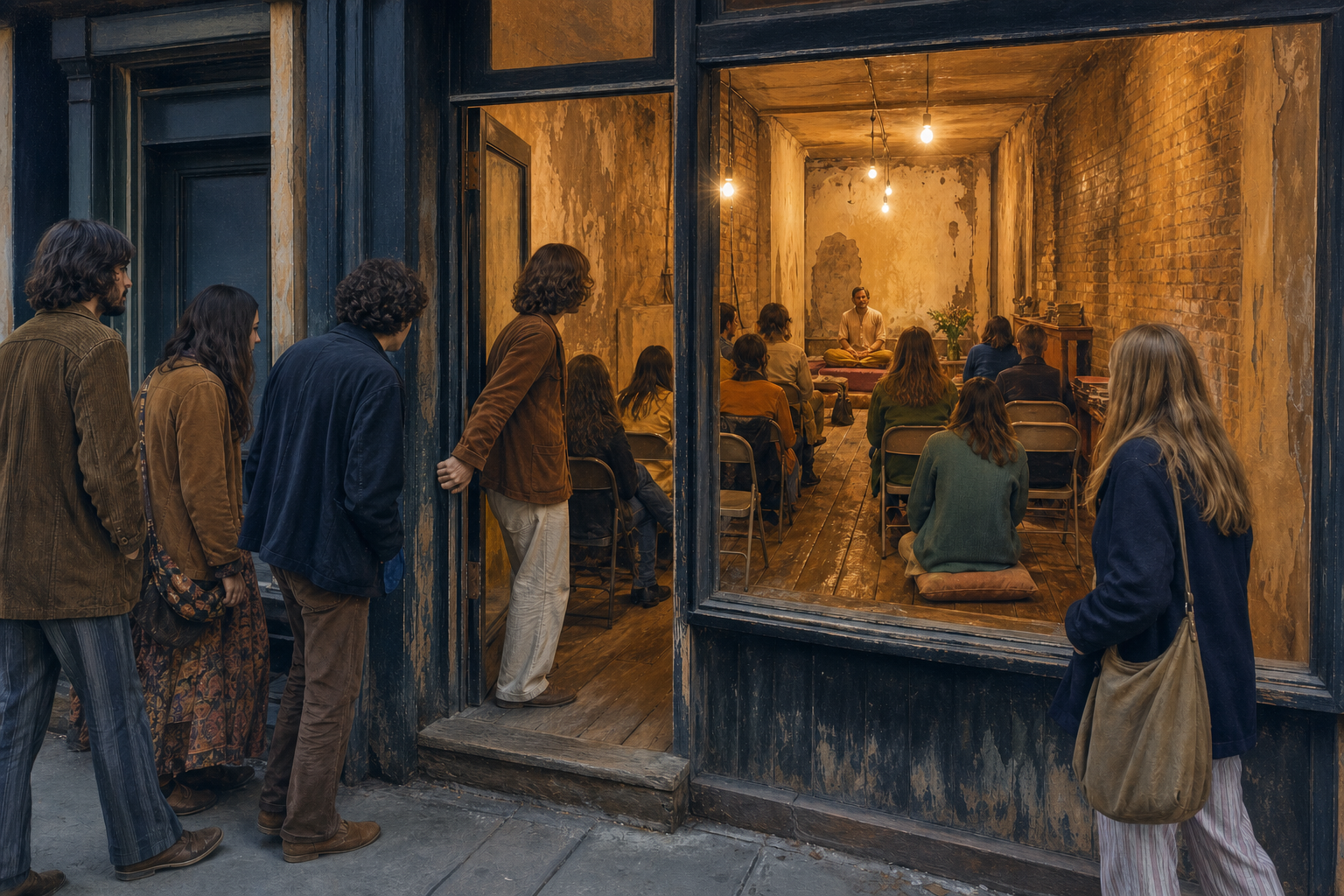
The room was neither a temple complex nor a secluded ashram. It occupied part of the ground floor of a four-story apartment building on Second Avenue, between First and Second Streets. The premises appeared to have served as a curio shop, and the words “Matchless Gifts” remained above the entrance. A filling station stood next door; a bar and funeral home were across the street.
That modest frontage nevertheless contained a complete public invitation:
- The subject was the Bhagavad-gita.
- The teacher was identified as A.C. Bhaktivedanta Swami.
- Classes were scheduled for Monday, Wednesday, and Friday.
- Each meeting had a defined two-hour window, from 7 to 9 p.m.
Those particulars matter. A chance conversation can produce interest, but it does not by itself create a presence. A visible room and three recurring evenings each week convert interest into a possible habit. A newcomer does not have to negotiate private access, guess the subject, or wait for another accidental meeting.
Prabhupada also asked whether the neighborhood was suitable. That small question shows a useful division of responsibility. He brought the teaching and the willingness to teach it consistently; the person who lived nearby could supply local knowledge. Confidence in a tradition does not require pretending to know every new social setting. You can preserve the centre of a teaching while still asking residents where and when people are likely to engage with it.
The invitation then moved through an existing relationship. Dasa said that he had friends who might be interested, and Prabhupada encouraged him to bring them. Before any lecture described in this episode had begun, one encounter had already become a small network. The mechanism was personal and reproducible: meet one person, make the next step concrete, and allow that person to arrive with people they trust.
The first circle brought questions, not automatic obedience
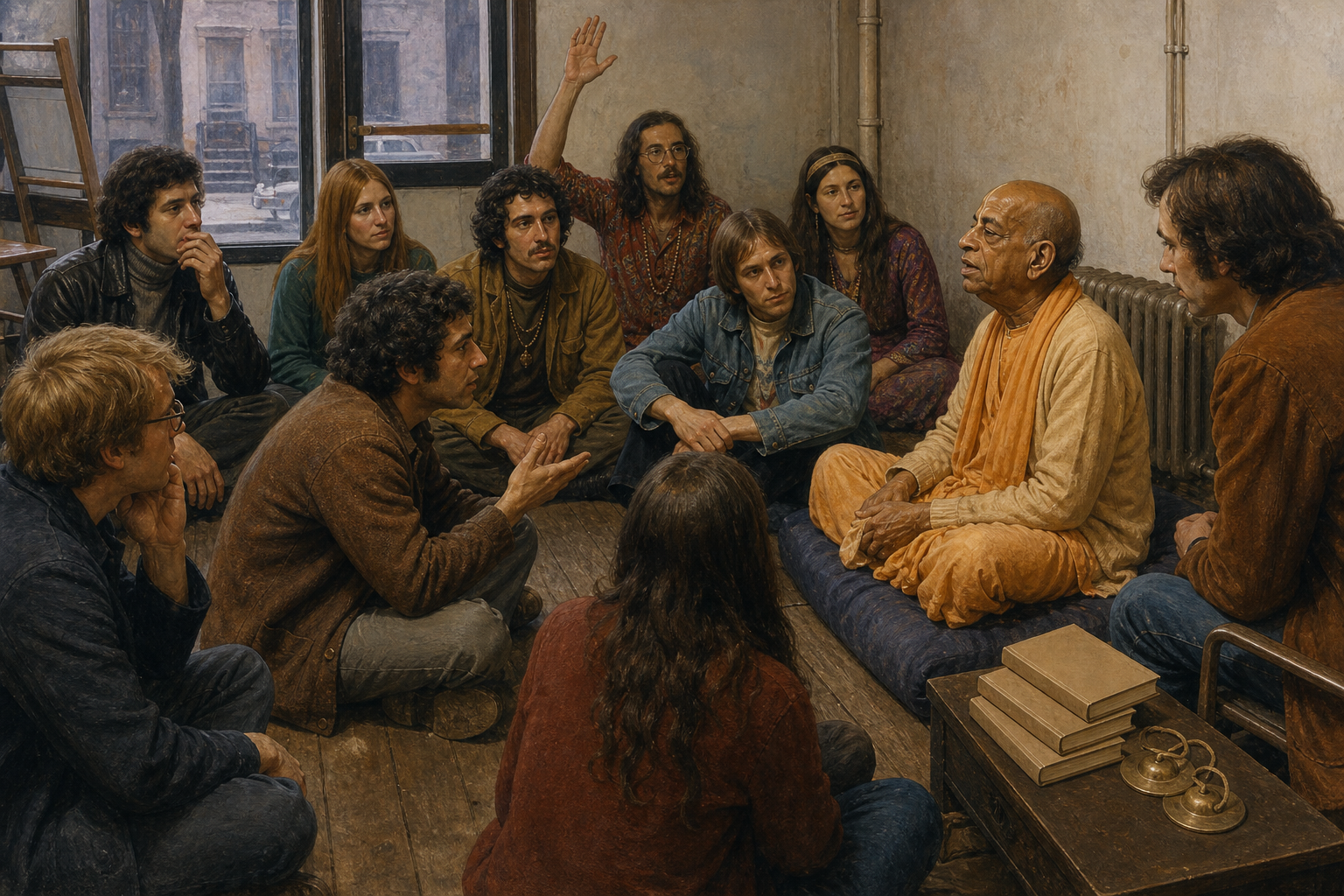
Back in a dark, cockroach-ridden apartment on Mott Street, Dasa told a group of friends in their twenties about the new swami. They were not spiritually blank. Keith Ham was working at Columbia University on a doctorate in American religious history. Wally Sheffey, a recording engineer, was studying Buddhism. Their conversations moved among ego-loss, death, Buddha, reincarnation, Christianity, psychedelics, music, Plato, Lao Tzu, and astral travel.
Nor were they instantly submissive. They wondered whether the newcomer was a guru, an avatar, or simply one more teacher in a city where spiritual experimentation was already familiar. Their joking skepticism ended in a practical decision to attend on Monday. That distinction is important: their first commitment was to listen, not to declare allegiance.
This corrects two easy distortions. Prabhupada did not meet passive Westerners waiting to absorb anything called Indian. He encountered people carrying prior reading, experiments, disappointments, and competing ideas. But they were not so cynical that they refused examination. They could question the category of “guru” and still walk two blocks to hear the Bhagavad-gita.
Dasa placed his generation against a wider background of atomic anxiety, postwar material expectation, campus rebellion, atheism, existentialist literature, the Cuban Missile Crisis, and the assassination of President Kennedy. He described rebellion and cynicism as increasingly unable to satisfy the need for something beyond nihilism. Treat that as a participant’s diagnosis of his milieu, not as a demographic verdict on every young American.
For this particular circle, the problem was not a shortage of ideas. It was the absence of a satisfying centre among many ideas. A regularly scheduled class devoted to one primary text therefore offered something different from another unstructured evening of speculation. Curiosity opened the door, but focus gave people a reason to return.
What this beginning teaches Dharmic communities
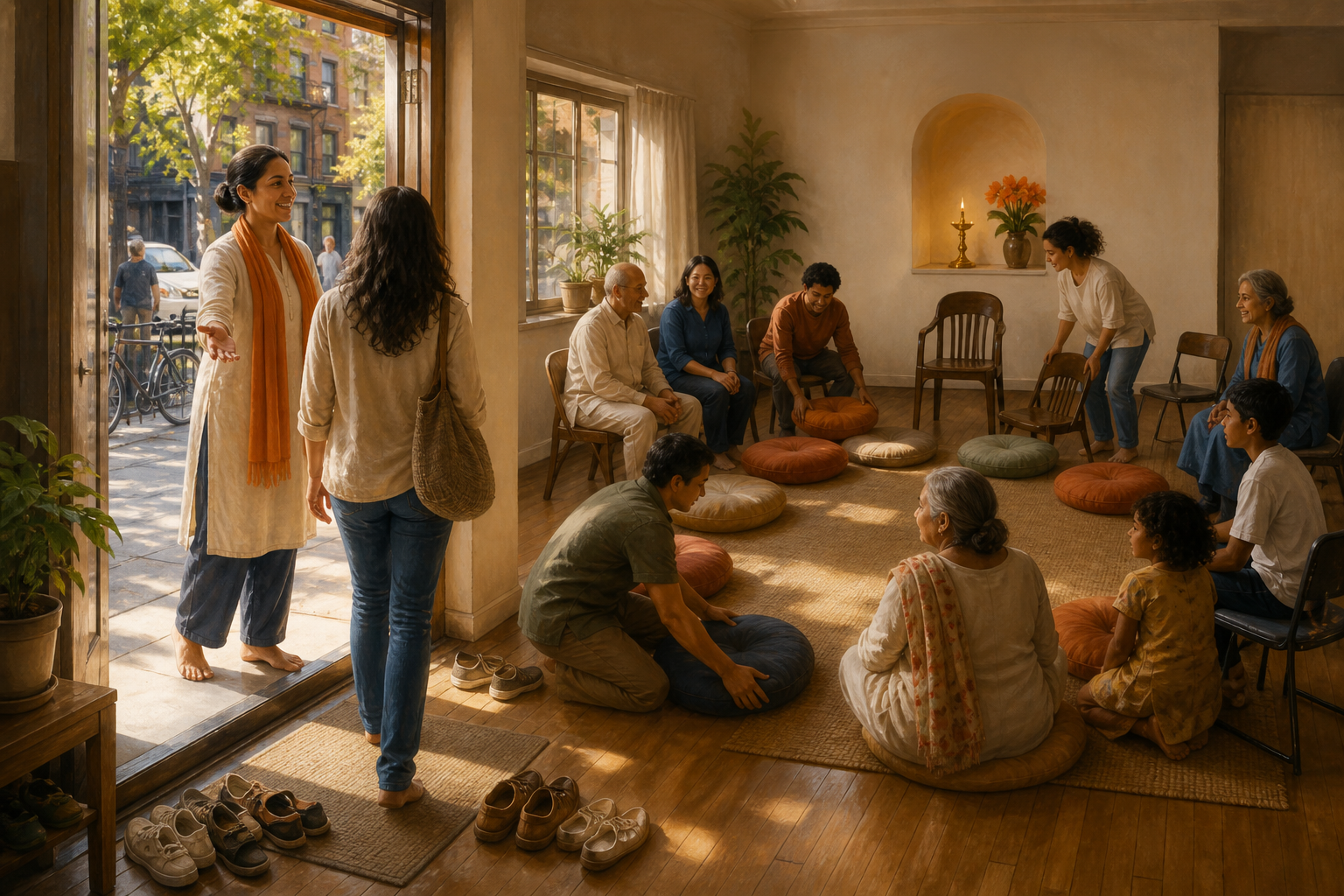
If you help run a temple, campus group, study circle, or cultural organisation, the early New York episode offers a disciplined model. The Manhattan conditions should not be copied as theatre. The useful principles are clarity, continuity, local intelligence, and personal connection.
- Name the centre of the teaching. The window announced Bhagavad-gita classes, not an undefined promise of exotic wisdom. Tell newcomers which text, practice, or tradition they will encounter. Precision lets an interested person make an informed choice.
- Give curiosity an immediate next step. A place without a timetable is only an address. A timetable without a clearly named subject is only an event. Supply the text, location, day, starting time, and expected format together.
- Use repetition to establish trust. Monday, Wednesday, and Friday created a rhythm. One gathering can feel accidental; a recurring gathering signals that the teacher will still be there after the initial novelty passes.
- Ask for local knowledge without surrendering the teaching. Prabhupada asked whether the area was suitable. In a new city or community, ask residents about access, timing, language, and the concerns people actually bring. Those questions improve the doorway; they do not require changing the philosophical centre.
- Invite friendship networks. The first contact became a circle because the newcomer was encouraged to bring friends. Give each interested person language simple enough to repeat: what is happening, where it is happening, and why a friend might want to come.
- Allow skepticism into the room. The Mott Street group did not settle every question before deciding to attend. Do not make prior agreement the price of admission. Ask for respectful attention, then let the teaching be heard and questioned on its own terms.
There is also a warning here. Do not romanticise hardship as the method. The Bowery traffic, neglected apartment, and bare storefront were circumstances, not a spiritual formula. The transferable elements were a recognisable teaching, a dependable rhythm, a direct invitation, and the willingness to meet people where they were. Poverty and disorder are not outreach strategies.
Do not universalise one circle’s psychology either. Existential dissatisfaction, experimentation, and disillusionment helped make these particular young New Yorkers receptive. People in another place or generation may arrive with different questions. Ask what problem they are actually trying to resolve before assuming that a remembered countercultural pattern still describes them.
Key takeaways
- Srila Prabhupada’s early visibility in New York grew through a human sequence: conversation, invitation, attendance, and friendship.
- The Second Avenue storefront worked because the offer was specific: Bhagavad-gita, a named teacher, three evenings, and fixed hours.
- The interested audience was already intellectually and spiritually active. Curiosity coexisted with skepticism.
- Prabhupada adapted the doorway to local conditions while keeping the Bhagavad-gita at the centre.
- A responsible historical reading distinguishes a participant’s spiritual perceptions from the remembered logistics of the encounter, while allowing each to illuminate a different part of the event.
On your next reading of Prabhupada’s New York years – or your next attempt to introduce a Dharmic text in unfamiliar surroundings – look for the actionable invitation. Give people a text, a place, a time, and a human connection. That is how a passing encounter can become an enduring presence.
References
