
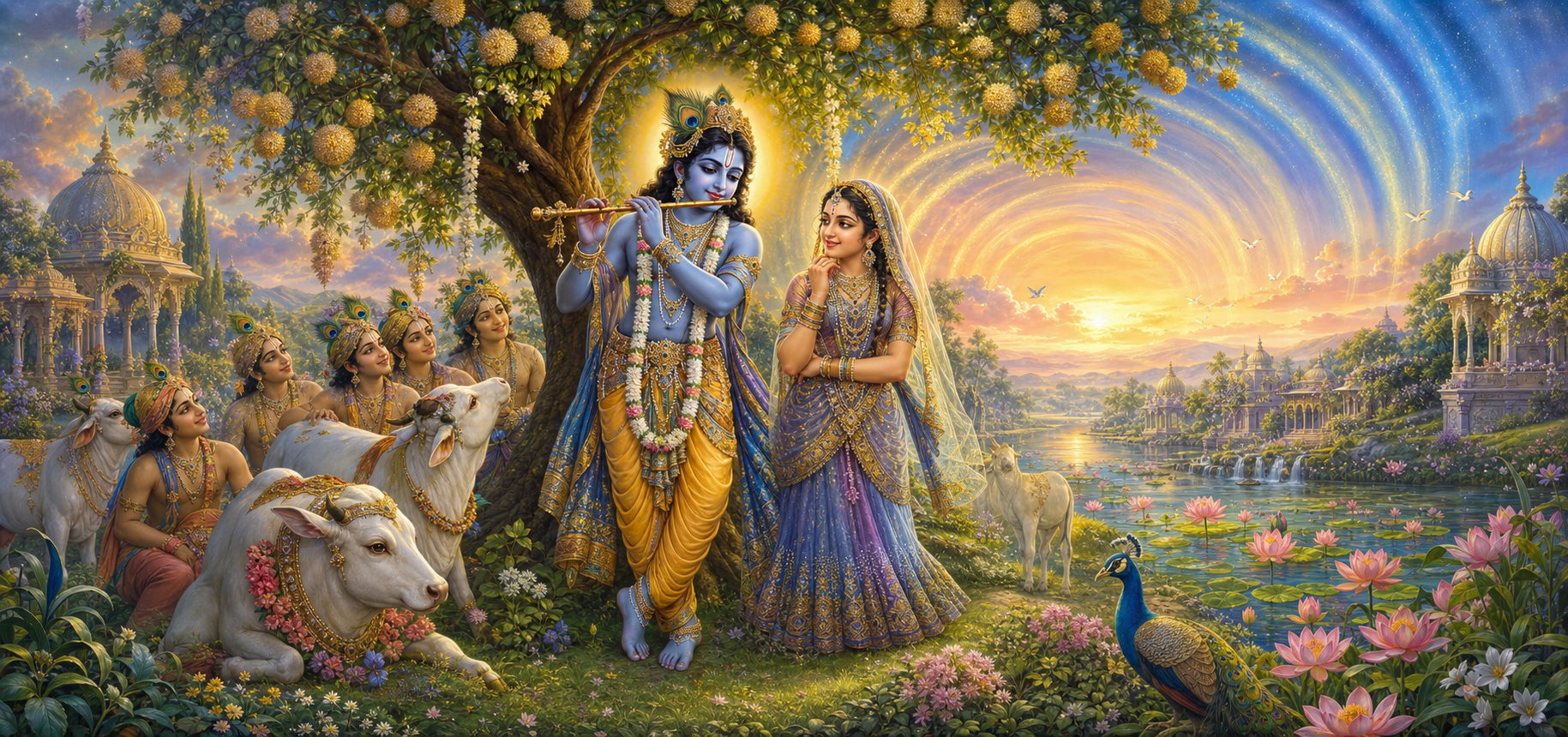
A divine name can be treated as a label, but the four source articles present Krishna’s names as entrances into relationship. Hare, Krishna, Rama and Govinda disclose attraction, joy, service, grace and care; they also connect the person who remembers Krishna with a spiritual reality larger than the visible world.
Read together, the sources supply four parts of one Gaudiya Vaishnava vision: names make the relationship audible, divine energies explain how it is possible, Goloka gives it an eternal setting, and protection describes what sustained affection for Krishna does to a person’s deepest orientation.
Key takeaways
- Krishna’s names disclose different relationships and qualities rather than functioning as interchangeable labels.
- In the Gaudiya interpretation examined by the sources, Hare invokes divine spiritual energy and is contemplated especially in relation to Sri Radha.
- The doctrine of shakti distinguishes Krishna’s internal, marginal and external energies without separating them from their divine source.
- Goloka is presented as an eternal realm of conscious relationship and loving service, not a materially luxurious destination.
- Krishna’s protection is best understood as the preservation of devotion, integrity and ultimate welfare, not a guarantee against every worldly loss.
Names that disclose relationship rather than mere identity

The Mahamantra article reports that the Hare Krishna Mahamantra contains sixteen names and thirty-two syllables. Its Gaudiya interpretation does not regard repetition as redundancy. Each occurrence of Hare, Krishna or Rama occupies a particular place in a contemplative movement involving attraction, separation, reunion, compassion and spiritual delight.
The article associates this sixteen-name exposition with Srila Jiva Gosvami and a work known as the Mahaa-mantrartha Dipika. Within that framework, Hare is understood through Haraa, Sri Radha, whose devotion captivates Krishna and whose compassion relieves devotees’ suffering. Krishna is the all-attractive one whose flute calls Radha, yet He is also the supreme attractor who becomes enchanted by Her love. Rama denotes the source and participant in spiritual joy within these Radha-Krishna pastimes, while the source acknowledges that other Vaishnava traditions may hear the name in relation to Sri Ramachandra or Balarama.
This plurality matters. A sacred name can carry several legitimate devotional associations without becoming vague. The sources present each name as precise in a relational sense: its meaning depends not only on an abstract definition but also on who calls, who responds and what form of love is being remembered.
The study of the spiritual world adds Govinda to this vocabulary. It explains the name through Krishna’s relationship with cows, the senses, the land and living beings, portraying the Absolute as both the source of existence and its attractive center. The pastoral image of Govinda tending cows makes care, rather than remoteness, an expression of divine greatness.
The study of Srimad-Bhagavatam 10.8.18 approaches naming from another angle. It places Garga Muni’s words within the quiet naming rites conducted for Krishna and Balarama while Kamsa posed a danger to the household. According to that source, Garga Muni explains names including Rama, Bala and Sankarsana, while speaking with enough restraint to reassure Nanda Maharaja without creating needless risk. Names in this setting both reveal identity and respect the needs of a vulnerable community.
Together, these accounts show why nama is more than religious terminology. The name makes Krishna rememberable as a person in relationship: beloved of Radha, giver of joy, tender of cows, child of Gokula and protector of those who direct affection toward Him. Chanting consequently becomes an education of attention, not merely the production of a sacred sound.
Shakti explains how difference belongs within divine unity
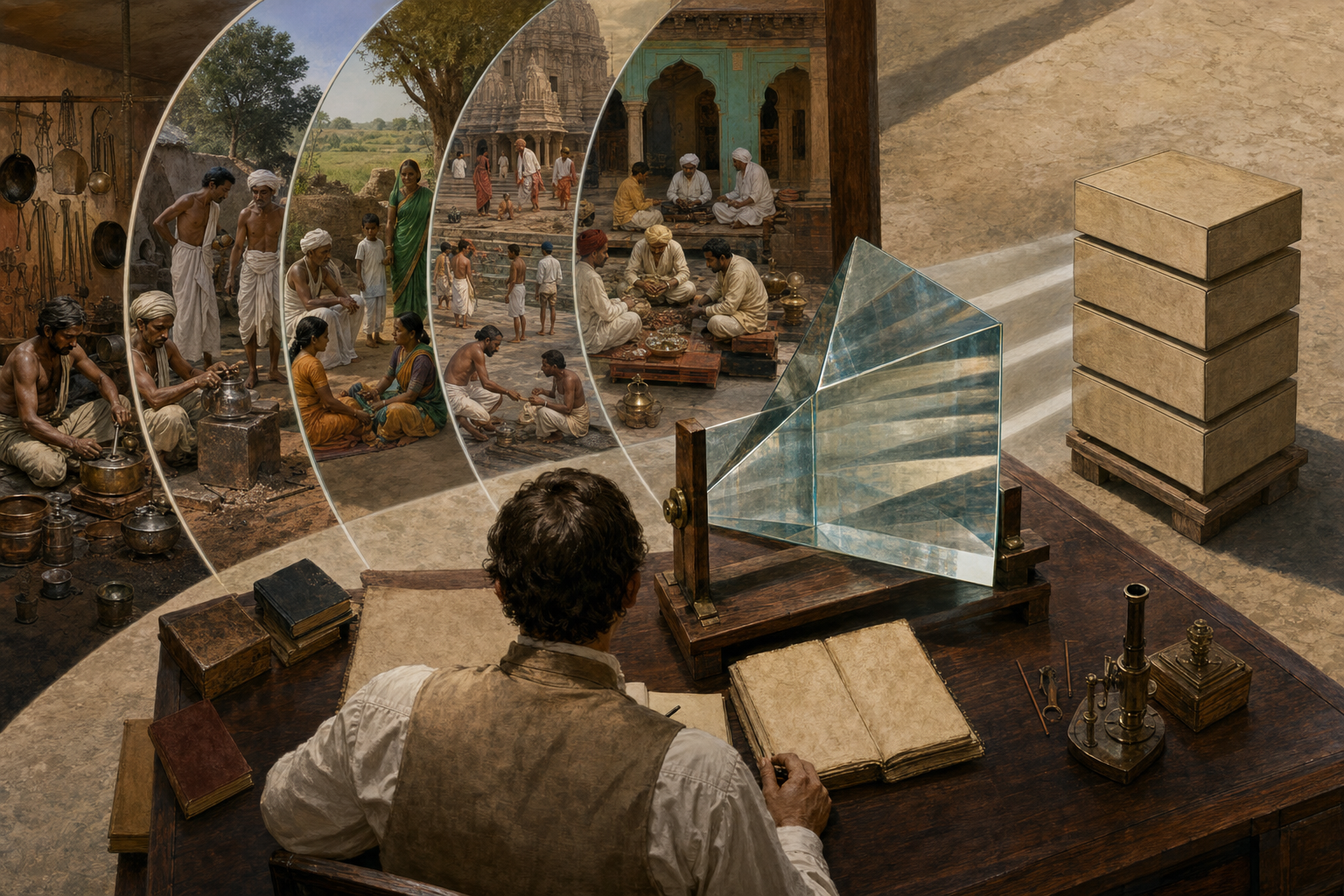
The Mahamantra source describes the chant as an invocation of both the Divine and the Divine’s spiritual energy. The article on Krishna’s energies supplies the conceptual structure behind that statement. It defines shakti as power, potency or capacity and presents Krishna’s energies as inseparable from their source, even though they can be distinguished for theological analysis.
Citing Vishnu Purana 6.7.61, the energy article reports a threefold classification. The internal potency manifests spiritual existence, divine forms, abodes and relationships. The marginal potency consists of the finite conscious living beings, or jivas. The external potency manifests material nature and the field of change, limitation and karmic consequence. These are not described as rival powers competing with Krishna; they are different operations of one divine potency.
The internal energy is further considered through sandhini, samvit and hladini. In the source’s account, sandhini sustains the reality and continuity of spiritual existence, samvit makes knowledge and meaningful recognition possible, and hladini brings bliss and love to fulfillment. Their interdependence is important: spiritual joy is not an isolated sensation but joy within conscious relationship, and relationship requires a real field in which lover, beloved, place and activity endure.
The marginal position of the jiva introduces freedom and vulnerability into this picture. The energy article uses the image of a shoreline to explain how the conscious self may be oriented toward spiritual knowledge and devotion or become conditioned by the external potency. It does not describe the soul as partly material. Rather, it presents a finite spiritual being whose attention can turn toward Krishna or become absorbed in possessiveness and forgetfulness.
This distinction connects the energy doctrine with both chanting and protection. If the jiva’s orientation matters, then remembrance is not an ornamental practice. Hearing, chanting, service and ethical discipline repeatedly direct consciousness toward the relationship invoked by Krishna’s names. Protection can then be understood partly as the strengthening of that orientation against forces that would obscure it.
The account of maya also prevents a simplistic split between a real spiritual world and an absolutely nonexistent material one. The energy article describes material forms as temporary, dependent and liable to misunderstanding. The problem is therefore not existence itself but the attempt to treat a changing, dependent field as self-sufficient or permanent. Divine energy provides continuity across the discussion: matter, living beings and Goloka differ in function and condition, yet none is imagined as independent of Krishna.
Goloka is a realm ordered by loving service

The spiritual-world article explains Caitanya-caritamrita, Adi-lila 5.22, which it reports as citing Brahma-samhita 5.29. The verse depicts Govinda in a realm of spiritual gems and innumerable desire trees, tending surabhi cows while attended by countless goddesses of fortune. The source cautions against reading this as either ghostly scenery or ordinary material luxury magnified to supernatural scale.
Its interpretation turns each image toward relationship. Cintamani suggests an environment responsive to divine purpose. Desire trees signify intention freed from acquisitive scarcity and centered on Govinda. The cows express gentleness, nourishment and abundance, while Govinda’s personal care for them makes service compatible with supreme greatness. Even extraordinary prosperity reaches its purpose through the attendants’ reverent and affectionate service rather than private possession.
Read through the doctrine of shakti, this imagery acquires a coherent ontology. Sandhini helps explain an enduring abode and its relationships; samvit accounts for mutual recognition within distinct devotional moods; and hladini accounts for the joy animating those exchanges. This is a synthesis of the sources rather than a claim that spiritual gems or trees are material objects with unusual physical properties.
The spiritual-world source distinguishes the innumerable Vaikuntha realms from Goloka or Krishnaloka, which occupies the highest position in the Gaudiya account. Vaikuntha emphasizes freedom from anxiety, whereas Goloka foregrounds the intimacy of friendship, parental affection and devotional love surrounding Krishna’s pastoral life. The distinction describes varieties of relationship, not conflict among divine realms.
The same source connects transcendent Goloka with earthly Gokula, presenting the latter as a manifestation of the original abode whose identity is ordinarily concealed by material perception. Pilgrimage, chanting, study and service are consequently portrayed as disciplines of perception. Their aim is not to deny the physical landscape but to encounter it as a bearer of divine relationship.
The article also marks an important boundary: this cosmology is a scriptural and devotional truth claim, not an experimentally established conclusion of natural science. Its proposed means of knowledge are a consciousness refined through practice and grace. That clarification allows the theology to be presented seriously on its own terms without disguising its method as empirical measurement.
Protection preserves the heart rather than every circumstance

The protection theme comes into focus in the source’s study of Srimad-Bhagavatam 10.8.18. It reports Garga Muni telling Nanda Maharaja that greatly fortunate people who direct priti toward Krishna cannot be overcome by enemies, just as hostile asuras cannot overcome those aligned with Vishnu. The surrounding narrative places this assurance inside a household facing genuine political danger, so the promise is not offered in ignorance of vulnerability.
The source interprets priti as affection, delight, goodwill and a deeply favorable disposition, not mere assent to a proposition. In bhakti, such affection acquires continuity through remembrance, hearing, chanting, worship, service and ethical conduct. Practice stabilizes feeling, while affection keeps practice from becoming mechanical. Loving protection therefore begins in an integrated reorientation of thought, desire and action.
Similarly, the expression Vishnu-paksha is treated as alignment with Vishnu rather than a partisan claim of divine endorsement. The study identifies truthfulness, restraint, compassion, responsibility, reverence and protection of life as relevant tests of that alignment. A profession of belonging that intensifies envy or cruelty would contradict the affection at the center of the verse.
The source explicitly resists interpreting protection as immunity from physical harm, grief or worldly defeat. Its reading is that opposition does not gain final authority over a consciousness anchored in divine love. Comfort, plans or reputation may be disrupted, but the decisive loss would be the surrender of remembrance, compassion and integrity. In that sense, being unconquered describes ultimate welfare and spiritual fidelity rather than uninterrupted external success.
This understanding also redirects attention from enemies outside to disorder within. Desire, anger, greed, delusion, pride and envy can overpower judgment even when no visible opponent is present. Krishna’s names give consciousness an object of loving remembrance; the doctrine of energy explains the jiva’s capacity to turn toward that object; Goloka reveals the relationship’s enduring horizon; and protection names the resilience cultivated through that turn.
A mature engagement with these teachings will measure spiritual progress less by claims of privileged status than by whether remembrance deepens affection, steadiness, truthfulness and care. On that reading, Krishna’s loving protection becomes visible first in the kind of person devotion is forming.
References
- DharmaRenaissance Blog – The Mahamantra Unveiled: Sixteen Names, Divine Love, and the Path to Krishna-Prema
- DharmaRenaissance Blog – The Unconquered Heart: Powerful Lessons from Srimad-Bhagavatam 10.8.18
- DharmaRenaissance Blog – Beyond Matter: A Clear Guide to the Eternal Spirit World in CC Adi 5.22
- DharmaRenaissance Blog – The Boundless Energies of Lord Krishna: A Deep Guide to Shakti, Maya and the Cosmos