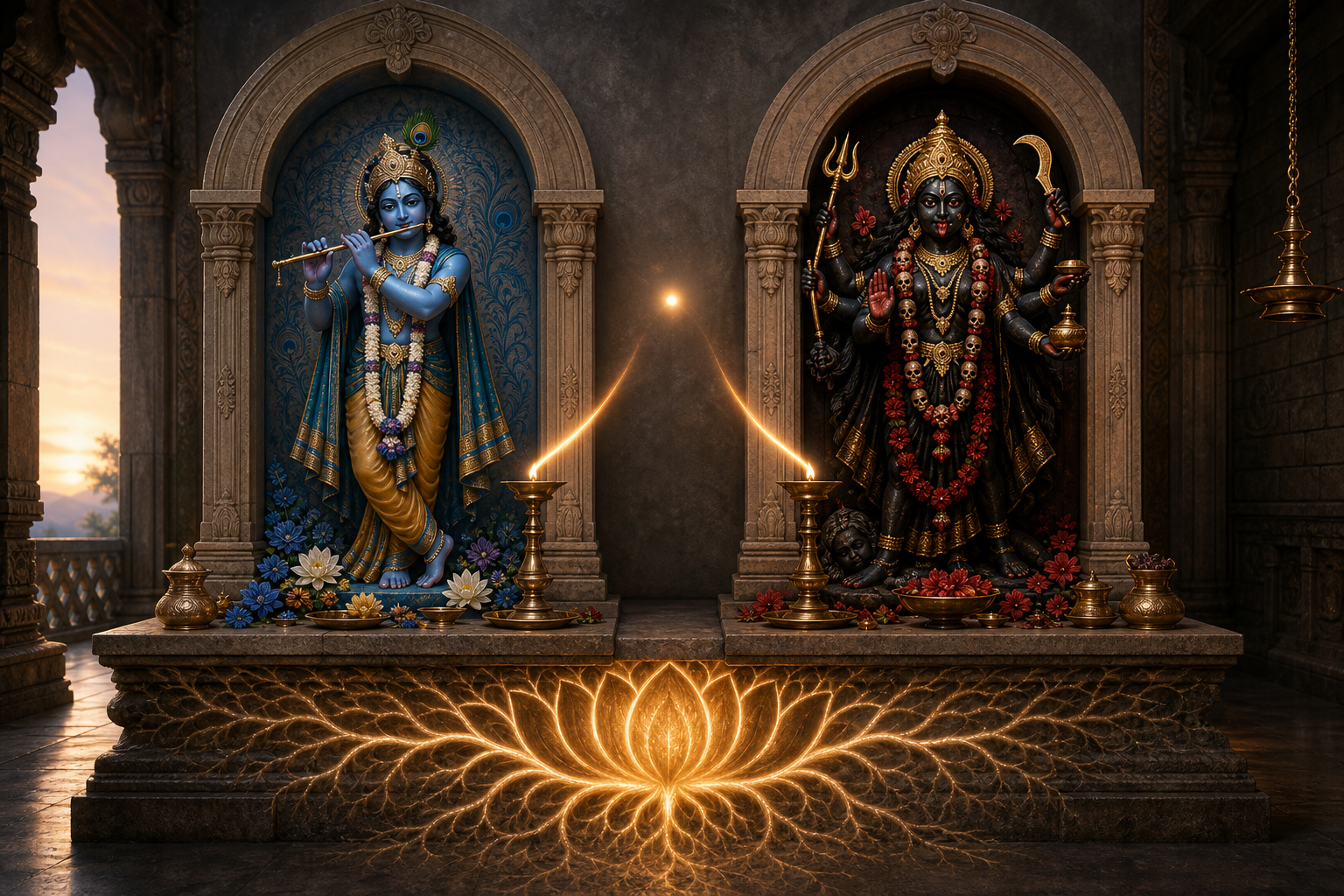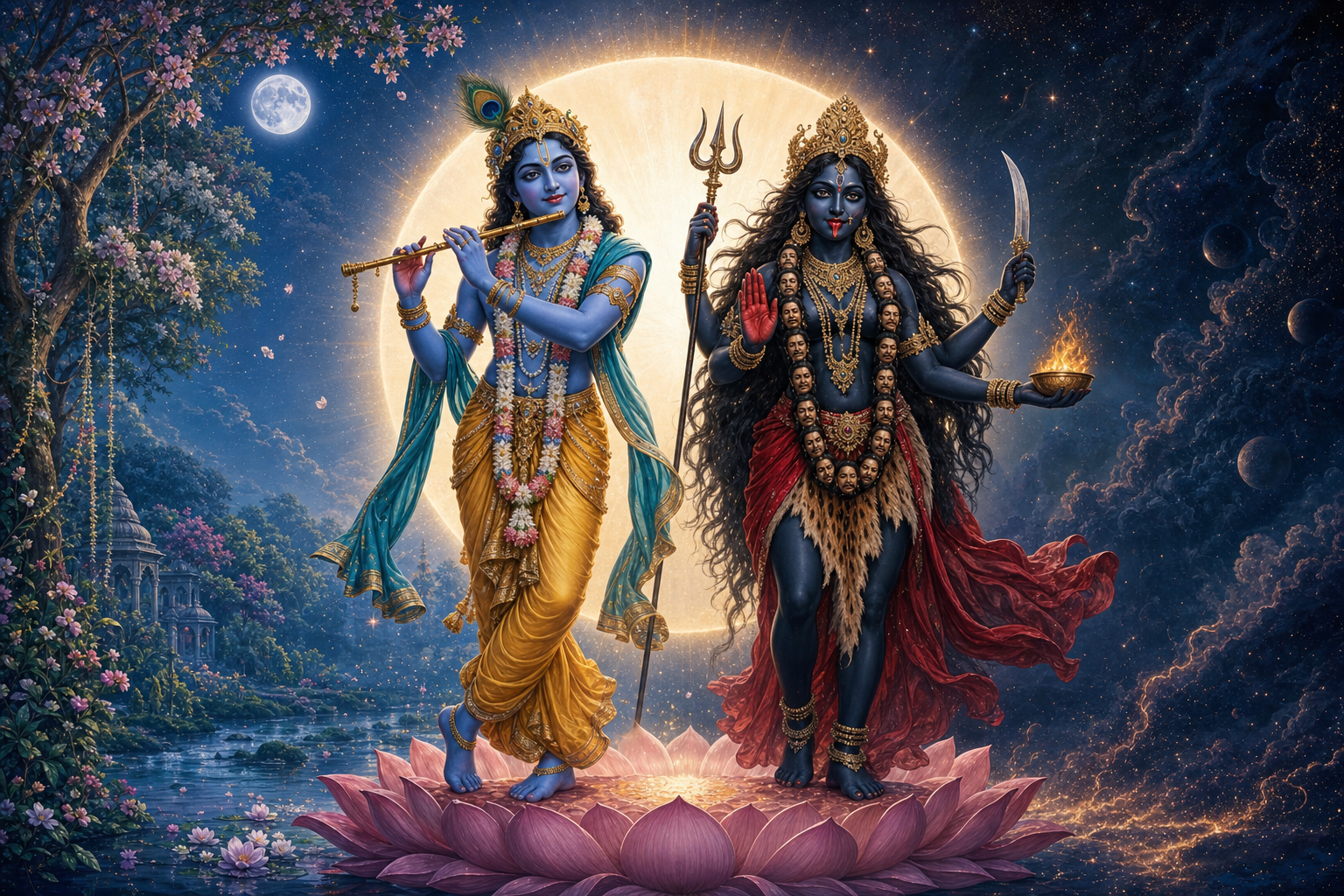
If Krishna draws your heart while Kali commands your attention, you may wonder whether you are mixing incompatible paths. Must tenderness and terror, loving relationship and uncompromising time, belong to separate spiritual worlds?
The Krishna-Kali non-dual vision offers a disciplined answer: their forms remain distinct, but the reality encountered through them is not divided. You do not have to erase either deity to understand their unity. You do have to distinguish unity at the level of ultimate reality from sameness in image, mood, worship, or lineage.
The question is not whether the two forms look alike
Krishna and Kali do not present the devotee with the same religious mood. Krishna’s gentle face evokes attraction, intimacy, beauty, and love. Mahakali confronts the limits that attraction cannot overcome: time, change, relinquishment, and the end of every possession. One draws you toward the Divine through relationship; the other prevents that relationship from becoming an attempt to make the temporary permanent.
Abhinna-rupa, or non-separate form, does not require visual or ritual interchangeability. It makes an ontological claim: difference need not become separation. At the level of form, you can address Krishna as Krishna and Kali as Kali. At the level of tattva, neither stands outside the one reality from which divine forms become available to devotion.
This distinction protects the teaching from two opposite mistakes. The first is sectarian rivalry: treating two divine forms as competing finite powers, as though honoring one requires contempt for the other. The second is careless flattening: declaring every form identical and therefore treating names, symbols, devotional moods, and disciplines as if they meant nothing. Non-duality corrects the first mistake without demanding the second.
Use a simple test when you hear someone invoke divine unity. If the claim makes Krishna and Kali spiritually disposable, it has confused unity with vagueness. If it preserves the force of each form while removing the need for rivalry, it is closer to abhinna-rupa.
This is also where theological humility matters. Hindu sampradayas do not all describe supremacy or divine identity in the same way. Some will interpret Krishna through a Vaishnava framework, Kali through a Shakta framework, or the relation between them through a different metaphysics altogether. Krishna-Kali non-duality should therefore be used as a contemplative lens, not announced as a formula that every Hindu tradition must accept.
Read the Sanskrit vocabulary as a map for inner practice
Several terms within this Krishna-Kali formulation belong together: advitiyam, without a second; amurtam iva, as if formless; ekata, unity; anuragamaya tattva, reality permeated by love; smriti, remembrance; vairagya, detachment; and samshaya-vinashana, the destruction of doubt. Read as a sequence, these words turn a metaphysical assertion into a practical discipline.
- Begin with the absence of a rival absolute. If reality is without a second, Krishna and Kali cannot be two self-existent ultimates competing for the same cosmic throne.
- Do not trap the absolute inside an image. The form makes relationship possible, but the reality disclosed through the form is not exhausted by its visible features.
- Move unity into the heart. Intellectual agreement is incomplete if you still nourish hostility toward devotees who approach the Divine through another form.
- Hold love and detachment together. Love keeps detachment from becoming coldness. Detachment keeps love from becoming possession.
- Return through remembrance. Non-duality becomes useful when you recall it amid attachment, fear, loss, or sectarian reaction, not merely when discussing philosophy.
The last point is especially important. Doubt is not destroyed merely by repeating that everything is one. A slogan can conceal confusion as easily as it can resolve it. Doubt loosens when you can understand why difference appears, why devotion needs a definite form, and why definiteness does not create a second ultimate reality.
Treat the Krishna-Kali shloka as a contemplative formulation unless you can independently establish its textual provenance. Sanskrit wording by itself does not establish a passage’s age, canonical status, or acceptance across sampradayas. Its spiritual value can be considered without turning an unverified provenance into a historical claim.
Cosmic love and supreme time correct each other
The union of Krishna and Kali becomes clearer when you stop treating love and time as unrelated themes. Love says that existence can be met through intimacy rather than mere control. Time says that no created arrangement can be possessed forever. Together, they teach you to participate fully without demanding permanence from what must change.
Krishna without Kali can be misread as permission to cling to sweetness, personality, relationship, or pleasing experience. That is not love; it is an attempt to possess the conditions under which love was felt. Kali without Krishna can be misread as sheer negation, as though impermanence made affection pointless. That is not detachment; it is withdrawal hardened into a worldview.
The non-dual pairing resists both distortions. Krishna tells you to love the real being before you. Kali tells you that loving does not grant ownership. Krishna draws you into relationship. Kali cuts the belief that relationship can secure the ego against change. Their unity is therefore not a decorative reconciliation of two cults. It is a demanding account of how to love without grasping and how to release without becoming indifferent.
You can apply that account whenever one of three reactions appears:
- When affection becomes control: ask what you are trying to preserve for yourself. Let Kali’s relation to time expose the demand for permanence, then return to Krishna’s love without that demand.
- When change makes you emotionally withdraw: notice whether detachment has become an excuse not to care. Let Krishna restore relationship while Kali keeps the relationship free of possession.
- When another form of worship provokes contempt: separate legitimate doctrinal difference from the urge to diminish another devotee’s chosen form. Abhinna-rupa does not abolish debate, but it does challenge the ego’s need to make reverence exclusive through hostility.
This is where non-duality becomes ethically visible. Its first evidence is not an unusual experience. It is a less possessive love, a less fearful response to change, and a reduced appetite for sectarian belittling.
Practice the insight without making a spiritual collage
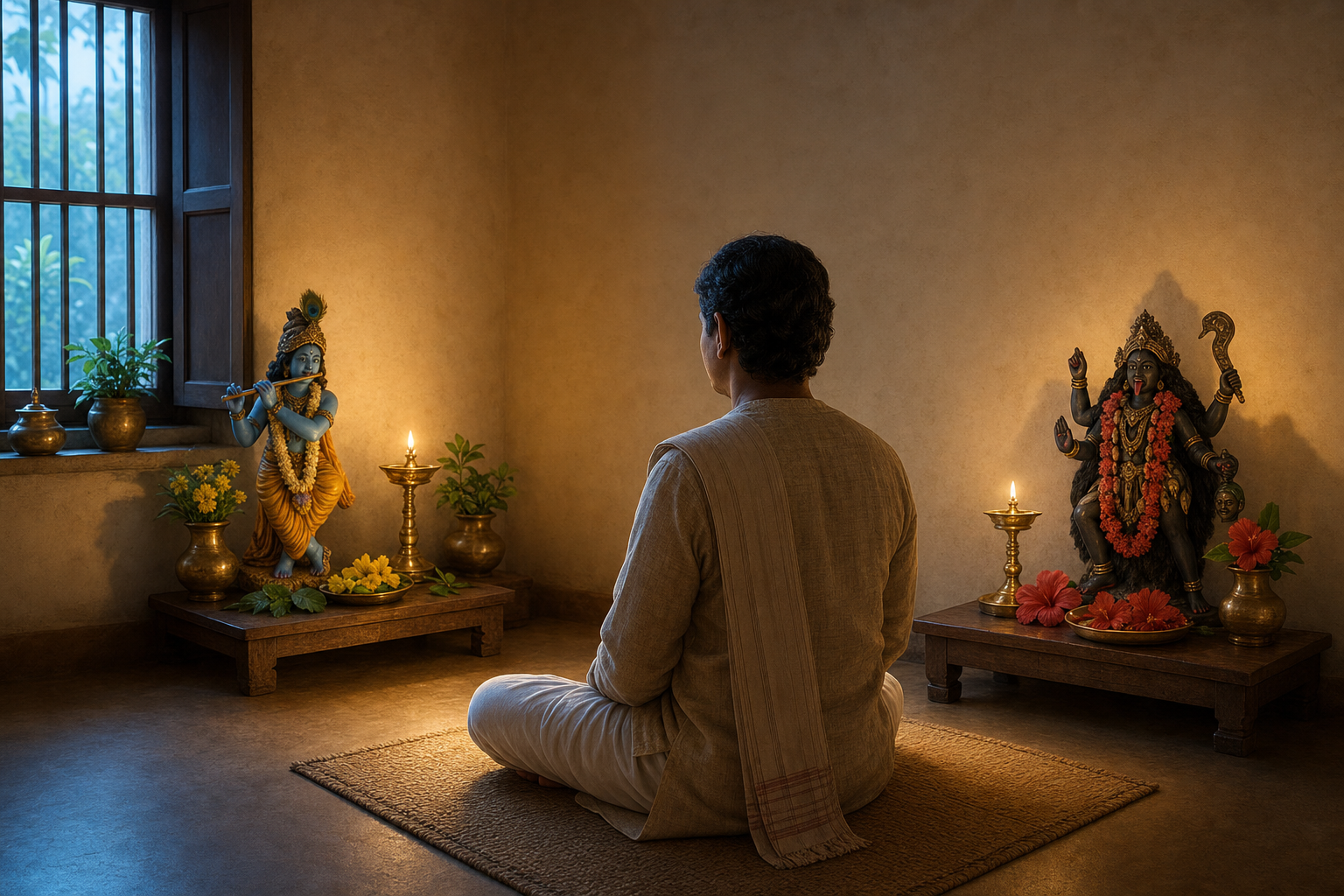
You do not need to merge two complete systems of worship to contemplate their non-separation. In fact, indiscriminate mixing can make both forms less intelligible. A steadier practice preserves a clear devotional doorway while using the non-dual insight to remove rivalry.
- Choose the form through which you will begin. If Krishna is your ishta-devata, address Krishna fully. If Kali is your ishta-devata, address Kali fully. Do not switch names merely to prove that you understand unity.
- State the bridge in plain language. After settling into your chosen form, remember: the reality met here is not outside the reality approached through the other form. This keeps unity intelligible without pretending that devotional moods are interchangeable.
- Contemplate the paired discipline. Ask, Can I love without clinging? Can I let go without hardening? The first question brings Kali’s detachment into Krishna’s love. The second brings Krishna’s love into Kali’s relinquishment.
- Keep ritual and lineage boundaries clear. Metaphysical unity does not automatically authorize you to combine mantras, initiatory practices, or ritual procedures. If you belong to a sampradaya, follow its discipline and seek guidance from a qualified teacher before altering established practice.
- Judge the contemplation by its fruit. Look for less rivalry, less grasping, less fear of change, and steadier devotion. If the practice produces only conceptual excitement or greater confusion, return to the simplicity of your chosen form and revisit the philosophy later.
You can also bring the insight into ordinary puja without adding a new rite. When offering something to Krishna, notice whether love is becoming a transaction for security. When offering something to Kali, notice whether surrender is becoming emotional avoidance. In either case, restore the missing half: love without possession, or release without indifference.
Do not use non-duality to overrule the devotional conscience of someone who does not share this interpretation. A Krishna devotee need not adopt Kali worship to honor the possibility of one reality, and a Kali devotee need not recast every practice in Vaishnava language. Unity is deepest when it removes compulsion as well as rivalry.
Key takeaways
- Krishna-Kali non-duality means non-separation at the level of ultimate reality, not sameness of image, devotional mood, mantra, or ritual.
- Krishna’s love and Kali’s relation to supreme time form a practical pair: love without possession and detachment without indifference.
- Abhinna-rupa preserves meaningful difference while denying that divine forms are rival, self-contained absolutes.
- A sound practice begins through one clear devotional doorway, then uses remembrance to remove hostility and grasping.
- The most reliable test is transformation: less sectarian contempt, less fear of change, and steadier love.
At your next act of worship, do not force a grand synthesis. Begin with the form you genuinely revere. Then carry one question into the offering: What would it mean to love completely without trying to possess? Let Krishna deepen the love, let Kali remove the demand, and allow their non-separation to become something you can live rather than merely assert.