
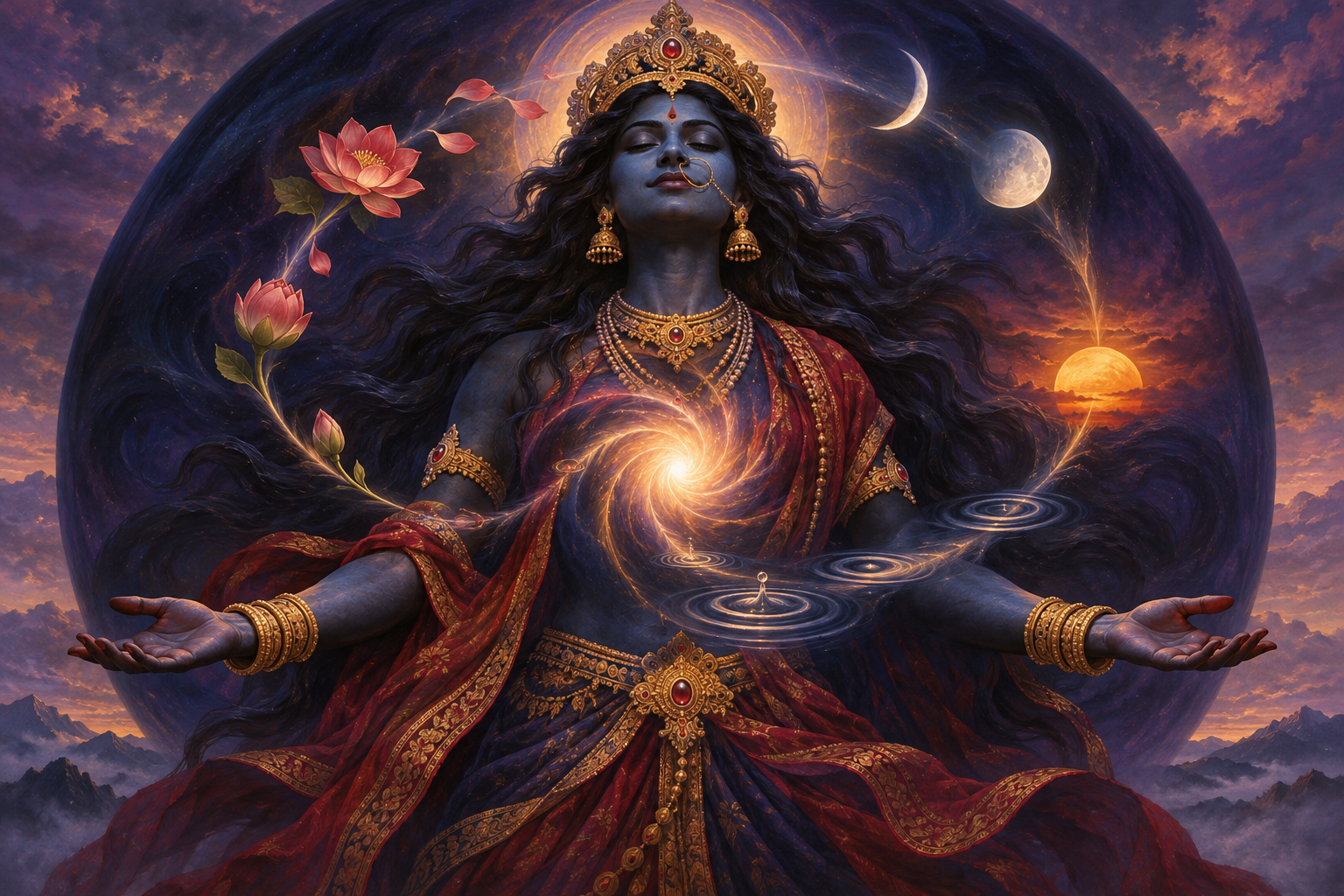
If you have heard that Kali is beyond time, the phrase can sound either grand or useless. Does it mean living forever, stopping thought, escaping change, or entering some blank state outside ordinary life? Krama Shaivism gives you a more exact way to approach the claim.
Your task is not to imagine a remote eternity. It is to examine the sequence already present in every experience: something appears, becomes known, changes, and disappears. When you notice what makes that entire movement knowable, Kali’s relation to time becomes philosophically precise rather than merely dramatic.
Sequence is the doorway, not the obstacle
The word Krama points to sequence, order, or succession. That emphasis matters. Ordinary consciousness seems to move from one event to another: sensation follows sensation, a thought replaces a thought, and memory gathers what is no longer present. Krama does not begin by pretending this movement has vanished. It investigates how the movement arises and what its existence presupposes.
Within the Maharthakrama, often rendered as the Great Sequential Doctrine, ten tattvas organise the movement between cosmic manifestation and supreme consciousness. A tattva is a principle of reality, not necessarily a physical substance or a separate divine personality. The tenfold structure should therefore be read as a map of relations, not as a collection of objects floating somewhere beyond the world.
This changes how you use the teaching. If you treat the Absolute as one more thing waiting at the end of a spiritual ladder, you have placed it inside sequence. It becomes a future acquisition: something absent now that you hope to possess later. Krama instead invites you to examine the sequence itself. Every stage must already depend upon the consciousness in which it is disclosed.
The path is sequential from the seeker’s point of view, but its ground cannot be merely the final event in that sequence. A destination reached tomorrow still belongs to time. Supreme consciousness must be present as the condition by which beginning, transition, and end are known at all.
This is also why Krama cannot be reduced to devotional emotion, even though devotion to Kali may be central to a practitioner’s life. An image of Kali can turn the heart toward the divine. Krama asks a further question: what power manifests the worshipper, the image, the act of worship, and the succession of moments through which worship occurs?
What it means for Kali to absorb time
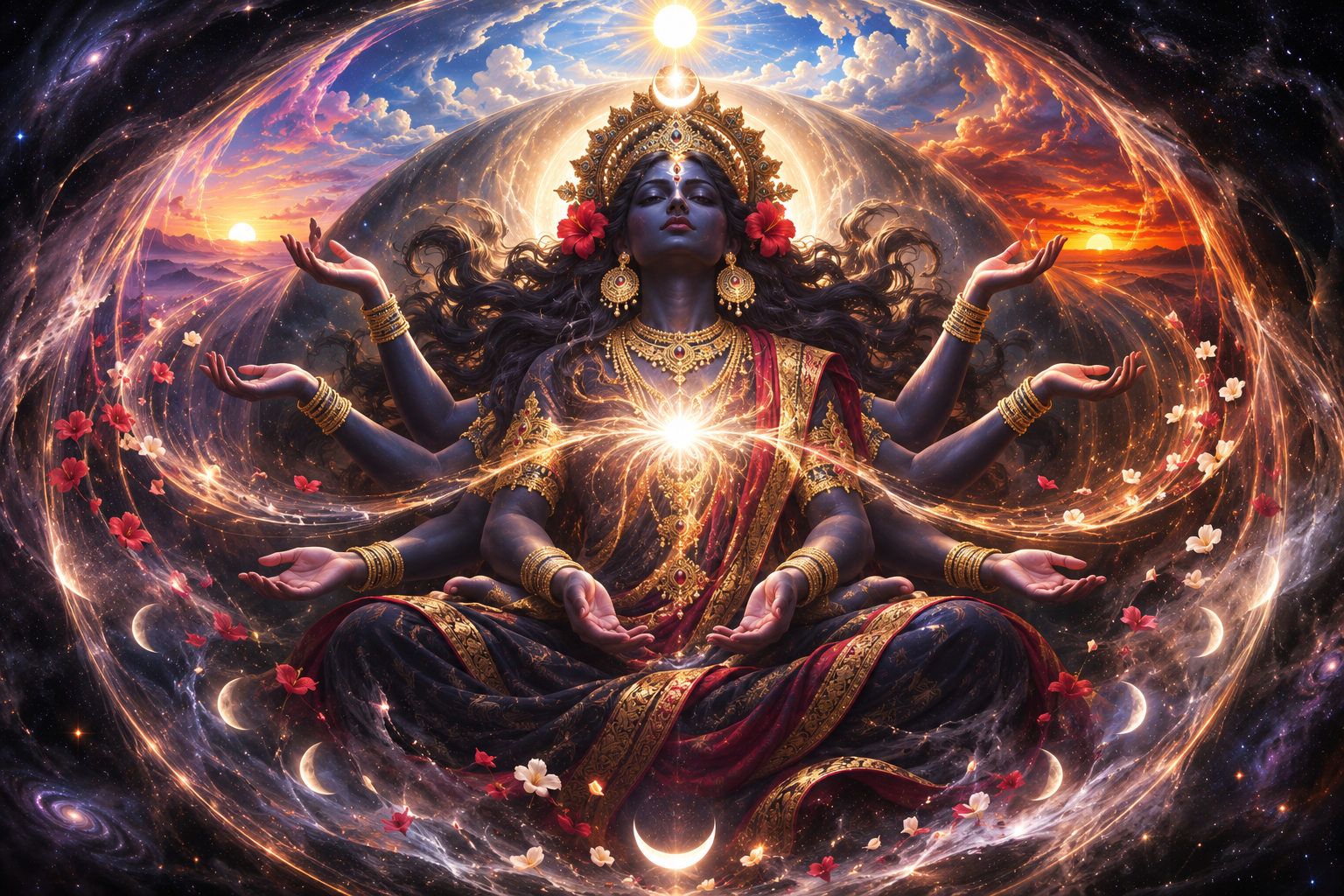
Kalasankarshini is the form of Kali most directly associated with this question. Kala means time, while the name Kalasankarshini presents her as the one who draws time in, absorbs it, and surpasses it. Within Krama, Kalasankarshini is treated as the supreme Kali and the summit of the Kali lineage, not merely as another deity operating somewhere inside the universe’s timeline.
The reversal is exact. Embodied beings ordinarily experience themselves as being consumed by time. Youth passes, conditions change, plans become memories, and every formed thing moves toward dissolution. Kalasankarshini represents the absorption of that consumer itself. Time can order appearances, but it cannot be the final container of the consciousness-power in which time appears.
You need to distinguish several meanings of time before this makes sense:
| Meaning of time | What transcendence does not mean | What you should notice |
|---|---|---|
| Clock time | That clocks stop or practical obligations disappear | Events remain measurable and consequences still follow actions |
| Lived time | That thought, memory, and anticipation must be forcibly suppressed | Past and future are encountered through experiences arising now |
| Ultimate status | That awareness continues for an infinitely long duration | Duration itself must become known within consciousness |
Timelessness is therefore not endless time. Endless duration would still be duration, only without a final date. Nor is timelessness a frozen instant. A frozen instant would remain a temporal condition opposed to movement. The stronger claim is that time is not self-sufficient: succession becomes manifest through consciousness, while consciousness cannot be adequately explained as just another passing item in the succession.
Do not turn that insight into a detached spectator standing outside life. If consciousness were an isolated witness and sequence belonged to something wholly separate, the result would be another dualism. Krama’s nondual force lies in recognising sequence as an expression of consciousness-power. Manifestation is not foreign to Shakti, and its reabsorption is not the repair of a divine mistake.
This also keeps the doctrine honest. Transcending the ultimate authority of time does not exempt you from deadlines, ageing, grief, causation, or responsibility. A missed obligation remains missed. A loss remains consequential. The teaching changes the metaphysical status of temporal experience; it does not grant permission to neglect the conditions of embodied life.
A contemplation you can test in ordinary experience
You can approach the central insight without pretending to perform an initiated tantric ritual. The following is a philosophical contemplation, not a mantra practice, a substitute for lineage instruction, or a claim to reproduce formal Krama sadhana.
- Choose a complete event. Listen to an ordinary sound from its first appearance until it can no longer be heard. A closing door, a passing vehicle, or a natural sound is enough.
- Notice the phases without freezing them. There may be anticipation, the sound itself, its fading, and a memory of what was heard. Observe how each phase gives way to another.
- Look for the past and future in immediate experience. The vanished sound is available now as memory. A possible next sound is available now as expectation. This does not prove that history or practical futures are unreal; it shows how past and future become present to you.
- Try to isolate the present. The moment you mentally name a present instant, it has already changed. Notice that the difficulty comes from treating the present as a tiny object situated between two larger objects called past and future.
- Turn from the event to its knowing. Did awareness arrive only after the sound, or was the sound disclosed through knowing from the beginning? Do not answer from memory or doctrine. Attend to the next event.
- Let the sequence finish. Do not chase a blank state once the sound ends. Notice instead that disappearance is also known. Absence, transition, and renewed appearance are not outside the field of awareness.
If the exercise produces mental blankness, you may simply be suppressing attention. If it produces only a verbal answer such as “everything is consciousness,” the concept has outrun observation. Return to the actual transition. The useful result is greater precision: you see succession clearly while becoming less certain that succession is the ultimate ground of the one who knows it.
This contemplation does not establish the full metaphysics of Krama by itself. It does give you an experiential foothold. “Kali absorbs time” no longer has to mean that a supernatural event destroys the clock. It can direct attention toward the dependence of every temporal phase upon the power that manifests, knows, and withdraws it.
Misreadings that block the teaching
- Timelessness means personal existence continuing forever. An endless personal history would still consist of earlier and later moments. Read transcendence as freedom from time’s claim to be ultimate, not as an indefinitely extended biography.
- Transcendence requires stopping thought. A stopped thought is merely one condition replacing another. Watch the arising and ending of thought instead of making mental silence into a trophy.
- The world must be rejected because it changes. Krama begins with sequence precisely because manifestation is where the structure can be recognised. Use change as evidence to examine, not as an enemy to despise.
- Kali can be understood through destruction alone. Destruction describes only the disappearance of formed things. Kalasankarshini points further, toward the reabsorption of time itself into its conscious ground.
- The ten tattvas are ten physical layers to be travelled through. Treat them first as principles that clarify manifestation and return. Otherwise, a subtle map becomes an imagined spiritual geography.
- Philosophical understanding authorises advanced ritual. It does not. If you wish to undertake formal tantric practice, learn its mantra, ritual setting, discipline, and interpretation from a qualified teacher within a living lineage.
One misreading deserves special attention: using the doctrine to deny pain or impermanence. Saying “time is unreal” over another person’s grief is neither insight nor compassion. At the conventional level, change and loss are real features of embodied existence. The deeper inquiry concerns whether those features exhaust the nature of consciousness. Keep both levels in view.
Key takeaways for reading and practice
- Krama uses sequence as the field of recognition rather than treating sequence as something you must first escape.
- The ten tattvas of Maharthakrama form a principled map between differentiated manifestation and supreme consciousness.
- Kalasankarshini is Kali understood as absorbing time, not merely as destroying objects that exist within time.
- Transcendence does not stop clocks, cancel consequences, or promise an endlessly prolonged personal future.
- The most useful inquiry is to observe appearance, transition, and disappearance, then ask what makes the entire succession knowable.
The next time memory or anticipation pulls you away from the life in front of you, do not merely repeat that time is unreal. Identify what is actually occurring: recollection, expectation, appearance, or disappearance. Then ask what knows that phase and its transition into the next.
That small discipline will not replace Krama initiation or sustained study. It will prevent a profound teaching from becoming decorative language. If you pursue the tradition further, take this clarity to a qualified teacher and learn its philosophical map, devotional orientation, and ritual context as parts of one path.

References
- Hindu Blog — The Ten Tattvas of Maharthakrama Siddhanta: The Sequential Path to Supreme Consciousness
- Hindu Blog — Kalasankarshini Kali: The Goddess Who Absorbs Time

Leave a Reply
You must be logged in to post a comment.