
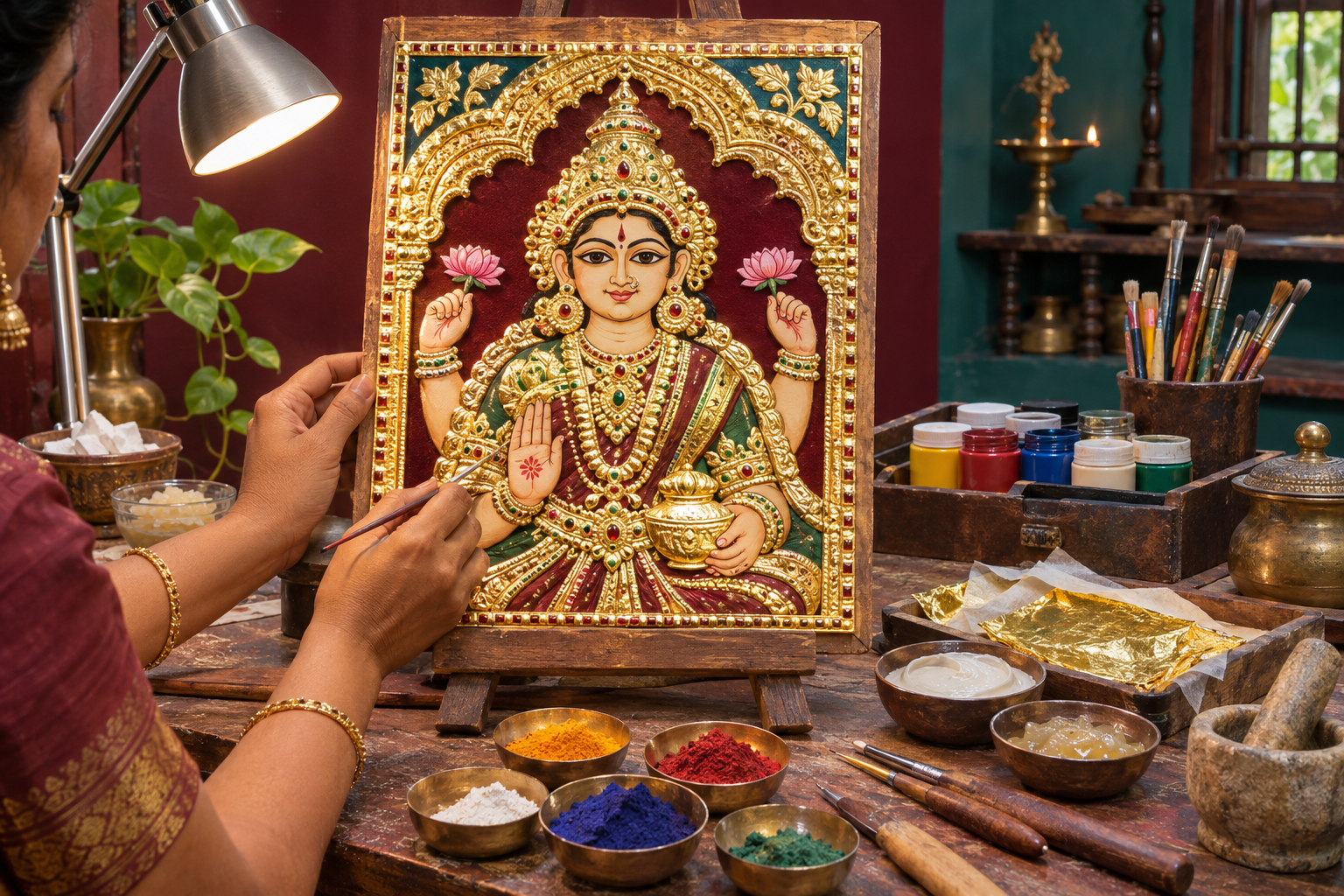
You are looking at two luminous images of a Deity. Both are being sold as Thanjavur paintings. One comes from a named artisan who explains the materials and method. The other is cheaper, vaguely described and bright enough to look convincing on a phone screen. How do you tell whether modern adaptation has kept the tradition alive or merely copied its appearance?
The answer is not to reject every new material. Thanjavur painting has never survived by becoming a museum specimen. You need to distinguish changes that help artisans continue their work from substitutions that conceal what you are actually buying.
Material change does not automatically break the tradition
Thanjavur painting emerged from a region shaped by the Kaveri and by the cultural worlds of the Cholas, Nayaks and Marathas. The form is known locally as palagai padam, or wooden-plank picture. That name points to a physical object, but the tradition cannot be reduced to one species of wood or one adhesive.
Contemporary painters may use plywood instead of jackfruit wood and factory-made glue instead of tamarind-seed paste. Those are substantial changes. They should be disclosed, but they do not by themselves turn a painting into an imitation. A support and an adhesive help construct the object; they do not alone determine its iconographic discipline, workmanship or devotional purpose.
This gives you a better test than asking whether everything is old-fashioned. Separate the painting into three layers:
- Structural materials: the board, adhesive and other components that allow the physical object to be made.
- Visible workmanship: the painted image, gold treatment, decorative elements, finish and, above all, the handling of the Deity’s face.
- Devotional integrity: whether the sacred subject is treated with knowledge, care and appropriate seriousness rather than used as an interchangeable luxury motif.
A change in the first layer does not necessarily erase the other two. By contrast, a seller can imitate the visible glitter while offering little evidence of either workmanship or devotional understanding. This is why appearance alone is an unreliable measure of continuity.
The craft’s Geographical Indication status helps establish its connection to a particular regional tradition. But the phrase “GI-tagged” is not a substitute for provenance. A geographical indication protects a name associated with place and inherited practice; it does not make every object advertised under that name equally accomplished. Ask who made the work, where it was made and what materials it contains.
The Deity’s face is where continuity becomes visible
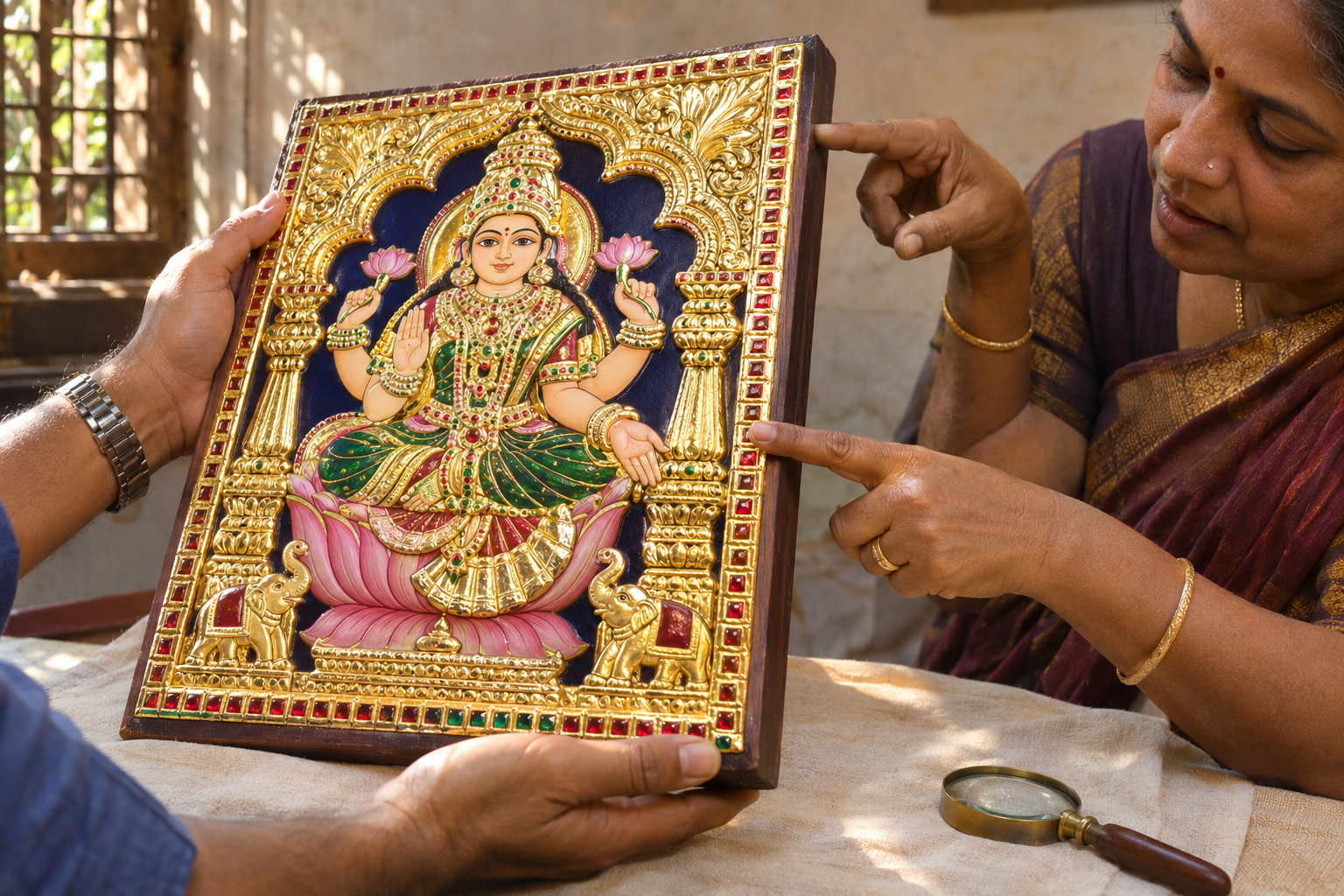
Gold immediately catches the eye, but glitter is the easiest part of the tradition to mimic. The more revealing place to look is the face. In continuing workshop practice, gold foil remains important, as does the master’s hand in rendering the Deity’s face.
That distinction matters because a devotional image does more than fill wall space. For a devotee, the face is the point of encounter. It must support attention rather than merely advertise opulence. Gold frames and honours the sacred presence; it should not overwhelm it.
When examining a painting, temporarily ignore the gold. Look at the expression, eyes and overall composure of the figure. Does the face remain steady and convincing when viewed closely? Does it invite sustained attention, or does the work depend on reflected light to create its entire effect? You do not need to be a trained painter to notice whether the sacred figure feels central or whether ornament has become the real subject.
You should also distinguish devotional continuity from one prescribed use. A Thanjavur painting may be placed in a shrine, given for a sacred occasion, collected as a work of cultural heritage or displayed elsewhere in a home. The decisive question is not whether every buyer performs the same ritual. It is whether the maker and buyer still recognise that the icon is more than a decorative pattern.
If you intend to use the work in daily worship, decide on the Deity and form before discussing size, frame or price. Ask a knowledgeable person within your own sampradaya or family tradition if a particular iconographic choice matters to your practice. A costly image chosen only because it matches the room may be less suitable than a simpler work selected with devotional clarity.
How to assess a modern Thanjavur painting before buying
Online photographs can make real gold, synthetic substitutes and reflective decorative material look deceptively similar. Social media may introduce you to an artisan, but the sales image should begin your inquiry, not end it. Use the following sequence before paying:
- Identify the maker. Ask for the artisan’s or workshop’s name and location. A seller who cannot identify the people behind a supposedly traditional handmade work is giving you a product claim without provenance.
- Ask what “gold” means. Request a plain statement of whether the work uses gold foil or a synthetic gold-coloured material. Do not accept “gold finish,” “gold work” or “traditional look” as answers to a materials question.
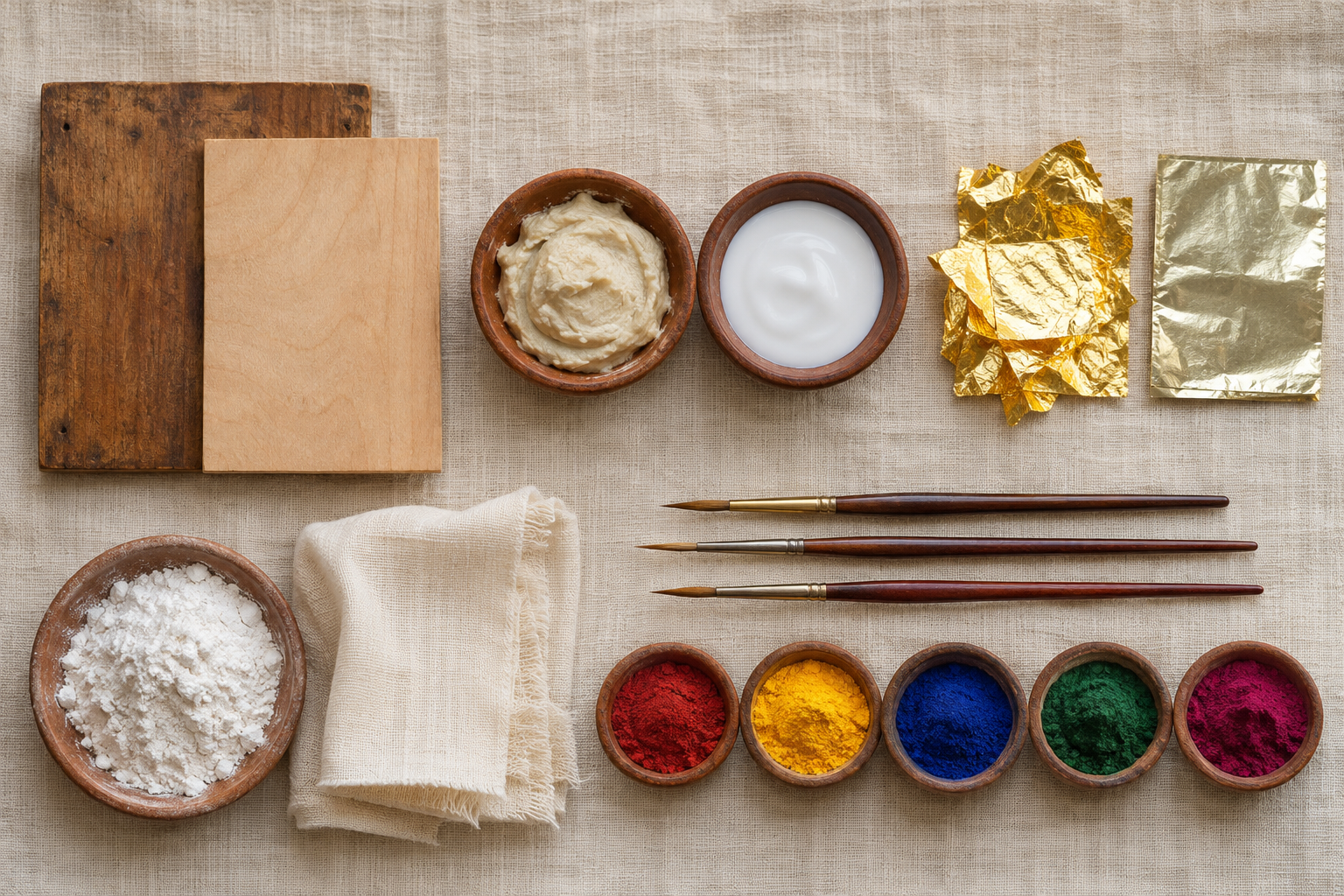
- Ask about the support and adhesive. Jackfruit wood and tamarind-seed paste belong to older practice, while plywood and factory glue are now used by painters. Your purpose is not to reject the modern answer; it is to obtain an honest one.
- Request close views of the face. Ask for an unfiltered photograph taken straight on and in even light. A short video that moves from the full composition to the face can reveal more than a highly polished catalogue image.
- Clarify what is handmade. Ask which parts were drawn, painted, decorated and finished by hand. “Handcrafted” can be used loosely, so a process description is more useful than a label.
- Seek written documentation. Ask the invoice or accompanying note to name the maker or workshop, subject, materials and place of production. Keep this with the painting. It preserves provenance if the work is later gifted or inherited.
- Choose purpose before scale. Decide whether the painting is for worship, a sacred gift or cultural display. That decision should determine the Deity, composition and size before decorative impact determines your budget.
A responsible artisan or seller should be able to answer these questions without turning the exchange into a mystery. Small variations in terminology are understandable. Persistent vagueness about the maker, gold or method is a reason to pause.
Do not assume that lower cost proves dishonesty. An affordable work can be entirely legitimate when its materials and degree of handwork are stated clearly. The problem begins when synthetic gold or partly mechanised production is hidden behind the language and pricing of traditional craftsmanship. Honest adaptation tells you what changed.
Key takeaways for buyers and devotees
- A plywood support or modern adhesive does not, by itself, make a Thanjavur painting inauthentic.
- Provenance, transparent material descriptions and identifiable handwork tell you more than glitter or a generic “traditional” label.
- Look closely at the Deity’s face. It reveals artistic control and whether ornament serves the sacred image.
- Ask explicitly whether the work uses gold foil or a synthetic gold-coloured substitute.
- Treat GI status as evidence of a regional craft identity, not as an automatic guarantee for every object offered under the name.
- If your budget is limited, choose a smaller honestly described work instead of an undisclosed imitation of a more expensive one.
Patronage must reward the artisan, not only the appearance
Cheap imitations create a deeper problem than disappointing purchases. Synthetic-gold copies compete with artisan-made paintings, while younger people may leave the craft for more stable employment. When buyers reward the cheapest resemblance, the market retains the visual shell while weakening the human chain that knows how to make the form properly.
You can support that chain without pretending that every old material must return. Buy from a named artisan or a channel that preserves the maker’s identity. Credit the artisan when you share the painting online. Retain the documentation. If you commission a work, agree on the sacred subject and material description before asking for embellishment. And do not demand artisan labour at the price of an undisclosed reproduction.
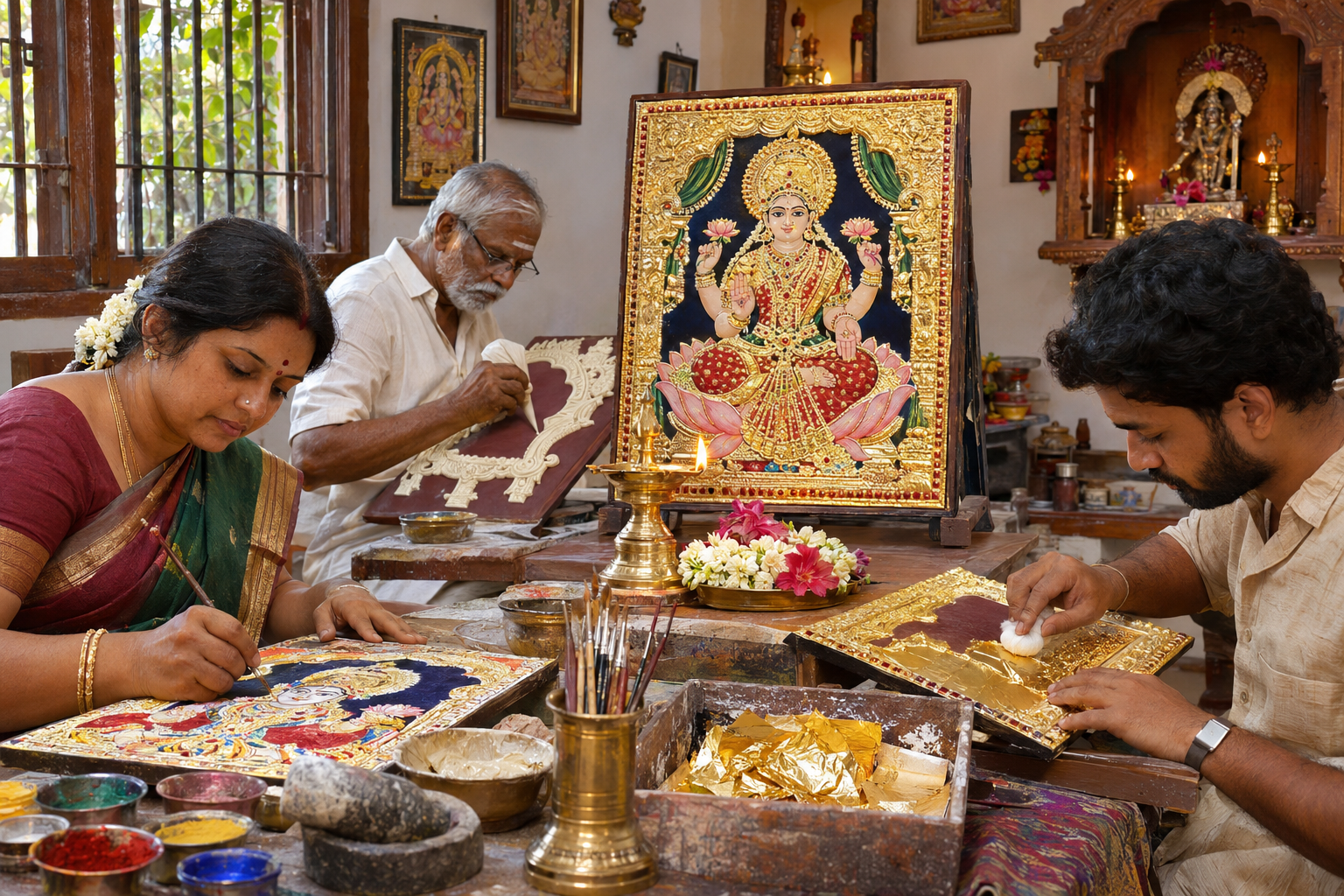
Institutional and commercial bridges also matter. Artisans Cards, Poompuhar showrooms and online selling are helping painters reach buyers. These newer routes do not diminish the tradition simply because the transaction no longer begins in a palace, temple town or local workshop. They can widen patronage, provided the artisan’s name, method and materials remain visible.
This is the practical meaning of a living tradition: change is permitted, but concealment is not; wider access is welcome, but the maker cannot be erased; ornament may evolve, but it must continue to serve the Deity. Before your next purchase, send the seller the seven questions above. The clarity of the answers will tell you more than the brightness of the gold.
References

Leave a Reply
You must be logged in to post a comment.