
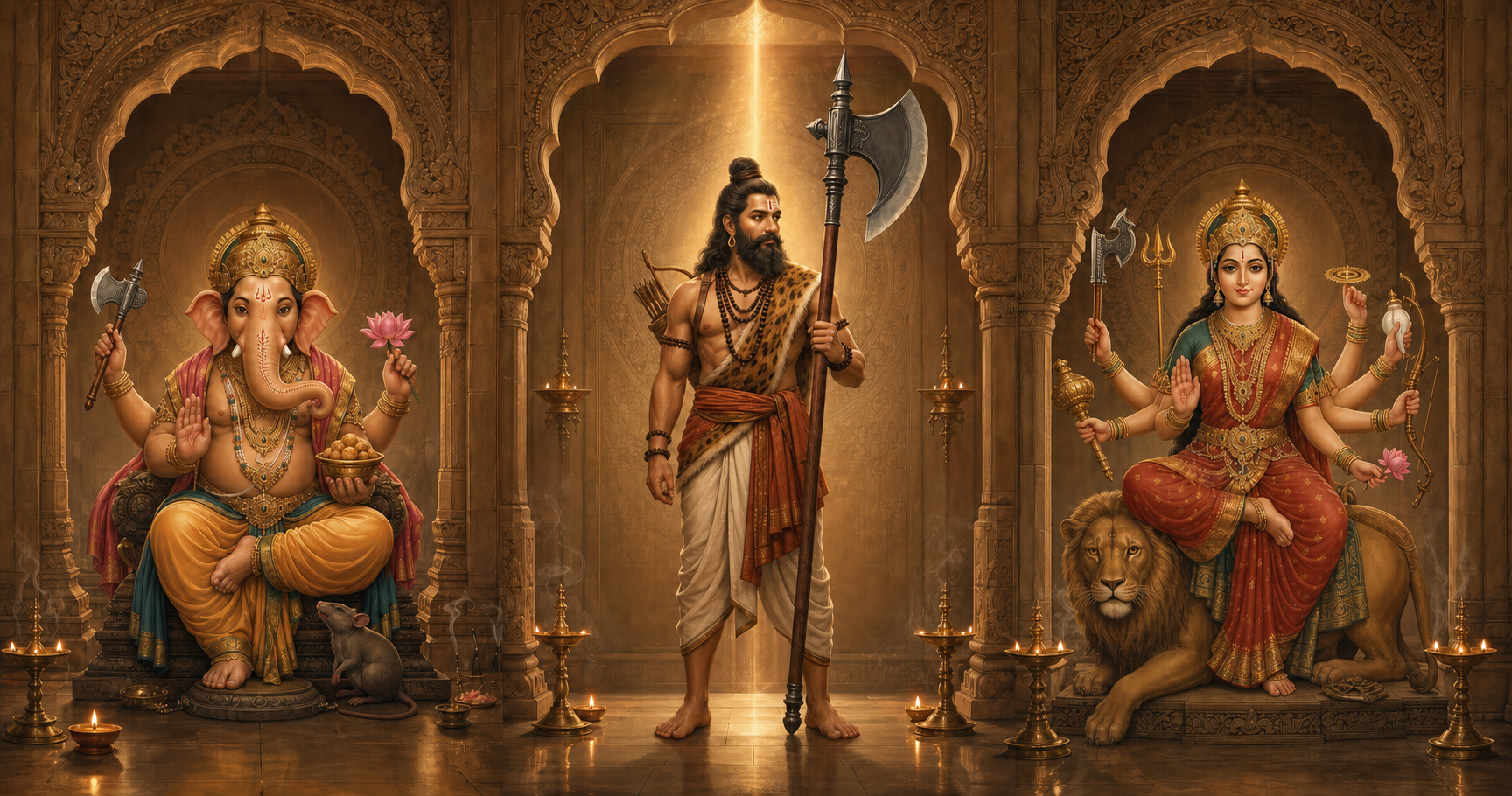
You are looking at a many-armed murti and one attribute resembles an axe. Is it merely a weapon, a sign of anger, or something more precise? With the parashu, the answer depends on who holds it, what accompanies it, and which episode the image brings to mind.
Read those elements in the right order and the parashu becomes remarkably clear. It signifies the power to make a necessary separation: to cut an obstacle, end a threat, remove corruption, or relinquish an exhausted order so that dharma can be restored. It does not make every bearer a deity of violence.
Identify the axe before interpreting its symbolism
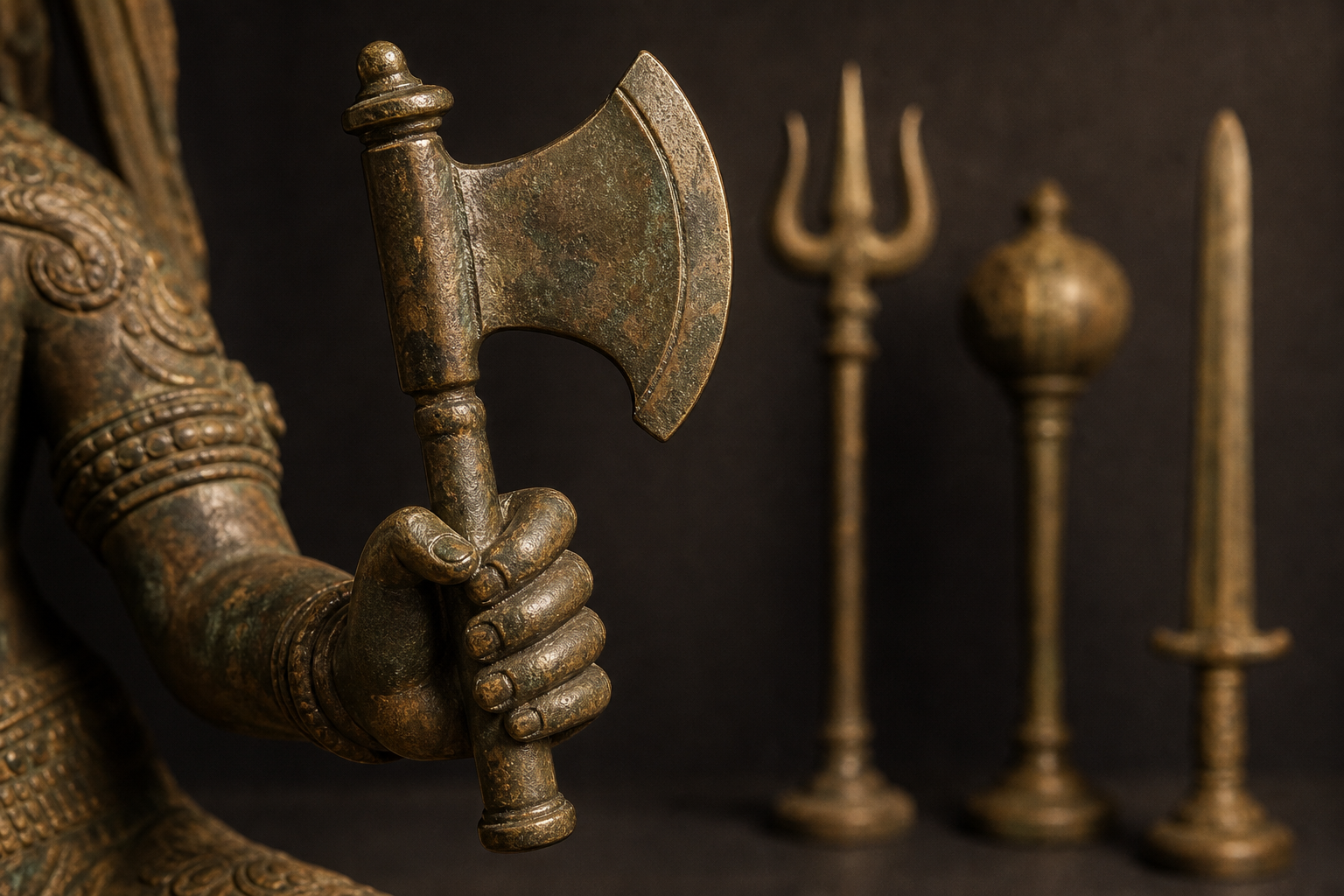
Begin with the object rather than a memorized symbolic definition. Paraśu, commonly written as parashu, denotes an axe used as a weapon; kuthāra is a related axe term encountered in Vedic and epic usage. Different labels in a catalogue do not necessarily indicate a wholly different iconographic idea, so inspect the form and its context.
A parashu normally has a short or medium haft and a head whose cutting edge is broad enough to read from a distance. The head may be crescent-shaped, half-moon-like, or bearded, meaning that the lower part of the blade extends beneath its point of attachment. A compact butt or counterweight may project from the other side. These blade, haft, and counterweight cues are more dependable than the apparent size of the weapon.
In a crowded composition, look behind bracelets, secondary arms, and neighboring attributes. The curved edge may be the only visible part. The hand often grips the middle of the haft, and an upper hand may carry the axe so that it does not obscure the deity’s face. In stone sculpture, the weapon is generally carved as part of the hand. In bronze, it may have been made separately and attached, which means an old image can survive after the attribute has disappeared. An empty gripping hand is therefore evidence of a missing implement, not proof that the implement was an axe.
The commonest confusion is between the parashu and Ganesha’s ankusha. The ankusha ends in a comparatively narrow hook or point used for directing; the parashu presents a broad cutting edge. If only a curved outline survives, follow it back toward the shaft. A hook turns sharply around a small point, while an axe blade widens into a cutting face. A trishula has distinct tines, and a sword continues lengthwise from its grip rather than sitting crosswise upon a haft.
Do not demand mechanical realism from sacred art. Shilpa traditions compress an attribute so that it remains legible beside the body, especially in a small shrine image. A blade that would look undersized as a battlefield weapon may be iconographically exact because its silhouette, not its practical reach, identifies it.
The parashu means disciplined separation, not destruction alone

An axe belongs to more than one human world. It clears, shapes, and builds; it can also wound and kill. Hindu theology does not erase that danger. It places the dangerous capacity under a moral claim: power becomes legitimate when it protects what ought to live and removes what is destroying the conditions of life, duty, or sacred order.
This is why the symbolism of cutting must be read more carefully than the symbolism of smashing. A cut creates a boundary. It separates the sound from the decayed, a true obligation from an ego-driven attachment, and necessary defense from uncontrolled revenge. The same visual action can therefore be read inwardly as severing avidya, ahamkara, or asakti, and outwardly as confronting entrenched adharma.
The blade and the haft offer a useful contemplative pairing. The blade is discernment sharp enough to make a decision. The haft is steadiness strong enough to govern that decision. Sharpness without steadiness becomes impulsive harm; steadiness without sharpness can become passivity in the face of injustice. This is an interpretive aid, not a universal code that every sculptural manual assigns word for word.
The parashu also belongs within Kshatra, the disciplined responsibility to protect. Its theological force is not established by rage, status, or victory. It is tested by necessity, proportionality, restraint, and restoration. The question is never simply, “Can the wielder destroy?” It is, “What must be stopped, what must be preserved, and will force cease when its dharmic purpose has been fulfilled?”
That last question matters because the axe is a close-range weapon. Unlike an arrow or a discus, it does not visually place the wielder far from the consequence. The moral proximity is part of its force as a symbol: the bearer cannot pretend that cutting is clean merely because the cause is righteous. Responsibility remains attached to the hand.
The deity determines what the parashu is cutting
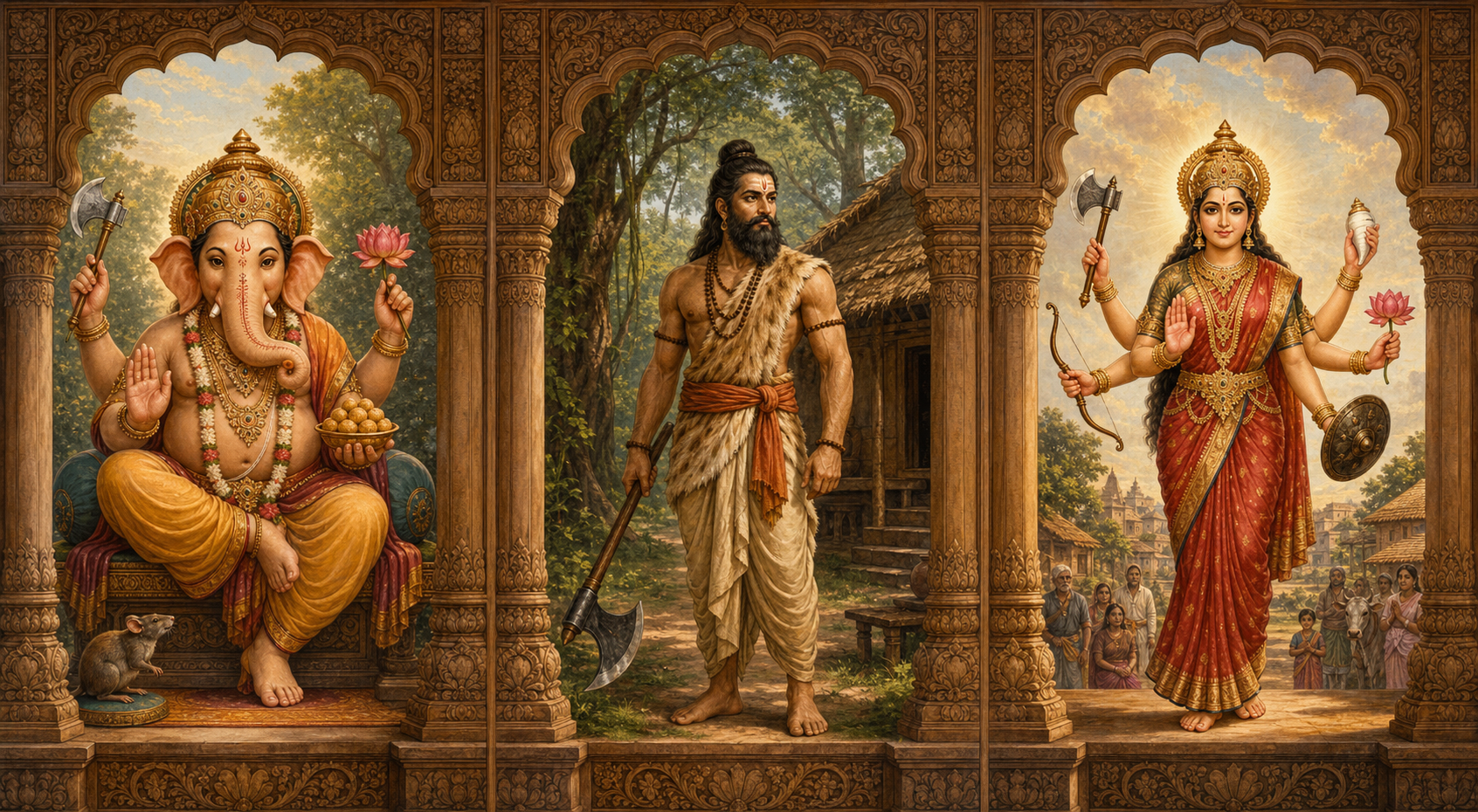
“The axe symbolizes the removal of obstacles” is correct in a Ganesha image, but inadequate as a definition of every parashu. Hindu attributes function within relationships. First identify the bearer; then read the other objects, gesture, posture, and narrative setting.
| Bearer or setting | What you should notice | Primary theological emphasis |
|---|---|---|
| Parashurama | The axe functions as an identity-bearing attribute, not a minor accessory. | Martial power must submit to penance, discipline, justice, and rightful succession. |
| Shiva, Virabhadra, or Bhairava | The parashu may appear beside other Shaiva attributes, especially in a forceful protective form. | Decisive severance of corruption, ego, decay, or an assault upon sacred order. |
| Ganesha | A small axe may accompany the ankusha, pasha, and modaka in four-armed or eight-armed forms. | Cutting entrenched obstacles and habits as one part of a larger discipline of guidance and gathering. |
| Devi or Durga | The axe appears among several weapons received from divine powers. | Precise protection of collective well-being through Shakti, rather than indiscriminate aggression. |
Parashurama: force that must know when to yield
Parashurama, the sixth avatara of Vishnu, is so closely joined to the weapon that the parashu enters his name and identity. His cycle includes penance before Shiva, the gift of the axe, conflict with Kartavirya Arjuna or Sahasrabahu, and the redress of injustice against his parents. These episodes place formidable martial capacity beside obedience, austerity, and accountability.
The meeting between Parashurama and Rama in the Ramayana’s Bala Kanda is especially important for interpreting the axe. It prevents us from treating Parashurama as a celebration of permanent militancy. The encounter marks a test of rightful standing and the transfer of martial ascendancy to Maryada Purushottama. In other words, dharmic force must recognize a more fitting bearer of order when the time comes.
Parashurama’s appearances around the Mahabharata add another dimension. As guru and examiner in narratives involving Bhishma and Karna, he tests whether skill is matched by truthfulness, humility, readiness, and fidelity to the discipline of combat. The axe does not certify virtue merely because its bearer is powerful.
Traditions of the Konkan and Kerala remember Parashurama throwing his axe and reclaiming coastal land from the sea. Whether you encounter this in temple memory, pilgrimage geography, or regional folklore, the narrative turns cutting into the opening of habitable space. The axe does not only end an old condition; it establishes ground on which community and law can stand.
Shaiva forms: decisive action under sacred authority
Shiva is more immediately recognized by the trishula, but the parashu belongs to a different aspect of Shaiva meaning. The trident evokes tripartite knowledge and cosmic order. The axe emphasizes the act that order may demand: severing a hardened obstruction quickly and completely.
In images of Virabhadra and some Bhairava forms, the weapon intensifies a protective or corrective presence. Do not translate that intensity into ordinary anger. Iconographic ferocity is controlled by the deity’s function within the narrative. Ask what violation has occurred and what boundary must be restored. Without that context, the image can be mistaken for a glorification of fury when it is actually a warning that sacred order cannot survive unlimited violation.
Ganesha: cutting is only one part of removing an obstacle
Ganesha gives the parashu its most immediately personal reading. Here the axe cuts an obstruction or an obsolete habit, but it should not be isolated from the other attributes. The ankusha directs. The pasha restrains or gathers. The parashu severs what cannot be guided into place. Together they show that compassionate discipline uses more than one method.
This offers you a practical way to contemplate a Ganesha image. Do not ask only, “What do I want removed?” Ask whether the difficulty calls for direction, restraint, patient gathering, or a clean break. Calling every discomfort an obstacle can turn the axe into a symbol of avoidance. The icon instead asks for discrimination between a duty that is difficult and an attachment that has become harmful.
Devi: many powers gathered for exact protection
In the Devi Mahatmya cycle, the gods contribute their ayudhas to the Goddess. The parashu therefore appears within an assembled field of divine capacities. In the hands of Durga and related forms such as Katyayani or Bhairavi, it represents Shakti acting with the exact force required to remove a threat to collective well-being.
The plurality of weapons matters. No single instrument exhausts the Goddess’s power, and no single mode of response is suitable for every danger. The axe contributes its particular logic: a corrupting or violent force may reach a point at which containment is insufficient and separation becomes necessary. The image still places that action within a larger cosmic purpose, not personal appetite.
Context changes the silhouette, not the ethical question
Canon, workshop, and region shape what you see
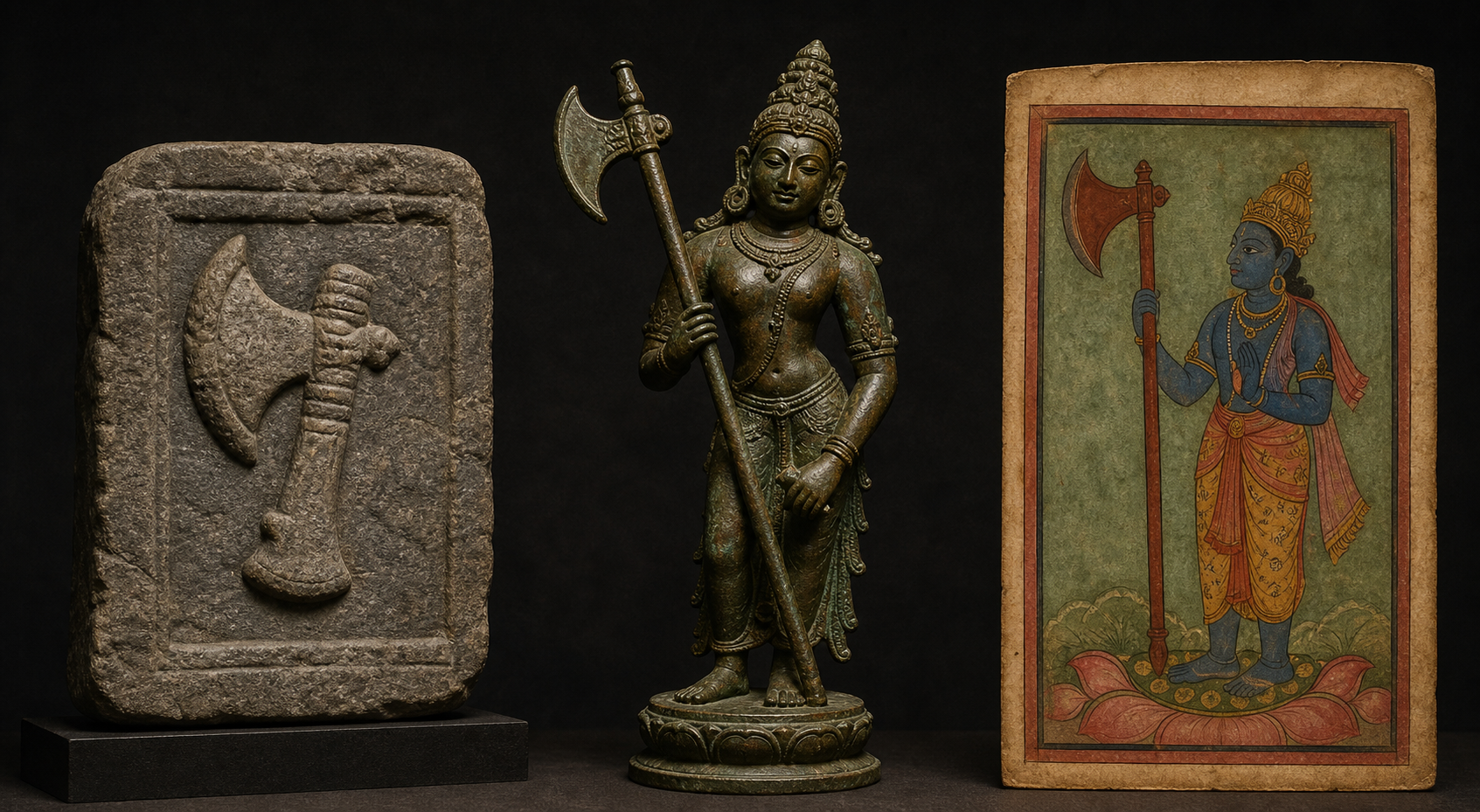
Texts associated with architectural and sculptural practice, including the Manasara, Mayamata, and Shilparatna, preserve conventions for rendering divine attributes. Yet the prescriptions vary by school and region. Treat them as disciplined traditions rather than a single universal diagram. A compact head, clear blade arc, and position that keeps the deity legible are recurring priorities, but proportion and ornament can change.
Regional style gives the parashu a visual accent. Chola bronzes often favor a lean crescent blade and smooth counterweight. Hoysala soapstone carving can deepen the relief and sharpen architectural detail along the edge. Pala-Sena works may enlarge the blade’s beard while compressing the haft. Odisha’s Kalinga idiom can emphasize an expressive curve along the spine. Khmer images associated with Angkor adapt Ganesha’s axe to a local sculptural vocabulary. These regional variations in the parashu’s profile help you look closely, but they should not be used alone to date or attribute an image.
A reliable reading therefore moves from broad to narrow. Confirm that the object is an axe. Identify the deity and accompanying attributes. Consider the relevant narrative. Only then use regional style to refine the reading. Reversing that order encourages confident mistakes, especially when a blade is damaged or a detachable bronze implement is missing.
Axes on hero stones and memorial reliefs add a related but distinct context. There the weapon can record martial defense and communal memory rather than serve as a divine attribute. The continuity still matters: agrarian work, protection, sacrifice, and sanctum imagery belonged to overlapping cultural worlds. But an axe-bearing human figure on a memorial should not be assigned the theology of Parashurama or Ganesha without additional evidence.
Ritual turns possession of power into responsibility
During Ayudha Puja in the Navaratri cycle, and in observances associated with Vishwakarma Puja, weapons and tools may be cleaned, adorned, and honored alongside implements of craft and learning. This does not worship violence or machinery for its own sake. It acknowledges that every capacity to cut, build, calculate, teach, or defend carries an obligation concerning how it will be used.
The ritual setting prevents the parashu from becoming a free-floating emblem of toughness. A consecrated implement is not simply “mine”; it is placed under dharma. Skill must accept discipline. Strength must protect more than pride. Even necessary force must aim at the recovery of order rather than the endless humiliation of an opponent.
Dharmic parallels should be compared without flattening them
The symbolism of severance reaches beyond Hindu iconography, but the objects and doctrines are not interchangeable. The kartika of Vajrayana Buddhism is a chopper whose symbolism includes cutting attachment. Jain traditions give primacy to ahimsa while preserving the inward language of cutting karmic bondage through austerity. Sikh martial heritage includes the tabar, a battle axe associated with the responsibility to protect the vulnerable within dharam yudh.
You can recognize a family resemblance without claiming that all these traditions teach the same thing or descend from one identical symbol. The shared question is discernment: when does separation liberate, when does force protect, and what discipline prevents cutting from becoming cruelty? Each tradition answers through its own theology, ethics, and practice.
Key takeaways
- Identify the parashu by its broad crescentic or bearded cutting edge, compact head, haft, and possible counterweight; do not confuse it with the narrow hook of an ankusha.
- Let the bearer determine the first layer of meaning: Parashurama, Shaiva forms, Ganesha, and Devi use the same weapon within different theological relationships.
- Read neighboring attributes and narrative context before assigning a symbolic definition. An isolated “axe equals destruction” reading is almost always too crude.
- Use regional style to refine identification, not to replace it. A missing bronze attribute or damaged stone blade can make certainty impossible.
- Judge the symbolism by what the cut preserves. In a dharmic reading, legitimate severance removes an obstruction or threat while safeguarding duty, dignity, compassion, and the possibility of restored order.
The next time you encounter a parashu, pause before naming its meaning. Trace the blade, identify the hand, inspect the companion attributes, and recall the bearer’s story. Then ask the question the axe places before both deity and devotee: what truly needs to be severed, and what must remain unharmed?