
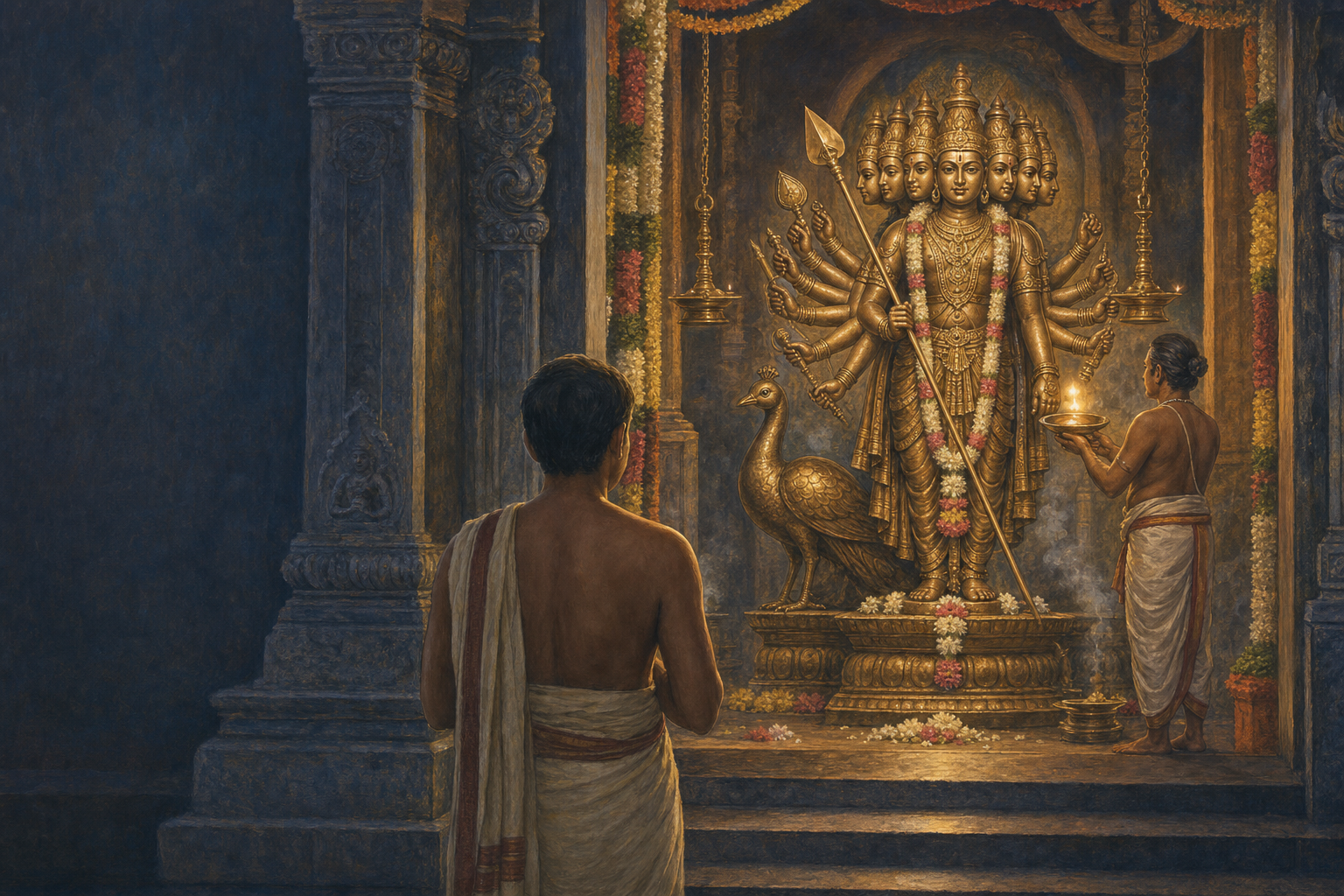
You may be standing before a six-faced Murugan, looking at a deity with several arms, or trying to understand why a goddess becomes a mare and leaves a shadow in her place. The immediate question – ‘What does it symbolize?’ – is useful, but incomplete.
A Hindu divine form is not a puzzle whose picture can be discarded once you find the answer. Sacred story, theology, visual convention, regional memory, worship, and inner discipline can all meet in the same form. If you learn to separate those layers without tearing them apart, you can interpret confidently while avoiding two common errors: calling the form merely symbolic, or presenting every attractive association as an ancient scriptural teaching.
Begin with presence, not a choice between literal and symbolic
The usual modern choice between ‘literal’ and ‘symbolic’ is too narrow. A divine form can belong to a narrated event, embody a cosmic power, communicate a theological claim, and serve as a living focus of devotion. These functions do not cancel one another.
Calling a murti symbolic can be valid if you mean that its visible features disclose meanings beyond ordinary appearance. It becomes misleading when ‘symbolic’ is used to mean imaginary, interchangeable, or spiritually disposable. For a devotee, the form is not simply a diagram placed between the worshipper and an abstract truth. It is the form through which relationship, darshan, mantra, offering, and remembrance become possible.
The opposite mistake is to treat sacred art as ordinary portraiture. Six faces do not require the claim that a divine body is limited in the same way as a human body. Hindu iconography can enlarge the body to express an enlarged range of awareness and action. Shanmukha’s faces, for example, can present a gaze extending through the four cardinal directions as well as above and below. The unusual body is part of the teaching.
Multiplicity also has to be read within Hinduism’s grammar of one reality approached through many names and forms. Rig Veda 1.164.46 expresses it succinctly: ‘Truth is one; sages call it by many names.’ The Sanskrit word deva is connected with div, ‘to shine’; a deva can therefore be understood as a luminous cosmic power and as a personal divinity approached through devotion.
This does not make every deity a replaceable label. An Ishta-devata, or chosen form, gives a practitioner the concentration and intimacy required for sustained sadhana. Bhagavad Gita 4.11 and 7.21 affirm that the Divine meets worshippers through the modes and forms in which they approach with faith. You can therefore go deeply into one form without dismissing the others. Unity provides coherence; distinction makes relationship possible.
Read the whole visual sentence, not one startling feature
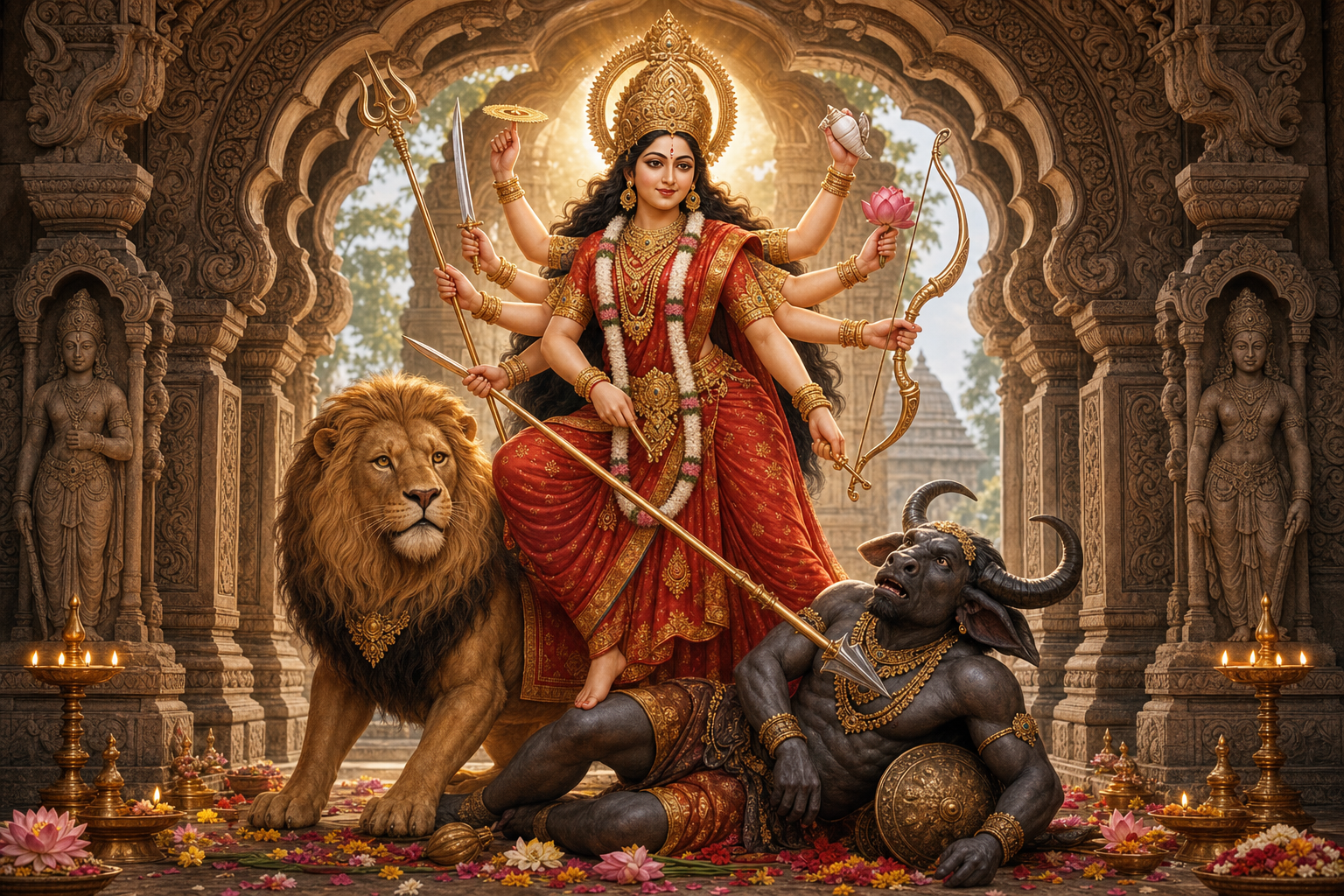
A murti speaks through relationships among features. Count the faces, but also notice what they face. Identify a weapon, but also ask who holds it, in which hand, and toward what purpose. Observe the vahana, companions, posture, banner, and setting. An interpretation built from one isolated detail will usually be thinner than the form itself.
| Visible feature | Question to ask first | Common overreach |
|---|---|---|
| Several heads or faces | Does a birth narrative, spatial scheme, or named function explain the number? | Assuming every extra face is only a psychological faculty. |
| Hands, mudras, and held objects | What is the exact gesture or object, and what does it do in this deity’s tradition? | Assigning a generic meaning before identifying the object. |
| Vahana, banner, or animal form | What relationship does it have to the deity’s story, power, and worship? | Treating it as decoration or a universal personality test. |
| Companions and family | What does the relationship reveal about the deity’s place in a larger cosmic order? | Reading the figure as if it stood alone. |
| Repeated number | Where else does that number appear in narrative, cosmology, mantra, pilgrimage, or practice? | Claiming that every matching list has the same origin or authority. |
A reliable sequence is to read nouns, then verbs, then relationships. First name what is visibly present: six faces, a spear, a peacock, a rooster emblem. Next ask what each element does: the faces see, the spear pierces, the mount carries, and the banner identifies. Finally ask what relation the complete form establishes among the deity, the cosmos, the devotee, and the problem being overcome.
Precision matters because Hindu sacred art is not assembled at random. In the case of Shanmukha, Agamic and Shilpa Shastra traditions regulate features such as proportions, gestures, stance, weapons, and mount. That does not mean every regional image looks identical. It means you should identify the particular form before assigning meanings to it.
The name is part of that identification. Kartikeya, Skanda, Subrahmanya, Kumara, Shanmukha, and Murugan refer to the same widely venerated divine figure, but a Tamil Murugan shrine may foreground associations that are less prominent in a northern representation of Kartikeya. Begin inside the vocabulary of the community that worships the form. Comparison becomes more accurate after that first act of attention.
Label each interpretive layer before making a claim
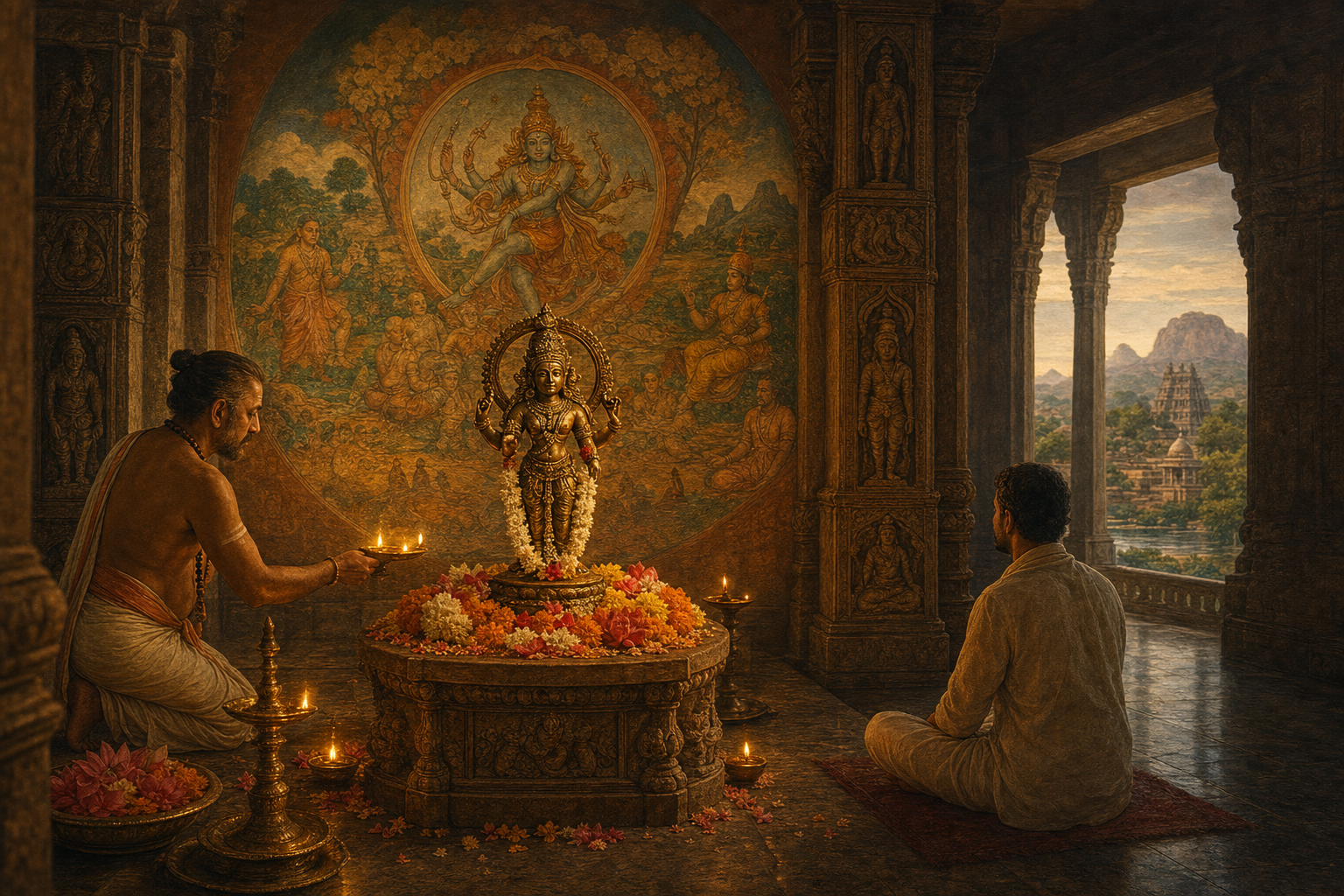
Several interpretations can be meaningful without having the same historical status. The practical discipline is simple: name the kind of interpretation you are offering.
- Narrative: a sacred story directly accounts for a feature, relationship, birth, weapon, or transformation.
- Iconographic: a visual convention gives the feature a recognized role within temple art or a particular ritual system.
- Theological: a darshana or sampradaya explains what the form reveals about the Divine, the cosmos, and the self.
- Exegetical: teachers connect the form to a philosophical, ethical, yogic, or mantric scheme, sometimes long after the earliest narrative.
- Contemplative: a worshipper uses the form to examine conduct, attention, attachment, courage, or another aspect of sadhana.
A later interpretation is not worthless because it is later. It may be philosophically exact and spiritually fruitful. But it should not be introduced with the phrase ‘the scriptures say’ unless you can name the relevant text and passage. Shanmukha’s six faces are sometimes connected with the six classical darshanas – Nyaya, Vaisheshika, Samkhya, Yoga, Mimamsa, and Vedanta. That is a powerful vision of intellectual integration, but it is better identified as a later exegetical reading than as a verbatim statement from the Puranic birth narrative.
The same care applies when moving between traditions. Advaita Vedanta distinguishes nirguna Brahman from saguna Ishvara while treating a divine form as a valid focus of meditation and worship. Vishishtadvaita places the many within the reality and auspicious fullness of Narayana. Dvaita maintains the distinction between the personal Supreme and finite selves. A sentence about what a murti ‘really is’ may therefore express one school’s metaphysics rather than a neutral definition accepted in precisely the same way by every Hindu lineage.
Nor should visual plurality be mistaken for a census of competing gods. The familiar claim that Hinduism has 330 million gods partly reflects the changing semantic field of koti. In older classifications, it can carry the sense of a class or type. The structured group of 33 devas consists of 12 Adityas, 11 Rudras, eight Vasus, Indra, and Prajapati. Brihadaranyaka Upanishad 3.9 moves pedagogically from many devas to 33, then to progressively fewer, and finally to one. The reader is being guided from experienced diversity toward underlying unity, not handed an arithmetic inventory.
Your interpretive rule should therefore be: understand a form’s distinct identity before placing it within a universal synthesis. If you begin with sameness, you erase the details that carry the teaching. If you stop at difference, you miss the larger coherence that permits many forms to be honored without contradiction.
Two worked readings show how the method changes
Shanmukha: begin with the six mothers, not a favorite list
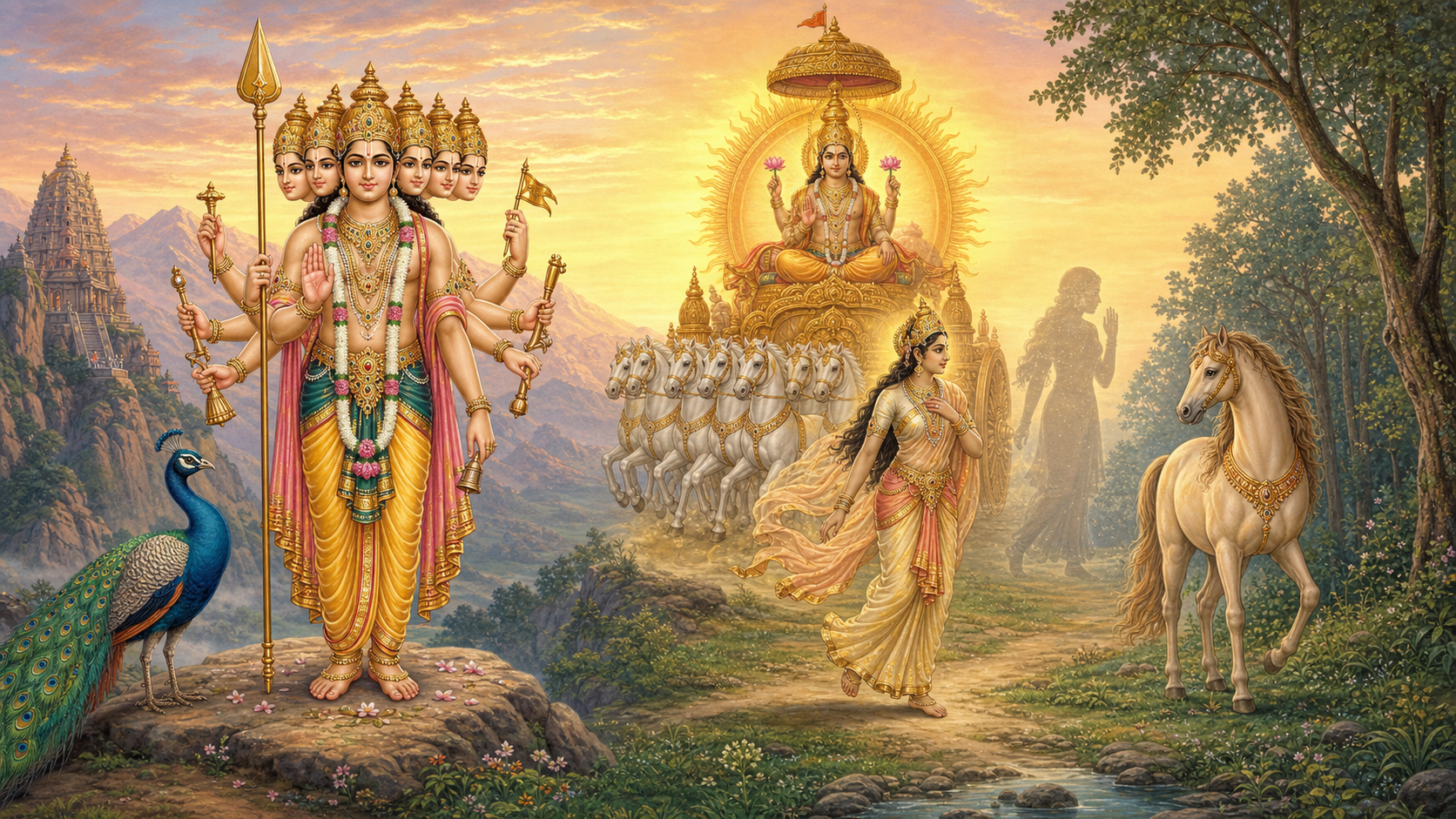
Begin with what can be seen: six faces, twelve arms, the Vel, the peacock vahana, and the rooster emblem. Then turn to the narrative anchor. Shiva’s fiery energy is carried through Agni and Ganga to Saravana Poigai. Six radiant infants appear on six lotuses and receive the care of the six Krittikas. Parvati gathers them into one child with six faces. The form thus remembers both sixfold birth and complete unity.
This narrative should lead when you are explaining why the deity is called Shanmukha. It also keeps the number connected with the Krittikas and the Pleiades. A spatial reading adds another layer: the faces survey east, west, north, south, above, and below. The deity’s expanded vision communicates protection and awareness throughout the full field of space.
Further readings give the sixfold form different uses. The six darshanas make it an image of philosophical breadth. Kama, krodha, lobha, moha, mada, and matsarya – desire, anger, greed, delusion, pride, and envy – make it a discipline of vigilance toward the six inner adversaries. The five senses together with manas turn it into a model of integrated cognition. Six principal adharas make it a yogic map in some Shaiva and Shakta settings. The six syllables of Saravanabhava connect sound and form, while the six Arupadai Veedu connect theology with Tamil sacred geography and pilgrimage.
These layers should not be piled up as if quantity proved accuracy. Choose the layer appropriate to the situation. In a historical explanation, lead with the birth narrative and label later mappings. In an ethical reflection, the six inner adversaries may be the most useful lens. In a yogic setting, identify the lineage in which the adhara interpretation operates. During darshan, you do not need to recite every possible correspondence. You might let the six faces call your attention to an impulse you have ignored, and let the Vel represent the discernment required to confront it.
The Vel is especially instructive. Within Tamil Siddha and Shaiva-Siddhanta readings, it can express incisive wisdom that pierces inner knots. That meaning fits the spear’s visible action: it penetrates rather than decorates. Form and interpretation reinforce one another.
Saranyu: read movement, kinship, and transition as form
Not every divine form is best known through a widely installed classical murti. Saranyu’s early Vedic presence is spare, and her meaning emerges strongly through her name, relationships, motion, and later narrative development. Her name is connected with the root sar, ‘to move, flow, or go,’ giving the sense of the swift one. She is the daughter of Tvastr, the divine artisan, and the wife of Vivasvat, the solar deity.
Later tellings often align Saranyu with Sanjna and Tvastr with Vishvakarman. Unable to bear Vivasvat’s scorching radiance, she departs and leaves Chaya, ‘shadow,’ as a substitute. Saranyu assumes the form of a mare; Vivasvat takes the form of a stallion; and their union brings forth the Ashvins, the swift healing twins associated with the thresholds of day. Across these variations, movement, solar brilliance, crafted form, and timely transformation remain connected.
Here the interpretive work begins with a relationship rather than an extra arm or head. Tvastr contributes formation, Vivasvat illumination, and Saranyu movement. Together they disclose rta not as frozen order but as a right pattern sustained through correctly timed change. Chaya can then be contemplated as a derivative presence: functional, but not an enduring replacement for the living original.
That last step should be labeled honestly. Using Chaya to examine ethical or ritual autopilot is a contemplative application; it does not reduce the goddess to a psychological metaphor. The application remains faithful when it preserves the larger pattern of the narrative: authentic presence withdraws, a shadow continues the role, and a necessary movement eventually restores a fuller order.
You can put this reading into practice at an actual threshold. At dawn, before beginning your usual activity, ask three questions: What needs to move today? At what pace? In what sequence? A measured walk, attentive breathing, study, or an act of service can then become a small discipline of timely movement. The point is not to imitate a mythic episode. It is to let the form train your sense of when motion serves order and when speed becomes mere agitation.
Key takeaways: use six questions at your next darshan
- What is the precise form? Name the deity, epithet, region, temple tradition, and visible variation before generalizing.
- What is actually present? Inventory faces, hands, gestures, objects, posture, vahana, companions, direction, and repeated numbers before assigning meanings.
- What is the narrative anchor? Find the story that accounts for the form, and distinguish an early witness from later elaboration where the distinction is known.
- What kind of interpretation is this? Label it as narrative, iconographic, theological, exegetical, regional, or contemplative.
- Does the reading fit the whole form? A strong interpretation explains relationships among several features without ignoring inconvenient details or contradicting the worshipping tradition.
- What should change in your practice? Choose one appropriate response: a mantra, a question for self-examination, a disciplined action, closer study, or more attentive participation in worship.
Be cautious whenever an explanation relies on ‘always,’ ‘merely,’ or an unnamed appeal to scripture. Hindu forms can sustain several compatible meanings, but compatibility is not a license for arbitrary invention. A responsible interpretation shows its visible evidence, identifies its traditional setting, and states the level at which it is being offered.
The next time a divine form arrests your attention, spend the first minute observing without decoding it. Then write or speak a two-sentence interpretation: one sentence naming the visible and narrative evidence, and one naming the spiritual demand it places on you. If you cannot yet identify the evidence or the interpretive layer, hold the idea as a possibility and keep looking. That restraint is not uncertainty before the sacred; it is part of learning to see.
References
- DharmaRenaissance Blog – Saranyu, Daughter of Tvastr: The Swift Vedic Goddess of Transformation and rta
- DharmaRenaissance Blog – Hinduism’s ‘330 Million Gods’ Demystified: Unity, Ishta, and the Logic of Many Paths
- DharmaRenaissance Blog – Shanmukha’s Six Heads: Mythic Origins, Deep Symbolism, and Dharmic Philosophical Unity