
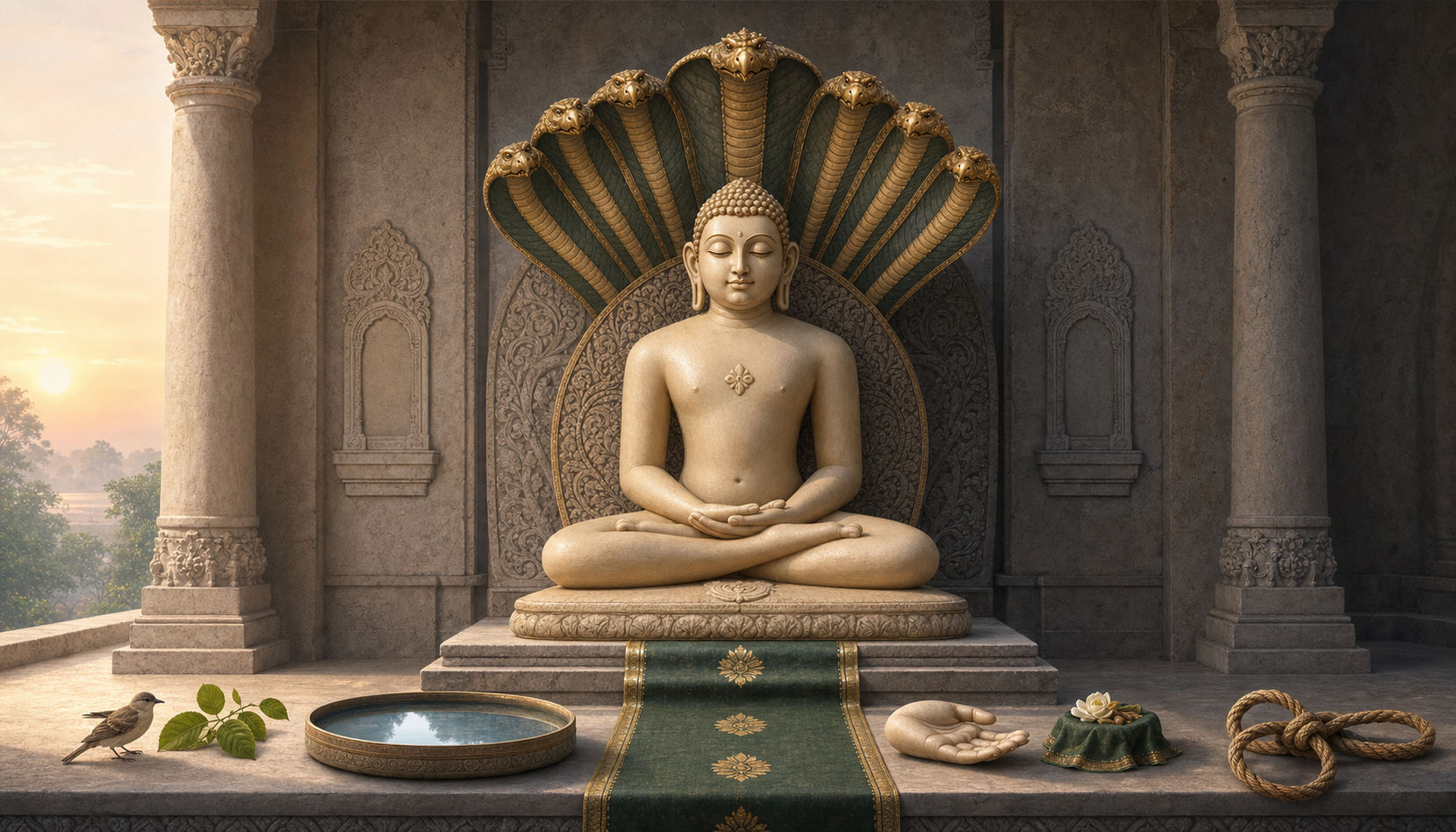
If you know Parshvanatha mainly by the many-headed serpent canopy above his image, the harder question still remains: why did his four restraints become foundational to Jain ethical life, and why did Mahavira’s community later speak of five vows? The answer reveals how a dharmic tradition can preserve its moral core while sharpening its discipline.
For you, the useful entry point is not a list to memorize. It is a way to examine a decision. Parshvanatha’s framework asks whether an act harms life, distorts truth, takes what has not been given, or deepens attachment. Those questions work together, which is why the four vows became more than four separate virtues.
Start with an ethical system, not an isolated teaching
Jain tradition reveres Parshvanatha as the 23rd Tirthankara and places him before Mahavira. Traditional chronologies place his life around the 9th-8th century BCE, while modern researchers generally locate him a few centuries before Mahavira and accept him as a historical teacher. The distinction matters: a traditional sacred chronology and a modern historical reconstruction do not make exactly the same kind of claim.
Archaeology should also be asked to prove only what it can. Some of the earliest recognizable Parshvanatha images come from Kushan-period Mathura, where the serpent canopy distinguished him from other Jinas. That consistency demonstrates established veneration and recognizable iconography; it does not, by itself, settle the precise dates of his lifetime. You can therefore respect the religious memory without pretending that every chronological question has been closed.
Parshvanatha’s central discipline was chaturyama-dharma: ahimsa, satya, asteya, and aparigraha – non-violence, truthfulness, non-stealing, and non-possessiveness. These were restraints, not merely admirable character traits. A restraint governs what you refuse to do even when desire, fear, convenience, or social approval pulls in the other direction.
The four vows also belong to a distinct Jain understanding of liberation. Jain thought distinguishes jiva, sentient being or soul, from ajiva, non-sentient reality, and understands karma as a subtle material influx that binds the soul. Stricter observance of the restraints lightens karmic bondage and clarifies the path toward moksha. Ethics is therefore not social polish added to spiritual life. It is part of the mechanism by which the soul ceases to be bound.
Each restraint closes a different route through which passion can govern conduct. Ahimsa confronts injury. Satya confronts distortion. Asteya confronts appropriation. Aparigraha confronts accumulation and attachment. An action can fail more than one test at once, so Jain ethics cannot be reduced to the question, Is this technically permitted?
Use the four restraints as one decision test

Ahimsa begins by noticing the life your action may affect
A defining narrative from Parshvanatha’s youth places ahimsa before formal renunciation. He saw serpents trapped in wood intended for an ascetic fire and intervened to prevent their destruction. The rescue anticipates both his teaching of non-violence and the serpent imagery later associated with him.
The practical lesson is sharper than a general instruction to be kind. Harm is often hidden inside an ordinary process. The person conducting the rite sees fuel; Parshvanatha sees living beings inside it. Before you send a harsh message, escalate a dispute, discard a usable object, or support a practice that burdens vulnerable life, ask who or what has disappeared from your field of attention. Ahimsa starts with making the unseen consequence visible.
This does not require pretending that a householder can eliminate every consequence from every action. It requires refusing casual harm. In speech, that may mean removing humiliation without concealing the truth. In conflict, it may mean addressing the wrong directly without trying to destroy the other person’s dignity. In consumption, it may mean choosing repair and restraint when replacement serves no genuine need.
Satya requires honest representation, not a convenient fragment
Satya asks whether your words and representations correspond to what you know. In digital life, the test applies before you forward an accusation, edit context out of an image, exaggerate a qualification, or present uncertainty as fact. If you later discover that you were wrong, truthful conduct includes correcting the record where the error was made.
Because the vows operate together, factual accuracy alone does not finish the inquiry. A true statement can still be selected and delivered for the purpose of humiliation. Satya asks whether you are being honest; ahimsa asks what you are trying to do with that honesty. The disciplined response is neither deception nor cruelty, but truthful speech stripped of the desire to injure.
Asteya extends to credit, permission, and digital property
Asteya prohibits taking what has not been given. The modern application is not confined to a physical object. Respect for intellectual property and transparent professional conduct belong naturally within the restraint. Copying another person’s work without permission or attribution, retaining money transferred by mistake, or charging for work not performed all depend on the same mental move: treating another’s property, labor, or trust as available for your use.
The corrective must be concrete. Return what was taken, supply the missing credit, seek permission, correct the invoice, or compensate the person who bore the loss. Private regret may begin an ethical response, but it does not complete one when another person still carries the consequence.
Aparigraha examines the attachment behind possession
For an ascetic, aparigraha points toward radical renunciation. For a householder, the discipline is expressed on a smaller and practicable scale through the minor vows. That difference in scope should not become an excuse to avoid the question. Before your next nonessential purchase, ask whether it meets a real need, whether something you already possess can be repaired, and whether status or novelty is doing most of the persuading.
Aparigraha also protects the other restraints. Attachment to reputation can tempt you to distort the truth. Attachment to acquisition can encourage appropriation. Attachment to victory can make injury feel justified. Non-possessiveness is therefore not only about the number of things in a room; it weakens the possessive impulse that recruits falsehood, taking, and harm in its defense.
When the vows seem to pull in different directions, do not select the easiest one and ignore the others. Adjust the action until it respects all four as fully as your situation allows. That integrated test is the ethical architecture Parshvanatha’s formulation gives you.
Mahavira’s fifth vow represents refinement, not rupture

Mahavira later consolidated the ascetic discipline and made brahmacharya, celibacy, an explicit fifth vow. The safest conclusion is also the most precise: brahmacharya became a separately stated restraint in Mahavira’s fivefold formulation. That fact alone does not tell us every detail of sexual discipline among earlier followers of Parshvanatha.
Two simplistic readings should therefore be rejected. One says Mahavira discarded an inadequate four-vow system and began again. The other says nothing meaningful changed because the traditions shared a liberating aim. Jain memory instead presents continuity with disciplined refinement: the moral lineage remained recognizable while its explicit formulation was sharpened.
The Uttaradhyayana Sutra gives this continuity narrative a human setting. Followers of Parshvanatha and disciples of Mahavira meet, discuss their practices, and reach reconciliation and mutual recognition. Difference does not have to end in either denial or schism. It can lead to clarification when both communities remain oriented toward the same liberating discipline.
This episode gives you a useful way to assess changes within a living dharmic tradition. First identify the enduring principle. Then identify what has become more explicit or more demanding. Finally, distinguish the discipline expected of an ascetic from the form practicable for a householder. If those levels are collapsed, refinement will look like contradiction and continuity will be mistaken for complete identity.
Parshvanatha’s place in Jain history is therefore formative rather than incidental. He stands in the lineage before Mahavira with a recognizable fourfold discipline; Mahavira receives and reorganizes that inheritance in a five-vow form. Jain ethics emerges here as a transmitted path capable of adaptation without surrendering its aim.
Bring the vows from ascetic teaching into household life
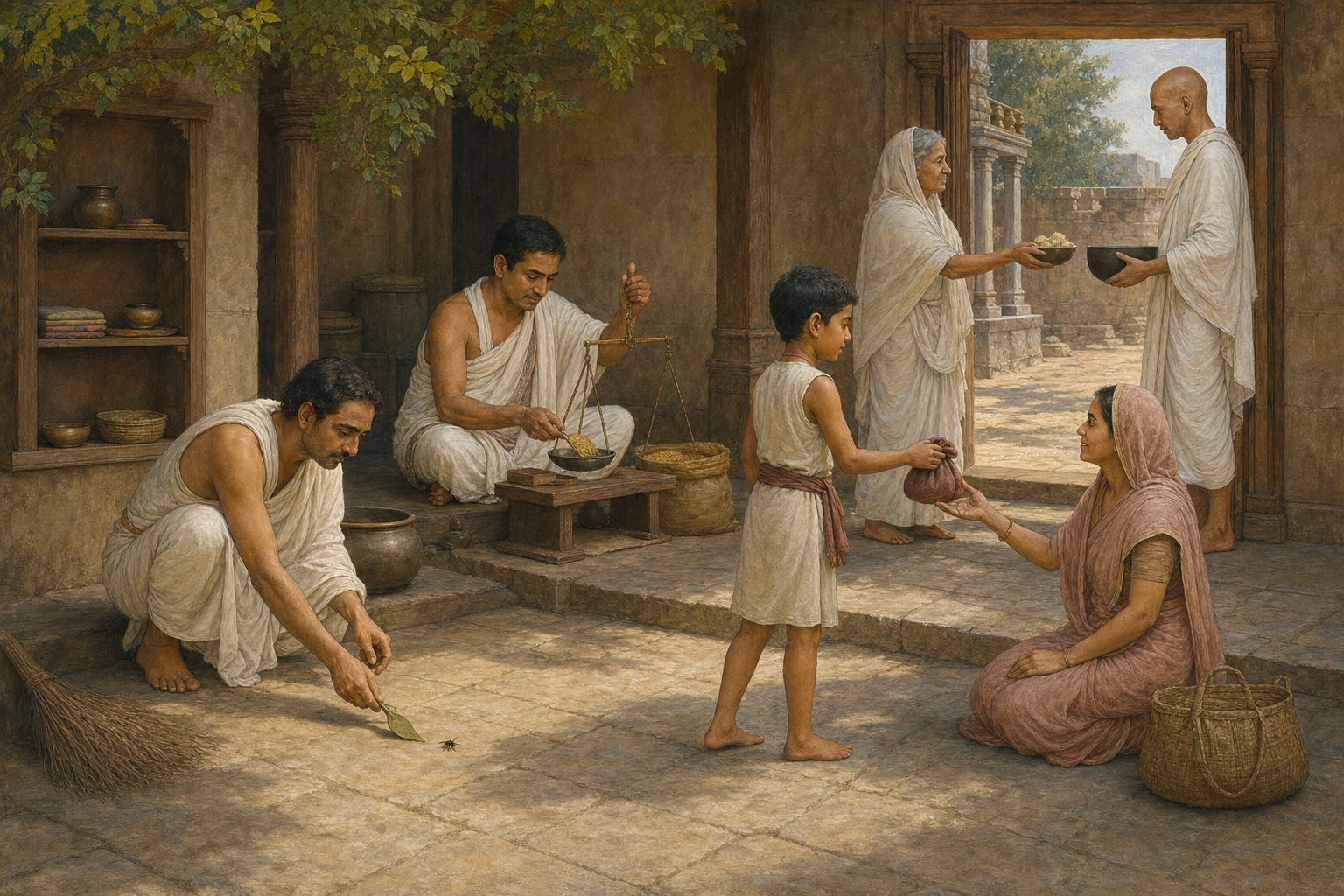
A householder is not expected to imitate monastic renunciation without regard for family and social obligations. Jain lay practice translates the vows into anuvratas, or minor vows. Samayik establishes periods of equanimity, while pratikraman provides a disciplined practice of reflection and atonement. The reduced scope makes observance possible in ordinary life; it does not turn the vow into a decorative ideal.
You can use that rhythm around a consequential choice. Before acting, pause long enough to name the possible harm, the truth that must not be distorted, what belongs to someone else, and the attachment influencing you. Afterward, review what actually happened. If you crossed a boundary, identify the breach precisely and make the repair that corresponds to it. Apologize for injury, correct a false statement, return or credit what was taken, or interrupt an unnecessary pattern of acquisition.
Consider the common decision to forward a damaging online claim. Satya asks whether it has been verified and whether uncertainty is clearly marked. Ahimsa asks what foreseeable injury the forwarding may cause. Asteya asks whether an image, private message, or creative work is being reused without permission. Aparigraha asks whether the desire for attention, group approval, or victory is driving the impulse. One click can implicate all four vows, which is precisely why a unified framework is more useful than an isolated rule.
The Navkar Mantra adds devotional orientation by honoring the Panchaparameshti: Arihantas, Siddhas, Acharyas, Upadhyayas, and Sadhus. Its focus encourages humility and ethical mindfulness rather than dependence on a transactional favor. If you belong to a Jain community, learn the formal forms of samayik, pratikraman, and mantra recitation from a qualified teacher within your lineage; the surrounding ethical questions can still guide each day’s choices.
Parshvanatha’s iconography can serve as another memory aid. Jain narratives connect the serpents he rescued with Dharanendra and Padmavati, who later protect him when Meghamalin directs a violent storm against his meditation. Parshvanatha remains unmoved in samadhi beneath Dharanendra’s serpent canopy. The ethical lesson is not that good conduct purchases immunity from difficulty. It is that compassion forms relationships of protection, while disciplined equanimity can remain steadier than the storm directed against it.
Ritual bathing, fragrant water, flowers, lamps, and mantra recitation vary among communities, but their ethical center remains character transformation rather than bargaining for external rewards. If devotion to Parshvanatha leaves your speech, consumption, honesty, and treatment of living beings untouched, the outward observance has not yet reached the conduct his vows regulate.
Readers from the wider dharmic family will recognize related moral languages: non-attachment in the Bhagavad Gita, non-violence and truthfulness among Buddhist precepts, and the Sikh emphasis on daya, honest work, and the welfare of all. These resonances can support dialogue across Hindu, Buddhist, Jain, and Sikh traditions. They should be used as bridges, not as reasons to erase real differences. The specifically Jain framework binds these restraints to the purification of jiva from karma and the movement toward moksha.
Key takeaways
- Parshvanatha’s fourfold chaturyama-dharma joins ahimsa, satya, asteya, and aparigraha into a single discipline of restraint.
- The vows examine different dimensions of the same action, so an honest choice may still fail through harm, appropriation, or attachment.
- Traditional chronology, modern historical reconstruction, and archaeological evidence answer different questions and should not be treated as interchangeable.
- Mahavira’s explicit addition of brahmacharya is best understood within Jain tradition as refinement of a continuing lineage, not rejection of Parshvanatha.
- Householders can embody the framework through anuvratas, equanimity, honest review, concrete repair, and mindful limits on consumption.
Take the next difficult decision in front of you and write four short answers: who may be harmed, what truth may be compromised, what is not yours to take, and what attachment is pressing for control. If a breach has already occurred, add the repair beside it and carry that repair out. That is a modest practice compared with ascetic renunciation, but it places Parshvanatha’s ethical architecture where it belongs: inside conduct.