
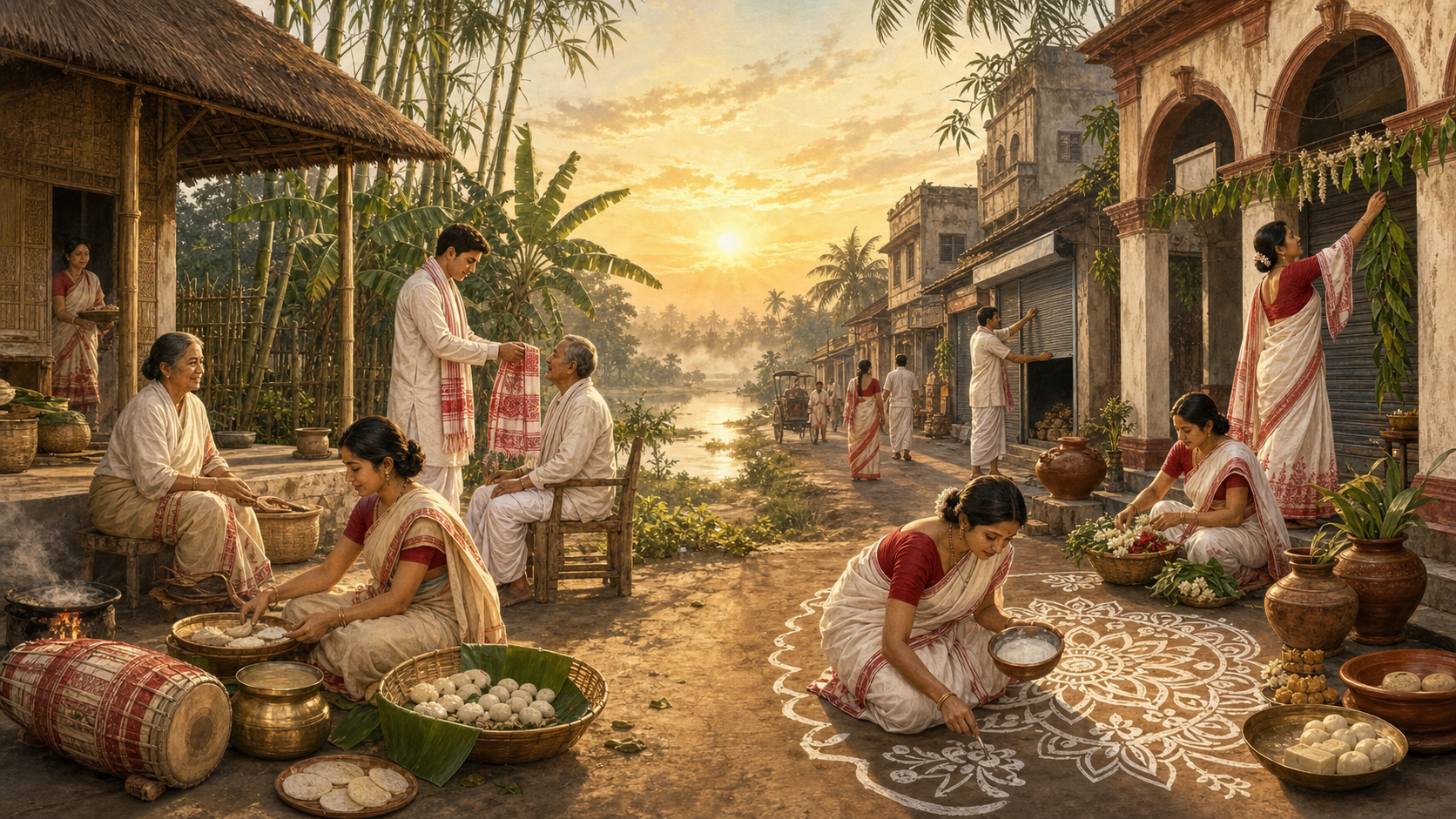
You have found two dates for the New Year in the same April week, and neither is necessarily wrong. A Bengali family in Dhaka may celebrate on 14 April, relatives in West Bengal may wait until 15 April, and an Assamese community may reserve several days around the same solar transition.
The practical answer is to follow the calendar used by the community you are joining. The deeper answer is even more useful: eastern India’s solar New Year is a shared civilizational threshold, not a single standardized festival. Once you understand what is shared and what must remain distinct, you can choose the right date, participate respectfully, and plan a celebration that carries more than decorative cultural symbols.
One solar threshold, several legitimate calendar dates
The common astronomical marker is Mesha Sankranti, the Sun’s sidereal passage from Meena Rasi to Mesha Rasi. It normally falls on 14 or 15 April and opens the first solar month in several regional calendars. Bengal calls that month Boishakh; Assam calls it Bohag. Odisha’s Pana Sankranti belongs to the same seasonal constellation, although the detailed practices considered here are Bengali and Assamese.
The word sidereal matters. These calendars relate the zodiac to the stars rather than treating the March equinox as New Year’s Day. The precise instant of Sankranti is calculated in regional almanacs, and the civil or ritual day assigned to it depends on local convention. You therefore cannot settle every date question merely by searching for the instant when the Sun enters Aries.
In traditional Bengali reckoning, the day begins at sunrise. Poila Baisakh is generally observed at the sunrise following Sankranti. Panjikas may use classical Siddhanta calculations or modern observational computations, and differences of several hours can occasionally move the observance to the next sunrise. This is why West Bengal observes Naba Barsha 1433 on 15 April 2026, while Bangladesh uses a reformed civil calendar that fixes Pahela Baishakh on 14 April.
Assam also places its New Year at the beginning of Bohag around Mesha Sankranti. Sunrise-based and Sankranti-based local reckoning can produce a small variation, but 15 April 2026 is the principal Manuh Bihu date. Goru Bihu normally precedes it and Gosai Bihu follows it, subject to the calendar used locally.
| Community or region | Main 2026 observance | Calendar rule | What you should do |
|---|---|---|---|
| Assamese Rongali Bihu | Manuh Bihu on 15 April, with observances around it | First of Bohag near Mesha Sankranti | Keep 14-16 April available and confirm the local sequence |
| Poila Baisakh in West Bengal | 15 April | Sunrise following Sankranti under the regional Panjika | Use the locally followed Panjika for puja and event timing |
| Pahela Baishakh in Bangladesh | 14 April | Fixed date in the reformed civil Bangla calendar | Plan civic and cultural programs for 14 April |
Key takeaways
- The shared anchor is Mesha Sankranti, but the assigned festival date depends on the regional calendar and its day-boundary rule.
- For 2026, use 15 April for the principal Assamese and West Bengali celebrations, while Bangladeshi civic observance remains on 14 April.
- Do not turn Rongali Bihu and Pohela Boishakh into interchangeable labels. Their solar timing is related; their ritual grammar is not.
- When a family custom, temple schedule, Panjika, and online calendar disagree, follow the living community whose observance you are attending.
Rongali Bihu begins with reciprocity, not performance
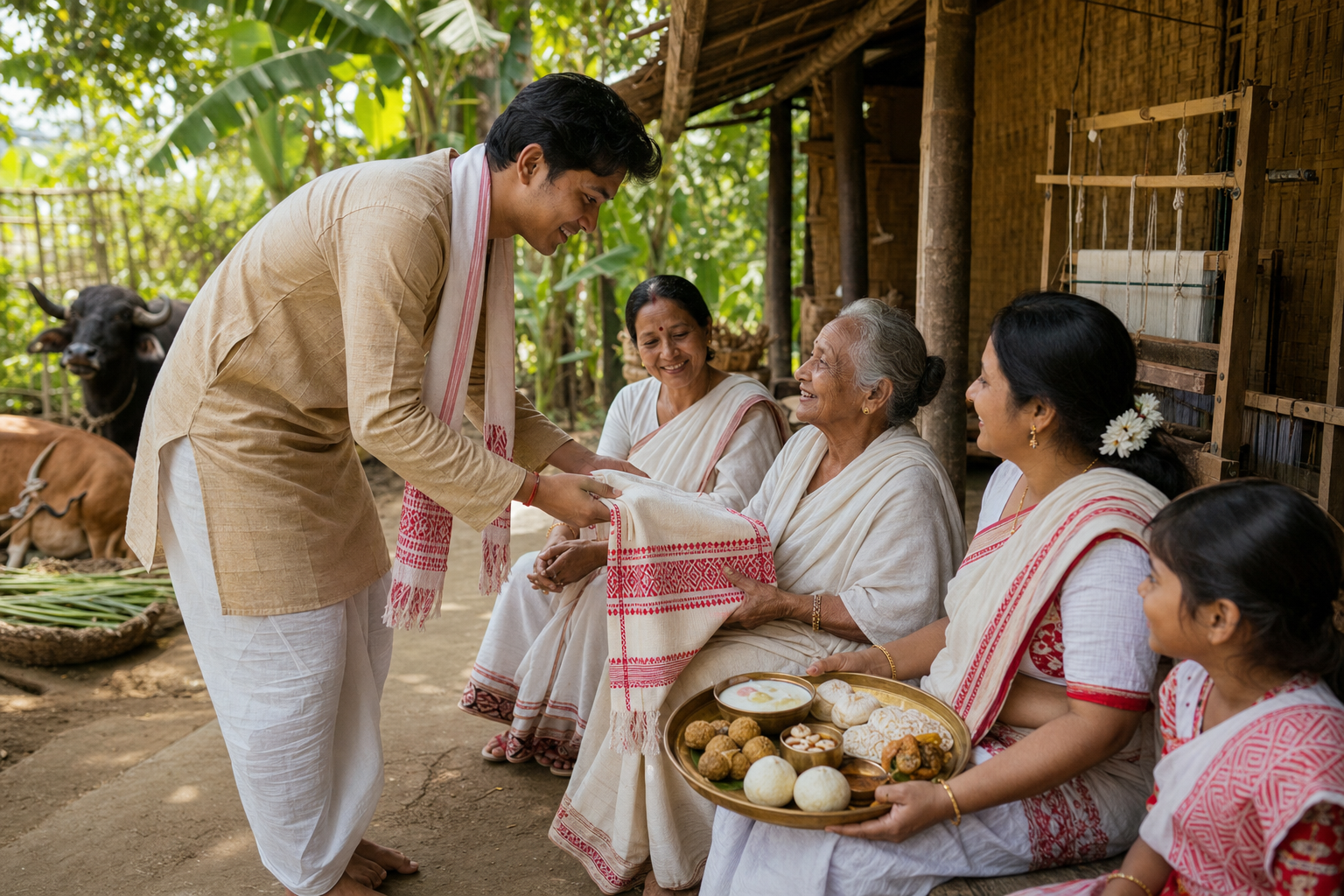
If your first encounter with Rongali Bihu is a public dance program, you may assume that dance is the festival’s center. It is central to the celebration, but the festival’s order reveals a larger Dharmic ethic. Renewal moves through the relationships that sustain life: animals and agriculture, people and community, and the household’s sacred presence.
Many contemporary celebrations concentrate on three days. Some districts preserve a more extended cycle that can include Raati Bihu, Chot Bihu, Kutum Bihu, Mela Bihu, and Sera Bihu. The names and ordering beyond the core vary, so a diaspora organization should not publish a supposedly universal seven-day timetable without checking the practice of the Assamese community leading it.
Goru Bihu: care for the beings that sustain the household
Goru Bihu is associated with cattle and agrarian wellbeing. Cattle are bathed, gently tended, and given fresh fodder. Affectionate verses wish them continued health and growth. The act recognizes that food does not begin in a shop or even in a kitchen. It begins in a field sustained by soil, water, animals, and human labor.
If you are a guest, notice the relationship before reaching for a camera. This is household and agrarian care, not a tourist demonstration. Participate only when invited, and ask before photographing animals, family rites, or the people performing them. If you live far from an agrarian setting, resist inventing a substitute and calling it Goru Bihu. You can support the principle through responsible care for animals and gratitude for food, while clearly identifying that as your own reflection rather than a reproduction of the Assamese rite.
Manuh Bihu: renew the human bonds
Manuh Bihu turns toward people. New clothing marks a fresh beginning; younger members seek elders’ blessings; and the gamocha, also given as a bihuwan, conveys honor and affection. If you want to bring a suitable gift, a locally woven gamocha has meaning that generic festival merchandise cannot supply. Buy it from an Assamese weaver or a community-recommended maker, and let your host guide its ceremonial use.
The day opens into collective expression through Mukoli Bihu, bihugeet, and husori. A husori troupe visits homes or gathering places with music, dance, and blessings for harmony and abundance. Women’s ensembles, known as mahila husori, also take part in contemporary celebrations. The recognizable sound comes from instruments including the dhol, pepa, gagana, taal, toka, and xutuli. When you attend, listen for the exchange between musicians and dancers rather than treating the instruments as stage props.
Hospitality often takes the form of jolpan. Chira with curd and jaggery, akhoi, and pitha such as til pitha, ghila pitha, sunga pitha, and tekeli pitha connect the festive table to grain, dairy, sesame, bamboo cooking, and household skill. If you organize a tasting, label each preparation and credit the person or community that made it. A tray of unnamed snacks may feed people, but it does little to transmit knowledge.
Gosai Bihu: place prosperity under sacred discipline
Gosai Bihu directs attention to household deities and the sacred protection of family life. Offerings may be arranged on a xorai, often with a gamocha, while prayers seek auspiciousness for the coming agricultural year. Vaishnavite devotion and collective hymns are part of the practice in many Assamese homes.
This sequence corrects a modern misunderstanding of prosperity. First comes care for the sources of livelihood, then the renewal of relationships, and then prayer that material wellbeing remain auspicious. If you are planning only a one-day community event, explain that the dance stage represents one visible part of a wider cycle. That single sentence helps younger participants understand why Bihu cannot be reduced to entertainment.
Pohela Boishakh renews the home, street, and marketplace
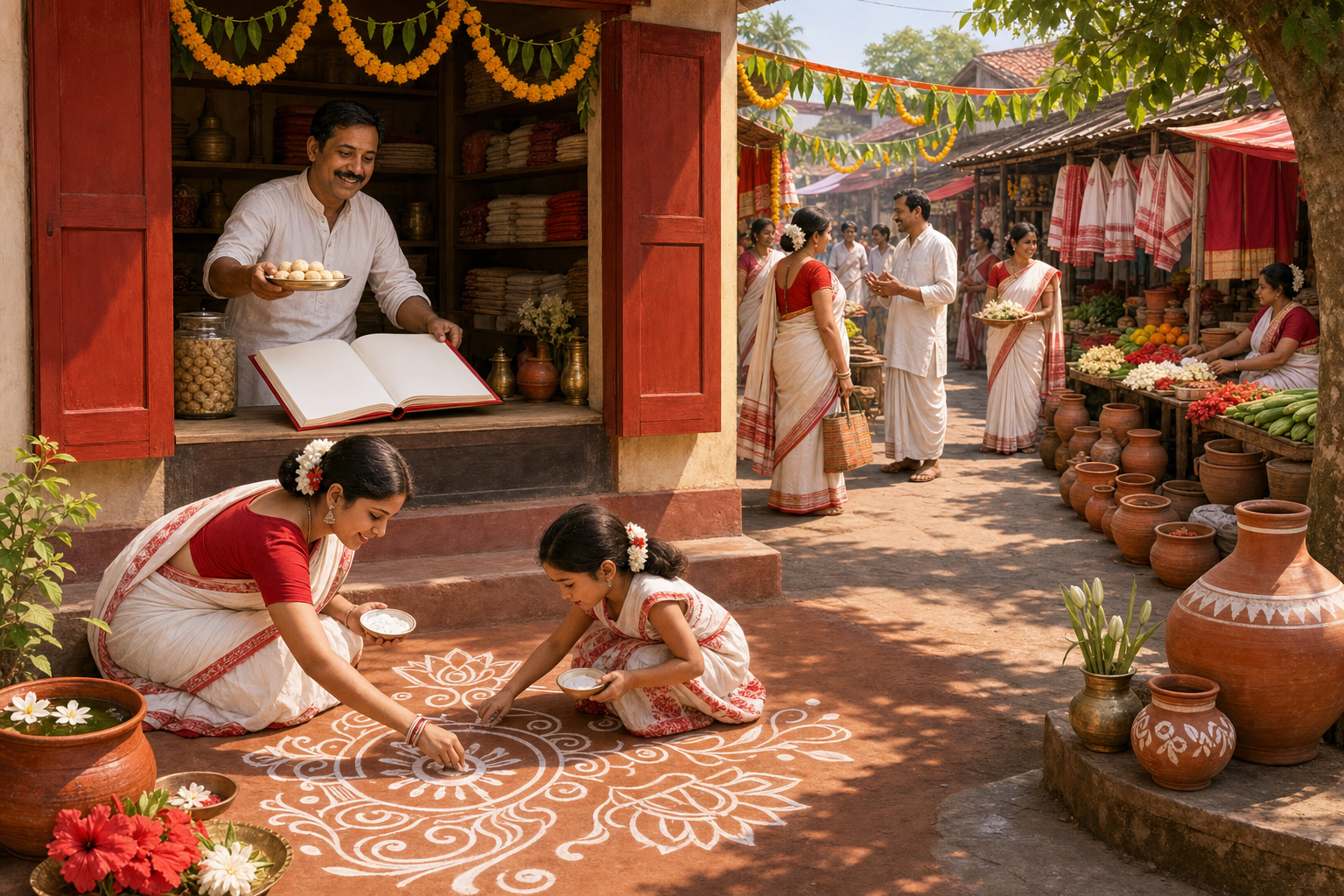
Bengali New Year works across several social spaces. The old year closes through household preparation and, in some communities, vows or public worship. The new year then moves from the decorated threshold to morning processions, puja, music, meals, and commercial relationships. You can participate in one part without pretending that every Bengali household follows an identical program.
Close Choitro before opening Boishakh
Choitro Sankranti is the final day of the outgoing month. Household cleaning, fasting, charity, and local fairs can form part of the transition. Charak Puja is also observed in several Bengali communities at this time, joining vows and penance to the ending of the old year.
A useful home observance begins here rather than with new clothes the next morning. Finish one neglected household task, identify an obligation you have carried into the new year, and make a concrete act of charity appropriate to your circumstances. These need not be presented as universal Bengali rituals. They are practical ways to take the closing of Choitro seriously instead of treating renewal as a change of decoration.
Welcome the morning through auspicious form
Poila Baisakh mornings can include prabhat pheri processions, the sound of the dhak, alpana at entrances, fresh clothing, and home worship of Lakshmi and Ganesha. Prosperity and clarity of purpose belong together here. The household asks not only for more, but for a worthy beginning and the capacity to use prosperity well.
Music carries this intention into public culture. Rabindra Sangeet, especially Esho He Boishakh, appears alongside Nazrul Geeti and Bengali folk repertoire. If you are creating a program, do not play a generic collection of vaguely eastern Indian music beneath unrelated visuals. Name the song tradition, provide the title and composer where known, and give the audience enough context to hear why it belongs to the day.
Halkhata makes commercial renewal an ethical act
Halkhata is the ceremonial opening of a new account book by traders and artisans. Customers may be invited to sign the fresh ledger and receive prasad. Digital bookkeeping has not made the rite meaningless, because its purpose is larger than the physical book: it renews trust between a livelihood and the community that sustains it.
If you run a business and want to adapt Halkhata responsibly, keep a ceremonial ledger rather than pretending your accounting software is the ritual. Review outstanding obligations before opening the new book, write an auspicious invocation appropriate to your family’s practice, invite established patrons without turning the gathering into a pressured sales event, and treat the moment as a commitment to honest dealing. The new page matters because conduct follows it.
Keep West Bengal and Bangladesh on their own calendars
In West Bengal, 15 April 2026 is the operative date for Poila Baisakh. In Bangladesh, 14 April remains the civic date for Pahela Baishakh. Families across borders may recognize the full 14-15 April window, but a public invitation should state which calendar it follows instead of presenting one date as a correction of the other.
Bangladesh’s Mangal Shobhajatra brings large masks, folk motifs, and handcrafted figures into a procession centered on collective wellbeing and resilience. UNESCO inscribed the observance on its Intangible Cultural Heritage list in 2016. That recognition belongs to this particular Bangladeshi cultural form; it should not be used as a loose label for every Bengali New Year parade.
Festival menus may include panta bhat with ilish, seasonal vegetables, luchi, mishti doi, and sandesh. No single menu defines every household. If you are hosting, name dishes accurately, provide choices appropriate to your guests, and avoid making hilsa a test of authenticity. Concern for river ecology and the sustainability of the fish belongs within the same ethic of renewal that the meal is meant to express.
How to plan a respectful community or diaspora celebration
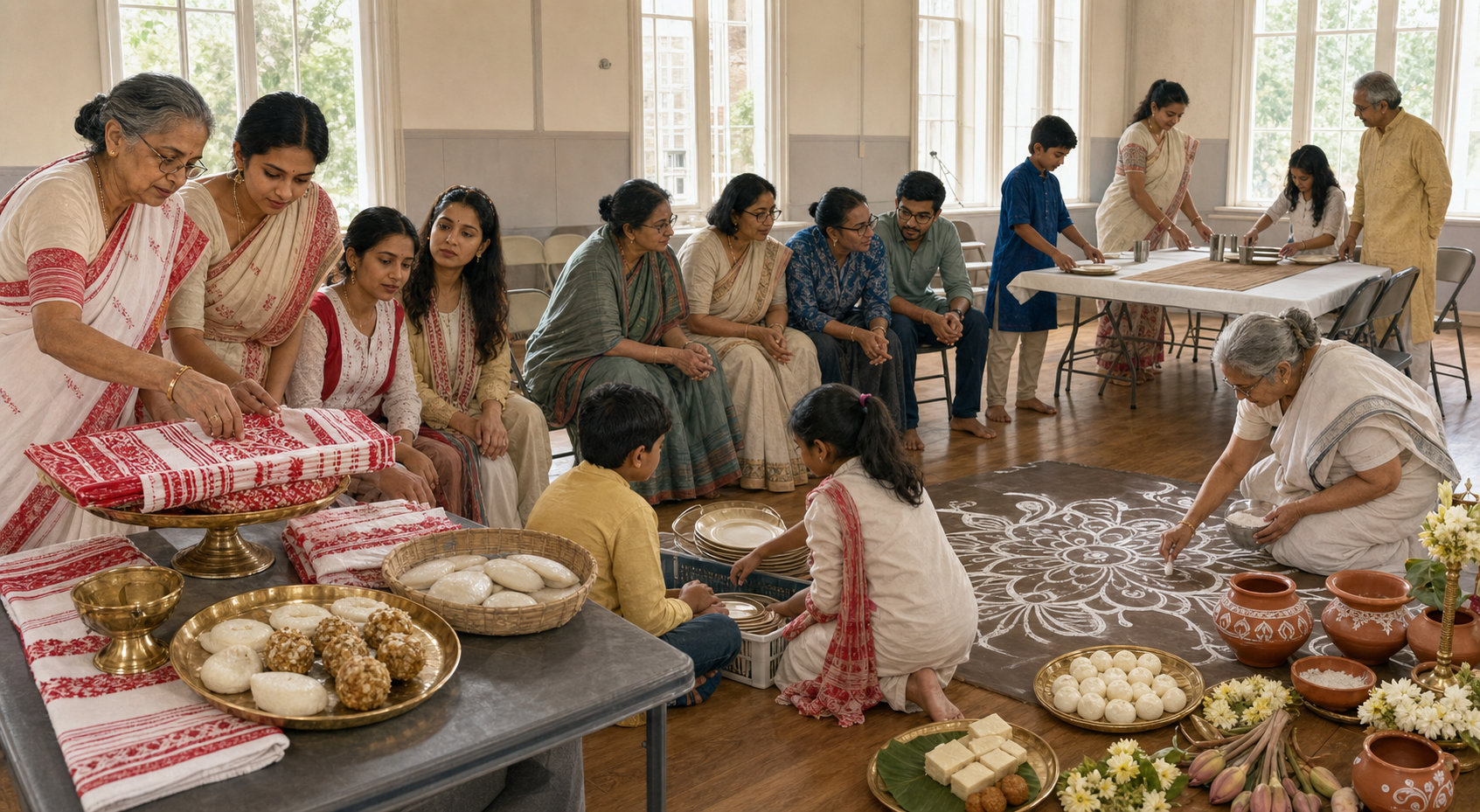
A community hall in Toronto, London, or New York cannot reproduce a Brahmaputra Valley household or a Kolkata neighborhood merely by assembling food, music, and red-and-white clothing. It can still transmit the tradition well. The decisive question is whether people who carry the practice have authority over its presentation.
- Choose the calendar before advertising. For 2026, reserve 14-16 April if you need to accommodate Bangladeshi, West Bengali, and Assamese participants. Publish the exact day assigned to each program.
- Name each observance precisely. Use Rongali Bihu or Bohag Bihu for the Assamese program, Poila Baisakh for West Bengal, and Pahela Baishakh for the Bangladeshi civic observance. A shared Mesha Sankranti introduction can connect them without erasing them.
- Give tradition-bearers control of ritual content. Ask Assamese participants to determine how a gamocha, xorai, husori, or Bihu performance is presented. Ask Bengali participants to shape the alpana, music, puja, procession, or Halkhata segment.
- Explain sequence, not just spectacle. A short account of Goru, Manuh, and Gosai Bihu adds meaning to a dance program. A short account of Choitro Sankranti and Halkhata places Bengali music and food inside a moral calendar.
- Set a photography rule in advance. Public stage performances and household rites are not the same setting. Tell visitors when photography is welcome and require permission around worship, performers, animals, and intimate family observances.
- Spend where cultural continuity is made. Purchase textiles from weavers, instruments or demonstrations from knowledgeable makers and musicians, and food from community cooks. Reusable decoration, low-waste service, and careful portions keep a nature-centered festival from producing avoidable waste.
If the schedule allows only one afternoon, do not compress every rite into a rapid cultural medley. Choose a clear frame: a joint opening on Mesha Sankranti, followed by separate Assamese and Bengali segments with their own hosts. Distinction makes the civilizational connection more credible, not less.
Families can use the same principle at home. Join the public celebration that corresponds to your community’s date, then choose one domestic act that carries its ethical center: seek an elder’s blessing, prepare and name a traditional dish, support a weaver, open a fresh ledger for honest work, care for an animal, or offer prayer at the household shrine. One understood act is better than a room full of disconnected symbols.
Shared Dharmic time does not require cultural sameness
Mesha Sankranti links eastern India’s New Year traditions to a wider April constellation that includes Pana Sankranti, Puthandu, Vishu, and Vaisakhi. The same solar turn can therefore be recognized across Hindu, Buddhist, Jain, and Sikh cultural worlds without claiming that every community performs the same rite or tells the same history.
What is shared is a pattern of attention. Nature and livelihood are treated as morally significant. Elders, relatives, customers, artisans, animals, and deities appear within the circle of renewal. Food and art are not diversions from spirituality; they are ways of making gratitude, memory, and reciprocity visible. Regional diversity is how this civilizational rhythm lives in actual communities.
For 2026, your first step is simple: ask which local calendar your hosts follow and keep 14-16 April open until they answer. Then build the day around one tradition’s real sequence rather than a generic idea of Indian festivity. You will arrive on the right date, but more importantly, you will know what the date asks you to renew.
References
- DharmaRenaissance Blog – Rongali (Bohag) Bihu 2026: Vibrant Assamese New Year Date, Seven-Day Cycle, Traditions
- DharmaRenaissance Blog – Pohela Boishakh 2026 (Naba Barsha 1433): A Comprehensive Guide to Dates, Rituals, and Heritage