

You can spend years collecting teachings and still remain caught by the same anger, fear, status anxiety, or confusion. The difficult question is not whether you know enough Sanskrit terms. It is whether your way of questioning is exposing ignorance or merely giving the ego a more spiritual vocabulary.
Dharmic inquiry has a practical arc: begin with a doubt that matters, identify the right means of knowing, listen carefully, reason without defensiveness, contemplate what has become clear, and test it in conduct. Questioning becomes spiritually fruitful when critical thought, contemplative assimilation, and ethical responsibility remain connected. That connection is what turns information into liberating knowledge.
Begin with the question beneath your question
A spiritual question becomes urgent when an inherited answer, an intellectual theory, and your actual experience no longer fit together. Arjuna’s crisis in the Bhagavad Gita is powerful for precisely this reason. He does not ask about dharma from a safe distance. His understanding of duty has broken down at the moment when he must act.
You do not need to manufacture that intensity. Start with the place where your life already resists your philosophy. Perhaps you affirm that the Self is not the body, yet criticism of your appearance controls your day. Perhaps you value ahimsa, yet your speech becomes cruel whenever you feel cornered. Perhaps you speak of impermanence but organize every decision around protecting a role that cannot last.
Turn that friction into a workable question. Replace a grand question such as What is ultimate reality? with something you can investigate:
- What am I taking myself to be in this moment?
- Which part of this experience is changing, and what is aware of that change?
- What belief is producing this fear or compulsion?
- What would I have to release if the teaching were true?
- Which dharmic responsibility becomes clearer when self-protection is no longer the only concern?
A question is not sacred merely because it concerns God, Brahman, karma, or liberation. Its sacredness lies in how you hold it. Nyaya distinguishes vada, truth-directed discussion, from jalpa, argument aimed at victory, and vitanda, attack without a constructive position. Apply that distinction inwardly. Are you trying to discover what is true, defend an identity, defeat another school, or postpone a change you already understand?
Three tests expose the difference. Can you state the opposing view fairly? Can you name what evidence or authority would alter your conclusion? Would a truthful answer change how you live? If every possible answer leaves your conduct untouched, you may be entertaining a topic rather than pursuing knowledge.
Rumination also disguises itself as inquiry. Rumination circles the same uncertainty without introducing a better reason, a relevant teaching, a contemplative test, or a change in conduct. When you notice that circle, do not generate another opinion. Write the exact unresolved proposition, identify what could resolve it, and move to the appropriate means of knowledge.
Match the question to the right means of knowing

Dharmic traditions do not treat every claim as if it could be settled in the same way. Classical discussions of pramana distinguish valid means of knowledge such as perception, inference, comparison, and reliable verbal testimony. Schools differ over their lists and applications, but the practical lesson is stable: use a means suited to the object you want to know.
| Question | Relevant way of knowing | Common error |
|---|---|---|
| What is happening in the observable situation? | Careful perception supported by sound inference | Replacing what can be checked with rumor, preference, or authority alone |
| What does a revelation concerning Brahman or liberation mean? | Scriptural testimony received through teaching, then examined through disciplined reasoning | Demanding that a supersensory claim become an ordinary sensory object, or suppressing every interpretive question |
| Am I identical with this passing thought, emotion, or role? | Direct discrimination between what is observed and the awareness to which it appears | Substituting an attractive concept for sustained observation |
| What is the dharmic action here? | Teaching, context, reason, motive, and honest attention to consequences | Isolating a convenient rule or verse from the responsibility it was meant to guide |
Advaita Vedanta makes a particularly exact claim about this. Ordinary perception and inference can disclose objects, relationships, and patterns within experience, but they cannot turn Brahman into another object. The Upanishadic shruti functions as the distinctive means of knowledge for the identity of Atman and Brahman. Reason does not manufacture that identity. It clarifies the intended meaning, removes contradictions and protects the seeker from a careless reading.
This is where shraddha is often misunderstood. It is not permission to believe any impressive speaker. It is the disciplined willingness to let a valid method operate before dismissing its result. A student of vision follows the conditions of an eye examination; a student of Vedanta follows the teaching closely enough to understand what it is actually revealing. In both cases, trust in the method remains compatible with careful reasoning.
Textual inquiry also requires context. Before building a doctrine around a sentence, identify the speaker, the question being answered, the teaching’s immediate purpose, and whether a statement is primary or supportive. Mimamsa developed rigorous ways of resolving apparent textual conflict because sacred reading becomes unreliable when isolated phrases are made to serve conclusions chosen in advance.
Keep a compact inquiry record whenever a teaching arrests your attention:
- Statement: Write the claim without embellishment.
- Type: Mark it as empirical, inferential, ethical, contemplative, or revelatory.
- Pramana: Name the means by which this kind of claim could be known.
- Doubt: Record the strongest real objection, not the easiest objection to defeat.
- Consequence: State what would change in your conduct if the claim became clear.
If you cannot identify the kind of claim or its appropriate pramana, suspend judgment. Suspension is not weakness. It is more truthful than calling an intuition knowledge or calling an inherited opinion realization.
Move from hearing to reasoning to assimilation

A clear question and a suitable pramana are the beginning, not the completion, of inquiry. The traditional movement through shravana, manana, and nididhyasana prevents three predictable failures: mishearing the teaching, leaving doubts unresolved, and retaining an insight only as a concept.
- Shravana: Listen to a coherent teaching closely enough to know its actual claim. Stay with one framework long enough to learn its definitions and internal reasoning. Quote collecting is not shravana because fragments cannot supply the structure that gives them meaning.
- Manana: Bring forward your genuine doubts. Ask whether the conclusion follows, whether two claims truly conflict, and whether you are objecting to the teaching or to a version of it you constructed. The aim is clarity, not obedient silence.
- Nididhyasana: Contemplate what has become intellectually clear until habitual identification stops overriding it. This is not the repetition of a slogan. It is the sustained removal of the contrary tendencies that govern perception and reaction.
In Advaita, the central error is adhyasa: qualities belonging to the body, senses, prana, mind, or social role are superimposed upon the Self. A tired body produces the conclusion that the whole of you has become diminished. An anxious thought appears, and you become an anxious self. A professional role is challenged, and the challenge is felt as a threat to existence.
The corrective is not hostility toward the body or mind. They remain necessary instruments in ordinary life. The inquiry asks whether something observed, changing, and intermittently absent can be the complete truth of the observer. Through neti neti, identification is withdrawn from each limiting description. The method does not end in blankness; it directs attention toward the awareness in which body, thought, role, waking, dream, and deep sleep are known.
Carry this discrimination into an ordinary activity:
- Before the activity, pause and notice that awareness is present before the next planned thought or role-performance begins.
- During the activity, especially when emotion rises, distinguish the role being performed, the reaction appearing in the mind, and the awareness to which both are present.
- After the activity, examine the residue. What are you still defending, replaying, craving, or resisting? Trace it back to the identity claim underneath it.
This exercise does not prove every Advaita proposition, and a moment of distance from thought is not jivanmukti. Its value is diagnostic. It shows where conceptual assent has not yet altered identification.
Advaita also distinguishes what removes ignorance from what prepares the mind. Within that school, knowledge removes avidya; ethical action, devotion, worship, meditation, and yogic steadiness purify and stabilize the mind so that knowledge can be received and assimilated. Do not dismiss preparatory disciplines because they are not the final means, and do not mistake the calm produced by a preparatory practice for the knowledge it was meant to support.
A competent teacher helps you preserve these distinctions. Look for someone who can explain a tradition in its own terms, welcome precise objections, separate temporary meditative conditions from stable knowledge, and connect realization with dharmic conduct. A teacher who treats every question as disloyalty obstructs manana. A teacher who offers endless novelty without a path of assimilation obstructs nididhyasana.
Keep the Dharmic differences in view

Hindu, Buddhist, Jain, and Sikh traditions share a civilizational respect for disciplined inquiry, ethical formation, contemplative practice, and freedom from egoic fixation. They do not, however, state one metaphysical thesis in four interchangeable vocabularies. Respectful synthesis begins by refusing to erase their disagreements.
- Advaita Vedanta identifies Atman with Brahman and treats avidya as the error that conceals this ever-present reality. Liberation is not the production of a superior self but recognition of what was never absent.
- Buddhist inquiry emphasizes impermanence, non-clinging, and anatta. Importing the Advaitic Atman into that vocabulary before understanding the Buddhist critique prevents either position from being heard accurately.
- Jain thought affirms jiva while using anekantavada, syadvada, and perspectival standpoints to discipline one-sided judgment. Many-sidedness does not mean every assertion is equally correct; it means claims must be qualified by standpoint and conditions.
- Sikh practice centers Ik Onkar, Shabad as Guru, reflective gurmat vichar, remembrance through nam-simran, and formation within sangat. Langar and seva make equality and service part of the test of understanding rather than an optional social addition.
The differences matter because methods are shaped by the problems they diagnose. An Advaitin discriminating the witness from the seen, a Buddhist investigating clinging and impermanence, a Jain qualifying a one-sided claim, and a Sikh remembering the Divine through Shabad are not necessarily performing the same inquiry. Calling them identical may sound inclusive, but it makes practice less precise.
You can compare traditions without turning comparison into competition. First state each position using its own account of self, bondage, knowledge, and liberation. Then name the actual disagreement. Next ask what habits of attention and conduct the path cultivates. Only after those steps should you consider convergence.
This discipline also guards against relativism. Hindu recognition of an ishta, a chosen form or focus of the Divine suited to a seeker’s temperament and stage, permits real plurality without claiming that method, doctrine, and result are irrelevant. Jain intellectual nonviolence restrains absolutism without abolishing truth. Nyaya’s preference for truth-directed debate protects disagreement without demanding hostility. Pluralism works when paths are represented accurately and criticism remains answerable to satya and ahimsa.
When you learn from more than one tradition, keep each practice inside its home vocabulary during the period of inquiry. Ask what authority establishes it, what problem it addresses, what transformation it seeks, and how its tradition evaluates success. Comparison becomes illuminating only after comprehension.
Test knowledge where identification becomes costly
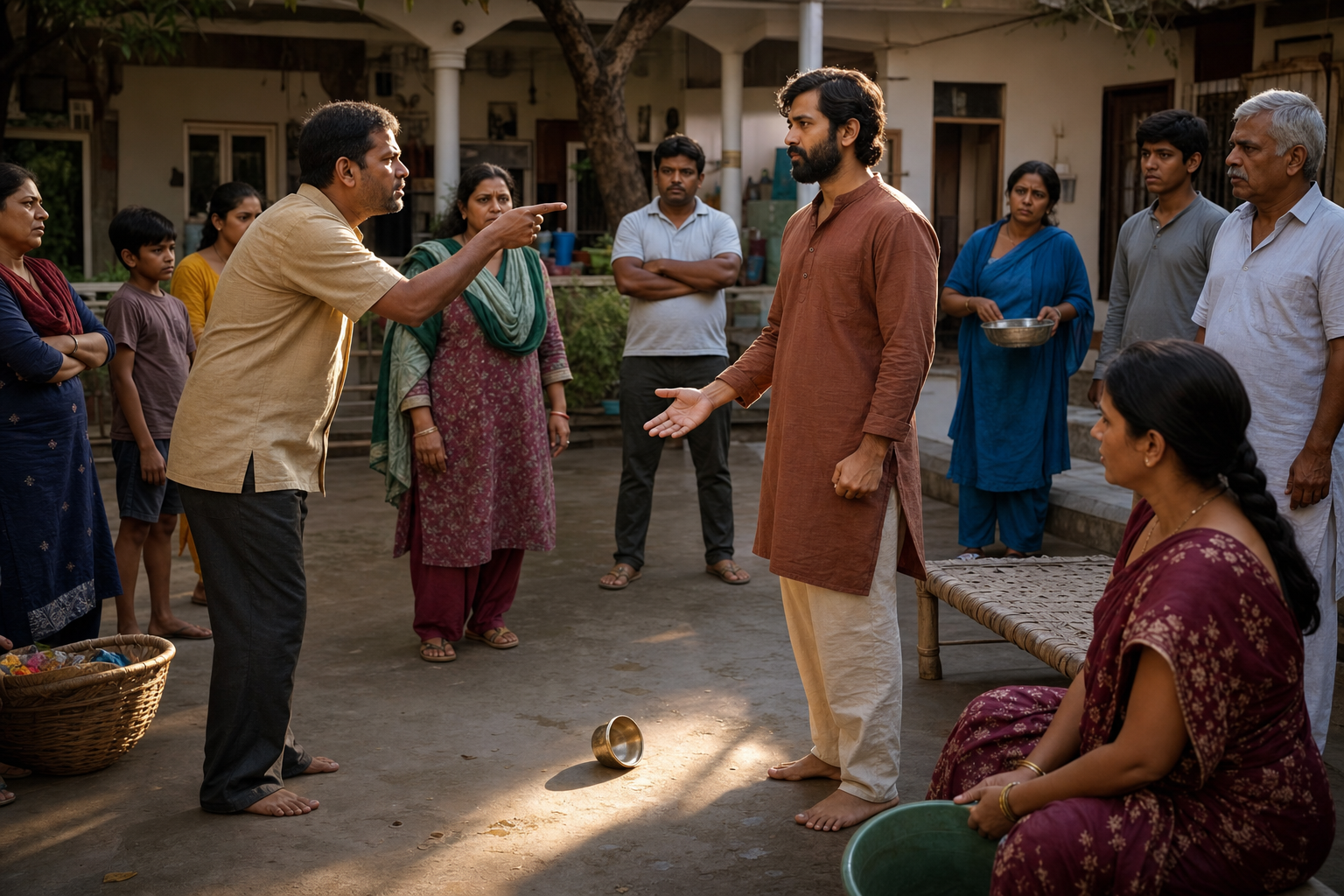
Spiritual knowledge must eventually meet the place where you lose freedom. That place may be an argument, the fear of being overlooked, resentment toward a family member, attachment to praise, or anxiety about a changing role. A quiet meditation can reveal the structure of awareness, but daily friction shows whether that insight remains available when identification is rewarded or threatened.
Choose one recurring situation rather than trying to transform your entire personality at once. Before it occurs, write the identity most likely to seize control: respected expert, obedient child, successful professional, indispensable parent, injured friend, or righteous defender. When the reaction appears, notice its bodily and mental components without pretending they are absent. Then ask what action serves dharma if that threatened identity is not allowed to dictate the answer.
Review the event afterward. The useful questions are concrete:
- How quickly did I notice identification?
- Did recognition produce clearer action, or did I use spiritual language to avoid action?
- Did I listen more accurately once self-defence loosened?
- Was a repair, apology, boundary, duty, or act of service required?
- Which unresolved doubt should return to manana?
Watch for several distortions. Conceptual accumulation lets you recite a mahavakya while remaining governed by every insult. Spiritual bypassing uses the witness to deny harm, grief, or responsibility. A nihilistic reading of maya declares that nothing matters. Constant path-switching prevents any method from reaching assimilation.
The corrections are equally specific. Return concepts to the doubt they are meant to resolve. Complete the ethical action that clarity requires. Remember that Advaita distinguishes absolute reality from empirical and illusory orders: vyavaharika life remains workable, consequential, and subject to dharma even though it is not absolute in the manner of Brahman. Stay with a coherent cycle of study, reflection, contemplation, and application before chasing novelty.
The mark of assimilation is not theatrical certainty. Look for a shorter interval between reaction and recognition, less compulsion to defend a role, greater ability to represent another view fairly, steadier ethical judgment, and compassion that requires less self-display. Equanimity, wise action, and spontaneous concern for others are practical signs that the center of gravity is moving away from anxious self-identification.
Key takeaways
- Begin with a question rooted in a real conflict between what you affirm and how you react.
- Match the claim to a valid means of knowledge instead of treating perception, inference, scripture, and contemplation as interchangeable.
- Use shravana to hear accurately, manana to remove doubt, and nididhyasana to assimilate what has become clear.
- Preserve the real differences among Advaita, Buddhist, Jain, and Sikh accounts of self, bondage, and liberation.
- Judge progress where identification is costly: in speech, duty, relationships, conflict, restraint, and service.
Take one unresolved question into your next period of study. Write the claim, identify its pramana, name the strongest doubt, and carry the clarified insight into one situation where your usual identity becomes defensive. That is a modest beginning, but it places inquiry on the road to freedom rather than leaving it on the shelf.
References
- DharmaRenaissance Blog – Unmasking Avidya: Adi Shankaracharya’s Advaita roadmap to the wonders within the Self
- DharmaRenaissance Blog – Why Questioning Is Sacred in Hinduism: A Deep Dive into Dharmic Philosophy and Pluralism