
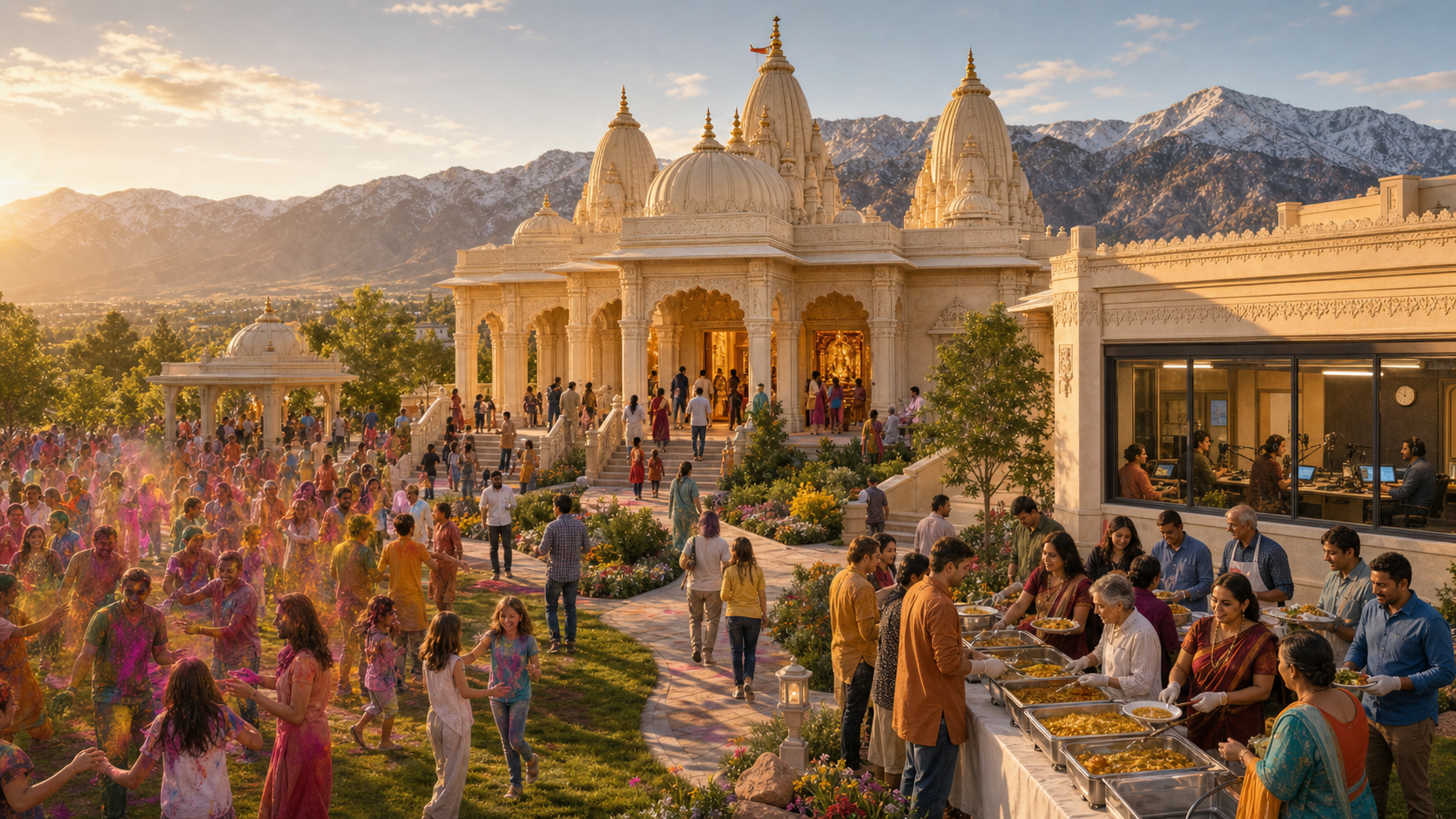
Perhaps your only image of Caru Prabhu is the Utah sky filled with colored powder. If so, you have seen the reach of his work, but not yet its institutional method. The festival mattered because a temple, a teaching tradition, a broadcasting platform, and recurring opportunities for service stood behind it.
Following HG Caru Prabhu ACBSP’s death on April 7, 2026, after a car accident in Utah, remembrance must eventually confront a practical question: what should Hindu American communities preserve from the way he built? If you help lead a temple, festival, youth group, media project, or local satsang, his legacy offers a demanding test. Do your activities lead people from first contact to study, service, and belonging, or are they merely successful events sitting beside one another?
The festival was a doorway, not the whole institution
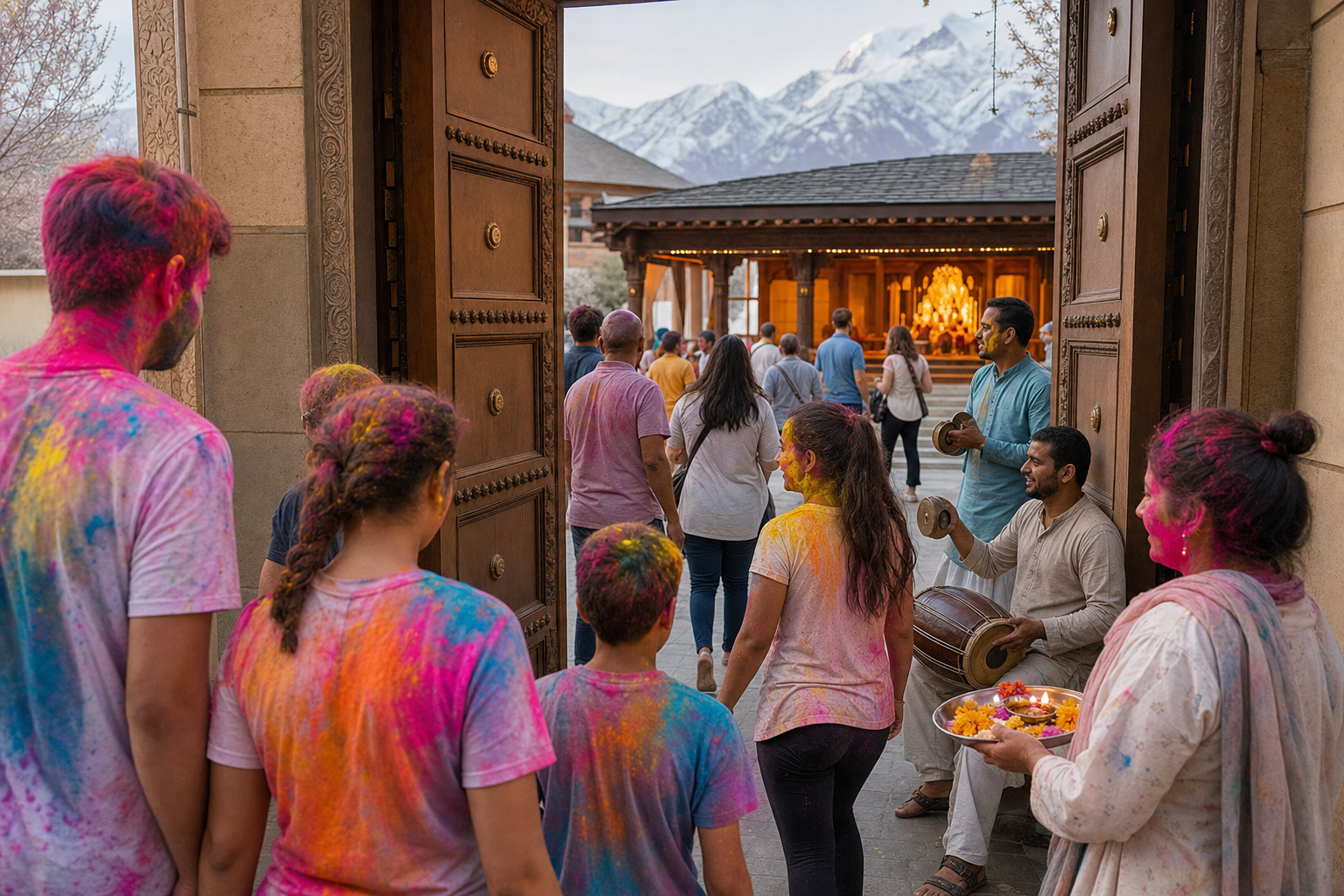
Utah Holi, widely known as the Festival of Colors, became Caru Prabhu’s most visible public achievement. It was grounded in Vaishnava theology, open to people of many backgrounds, and able to draw a large and diverse public. That combination is important. The celebration was neither a private observance unintelligible to a newcomer nor a generic color party emptied of sacred meaning.
A joyful festival can do something that a conventional temple program often struggles to do: give an unfamiliar visitor a low-friction reason to cross the threshold. Music, movement, vegetarian hospitality, and shared celebration make participation possible before the visitor understands the vocabulary of bhakti. Names such as Krishna and Rama cease to be distant concepts when people hear them in kirtan and encounter them through a living community.
But spectacle alone does not transmit dharma. Colored powder produces a memorable photograph; it does not by itself teach the Bhagavad-gita, establish a devotional practice, or form a community capable of serving together. The institutional value of Holi came from its connection to an identifiable Vaishnava center, regular teaching, worship, and volunteer participation.
You can test your own public celebration by mentally removing its most photogenic feature. Would a first-time visitor still know what sacred story or principle gives the event meaning? Would that person know where to return for a class, kirtan, meal, or service opportunity? If the answer is unclear, you have an attractive event but an incomplete doorway.
Temple, radio, and festival formed one system
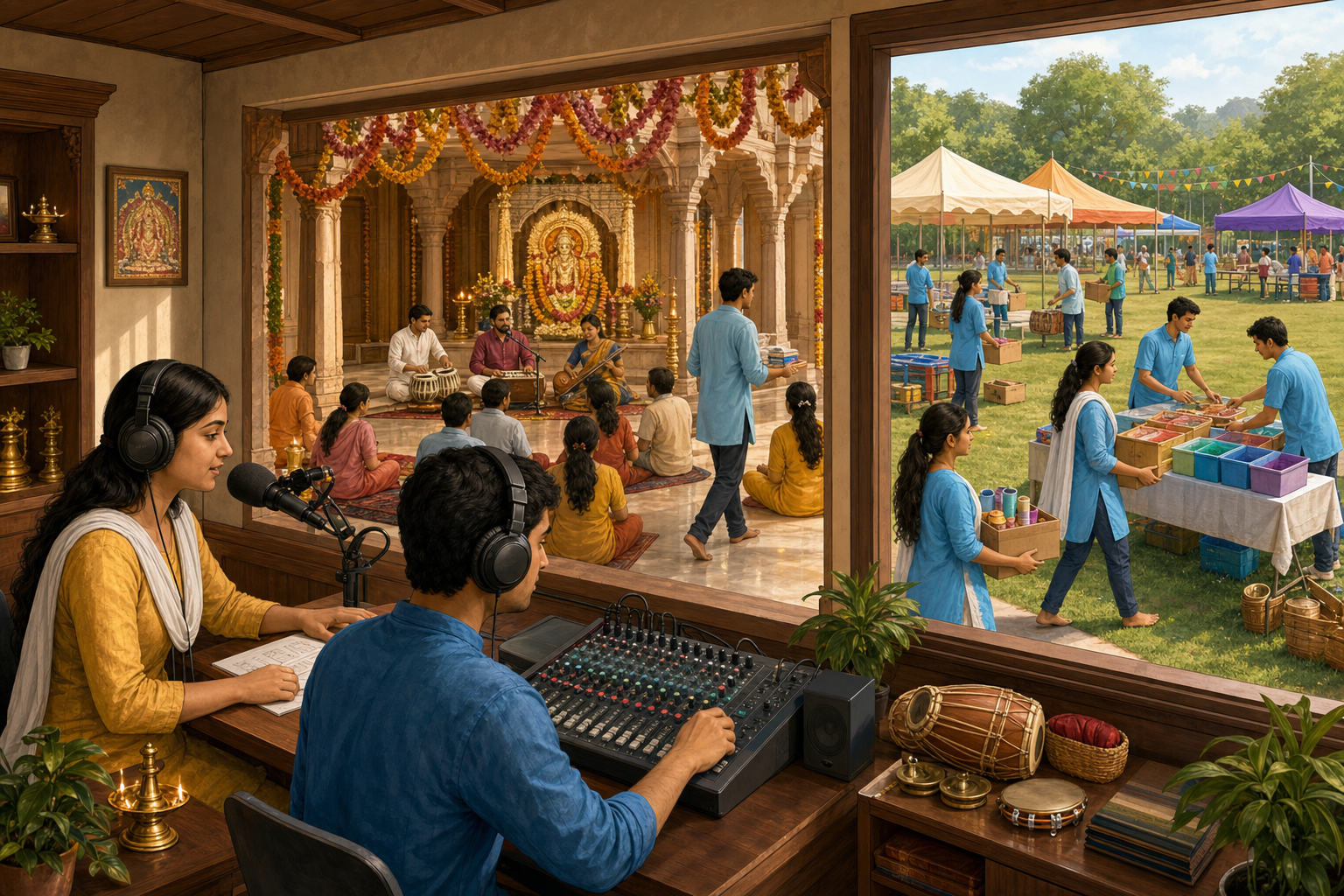
Caru Prabhu founded the Krishna temples in Spanish Fork and Salt Lake City, KHQN Radio, and Utah Holi. These were different institutions performing different jobs. Their strength becomes clearer when you see their relationship rather than considering each achievement separately.
The festival created reach. It met neighbors, students, families, and curious newcomers in a public language of celebration. It reduced cultural distance and made an encounter with Krishna bhakti socially accessible.
The radio station created rhythm. KHQN carried kirtan, philosophical readings, and dharmic conversation into the routines of home and work. A festival encounter is brief. Broadcasting makes repeated contact possible and allows unfamiliar words to become part of ordinary life.
The temples created roots. The Spanish Fork temple became a regional landmark and a center for worship, classes, music, cultural life, and interfaith engagement. The Salt Lake City temple carried regular kirtan, study, and service into the urban center. A physical sacred space gives continuity a location. It is where a listener or festival visitor can become a participant, and where a participant can accept responsibility.
Each part compensated for a weakness in the others. A major festival can achieve reach without depth. A radio broadcast can provide repetition without embodied fellowship. A temple can preserve depth while remaining invisible to much of its surrounding city. Connected properly, they create a path: public encounter, recurring familiarity, physical participation, and eventually seva.
This is the most transferable part of Caru Prabhu’s legacy. Your community does not need to reproduce his exact media format, architecture, or festival scale. It does need institutions that perform the functions of reach, rhythm, and rooted participation. When one function is missing, the gap usually appears as a familiar complaint: large crowds that never return, good classes that few people discover, or enthusiastic volunteers who never receive a durable role.
Hospitality worked because the tradition stayed visible
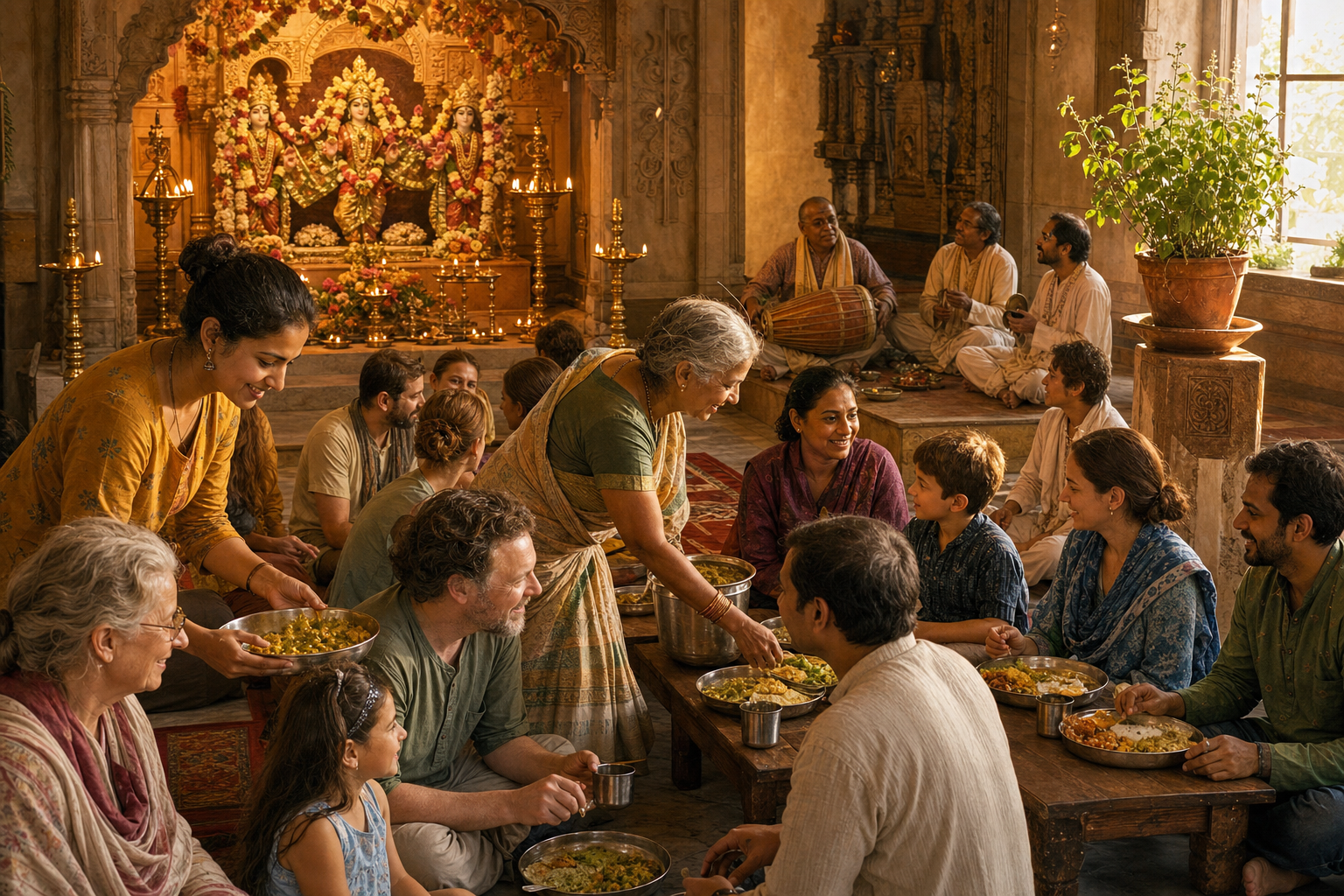
The suffix ACBSP identifies Caru Prabhu as a disciple of A. C. Bhaktivedanta Swami Prabhupada, ISKCON’s Founder-Acharya. That lineage was not a private footnote to his public work. Kirtan, Bhagavad-gita discourse, Krishna-centered worship, practical seva, and vegetarian hospitality gave the institutions their recognizable center.
This corrects a false choice that often weakens Hindu outreach. A community does not have to conceal its theology to welcome newcomers, and it does not have to make visitors decode an unfamiliar religious world without help. Accessibility concerns the manner of invitation. Dilution concerns the disappearance of the tradition being offered. They are not the same thing.
Caru Prabhu’s model joined an easy public entry with an explicit devotional identity. Someone could enjoy music, colors, food, and fellowship without first passing a test of knowledge. Yet the visitor was not left wondering whether the celebration had anything to do with Krishna. The welcome opened toward the tradition rather than away from it.
The same distinction matters in wider dharmic cooperation. Hindu, Buddhist, Jain, and Sikh communities can work together through ethical points of contact such as seva, ahimsa, disciplined community life, and respect for sincere spiritual practice. Cooperation does not require pretending that their scriptures, metaphysics, rituals, or understandings of liberation are interchangeable. Durable unity is strongest when each path can contribute from its own center.
When planning a public program, identify three things before approving the publicity. State the sacred center clearly: which deity, teaching, lineage, festival, or practice gives the gathering its meaning? Choose an intelligible bridge: music, hospitality, service, art, or a shared ethical concern. Then provide a real next step into the tradition: a class, kirtan, temple visit, reading group, or volunteer responsibility. If you can describe the bridge but not the center or the next step, the program is not yet ready.
Key takeaways: a durability test for a Hindu institution
- Reach: Can someone outside your existing circle encounter the tradition without already knowing its customs or vocabulary?
- Root: Does the encounter point toward an identifiable sacred community where worship, teaching, and fellowship continue?
- Rhythm: Is there a recurring channel that keeps people connected between major gatherings?
- Responsibility: Can an attendee move beyond consumption and take up a defined act of seva?
- Handoff: Could another trained person continue the program without depending on the founder’s memory, contacts, passwords, or personal presence?
A weak answer in any of these areas identifies a specific institutional gap. Attendance alone cannot tell you whether dharma is being transmitted. Look instead for a visible path from encounter to return, from return to learning, and from learning to responsibility.
Put the model to work before your next major event
Begin with the visitor’s path. Write down what a newcomer sees before arriving, who explains the sacred meaning on site, how the person learns about the next gathering, and where a first act of service becomes available. Do not assume that a stage announcement or crowded information table completes this work. The next step should be obvious while interest is still alive.
Then test the interval between public events. If your community becomes visible during an annual celebration and largely disappears afterward, add a dependable form of continuity. Caru Prabhu used radio. Your equivalent might be a recurring class, recorded discourse, newsletter, local gathering, or other channel your team can actually sustain. The correct format is not the most fashionable one; it is the one that reliably carries teaching and an invitation to return.
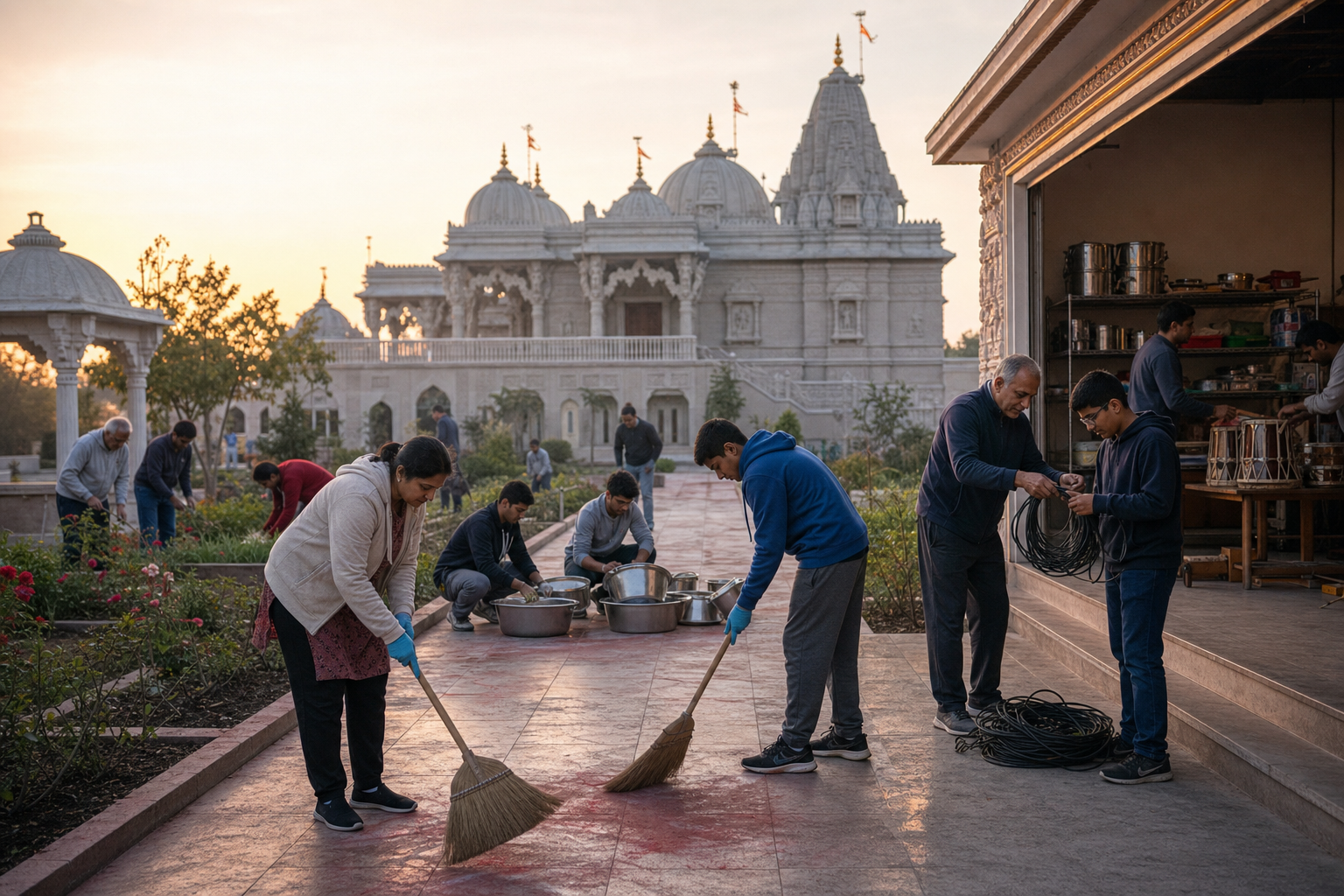
Next, turn spectators into contributors. Give youth and first-time volunteers work that is real, bounded, and connected to the institution’s purpose. Hospitality, kirtan support, festival preparation, educational assistance, communications, and care of sacred space can all become routes into belonging. A person who is trusted with meaningful seva has a different relationship to a temple than a person who is treated only as an audience member.
Finally, prepare for leadership continuity before a crisis forces the question. Record program schedules, access details, partner relationships, teaching materials, volunteer responsibilities, and the sacred standards that must be protected. Identify which public-facing forms may change and which theological commitments give the institution its identity. Founder-led energy becomes a legacy only when other people can inherit both the work and the reasons for doing it.
A publicly available class delivered two days before Caru Prabhu’s passing gives this question added weight. Teaching continued almost to the end of his life. The task now is not to imitate every outward feature he created, but to preserve the relationship he built among teaching, sacred place, public invitation, media continuity, and service.
If you want to honor Caru Prabhu institutionally, choose one disconnected program in your community and build its next step before the next crowd arrives. Make it clear where a visitor can learn, return, serve, and eventually help carry the tradition. That is how a memorable encounter becomes a durable Hindu presence.