
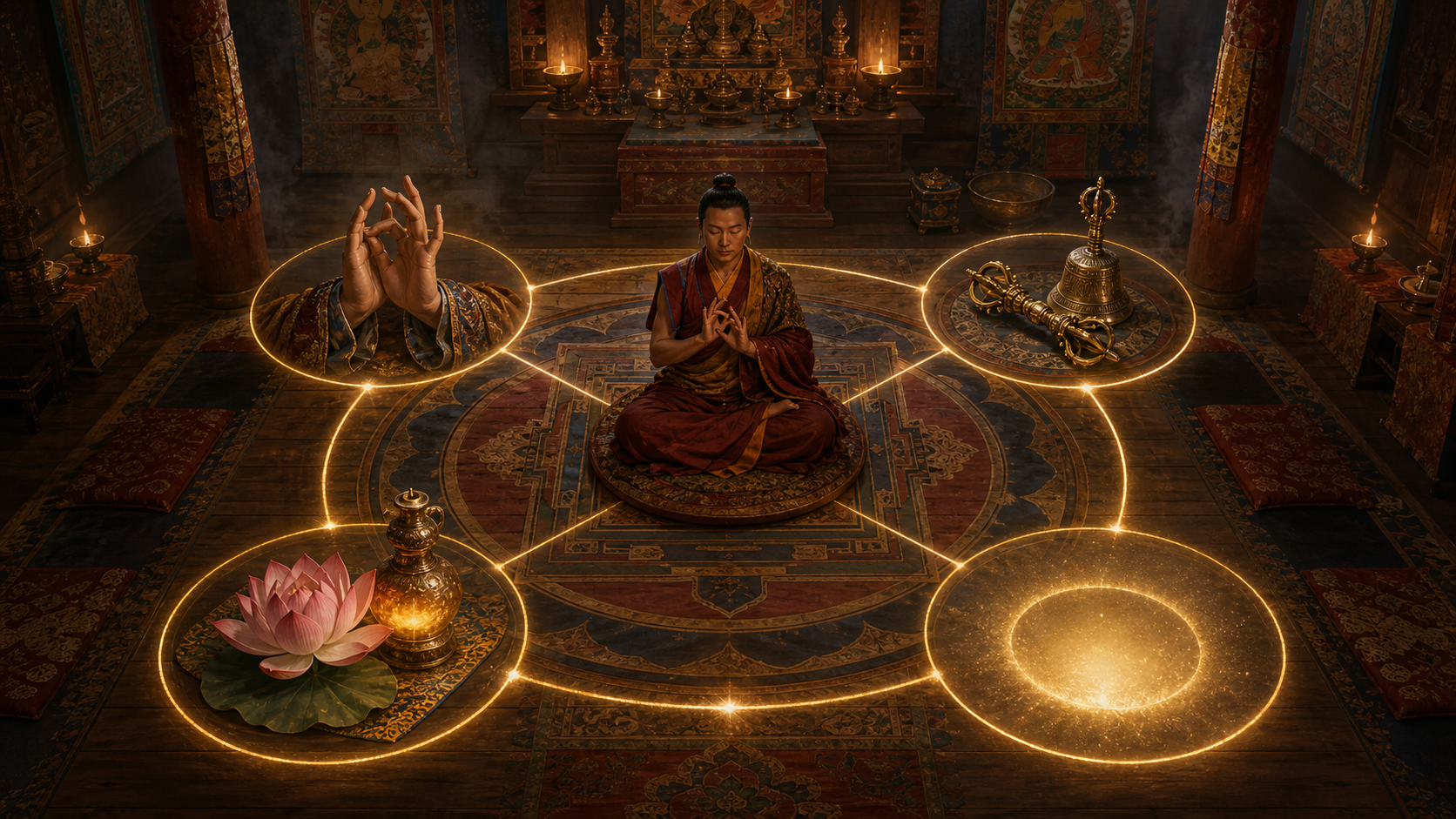
Karmamudra, Dharmamudra, Mahamudra, and Samayamudra are often presented as four definitions to memorize. Their real value emerges only when they are read as an interconnected tantric grammar linking action, sacred speech, embodied form, commitment, and awakened awareness.
The central challenge is context. The supplied DharmaRenaissance account locates this precise quartet most clearly in Buddhist Yoga Tantra and later Vajrayana systems. Related concepts occur across the wider Indic tantric world, but the fourfold classification should not be treated as a universal formula accepted by every Buddhist or Hindu lineage.
What a tantric seal does beyond the hands
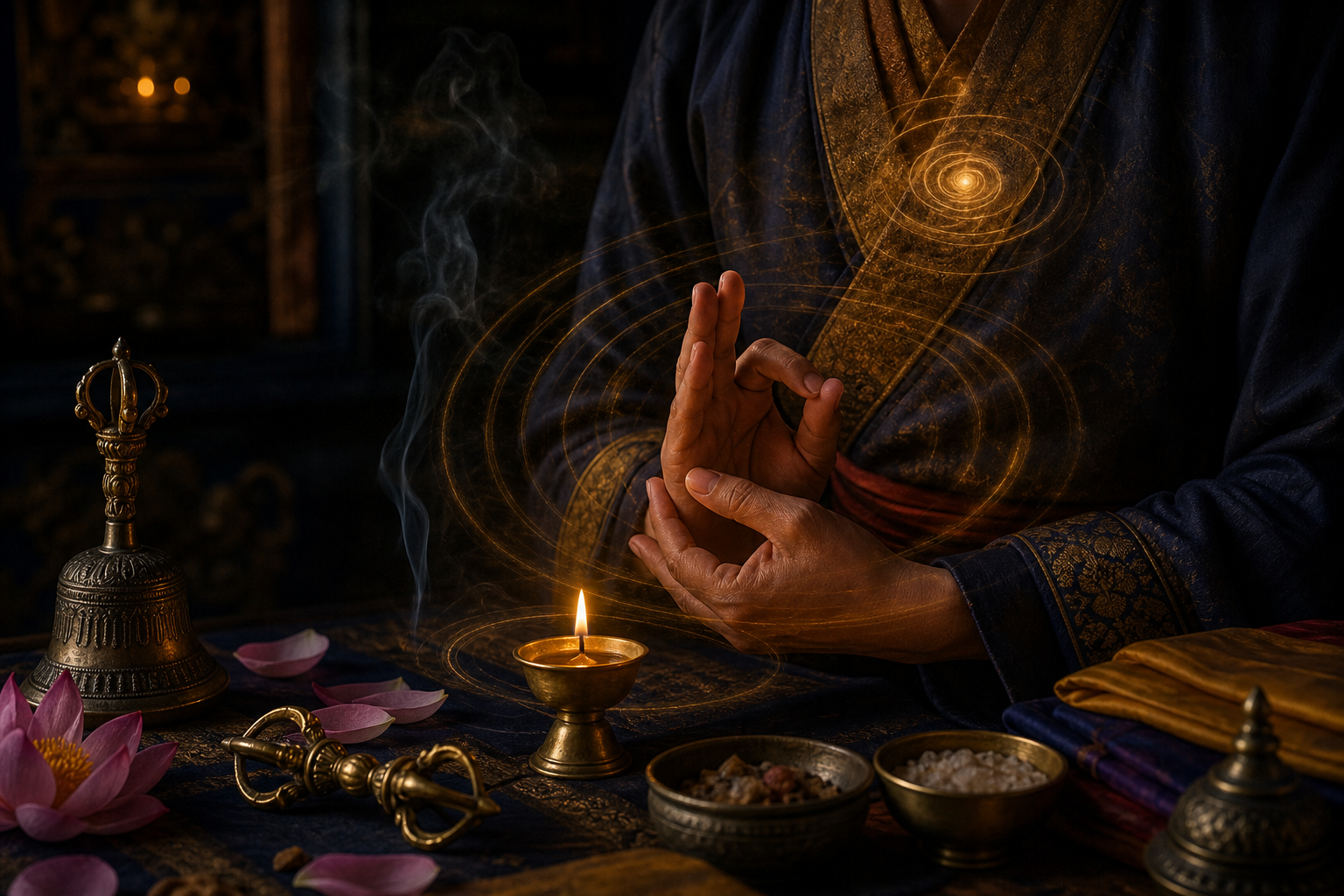
The Sanskrit word mudra can denote a seal, mark, sign, token, or gesture. A hand position may therefore be a mudra, but the term can also identify a mantra, a deity’s complete form, a ritual commitment, a contemplative realization, or, in restricted settings, a practice partner. Translating every occurrence simply as “hand gesture” hides this range.
The image of a seal helps explain the underlying logic. Just as a seal marks something as authorized or authenticated, a tantric mudra binds a ritual act to a sacred pattern. Gesture, mantra, visualization, ethical intention, and awareness acquire their significance through their relationship with one another. A movement extracted from its mandala, deity practice, initiation, and ritual purpose cannot carry the same meaning by itself.
This also explains why mudras are not merely symbolic illustrations. Within tantric practice, body, speech, and mind are deliberately coordinated around an awakened form. The practitioner is not only depicting a religious idea from the outside; the ritual seeks to reshape perception and conduct through an integrated discipline.
Key takeaways
- The fourfold system is best documented as a Buddhist tantric classification, not as a universal scheme for all Indic traditions.
- A mudra may be a gesture, mantra, commitment, embodied form, partner, or realization, depending on its setting.
- The familiar body-speech-mind-activity correspondence is a useful guide, but the source explicitly presents it as one mapping rather than the only interpretation.
- Later meanings should not be projected backward onto earlier ritual texts.
- No isolated sign substitutes for initiation, ethical discipline, visualization, mantra, and lineage-specific instruction.
The four seals as a coordinated ritual grammar
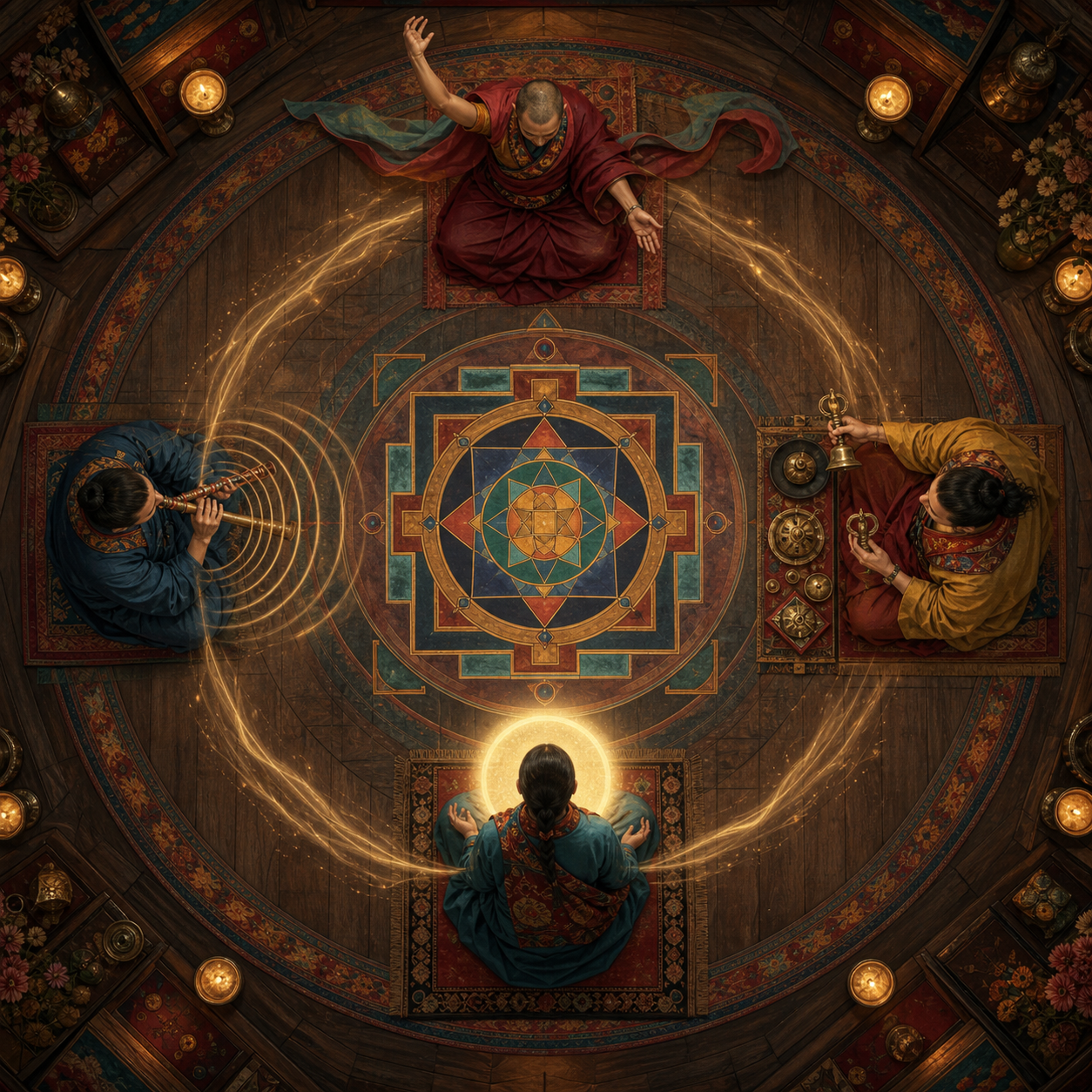
A common ritual correspondence associates Mahamudra with awakened body, Dharmamudra with awakened speech, Samayamudra with awakened mind or sacred commitment, and Karmamudra with awakened activity. The following map is therefore an orientation tool, not a claim that every text assigns identical meanings.
| Seal | Central emphasis in the reported ritual mapping | Important qualification |
|---|---|---|
| Karmamudra | Action, operative gesture, and awakened activity | In later Yogini Tantra and completion-stage contexts, the term can also denote an embodied consort or an internally visualized wisdom seal. |
| Dharmamudra | Mantra, sacred speech, teaching, and reality | Its tantric use should not automatically be equated with the wider Buddhist doctrinal expression “Dharma seal.” |
| Mahamudra | Awakened body within one common ritual correspondence | Later contemplative systems can place the four seals within broader accounts of ground, path, method, and fruition. |
| Samayamudra | Awakened mind and sacred commitment | Its force comes from the commitments and ritual relationships it seals, not from a hand position alone. |
Karmamudra shows most clearly why the system should be understood dynamically. Karma in this compound principally means action or activity. In an early ritual setting, the action seal gives operative expression to an intention established through mantra, visualization, and awareness. At an accessible ethical level, it asks whether contemplative understanding changes speech, choices, relationships, and service.
Dharmamudra connects sound with meaning and realization. The source describes mantra not as an inspirational sentence or mechanical repetition, but as sacred sound whose syllables, rhythm, deity association, visualization, and authorized transmission belong together. Dharmamudra can also point toward insight into phenomena as lacking an isolated, permanent essence while still arising through causes and conditions. On this account, emptiness weakens grasping without erasing conventional reality or moral responsibility.
Mahamudra and Samayamudra complete the common ritual correspondence through awakened body and awakened mind or commitment. Yet the four should not be forced into a rigid sequence. They function more coherently as mutually supporting dimensions: sacred form informs awareness, awareness gives integrity to speech, commitment stabilizes the practice, and insight is tested through activity.
Why the meanings change across texts and lineages

The apparent instability of these definitions is part of their history. The DharmaRenaissance source notes that textual period, initiation system, ritual context, and lineage can all change what mudra means. Some sources alter the order of the four; others emphasize different relationships among them. Later contemplative traditions may reinterpret a ritual classification through categories such as ground, path, method, and fruition.
This historical layering is especially important for Karmamudra. Its early sense as an action seal should not be collapsed into its later association with consort practice. Conversely, the existence of a ritual-gesture meaning does not make the later technical use unreal. The two belong to different but historically related interpretive settings.
Cross-traditional comparison requires the same care. Hindu worship, yoga, Buddhist ritual, and Jain iconography all employ mudras, while Hindu tantric traditions share terminology and ritual technologies with Buddhist systems. That broad cultural relationship does not establish that every tradition recognizes the same quartet or gives each name an identical function. Similar vocabulary may indicate exchange, parallel development, or reinterpretation without producing complete doctrinal equivalence.
A responsible explanation therefore begins by asking which text, period, lineage, and practice level are under discussion. Without those coordinates, a concise definition can become misleading even when one part of it is technically correct.
Ethical and interpretive safeguards for modern readers

Restricted meanings of Karmamudra
Later Buddhist Yogini Tantra and completion-stage literature can use Karmamudra for an embodied consort and for advanced practices integrating bliss with insight into emptiness. The source also reports distinctions between a physical Karmamudra and an internally visualized wisdom seal. These specialized meanings cannot responsibly be converted into general lifestyle advice or treated as the essence of tantra as a whole.
The reported traditional framework places such practice within initiation, vows, ethical discipline, meditative stability, and qualified supervision. Consent, maturity, freedom from coercion, and protection from abuse remain indispensable. A claim of spiritual authority does not excuse manipulation, and a general educational article cannot provide authorization or adequate instruction for a restricted practice.
A disciplined way to evaluate definitions
Any proposed definition should first be tested for scope. Is it describing a manual gesture, an entire ritual operation, a mantra, an ethical bond, a partner, or a realization? It should then be located historically: does it belong to Yoga Tantra, a later contemplative interpretation, or a completion-stage setting? Finally, its function should be examined within the full practice rather than judged as a detached symbol.
The body-speech-mind-activity correspondence remains useful when treated as a map rather than an equation. It shows how the four seals can coordinate sacred form, meaningful sound, committed awareness, and compassionate conduct. It becomes misleading only when presented as the sole definition accepted in every lineage.
Future study can move beyond competing glossary entries by comparing how particular texts and lineages make the four seals work together. That contextual approach preserves both the historical diversity of tantra and the practical seriousness its terminology demands.