
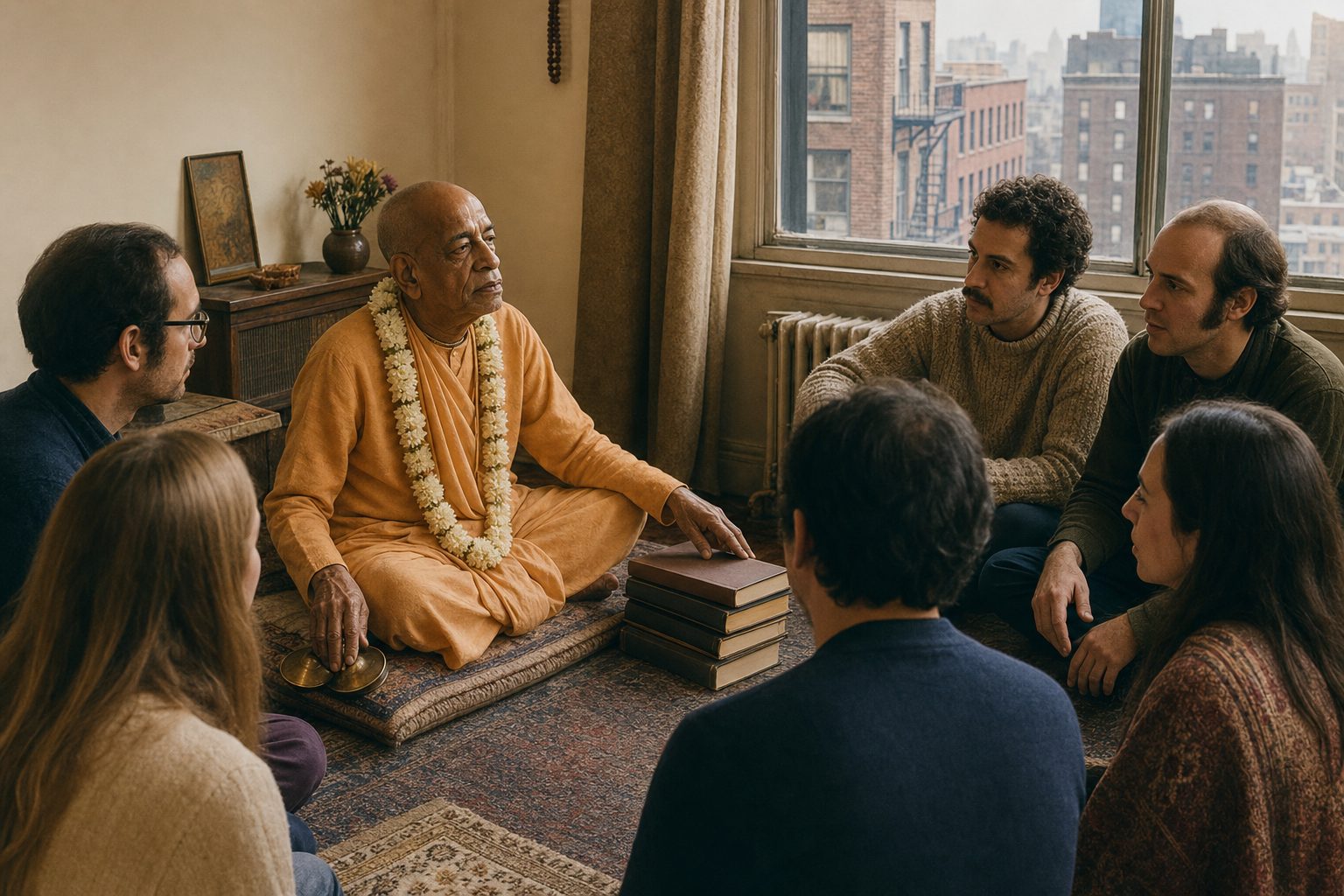
If you have encountered Srila Prabhupada mainly through reverent retellings, you may wonder how to move from admiration to understanding. If you have encountered him mainly through criticism of ISKCON, you may have the opposite problem: an institution has eclipsed the spiritual teacher whose legacy you are trying to judge.
A clearer reading keeps three things in view: the life, the teaching, and the movement that carries his memory. You should examine them separately before asking how well they fit together. That approach neither demands unquestioning acceptance nor mistakes suspicion for discernment.
Start with the life, but do more than collect events
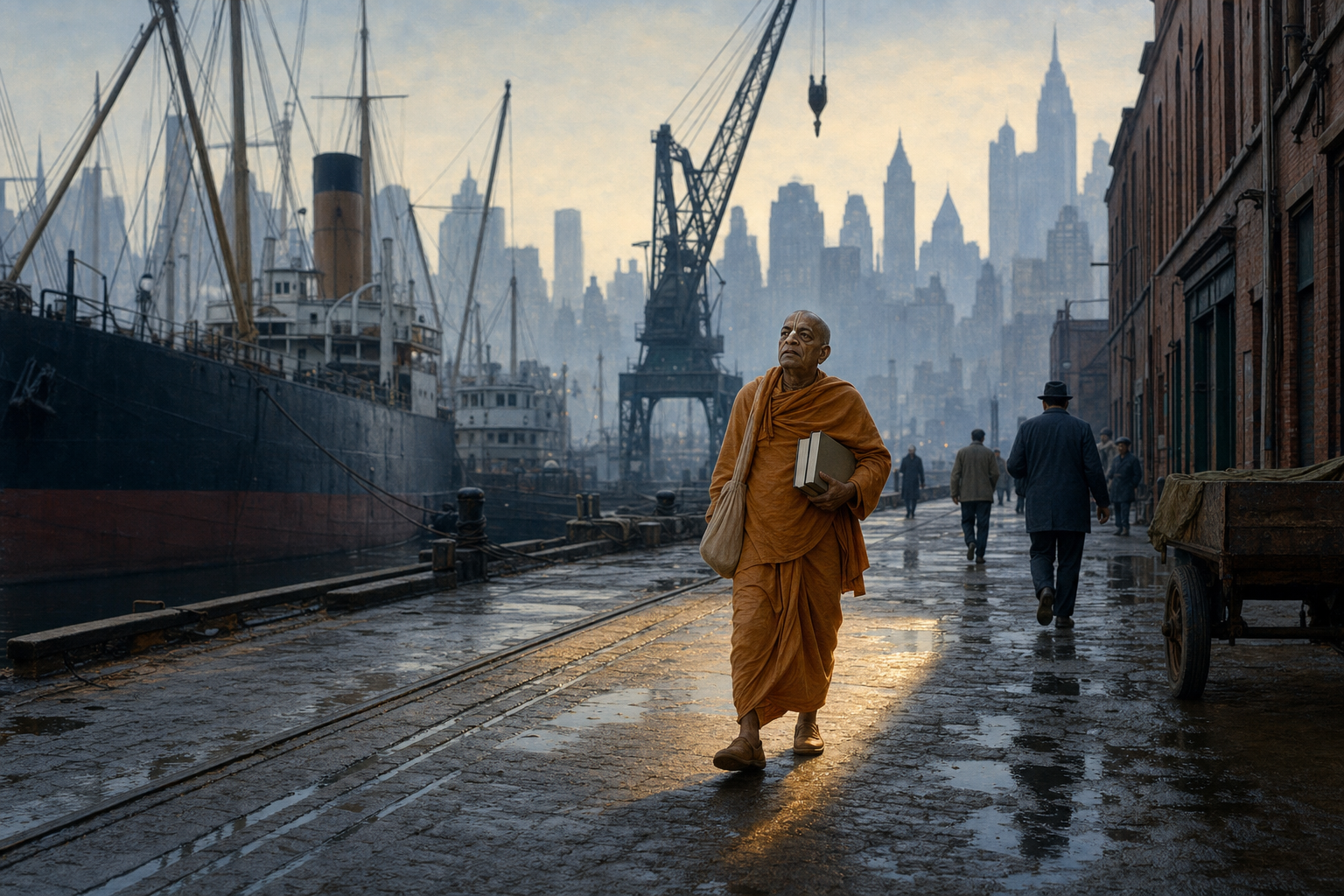
Begin with the Srila Prabhupada Lilamrita presentation, but do not watch only for a sequence of memorable incidents. Watch for the structure of a spiritual vocation: the convictions behind a decision, the cost of acting on them, the practices being taught, and the consequences that remain after the individual is gone.
Treat Lilamrita as devotional narration rather than as a neutral chronicle. The Sanskrit word lila places a life within a sacred frame, while amrita conveys the sense of nectar or immortality. That framing is not a defect to be removed. It tells you what kind of meaning a community finds in the life. It also tells you to distinguish a reported event from the spiritual interpretation placed upon it.
Use a simple reading method:
- Record the decision. What choice is Srila Prabhupada shown making?
- Identify the stated principle. What conviction is presented as the reason for that choice?
- Notice the cost. Does the account show inconvenience, uncertainty, opposition, sacrifice, or responsibility?
- Find the instruction. What is a follower expected to understand or practise because of the incident?
- Label the evidence. Are you hearing a documented event, a recollection, a devotional interpretation, institutional memory, or praise?
- Keep unresolved questions open. A question that cannot yet be answered does not have to become either an accusation or an article of faith.
This method prevents biography from becoming a collection of wonders on one side or a hunt for faults on the other. A spiritual life becomes intelligible when you can see how principles shaped choices. Reverence may motivate the inquiry, but careful attention gives reverence substance.
Separate the layers of Prabhupada’s legacy
Legacy is often treated as a single verdict: great or flawed, successful or unsuccessful. That is too blunt. Srila Prabhupada’s legacy operates through several connected layers, and each needs a different test.
| Layer | What to examine | The useful question |
|---|---|---|
| Teaching | The principles attributed to him and the reasoning behind them | Can you state the teaching accurately without reducing it to a slogan? |
| Practice | The conduct, discipline, worship, study, and service encouraged among followers | What changes in an ordinary day when the teaching is taken seriously? |
| Institution | The roles, routines, communities, and forms of authority used to preserve the mission | Does the structure serve the teaching, or has preserving the structure become the goal? |
| Formation | The kind of person the tradition seeks to form | Do humility, steadiness, responsibility, and service become more visible? |
| Public memory | The stories and commemorations through which later followers interpret the founder | Which qualities are being preserved, and which difficult questions are being omitted? |
An ISKCON NYC Sunday Feast lecture dedicated to Srila Prabhupada’s legacy makes public memory visible. A community gathers around its inheritance and interprets that inheritance for people present now. This matters because a legacy survives through recurring acts of transmission, not through a founder’s name alone.
At the same time, the presence of a commemorative lecture proves active remembrance, not the quality of every institutional outcome. Ask what the gathering transmits. Does it explain a teaching? Does it connect gratitude to practice? Does it make room for responsibility? Or does praise become a substitute for learning? You can honour the occasion while still applying those tests.
Let devotion and history answer their proper questions
Devotional memory asks why a life is spiritually meaningful. Historical inquiry asks what happened and what evidence supports a claim. Institutional memory asks which account helps a community understand its identity and obligations. These questions overlap, but they are not interchangeable.
Confusion begins when one kind of claim is used to settle another. Spiritual importance does not automatically verify every recollected detail. A gap in external corroboration does not automatically erase the spiritual meaning that followers find in an event. Neither move is careful enough.
As you study, mark claims by type:
- Event claim: something is said to have happened in a particular setting.
- Teaching claim: a principle or instruction is attributed to Srila Prabhupada.
- Interpretive claim: an event is given spiritual significance.
- Character claim: the account presents a quality such as courage, compassion, endurance, or humility.
- Institutional claim: a later practice is justified through his authority or example.
Then test each claim appropriately. Look for context when a teaching is quoted. Look for corroboration when an event carries historical weight. Look at conduct when a character claim is made. When an institution invokes Prabhupada’s authority, ask for the connection between his teaching and the policy, custom, or decision in question.
This distinction protects the devotee as much as the sceptic. It prevents an administrator’s preference from acquiring sacred status merely because Prabhupada’s name is attached to it. It also prevents a critic from treating every expression of devotion as though it were a failed academic argument.
Judge a living legacy by formation, not visibility
A founder can remain highly visible while the demanding parts of his teaching gradually recede. Portraits, honorifics, lectures, and commemorations show remembrance. They do not, by themselves, show whether followers are being formed by the principles they celebrate.
Use tests that reach beyond visibility:
- Clarity: Can followers explain the purpose of a practice, or can they only repeat its rule?
- Consistency: Does the discipline continue away from festivals, lectures, and public settings?
- Character: Does spiritual authority encourage humility and service, or status and insulation from questions?
- Transmission: Are newcomers taught how to understand, examine, and internalise the tradition?
- Accountability: Can the community acknowledge failure and correct it without treating honest scrutiny as disloyalty?
- Continuity: Can the teaching be carried into a new cultural setting without losing its spiritual centre?
Apply these standards symmetrically. Do not demand perfection from a religious community while excusing comparable failures elsewhere. Do not lower the standard because a community uses sacred language. Fairness requires the same moral seriousness in both directions.
This also gives you a better way to understand institutional controversy. The decisive question is not whether an organisation has ever experienced conflict; human organisations do. Ask whether its habits of correction reflect the spiritual qualities it claims to transmit. A legacy capable of examining its own failures is stronger than one protected by silence.
What a Dharmic reader can learn without becoming uncritical
You do not have to choose between sectarian allegiance and detached observation. Srila Prabhupada’s life can confront any Dharmic reader with practical questions: What makes a teacher’s conviction transmissible? How does a community preserve a mission after the founder is absent? How can dharma enter a different cultural setting without becoming either a curiosity or a diluted lifestyle label?
Work through those questions with a concrete exercise:
- Select one incident from the Lilamrita presentation that stays with you.
- Describe the incident without honorific adjectives. This shows whether you have understood the event itself.
- Write the spiritual interpretation separately. Ask what principle gives the incident meaning.
- Identify the practice that should follow if that interpretation is accepted.
- Observe how a living ISKCON community presents the same principle. Compare formal teaching with visible conduct, while remembering that one visit cannot settle a judgement about an entire community.
- Choose a response proportionate to what you have established: further study, a trial of a practice, participation in service, a respectful question, or a decision to reserve judgement.
The separation between event, meaning, and practice is especially valuable. It lets you receive a genuine insight without pretending that every institutional expression of it is beyond criticism. It also stops institutional disappointment from automatically cancelling a teaching that deserves to be considered on its own terms.
When speaking with devotees, ask questions that invite substance. Instead of asking whether Prabhupada was great, ask which of his teachings has most changed the person’s daily conduct and how. Instead of asking whether ISKCON preserves his legacy, ask what the community does when its customs and its stated principles appear to conflict. The answers will reveal far more than ceremonial praise or blanket criticism.
Key takeaways
- Read Srila Prabhupada’s life for the relationship between conviction, decision, sacrifice, instruction, and consequence.
- Distinguish reported events from devotional interpretation without assuming that one makes the other worthless.
- Examine teaching, practice, institution, formation, and public memory as connected but separate layers of legacy.
- Do not use visibility or organisational survival as a substitute for examining character and conduct.
- Test institutional appeals to Prabhupada’s authority by asking for the actual connection to his teaching.
- Begin with one incident and one principle, then trace what that principle asks a person or community to do.
Your next step can be modest and serious. Watch the Lilamrita presentation with a notebook, then listen to the ISKCON NYC legacy lecture. Record the events, interpretations, instructions, and recurring themes separately. Take the clearest principle into a conversation with a knowledgeable practitioner, and ask how it should become visible in ordinary life. That is where remembrance begins to become discernment, and where a celebrated legacy can become a living responsibility.

References
- Dandavats — Srila Prabhupada’s Legacy — ISKCON NYC Sunday Feast Lecture | HG Aditya devi dasi
- Dandavats — Today’s Featured Video: Srila Prabhupada Lilamrita