
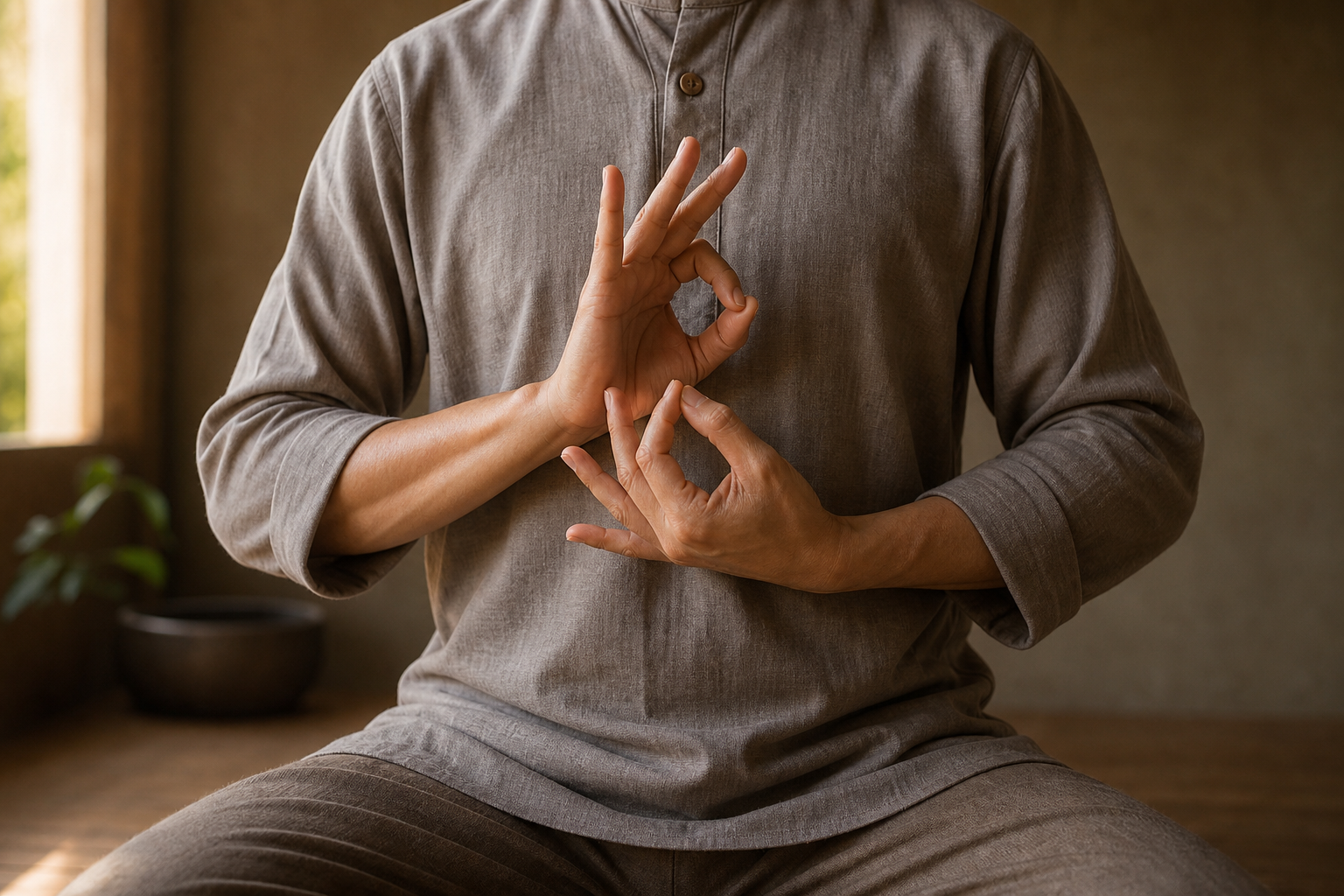
You may be looking at a sacred image, trying to reproduce its hand position, or wondering whether Dharma Chakra Mudra belongs in your own practice. The difficult part is not making two circles with your fingers. It is understanding what the whole gesture communicates.
Once you can read the position of the hands, their orientation, and their place near the heart, the mudra becomes more than a pose. You can use it as a disciplined reminder that Dharma must move from understanding into expression and conduct.
Read the wheel before copying the hands
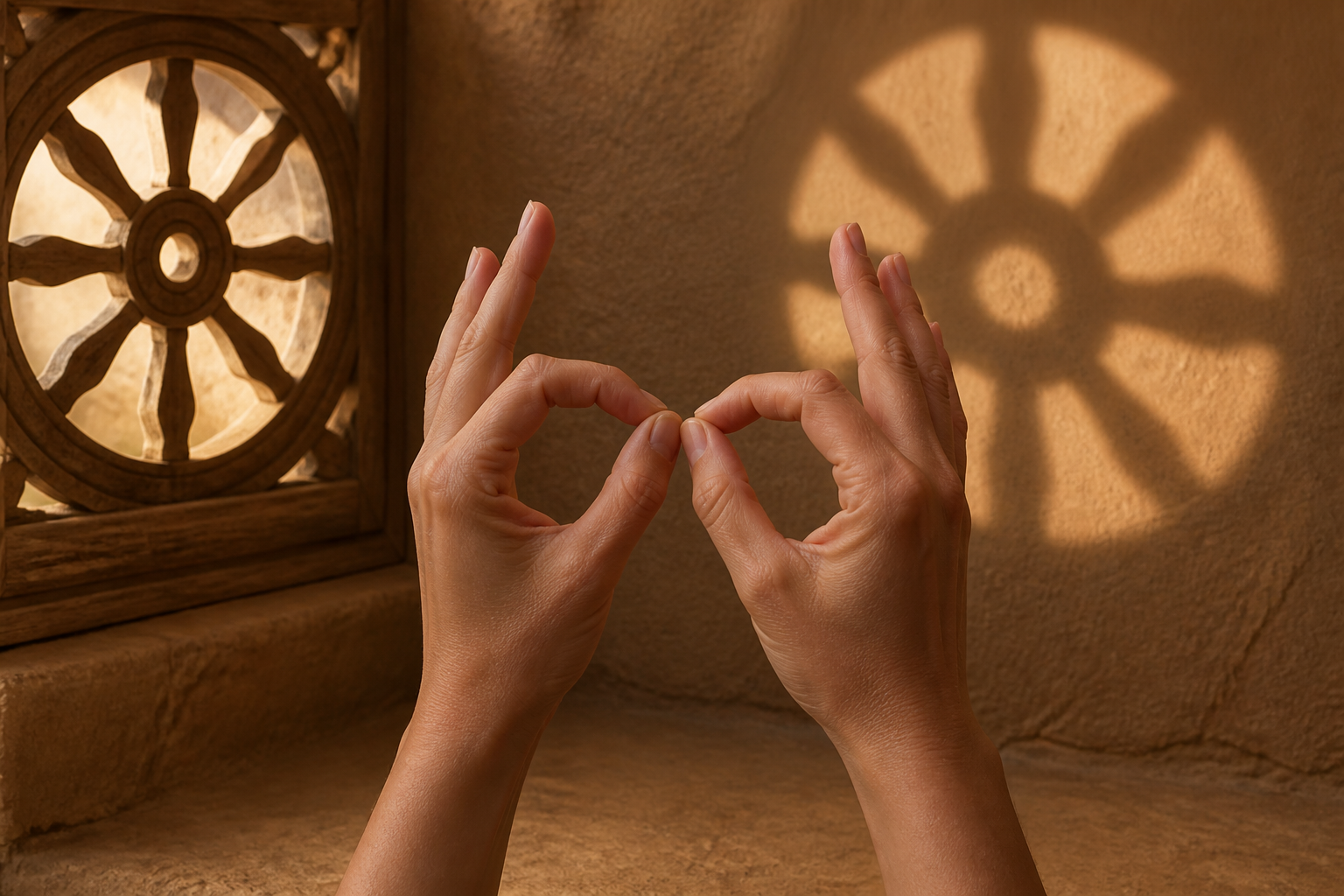
Dharma Chakra Mudra means the Gesture of the Wheel of Dharma. It is commonly associated with sacred representations of the Buddha teaching. The wheel is not a physical object being held. The arrangement of the hands makes the movement of teaching visible: Dharma is understood, articulated, received, and carried forward.
Three features help you recognize the gesture:
- Both hands participate. A thumb-and-index-finger circle made by one hand alone is not enough to identify Dharma Chakra Mudra.
- The hands are held around the chest or heart area rather than resting passively in the lap.
- The palms have a complementary relationship, commonly with the right palm facing outward and the left turned inward.
The circular contacts suggest a wheel without requiring a carved or painted wheel. Their placement near the heart joins inward comprehension with outward communication. The two hands also make the gesture relational. Dharma is not treated as a private possession; it enters a living relationship between learning, teaching, listening, and practice.
That reading is more reliable than elaborate claims about what every individual finger must represent. Detailed finger correspondences can vary between traditions and later interpretations. Unless a lineage, teacher, or iconographic context supplies a particular explanation, do not present one symbolic code as universal.
This restraint is especially important for a cross-Dharmic audience. A shared Sanskrit vocabulary does not make Hindu, Buddhist, Jain, and other Dharmic uses interchangeable. When you encounter the mudra in a temple, manuscript, statue, or living practice, begin with the tradition and setting of that particular representation.
Form the commonly recognized version with relaxed hands
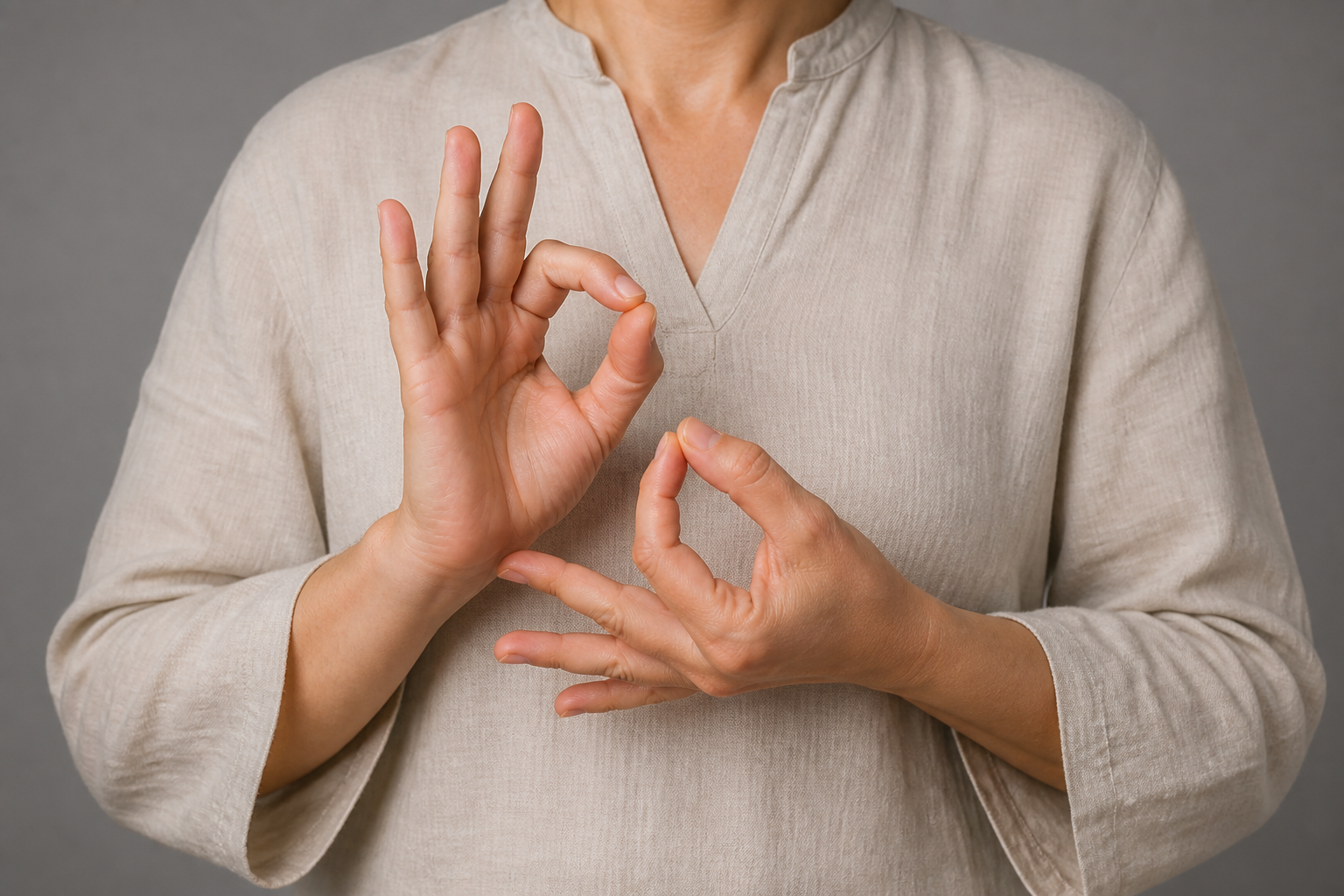
The following method gives you a common iconographic form, not a universal ritual prescription. If you are reproducing a particular sacred image or following instruction from a teacher, let that context take precedence.
- Sit or stand with your spine naturally upright. Keep the chest open without pushing it forward.
- Raise the left hand toward the center of the chest. Turn its palm generally inward, toward the body.
- Bring the right hand slightly forward at about the same level. Turn its palm generally outward.
- On each hand, touch the tip of the thumb lightly to the tip of the index finger, forming a small circle.
- Let the remaining fingers extend naturally. They should look awake and deliberate, but they should not be rigidly spread.
- Bring the two hands into a balanced relationship near the heart. Depending on the version you are following, the hands may touch at particular fingers or remain slightly apart.
- Release unnecessary effort from the shoulders, wrists, palms, and jaw. The form should be clear without becoming a test of flexibility.
Check the whole silhouette
Look at the gesture from the front, or compare it with the sacred representation you are studying. You should be able to notice both circular finger contacts, the complementary directions of the palms, and the location of the hands near the chest. If only the finger circles are correct while the hands hang at the waist or rest in the lap, the gesture’s distinctive visual grammar has been lost.
Do not force the fingertips into hard pressure. A light contact is sufficient. If the position causes pain in your fingers or wrists, release it or adapt it. The symbolic value does not depend on muscular strain.
Expect legitimate variations
Sculptures, paintings, and lineages do not always arrange the secondary fingers in exactly the same way. Some representations bring the two hands into contact; others preserve a small space. The relative height and angle can also change with artistic style and context.
Variation does not mean that every arrangement is equally precise. Preserve the core structure, then follow the version relevant to your purpose. An artist documenting a particular statue should reproduce that statue rather than silently combining several variants. A practitioner receiving lineage instruction should follow the teacher rather than correcting the form to match a generic diagram.
Use the mudra to turn understanding into conduct
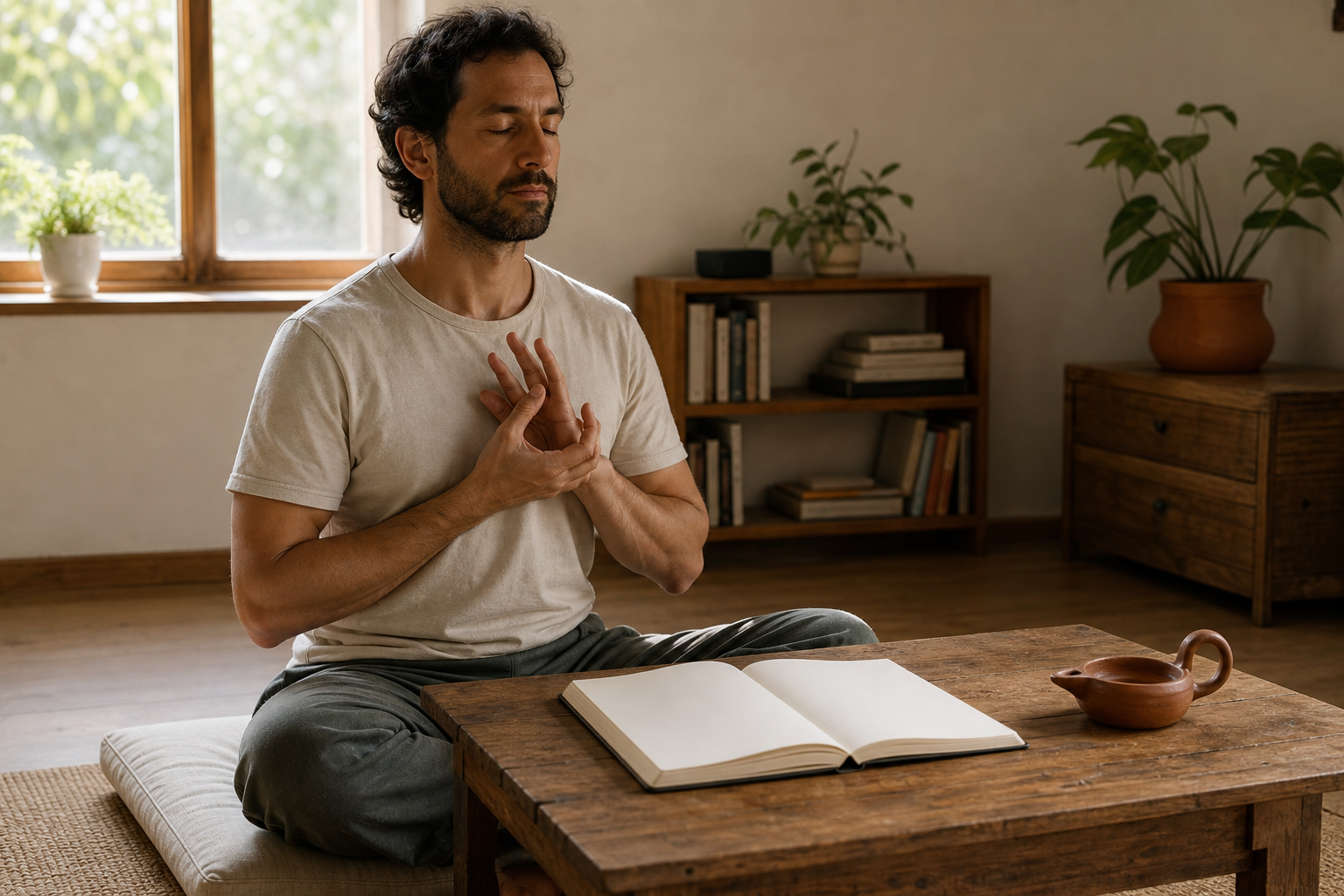
A sacred gesture becomes useful when it disciplines attention. You do not need to claim that the hand position mechanically produces wisdom, healing, or spiritual attainment. Its immediate value is simpler: it gives the body a form through which you can examine the movement from receiving Dharma to living and communicating it.
Try this contemplative sequence after study, before teaching, or when you need to apply a principle in a difficult situation:
- Choose one teaching or Dharmic principle you are already studying. Do not begin with a vague wish to become spiritual.
- Name the real situation in which the teaching matters: a conversation, a duty, a conflict, a decision, or a habit.
- Form Dharma Chakra Mudra and allow your breathing to remain natural.
- Notice the inward-facing hand and ask: What must I understand or receive more honestly?
- Notice the outward-facing hand and ask: What can I communicate or enact without vanity, aggression, or distortion?
- Release the gesture and choose one concrete expression of the teaching in the situation you named.
This is a simple contemplative use of the mudra, not a claim that every tradition prescribes the same exercise. Its test comes after the hands separate. If you contemplated restraint, speak with restraint. If you contemplated duty, complete the neglected duty. If you contemplated truthful speech, remove the exaggeration from what you are about to say.
The mudra can be particularly corrective before you advise someone else. The outward hand may draw your attention toward teaching, but the inward hand asks whether you have listened and understood. That balance keeps Dharma from becoming a weapon applied only to other people’s conduct.
You do not need to hold the gesture for a prescribed duration. Keep it only while it supports clear attention, and release it before discomfort becomes the main object of awareness. If your tradition pairs the mudra with a particular recitation, visualization, or ritual procedure, use that instruction. Do not invent an ancient pedigree for a personal method.
Avoid the mistakes that reduce a sacred gesture to costume
The most common errors are not merely anatomical. They arise when appearance is separated from meaning or when one context is made to speak for every tradition.
- Identifying the mudra from one finger circle: Read both hands, their orientation, and their position near the chest before naming the gesture.
- Treating one diagram as universal: Compare the form with the particular sculpture, painting, temple tradition, or lineage in front of you.
- Inventing a code for every finger: Distinguish a tradition’s stated interpretation from attractive symbolism added later.
- Prioritizing tension over clarity: Keep the contacts deliberate but gentle. Strained fingers do not make the symbolism more authentic.
- Using the gesture to perform authority: Forming a teaching mudra does not make a person’s words Dharmic. Conduct remains the test.
- Flattening Dharmic traditions: Respect shared civilizational vocabulary while allowing each tradition and lineage to explain its own sacred forms.
When identifying the mudra in sacred art, examine the complete figure. Hand placement is important, but so are posture, gaze, accompanying figures, ritual objects, and the larger narrative setting. Damage to an old sculpture can also obscure fingertips, so avoid building an identification on one surviving detail.
A practical standard is to ask what remains after the visual impression. Can you name the teaching being contemplated? Can you identify the action it requires from you? Sacred beauty has its own value, but a teaching gesture asks for more than admiration.
Key takeaways
- Dharma Chakra Mudra represents the Wheel of Dharma through the coordinated form of both hands.
- Its commonly recognized form places the hands near the chest, joins each thumb and index finger, turns the right palm outward, and turns the left palm inward.
- Finger arrangement and hand contact can vary, so the relevant sacred image or lineage should guide precise reproduction.
- The gesture is best used as a reminder to connect understanding, communication, and conduct, not as a mechanical promise of spiritual results.
- Respect for Dharma requires contextual accuracy. Shared vocabulary should not be used to erase differences among traditions.
The next time you encounter Dharma Chakra Mudra, pause before copying the fingertips. Read the relationship between the hands, identify the Dharma being communicated, and decide how that teaching should move through your next action. That is where the wheel begins to turn in practice.
References
