

You may have been told that the banyan and banana are both sacred, yet that answer leaves the important question untouched. Why would Hindu thought read a vast, long-lived tree beside a soft, fast-renewing plant? Their difference is the point.
The banyan gives visible form to continuity and conscious witnessing. The banana gives visible form to growth, manifestation, nourishment, and renewal. When you read them together, they illuminate the relationship between Purusha and Prakriti: awareness and the changing field of nature.
Begin with the plants, not a memorised definition
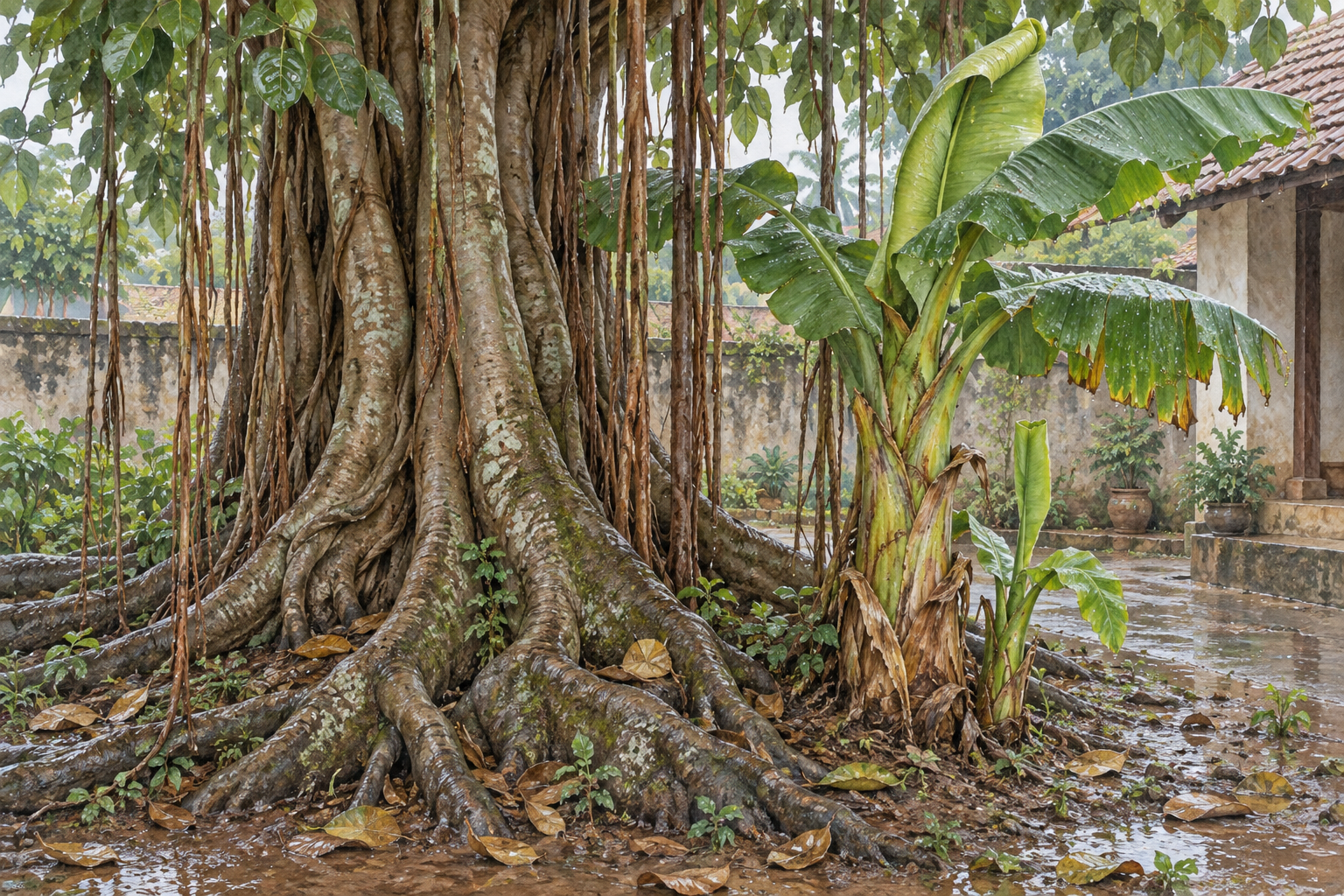
A Hindu symbol usually becomes clearer when you first notice the natural form carrying it. The plant is not an arbitrary label pasted onto an abstract idea. Its structure, rhythm, and way of persisting make the idea visible.
The banyan is woody, expansive, and long-lived. Aerial roots descend from its branches and can thicken into additional supports. Its canopy can keep spreading while remaining anchored. What looks like one tree may eventually resemble a gathering of trunks, yet those supports belong to one connected life.
The banana has a different architecture. Botanically, it is a large herb rather than a woody tree. What appears to be its trunk is a pseudostem formed from tightly packed leaf sheaths. A fruiting stem completes its cycle, while new shoots continue the plant’s life from its base. Its continuity is expressed through succession rather than through one enduring trunk.
That contrast gives you the first reliable interpretive rule: do not ask only what each plant is called. Ask how it lives. The banyan persists by establishing support and extending its shelter. The banana persists by producing, completing, and renewing. One makes continuity conspicuous; the other makes becoming conspicuous.
What the banyan and banana reveal about Purusha and Prakriti

The paired symbolism of the banyan and banana connects this botanical contrast with one of Hindu philosophy’s central distinctions. In this interpretive frame, the banyan evokes Purusha, the conscious principle, while the banana evokes Prakriti, nature as the active power of manifestation.
The banyan: steady awareness, not lifeless immobility
Purusha is not your changing mood, social role, possession, or personal history. It points toward that by which change is known: the capacity to witness experience without being identical to every experience that passes through awareness.
The banyan suits this idea because its visible identity can remain coherent through enormous outward growth. Branches spread, roots descend, and new supports appear, but the tree’s continuity is not lost in that activity. It offers an image of presence spacious enough to contain movement.
This does not make Purusha a symbol of laziness or withdrawal. A banyan is hardly inactive. It grows, shelters, and establishes new points of support. Its lesson is constancy within expansion, not refusal to participate in life. If you use spiritual witnessing to avoid responsibility, you have mistaken detachment from compulsive reaction for detachment from dharma.
You can notice the distinction directly. A thought changes, and you know that it changed. An emotion rises and falls, and you can observe its movement. A role that once defined you may disappear, yet awareness remains capable of recognising the transition. The banyan becomes a prompt to ask: what is changing here, and what is able to notice the change?
The banana: manifestation, fruitfulness, and renewal
Prakriti is the active field in which forms arise, develop, produce consequences, and pass into other forms. It includes nature not merely as scenery outside you, but as embodied life: sensation, emotion, material conditions, action, growth, and transformation.
The banana makes this dynamism visible. It grows through layers of living tissue, produces fruit, completes a stem’s cycle, and continues through fresh shoots. Its form does not depend upon preserving one permanent woody structure. It displays continuity through fertility, expenditure, and renewal.
Calling Prakriti changeable does not call it worthless. The banana corrects that mistake. Its changing form is precisely how nourishment and new growth become possible. In the same way, your body, work, relationships, duties, and material circumstances are not debris left outside spiritual life. They are the field in which discernment must become action.
The pair is a relationship, not a contest

The easiest misreading is to turn the two plants into a ranking: banyan above banana, consciousness above nature, stillness above activity. The symbolism works better as a disciplined contrast. Each plant reveals something the other cannot reveal by itself.
| What to notice | Banyan | Banana |
|---|---|---|
| Visible structure | Woody, spreading, anchored by multiplying supports | Herbaceous, layered, renewed through successive shoots |
| Dominant rhythm | Continuity through sustained presence | Continuity through growth, fruiting, completion, and renewal |
| Philosophical lens | Purusha: the conscious witness | Prakriti: manifest nature and active becoming |
| Common error | Mistaking steadiness for passivity | Mistaking change for inferiority or chaos |
| Practical question | What remains able to witness this experience? | What is taking form, changing, or asking for action? |
Your life is not lived from only one side of this table. You encounter changing conditions through a body, a mind, and relationships. You also possess the capacity to notice those conditions rather than respond blindly to each one. The pairing asks you to preserve both truths: do not deny the world of change, and do not reduce yourself to its latest movement.
This balance matters in practice. Emphasise Prakriti without witnessing, and activity can become compulsion: every mood feels final, every pressure dictates a response, and every new form demands attachment. Emphasise Purusha without Prakriti, and witnessing can become an excuse for indifference. Clear awareness should improve the quality of action, not erase the need for it.
Key questions that prevent common misreadings
Is the banyan more spiritual than the banana?
No hierarchy is required by the symbolism. The banyan makes enduring awareness easier to contemplate; the banana makes generative nature easier to contemplate. One without the other gives you an incomplete lens. Awareness must illuminate lived reality, while activity needs discernment if it is to become dharmic action.
Do Purusha and Prakriti simply mean man and woman?
No. Do not turn a philosophical distinction into a social hierarchy between men and women. In the symbolism considered here, Purusha and Prakriti name principles that every person can examine: conscious witnessing and the changing processes of embodied life. Gendered imagery may be used in particular settings, but it should not replace the philosophical distinction or be used to justify unequal human worth.
Does every Hindu tradition give the plants exactly this meaning?
You should treat the Purusha-Prakriti pairing as an interpretive key, not a universal dictionary entry that cancels every other context. Hindu traditions do not all explain philosophical terms or ritual symbols in an identical way. A plant used in a particular ceremony, temple, region, or family observance may carry a more specific meaning.
When the context is specific, ask a specific question: why is this plant present here, in this observance, within this tradition? That protects you from replacing living practice with a general explanation learned elsewhere. The broad symbolism can orient you, but context decides how far the interpretation should be carried.
Use the symbolism as a method of reflection

You do not need to force the plants into a rigid code. Use their contrast as a sequence of questions whenever a situation feels either chaotic or spiritually detached.
- Name the changing field. Identify the feelings, physical conditions, relationships, duties, opportunities, and constraints currently in motion. This is the banana side of the reflection: what is forming, producing consequences, or completing its cycle?
- Find the witnessing standpoint. Notice that you can observe those movements. Do not suppress them or pretend they are unreal. Simply distinguish an experience from the awareness that recognises it. This is the banyan side.
- Look for continuity without clinging. Ask what should remain steady while circumstances change. Keep this distinct from stubbornly preserving a form whose proper cycle is finished.
- Allow renewal without losing discernment. Ask what needs to grow, bear fruit, end, or begin again. Change is not automatically progress; judge it by the responsibilities and consequences involved.
- Choose an action that honours both. Act from a settled awareness of the situation rather than from the loudest passing impulse. The purpose of witnessing is clearer participation.
In a conflict, for example, the first surge of anger belongs to the changing field. Recognising that surge without immediately becoming its instrument is the witnessing movement. You still have to respond, but you can choose speech that addresses the actual problem instead of merely discharging emotion. Purusha does not remove you from Prakriti; awareness changes how you participate in it.
The same distinction helps when a phase of life ends. The banana warns you not to demand permanence from every visible form. The banyan warns you not to confuse a changing form with the whole of who you are. Together, they make room for renewal without rootlessness and steadiness without rigidity.
The next time you encounter the banyan and banana together, resist the urge to ask which one carries the higher meaning. Look closely at how each plant continues. Then ask what in your situation must be witnessed steadily, what must be allowed to change, and what dharmic action can unite the two.
References

Leave a Reply
You must be logged in to post a comment.