
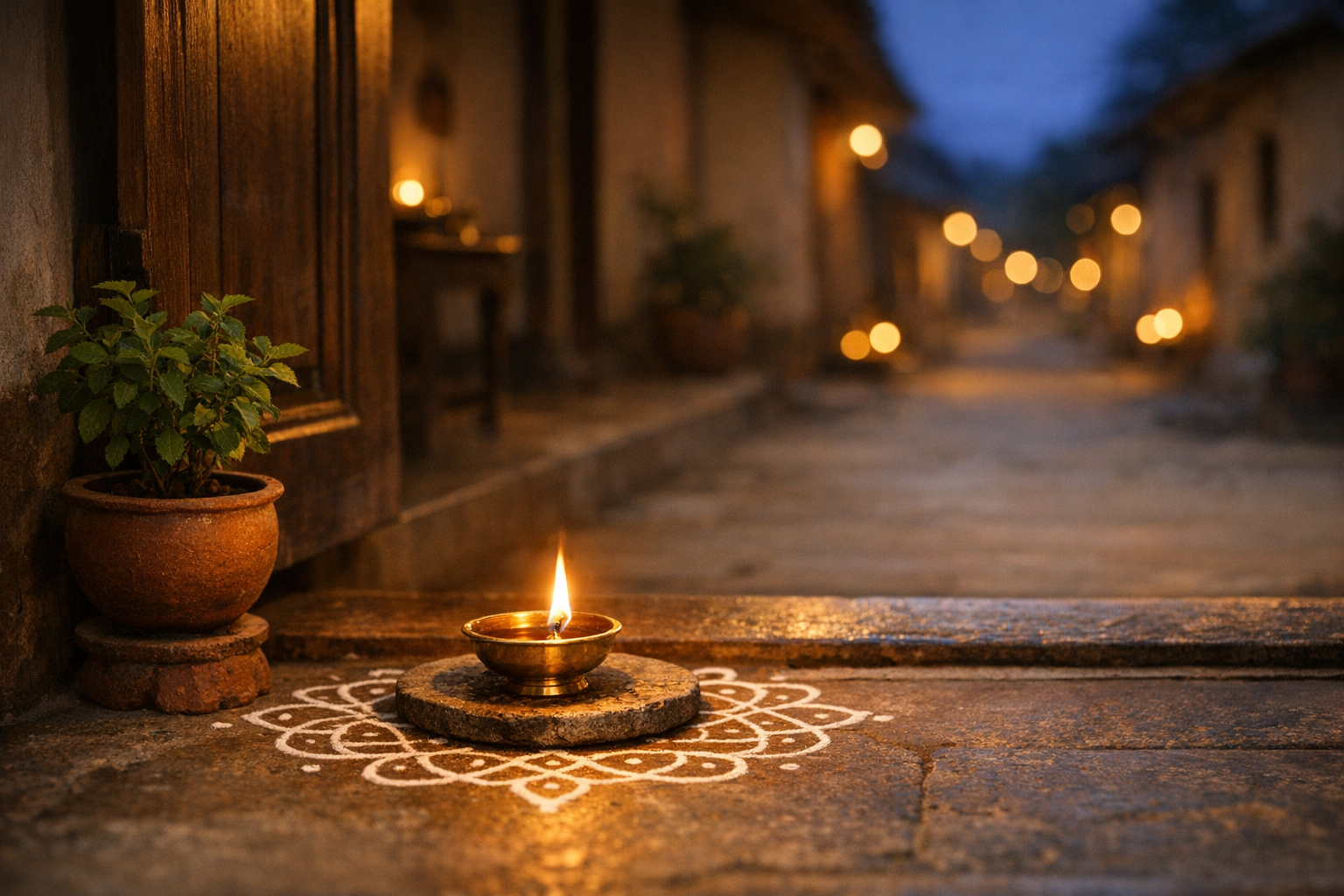
A simple lamp placed at the threshold of a home embodies a profound teaching in Hinduism: illumination should nurture both the inner life and the outer world. This recurrent image, found in household ritual, regional custom, and classical discourse, encodes a vision of knowledge that begins within but cannot remain confined. The threshold lamp functions as a living metaphor, quietly proposing that genuine insight (jnana) matures into service, hospitality, and collective well-being.
Within Hindu philosophical vocabulary, light regularly signifies knowledge, clarity, and discernment. The Upanishadic prayertamaso mā jyotir gamayaframes spiritual effort as a movement from obscurity to illumination. The doorstep lamp, therefore, is not merely decorative; it signifies a commitment to cultivate inner lucidity and to let that clarity radiate outward as conduct, speech, and duty.
Architecturally and ritually, the threshold is a liminal zoneneither fully inside nor fully outsideakin to a sandhi or point of transition. In dharmic thought, liminal spaces invite mindfulness because they mediate movement and relationship: householder (gṛhastha) obligations begin at the doorway where the private self becomes a social presence. A lamp at this juncture announces readiness for exchangeof greeting, aid, counsel, and protectionwithout surrendering the sanctity of the home.
Across regions, this practice appears with rich local color. In North India the small clay diya glows at dusk; in the South, agal vilakku and deepam line thresholds and verandas; in coastal and hill communities, lamps near the entryway welcome guests and travelers. Despite linguistic variety, the symbolism converges: the household’s inward devotion should become a visible source of warmth and guidance.
Festival cycles reinforce the teaching. During Diwali, households illuminate doorways to honor prosperity and the victory of light over darkness, turning streets into pathways of shared joy. In many regions, Yam Deep Daan is observed by placing a lamp near the entrance as a prayer for well-being and longevity within the family. In Karthika masam and Karthigai Deepam, rows of lamps at thresholds and courtyards cultivate sustained remembrance of the inner light throughout the month. Each observance binds personal devotion to collective ambience.
Ritual technique deepens the symbolism. Cotton wicks are commonly used with ghee or sesame oil; texts and commentarial traditions often associate ghee with sattva (clarity and serenity), while regionally sesame oil is valued for steadiness of flame. Lamps are placed on clean, stable surfaces, the flame shielded from wind yet visible from both sides of the door. Householders frequently face the flame toward the East or North, aligning daily worship with the directional grammar of auspiciousness embedded in custom.
Vastu considerations likewise link a well-lit entrance with cultivated prāṇa and welcome. Traditional vastu manuals emphasize cleanliness, unobstructed pathways, and steady light at the doorway so that the first and last impressions of the home communicate harmony. The threshold lamp thus functions as both a devotional act and a micro-architecture of care.
Scriptural and ritual literature sustain these practices. Gṛhya-sūtra materials describe lamps employed at rites of passage and domestic worship, marking transitions with light. Agni, honored as witness (agnisākṣī) in marriage and vows, signifies truth’s presence in human bonds; the household lamp echoes this witness at the place where promises of hospitality and restraint are daily renewed. The metaphor remains consistent: knowledge must show itself by illumining conduct.
Ethically, the image aligns with Bhagavad Gita’s call to loka-saṅgrahaactions undertaken for the steadying of the world. As understanding grows, responsibility expands; inner refinement without civic expression remains incomplete. The threshold lamp conveys this progression with elegance: it shines within as mindfulness, and outward as empathy, generosity, and protection of the vulnerable.
Socially, a lit doorway fosters hospitality and safety. In many communities, such light has historically guided late-returning workers, signaled openness to neighbors, and created safe corridors in seasons of early dusk. Even today, a modest lamp can soften boundaries, encouraging exchange and cooperation while deterring neglect or indifference.
Resonances extend across the dharmic family. In Buddhism, the injunction attadīpā viharatha“dwell as a lamp unto yourselves”ties the lamp directly to discernment and self-reliance in the path. Narratives of Dīpankara Buddha accentuate light as an emblem of timeless awakening. The symbolism coheres: insight within becomes guidance for others without presumption or coercion.
In Jainism, Dīpāvali commemorates the nirvāṇa of Mahāvīra, with lamps honoring the enduring radiance of his jñāna. The teaching dovetails with Anekantavada, which upholds many-sided truth and cautions against dogmatic closure. A lamp at the threshold thus suggests both clarity and humilitythe willingness to share light while recognizing the manifold perspectives through which reality may be known.
In Sikh tradition, the observance of Bandi Chhor Divas alongside Diwali bathes gurdwaras and homes in light, recalling the release of Guru Hargobind and the inseparability of spiritual insight from social liberation. Gurbani’s reminderman tu jot saroop hai apna mool pachhaanframes the inner light as the essence to be recognized, while seva and langar demonstrate how that light nourishes the wider community. The doorway lamp symbolically places this recognition at the point of human encounter.
Taken together, these parallel intuitions across Hinduism, Buddhism, Jainism, and Sikhism affirm a shared civilizational axiom: light stands for liberating knowledge, and knowledge is fulfilled in compassionate action. The threshold becomes a pedagogy in miniaturewhere contemplation meets responsibility, and where unity in diversity is practiced as everyday ethos.
Psychologically, environmental light shapes mood and conduct. Studies consistently associate warm, steady illumination with feelings of safety, trust, and reflection. Traditional yogic disciplines such as trataka (steady gazing on a flame) likewise harness the visual simplicity of a lamp to calm attention and stabilize the mind. Placed at the doorway, the flame offers a daily micro-meditation at the moment of departure and return.
Practical considerations preserve both safety and sanctity. A stable lamp base, a flame shielded from drafts, and non-toxic oils reduce risk and smoke. The area around the threshold should remain clean, with rangoli or kolam patterns framing the lamp to signal auspiciousness and care. Many households keep a Tulasi near the entrance; placing a lamp by Tulasi during Karthika masam weaves botanical reverence into the ethic of illumination.
Intent (saṅkalpa) completes the act. Before lighting, many silently dedicate the lamp to clarity of thought, kindly speech, and right action that benefits both family and neighborhood. Over time, the repetition links inward aspiration to outward habit, making the doorway a site of ethical training rather than only a circulation space.
The metaphor adapts readily to contemporary life. At today’s “thresholds”whether residential, civic, or digitalthe counsel remains: cultivate depth within and share light without. In practice, this might mean reliable mentorship, transparent scholarship, neighborhood cooperation, or thoughtful online discourseall luminous extensions of the same inner flame.
Viewed through this lens, the teaching that a lamp on the threshold illumines both inside and outside becomes a concise guide to dharmic living. It integrates philosophy with architecture, ritual with ethics, and private devotion with public service. Above all, it affirms a unifying principle across the dharmic traditions: illumination is most authentic when it warms the heart at home and brightens the path for the wider world.
Inspired by this post on Hindu Blog.
