

You may have seen Aghora Shiva covered in ash, carrying skull emblems, surrounded by serpents or standing against a cremation-ground setting, and wondered whether the image celebrates terror. That first impression is understandable. It is also almost the reverse of what the murti is meant to communicate.
Aghora teaches you how to look at death, change, instinct and fear without becoming their servant. Once you understand the theology behind the fierce appearance, each unsettling feature becomes part of a disciplined visual language: see clearly, release what cannot last, and act without panic.
Begin with the name, not the frightening appearance
The Sanskrit name provides the interpretive key. A-ghora means “not terrible,” “non-fearsome” or that which is no longer dreadful. The prefix does not pretend that loss, death and radical change feel pleasant. It announces that they cease to rule consciousness when they are seen within Shiva rather than as powers outside the Absolute.
This matters because Aghora is sometimes treated as Shiva’s evil, sinister or merely destructive side. Shaiva theology offers a more precise reading. Aghora belongs to the pañcabrahma, the fivefold revelation of Shiva expressed as Sadyojāta, Vāmadeva, Aghora, Tatpuruṣa and Īśāna. These are not five competing gods. They disclose different dimensions of one reality and its cosmic activity.
In a widely transmitted set of correspondences, Aghora faces south and is associated with agni, the fire principle, and saṁhāra, dissolution. Particular correspondences can vary across texts, regions and lineages, so they should not be turned into a rigid universal chart. The stable theological point is that Aghora dissolves what obstructs recognition: avidyā, or ignorance; bhaya, or fear; and mala, the constriction that makes consciousness experience itself as small and separate.
Saṁhāra therefore does not mean meaningless devastation. Consider what fire does in the imagery: it consumes an exhausted form, exposes what cannot be preserved and clears space for renewal. Aghora is protective precisely because this dissolution is directed at bondage. The grace is in the clearing.
The Aghora mantra carries the same theology through sound. It offers reverence across the full range of Rudra’s manifestations, from the non-fearsome to what appears exceedingly fearsome:
Om Aghorebhyo’ghorebhyo ghoraghoratarebhyah Sarvebhya sarva sarvebhyo namaste astu rudrarupebhyah.
Pañcabrahma mantra corpus
The mantra does not secure peace by imagining that only gentle experiences belong to Shiva. It removes the imagined boundary between the sacred and the frightening. If every Rudra-form is held within the Absolute, fear can still arise in the mind and body, but it no longer possesses the final word.
Use this principle whenever an Aghora image initially repels you. Do not begin by asking, “Why is Shiva threatening me?” Ask, “What fear, false permanence or constricted identity is this form asking me to release?” That change of question brings the image back into its proper theological frame.
Read the murti as a map of transformation
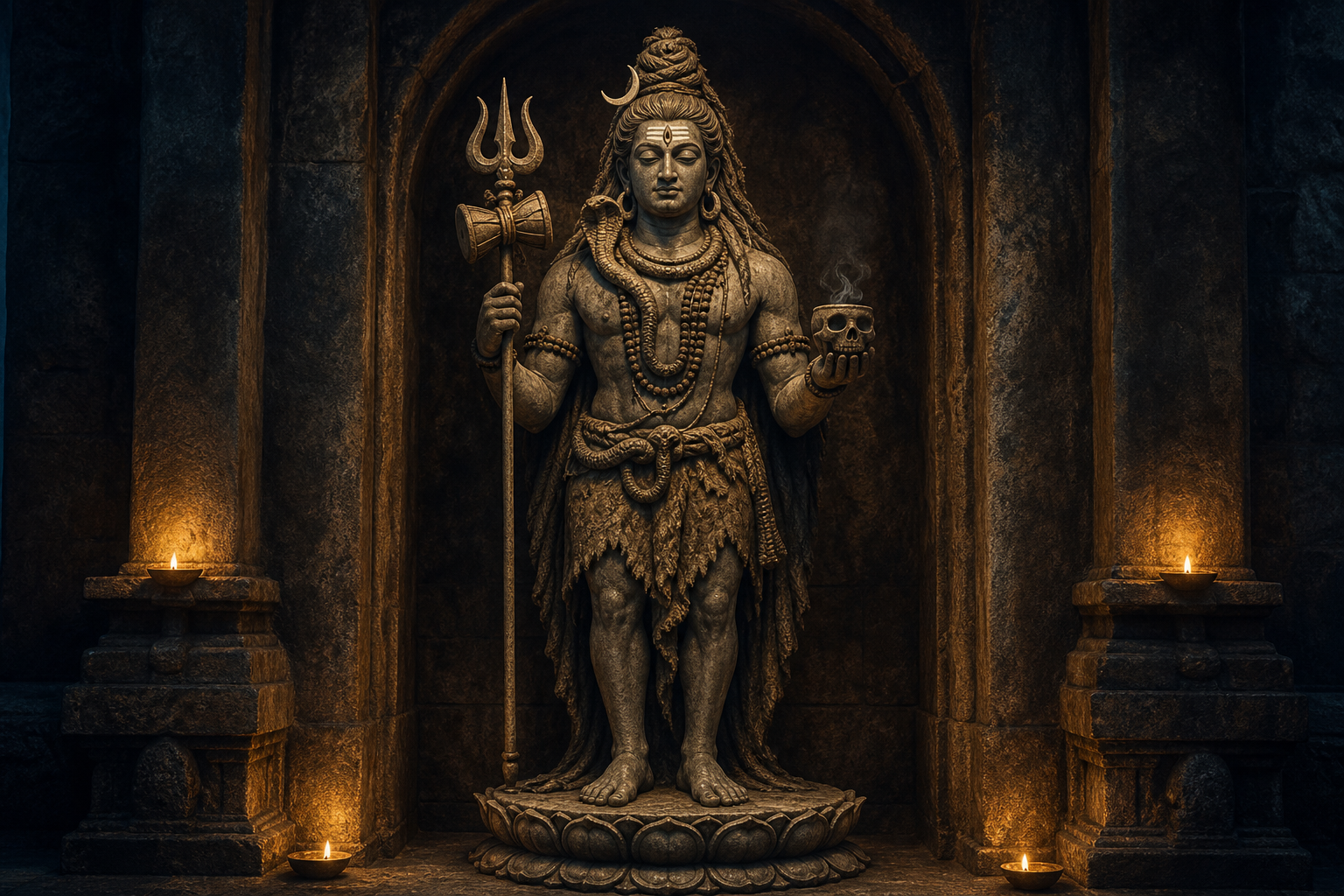
Aghora iconography is not a random collection of frightening objects. Each feature performs a teaching function, and the features interpret one another. The skull must be read beside the gesture of fearlessness; the cremation ground beside steadfast Nandi; the trident beside the drum. Isolating the fierce objects while ignoring the signs of grace reverses the grammar of the murti.
| Symbol | Theological meaning | What you should notice |
|---|---|---|
| Vibhūti, or sacred ash | Every embodied form eventually loses its present shape. Ash also represents what remains after the fire of discernment consumes attachment. | Let impermanence simplify your priorities rather than make you cynical. |
| Third eye | An awareness deeper than ordinary sense perception and reactive judgement. | Do not confuse your first emotional response with complete vision. |
| Jaṭā, crescent moon and Gaṅgā | Matted locks express yogic mastery; the moon evokes time and cyclical change; Gaṅgā conveys purifying grace held and released by Shiva. | Power is shown as disciplined, measured and life-giving rather than uncontrolled. |
| Triśūla | The trident is commonly read as mastery over the three guṇas and the three divisions of time. | Past, present and future condition experience, but none stands outside consciousness. |
| Ḍamaru | The hourglass drum evokes manifestation’s pulse, rhythm and return to silence. | Creation and dissolution belong to one movement; activity must make room for stillness. |
| Kapāla and khaṭvāṅga | The skull bowl and skull-topped staff refuse denial of mortality and finitude. | Wisdom does not need to hide death before it can affirm life. |
| Serpents | Primal energy, including the symbolism of awakened kuṇḍalinī, brought under conscious mastery. | Instinct is neither worshipped nor hated; it is governed. |
| Tiger skin | Mastery over untamed impulse and predatory force. | Spiritual strength includes the ability to direct one’s own appetites. |
| Muṇḍamālā, or skull garland | The many identities assumed and discarded in conditioned existence. | Roles and self-images deserve responsible use, not absolute identification. |
| Abhayamudrā and varadamudrā | Fearlessness and benevolent assurance. | These gestures reveal the purpose of the fierce imagery: protection and liberation, not intimidation. |
| Nandi | Steadfast devotion, dharma and stable strength. | Courage is sustained by disciplined loyalty to dharma, not by emotional intensity alone. |
The best reading order begins with the face and hands. Look for awareness, composure, abhayamudrā and varadamudrā. Only then move to the weapons, skulls, serpents and setting. This prevents a common mistake: treating the murti’s instruments of liberation as if they were evidence of cruelty.
The triśūla is a good test of that method. Viewed in isolation, it is a weapon. Read within Aghora theology, it signifies mastery over forces that ordinarily bind experience. The same applies to the kapāla. Its purpose is not to make death fashionable. It asks whether you can acknowledge mortality without wasting the life presently entrusted to you.
Regional images will not always display every emblem in the same combination. Śilpaśāstra traditions regulate proportion, stance and implements, yet Chola, Central Indian and Himalayan visual languages need not look identical. Do not declare a murti “incorrect” merely because it differs from the first image you encountered. Identify its regional and ritual context before interpreting an omitted or altered attribute.
Why the cremation ground is a place of instruction

The cremation ground removes the usual supports of social identity. Wealth, reputation, occupation and argument cannot prevent the body’s return to its elements. In Aghora imagery, this setting does not proclaim that life is worthless. It exposes the cost of treating a temporary form as if it were permanent.
That is why funeral pyres, darkness, jackals and skulls can coexist with Shiva’s composure and Nandi’s fidelity. The setting names the fact of dissolution; Shiva demonstrates the consciousness that is not shattered by seeing it. Nandi adds the practical counterweight: recognition of impermanence should deepen dharma, not excuse indifference.
A contemporary reader may find the language of “shadow integration” helpful as an analogy. What is denied often acquires disproportionate power over attention. Aghora instead trains the gaze to remain present before endings, grief and disowned impulses. The analogy has limits, however. Aghora is not merely a psychological technique. Its centre is theological: what seems terrible is encountered as inseparable from Shiva-consciousness.
Do not collapse Aghora, Bhairava and the Aghori path
Three related terms are routinely treated as synonyms, and that confusion produces sensational explanations:
- Aghora is a pañcabrahma aspect of Shiva associated with fear-dissolving dissolution. Fierce imagery serves a grace-laden theological purpose.
- Bhairava is often presented more explicitly as a guardian and kṣetrapāla, the protector of a sacred precinct. Bhairava iconography frequently includes the dog as vāhana.
- The Aghori path is a particular ascetic tradition. Its existence does not mean that devotion to Aghora requires cremation-ground disciplines or transgressive rites.
This distinction changes what you do with the teaching. A householder does not need to imitate an ascetic vocation in order to contemplate Aghora, receive darśana or participate in temple worship. A simple home practice, abhiṣekam, mantra recitation and attentive study can all belong to legitimate engagement with this form of Shiva.
Recognise Dharmic resonances without claiming equivalence
Aghora also illuminates a wider Dharmic conviction: a fierce appearance can serve compassion rather than hatred. Vajrayāna representations of Mahākāla employ charnel-ground imagery in the service of protectorship. Jain images give abhayamudrā an important place in the visual expression of fearlessness. The Sikh affirmation Nirbhau, Nirvair joins freedom from fear to freedom from enmity.
These are resonances, not interchangeable doctrines. Mahākāla is not simply Aghora under another name, and distinct traditions should not be flattened into a single system. The meaningful civilisational connection lies in the ethical direction: genuine courage is not cruelty, and spiritual fearlessness must not become enmity.
Turn Aghora darśana into a disciplined household practice

You do not need theatrical surroundings or macabre objects to practise what Aghora teaches. The essential movement is from avoidance to clear seeing, and from clear seeing to dharmic action. If you maintain a home altar, the following sequence keeps that movement simple and grounded.
- Establish a clean, undramatic setting. Sit before an Aghora or pañcamukha Shiva murti or image. The purpose is attention, not atmosphere.
- Receive the assurance first. Look initially at Shiva’s face and any abhayamudrā or varadamudrā. Remember that the fierce emblems are held within this field of protection and grace.
- Name one fear plainly. Complete the sentence, “The outcome I am trying not to face is…” Do not enlarge it into a story. Identify the concrete possibility that is producing contraction.
- Choose one emblem as your instruction. Use vibhūti to examine an attachment to permanence, the triśūla to bring thought, feeling and action into alignment, the ḍamaru to restore a neglected rhythm of activity and rest, or Nandi to remember the duty that fear is delaying.
- Make a simple offering if it belongs to your practice. Water, bilva leaves and vibhūti are used in Aghora and pañcabrahma worship. Abhiṣekam can remind you that purification is enacted through reverence, not merely discussed.
- Close with one dharmic response. Ask what truthful, proportionate and non-harmful action is now possible. Take that action instead of using contemplation to postpone it.
Mantra may accompany this practice when it is already part of your devotional life. Its value is not in cultivating a frightening mood. Its repeated salutations train the mind to stop dividing reality into a small sacred zone and a threatening remainder. Recitation should therefore produce greater steadiness, responsibility and freedom from hostility. If it feeds fascination with power or transgression, the emphasis has drifted away from Aghora’s meaning.
Temple and household observances may include water or pañcāmṛta abhiṣekam, bilva offerings and the application of vibhūti. Mahāśivarātri’s night vigil offers an especially intelligible setting: darkness is not denied, but wakeful attention prevents it from becoming unconsciousness. The outer lamp and the practitioner’s vigilance express the same discipline.
Keep lineage boundaries intact. Nyāsa places pañcabrahma mantras at sanctified locations in the body, but the positions and seed formulas can differ by lineage. Do not assemble an esoteric practice from disconnected charts because the correspondences look compatible. Learn technical nyāsa and bīja practice from a qualified teacher within a coherent transmission.
Keep practical boundaries intact as well. Facing fear does not mean ignoring danger, remaining in abuse or substituting worship for medical or psychological care. Aghora asks you to see without panic so that right action becomes possible. It does not ask you to surrender judgement.
Key takeaways for reading Aghora clearly
- Aghora means “non-terrible.” The name tells you how the fierce appearance must ultimately be interpreted.
- Aghora is one of Shiva’s five pañcabrahma revelations and is widely associated with the south, fire and transformative dissolution.
- Saṁhāra removes ignorance, fear and constriction; it is not a celebration of meaningless destruction.
- Ash, skulls and cremation-ground imagery teach impermanence and freedom from denial. Abhayamudrā and varadamudrā disclose their protective purpose.
- Aghora, Bhairava and the Aghori ascetic path are related but distinct. Household devotion to Aghora does not require ascetic or cremation-ground praxis.
- A sound interpretation should make you more truthful, steady, compassionate and responsible. Fascination with shock is not the measure of understanding.
- Simple pūjā and contemplation are appropriate for householders, while lineage-specific nyāsa and bīja practices should be learned within a qualified tradition.
The next time Aghora’s imagery unsettles you, stay with the murti long enough to find the gesture of assurance within it. Then identify the attachment or fear that makes the image feel threatening. Let one symbol give you one instruction, and carry that instruction into a concrete act of dharma. That is where the non-terrible power of Aghora becomes more than an idea.