

If you are choosing dates for a vrata, family ceremony, house entry, or launch in May and June 2026, a festival list alone will not answer the question. The same period can be especially fruitful for japa and seva while remaining unsuitable, under your family tradition, for a wedding or formal griha pravesh. Even a correct tithi time can become wrong when copied from another city.
The most useful approach is to separate spiritual observance from worldly inauguration, then confirm every clock time against a Panchang calculated for your location. For Telugu Chandramana households, the central calendar fact is Adhika Jyeshta Masam, from 17 May through 15 June 2026. That month gives this entire planning window a devotional character.
Mark 17 May to 15 June as a different kind of month
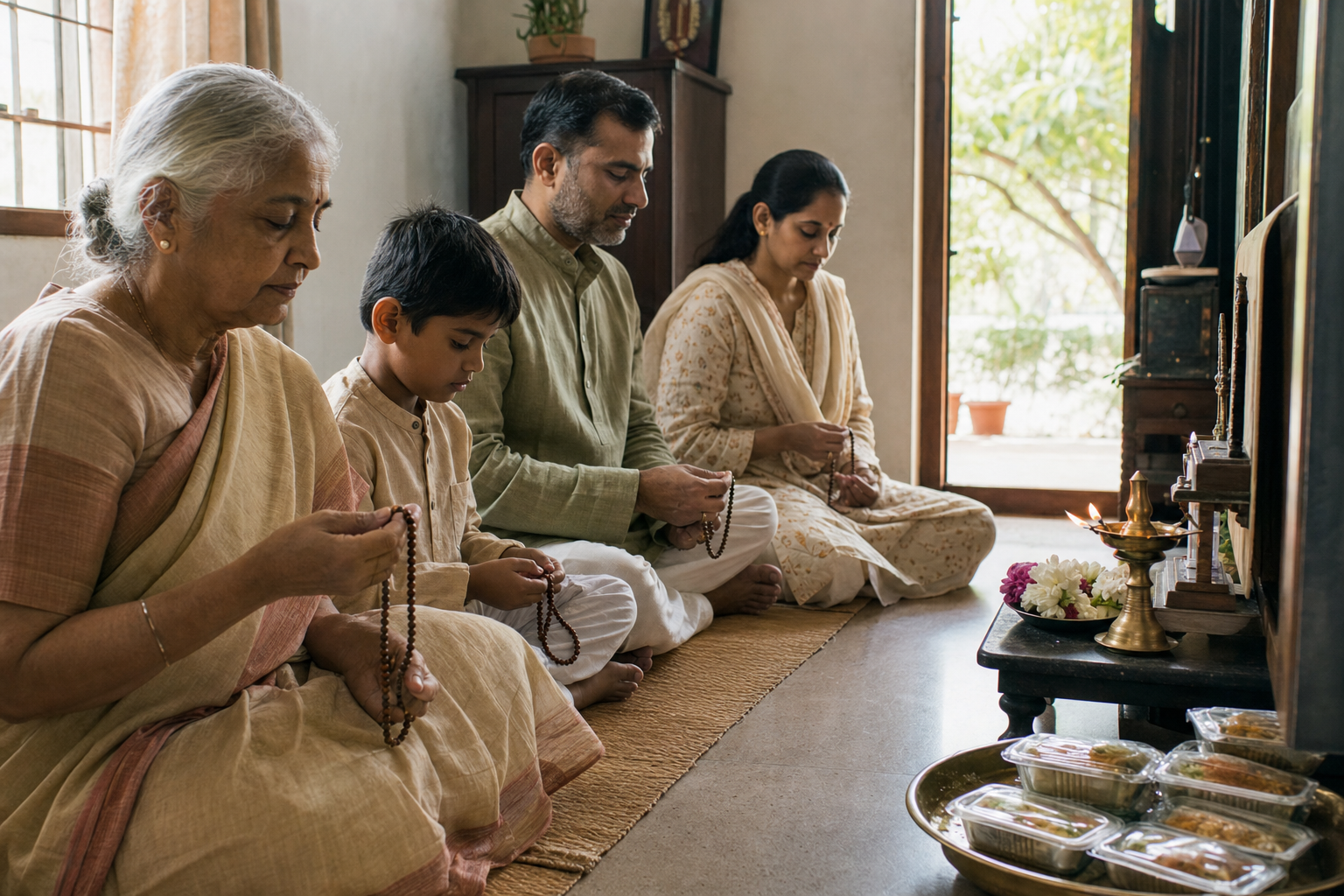
In the Telugu amanta calendar, Adhika Jyeshta Masam begins on 17 May and concludes on 15 June 2026. It falls in Parabhava Nama Samvatsaram and is widely observed as Purushottama Maas, a month dedicated especially to Lord Krishna or Vishnu.
Adhika Masam is a calendar correction, not an arbitrary interruption. Twelve synodic lunar months amount to about 354 days, roughly 11 days short of a solar year. An intercalary month appears roughly every 32 months to keep lunar months aligned with the seasons. In the amanta calculation, a lunar month containing no sankranti, or solar ingress into a new rashi, receives the Adhika designation. The regular month that follows may be identified as Nija or Shuddha Jyeshta.
If your household follows a purnimanta calendar, a North Indian almanac, or a temple-specific computation, the displayed month name may differ around the boundaries. Do not try to settle that difference by comparing Gregorian dates alone. Record these four items before making a ritual calendar:
- Your city and time zone, because sunrise and tithi boundaries are local.
- Your calendar convention, especially amanta or purnimanta.
- Your family or temple parampara, including any rule concerning Adhika Masam.
- The exact purpose of the date: daily worship, vrata, samskara, contractual necessity, physical move, or ceremonial inauguration.
Use the month as a container for a practice you can actually sustain. Suitable choices include daily nama-japa, Bhagavad-Gita or Srimad Bhagavatam reading, Vishnu Sahasranama, satsanga, dana, annadana, truthfulness, cleanliness, ahimsa, and seva. If you plan to observe both Ekadashis in the month, obtain their fasting and parana times from your local Panchang; sunrise and tithi differences make a borrowed city schedule unreliable.
A modest rule kept faithfully is better than an elaborate programme abandoned after enthusiasm fades. Write a clear sankalpa stating the practice and period, place it beside your household calendar, and decide in advance what you will do on a day when work or caregiving disrupts the usual routine. The aim is steadiness, not display.
Separate sadhana from samskara before choosing a date
Adhika Masam should not be described simply as an inauspicious month. It is highly valued for devotion, self-restraint, study, charity, and inner correction. The caution concerns selected shubha karyas whose purpose is to inaugurate a new worldly phase. Daily and obligatory worship does not stop, nor do calendrically ordained festivals and temple observances.
Keep Adhika Masam and Moodami conceptually separate. Adhika Masam is an intercalary lunar month. Moodami is the combustion of Guru or Shukra near the Sun. Either may affect event selection under a regional muhurta tradition, but one does not prove the other.
| What you need to do | Practical May-June approach | What must be checked |
|---|---|---|
| Nitya puja, japa, vrata, scriptural reading, dana, or seva | Continue and, if appropriate, deepen the practice during Purushottama Maas. | Use local tithi and parana times when the observance depends on them. |
| Wedding or formal engagement | Many traditions defer it during Adhika Masam. Shukra Moodami is an additional reason to avoid a marriage muhurta. | Family parampara, local Panchang, Shukra condition, and a complete personalized muhurta. |
| Griha pravesh | Where a move cannot wait, enter simply and reserve the formal Vastu shanti, Lakshmi puja, or ceremonial housewarming for an accepted muhurta. | Adhika Masam rule, Guru condition, property deadlines, and household safety. |
| Aksharabhyasam or a learning-related samskara | If school timing is fixed, begin necessary learning without treating that administrative date as the formal samskara. The ceremony can be held later where the lineage advises postponement. | Guru Moodami, local custom, child and family constraints, and the formal muhurta. |
| Seemantham | Do not sacrifice the well-being of mother or child to an ideal date. A time-sensitive observance requires compassionate guidance, not automatic postponement. | Medical needs first, then the permitted pregnancy period, family tradition, and priestly guidance. |
| Business launch, vehicle, ornament, or important first use | Separate preparation or a necessary transaction from the public opening, first invoice, inaugural sale, or ceremonial first use. | Whether the act can be staged lawfully and safely, plus Guru or Shukra Moodami and the event muhurta. |
This staged approach is often the cleanest answer when life cannot be paused. Registrations, compliance work, staff training, packing, or technology setup do not have to be confused with an inaugural act. Likewise, a lease deadline may require physical possession before the household conducts formal griha pravesh. Preserve the distinction in your sankalpa instead of pretending the practical constraint does not exist.
Moodami does not prohibit japa, dana, vrata, homa, scriptural study, or routine worship. Shanti-oriented worship may continue even when a particular samskara is deferred. If housing safety, pregnancy care, or another genuine medical need conflicts with a preferred muhurta, protect the person first. Calendric prudence is meant to serve dharma, not reverse its priorities.
May 23 shows why a Gregorian date is not a tithi

Saturday, 23 May 2026 offers a useful worked example inside Adhika Jyeshta. In most regions, Shukla Saptami continues until 10:08 AM and Shukla Ashtami follows. That does not mean 10:08 AM is safe to copy into a calendar for Toronto, London, Hyderabad, or another city without verification. The operative boundary must come from a Panchang using the relevant location and time zone.
A tithi is determined by the angular separation of the Moon and Sun, with each tithi occupying another 12 degrees of elongation. The geometry changes continuously, so its boundary rarely agrees with midnight. A civil date can therefore contain more than one tithi, and the tithi present at sunrise can differ from the one present when an afternoon ritual begins.
If your local Panchang confirms the same May 23 sequence, you can give the day a coherent ritual shape:
- During the Saptami morning, offer arghya to Surya and choose a familiar Surya practice such as Gayatri japa or Aditya Hridayam. The emphasis is clarity, vitality, and disciplined beginning.
- After the verified Ashtami transition, turn toward quieter Devi upasana, devotional reading, deepa, restrained speech, or seva. Durga Saptashati passages or Devi Kavacham may be used where they belong to your practice.
- Because it is Saturday, Shani-related discipline may be expressed through a sesame-oil lamp, Hanuman Chalisa or a Shani hymn, responsible conduct, and generosity toward people facing hardship.
Do not force every action into the tithi transition. A household sankalpa may follow the tithi or nakshatra prevailing at sunrise, while a moment-specific undertaking may be judged by what prevails when it begins. Regional and lineage practice determines which rule governs. Ask that question explicitly when consulting a priest; otherwise two correct Panchang entries can appear to contradict each other.
Build a local muhurta from the full Panchang
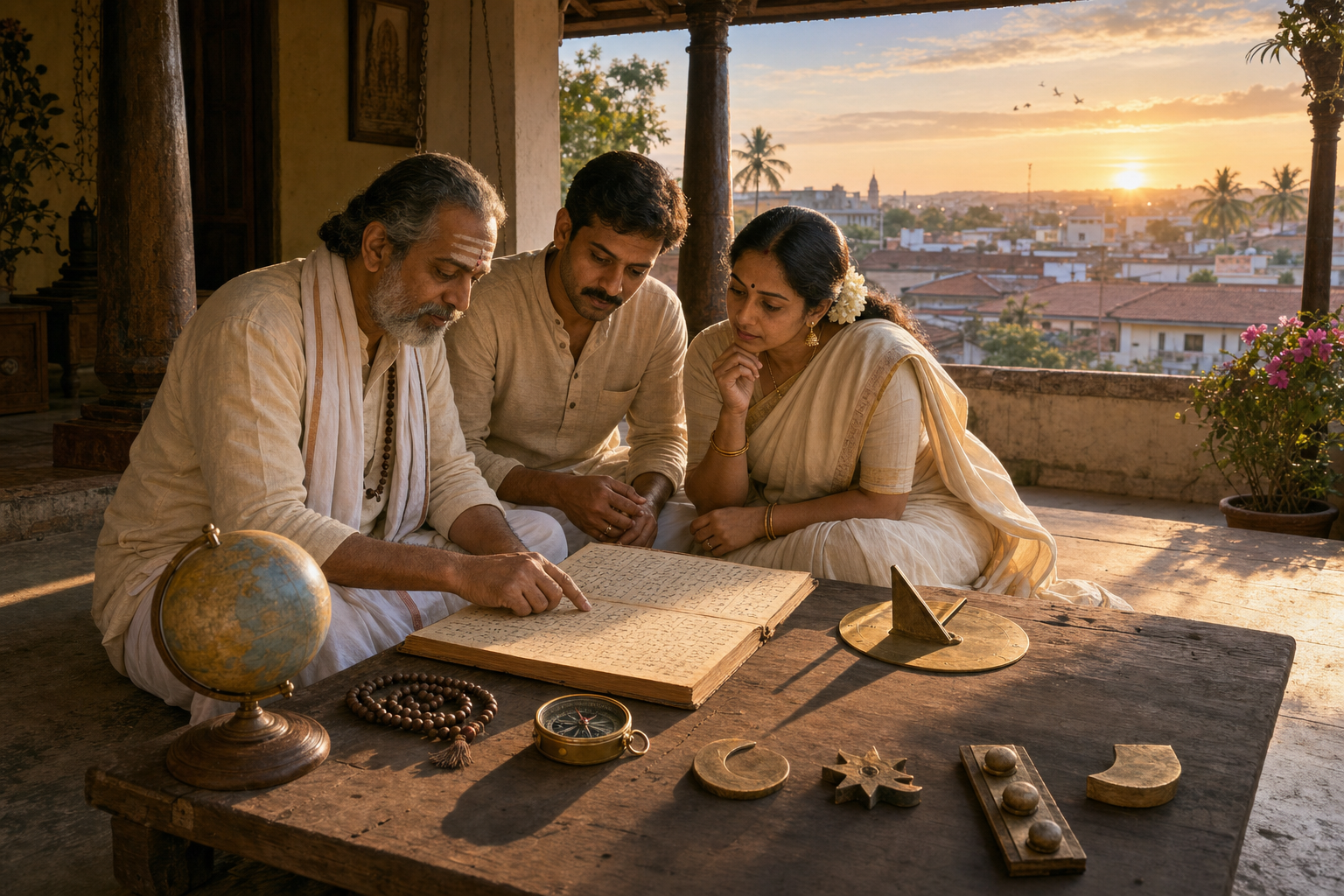
A label such as Shubh Choghadiya is not a complete verdict on a wedding, house entry, or major investment. Classical muhurta selection begins with the five limbs of the Panchang: tithi, vara, nakshatra, yoga, and karana. It may then include the principal participants’ Tarabalam and Chandrabalam, an appropriate lagna, and relevant graha conditions. Use the following workflow when you request a date:
- State the exact city where the act will occur, not merely the country or the city where the family lives.
- Name the act precisely. Signing an agreement, moving possessions, lighting the first household lamp, conducting Vastu shanti, opening a shop, and making the first sale are not automatically the same ritual moment.
- Confirm the calendar convention and family parampara before comparing month names.
- Check the tithi at the required reference point, then nakshatra, yoga, and karana. Vishti, also called Bhadra, is generally avoided for auspicious beginnings.
- Apply daylight-based avoidance windows and favourable intervals only after local sunrise and sunset are known.
- For a life-cycle samskara or consequential undertaking, ask whether a personalized muhurta is required rather than relying on a general daily calendar.
What the familiar clock labels actually mean
Abhijit Muhurta is centred around local solar noon and spans approximately one muhurta, about 48 minutes. It must be derived from the local sunrise-to-sunset arc; noon on a wall clock is not automatically solar noon.
Rahu Kalam, Gulikai, and Yamaganda are also daylight-dependent. The period from sunrise to sunset is divided into eight equal segments, and weekday rules assign the segments. On Saturday, the conventional Rahu Kalam placement is the second daylight segment. Seasonal day length therefore changes its clock time.
Choghadiya divides both day and night into eight segments. Labh, Amrit, and Shubh are commonly preferred for routine favourable work, while Rog, Kaal, and Udveg are avoided. It is a useful portable filter, especially when you need flexibility, but it does not override a prohibited tithi, Vishti Karana, Adhika Masam rule, Moodami restriction, or a weak personalized election.
Where Guru and Shukra Moodami fit
Combustion is assessed through the planet’s geocentric angular separation from the Sun. Practical thresholds are approximately 11 degrees for Guru and 10 degrees for Shukra, although traditions vary. Guru is associated with dharma, teachers, children, learning, and long-term growth; Shukra with marriage, harmony, beauty, vehicles, comforts, and prosperity. The caution becomes especially relevant when the proposed ceremony centres on that graha’s domain.
Do not infer a Moodami interval merely because the date falls in Adhika Jyeshta. Its exact beginning and end depend on astronomical longitudes, the threshold adopted by the tradition, and local sunrise-based reckoning. Ask your regional Panchang to identify the interval explicitly. The available May-June dates for Adhika Jyeshta do not, by themselves, supply start and end dates for either Guru or Shukra Moodami.
For a wedding, upanayana, formal griha pravesh, or another consequential ceremony, send the muhurta adviser the location, event definition, family tradition, non-negotiable deadlines, and the principal participants’ details if the method requires them. A screenshot showing only a favourable Choghadiya is not enough evidence for the decision.
Key takeaways
- For Telugu amanta households, mark 17 May through 15 June 2026 as Adhika Jyeshta Masam, or Purushottama Maas.
- Use the period confidently for Krishna or Vishnu bhakti, nama-japa, scriptural study, vrata, dana, annadana, ahimsa, and seva.
- Ask separately whether your tradition defers weddings, formal griha pravesh, samskaras, or public commercial inaugurations during Adhika Masam.
- On 23 May, the general sequence is Shukla Saptami until 10:08 AM and Shukla Ashtami afterward, but the boundary must be verified for the ritual location.
- Calculate Abhijit, Rahu Kalam, Gulikai, Yamaganda, and Choghadiya from local sunrise and sunset. Never transplant another city’s clock table.
- Treat Moodami as an additional graha-condition check. Do not manufacture Guru or Shukra combustion dates from the Adhika Masam date range.
Before you book a hall, announce a ceremony, or print invitations, obtain one written local schedule showing the calendar convention, tithi boundary, relevant avoidance periods, and selected muhurta. Until then, use 17 May to 15 June for the work that needs no uncertainty: deepen your daily practice, settle practical preparations, and let the formal beginning wait for a date your household can honour without confusion.
References
- DharmaRenaissance Blog — May 23, 2026 Panchang: Shukla Saptami to Ashtami, Auspicious Muhurat, Nakshatra & Rashi Guide
- DharmaRenaissance Blog — Moodami Decoded: Avoidable Events When Guru & Shukra Are Combust and Safer Alternatives
- DharmaRenaissance Blog — Adhika Jyeshta Masam 2026 (Telugu Calendar): Sacred Dates, Rituals & Purushottama Vrata Guide