
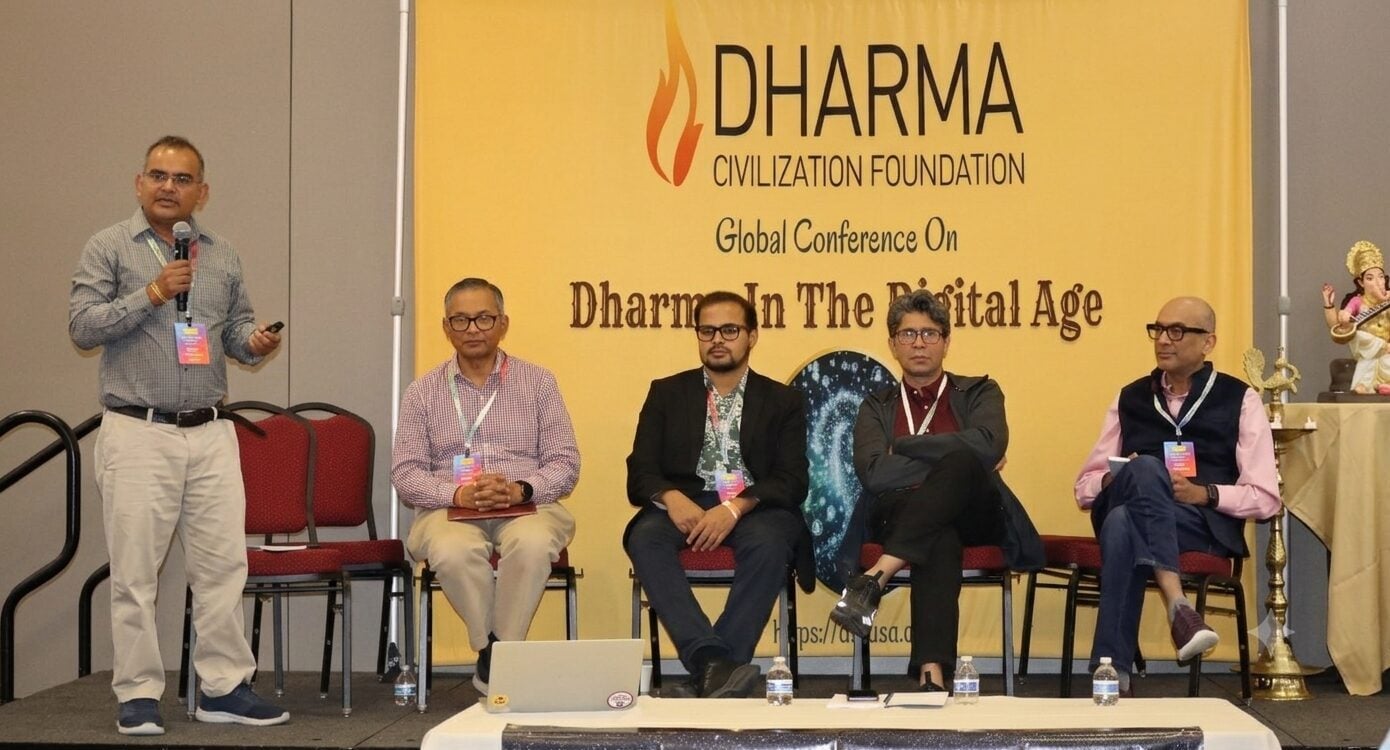
An AI system can produce a fluent answer without knowing whether that answer is true, beneficial or culturally fair. A DDA ’26 panel reported by Dharma Civilization Foundation treated this gap as more than a technical problem: it is a question of dharma, human judgment and civilizational agency.
Moderated by Biplav Srivastava, the discussion brought together Anand Rao, Alok Chaturvedi, Nomesh Bolia and Arijit Patra. Their arguments point toward a practical standard: technology should support clear thought and social good instead of capturing attention or displacing human responsibility.
Where AI’s objective diverges from dharma
Rao distinguished predictive, generative and agentic forms of AI. This matters because AI is not a single intelligence with one purpose. Generative language systems generally produce likely continuations from patterns in training data; likelihood is not the same as truth.
The panel framed this difference through satya and maya. A model can reproduce what is frequent, fashionable or heavily represented while still misleading the user. Rao therefore described language models as cultural as well as linguistic systems: their outputs carry the assumptions and omissions of their data and alignment processes. The recap also relays striking claims about recommendation systems, deepfakes and data-centre resource use, but does not provide the underlying studies. Those figures are best treated as panel-reported warnings rather than independently verified findings here.
The inner instrument must remain in command
Chaturvedi located the first line of defence in the antahkarana, the inner instrument described through manas, buddhi, chitta and ahamkara. In practical terms, the mind receives and generates possibilities, discernment evaluates them, memory supplies context, and ego can distort the final choice. AI may assist these functions, but outsourcing all four leaves the user articulate without necessarily being knowledgeable.
His criticism of continuous scrolling is especially relevant. Removing natural stopping points weakens the pause between stimulus and response, while engagement-driven systems can reward outrage. Viveka restores evaluation; vairagya limits attachment and excess. These principles belong to a wider Dharmic moral family: Hindu, Buddhist, Jain and Sikh traditions differ in doctrine, yet each values disciplined awareness, truthful conduct, restraint, compassion or seva over compulsive consumption.

Trust must be earned in a cultural context
Patra’s contribution complicates the label of trustworthy AI. According to the Foundation’s account, he argued that trust is dynamic, asymmetric and dependent on audience and context. A system should not be trusted merely because its maker declares it safe. Users need evidence about its data, limitations, failure modes and suitability for a particular decision.
Cultural context is part of that evaluation. If Indic languages, scriptures and social categories are poorly represented, even technically polished systems may misdescribe Dharmic life through imported defaults. The panel’s call for sovereign AI is therefore best understood as constructive self-representation, not digital isolation. Dharmic communities need the confidence to encode their own knowledge while still testing it through reason, experience and open scrutiny.
Key takeaways for using and building AI
- Test for satya: separate a plausible response from a supported and contextually sound one.
- Restore the pause: do not let speed, infinite scroll or automated suggestions make the decision.
- Practise viveka and vairagya: use AI where it serves a defined purpose and stop when additional output adds little value.
- Preserve human skill: treat AI as assistance, not a substitute for memory, judgment or professional competence.
- Examine cultural assumptions: ask whose language, categories and values shaped the model’s answer.
From ethical use to Dharmic technological agency
Bolia moved the discussion from defence to creation. His framework of purpose, procedure and paradigm asks builders to decide what a tool is for, how it should be developed and what vision of life it advances. His further counsel was to trust Dharmic traditions, tinker with existing tools, reverse harmful methods and, where necessary, replace the prevailing paradigm.
The strongest path is neither passive adoption nor rejection of technology. It is confident participation: developing Indic knowledge structures, protecting children and elders, measuring social and environmental costs, and designing for human flourishing. A plural Dharmic civilization can contribute precisely because it knows that wisdom may take many forms while responsibility cannot be delegated.
Inspired by this post on Dharma Civilization Foundation.

Leave a Reply
You must be logged in to post a comment.